
UPSC CURRENT AFFAIRS — 27 NOVEMBER 2026
1. Constitutional Morality: Living the Spirit of the Constitution
(POLITY AND GOVERNANCE) (TH | TH) India observed Constitution Day (Samvidhan Divas) on 26 November 2026, the 77th anniversary of the adoption of the Constitution in 1949. The occasion renewed the call to build constitutionalism and cultivate constitutional morality among state institutions and citizens alike.
Constitution Day: Key Facts
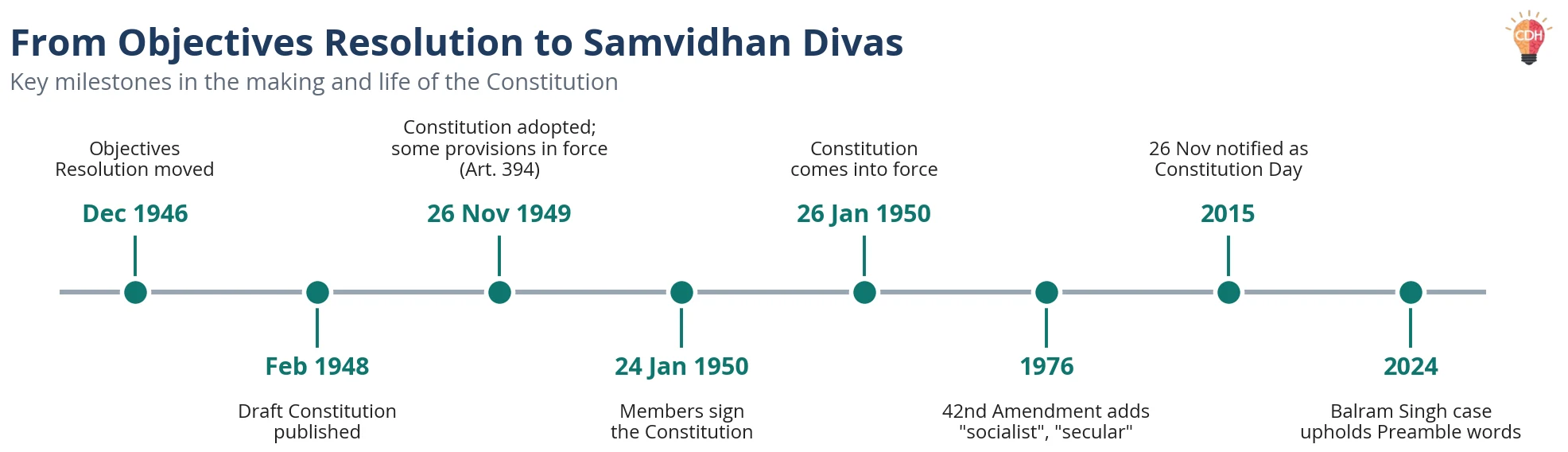
- Adoption vs enforcement: the Constituent Assembly adopted the Constitution on 26 November 1949. Provisions on citizenship, elections and the provisional Parliament came into force at once under Article 394; the rest took effect on 26 January 1950.
- The Assembly: formed under the Cabinet Mission Plan (1946), it had 229 members elected from British provinces and 70 nominated by princely states after Partition.
- Drafting: Constitutional Adviser B.N. Rau prepared an initial draft in October 1947; the Drafting Committee under Dr B.R. Ambedkar published the Draft Constitution in February 1948. The Assembly considered over 2,000 amendments in nearly three years.
- The manuscript: handwritten in English and Hindi and illuminated by artists led by Nandalal Bose of Santiniketan; members signed it on 24 January 1950, the day Dr Rajendra Prasad was elected the first President.
- From Law Day to Constitution Day: 26 November was observed as National Law Day from 1979. The Government announced it as Constitution Day on 11 October 2015 while laying the foundation of the Ambedkar memorial at Indu Mills, Mumbai.
- Preamble words: “socialist” and “secular” were added by the 42nd Amendment Act, 1976. In Balram Singh v. Union of India (2024) the Supreme Court upheld them: secular means equal respect for all religions, socialist means a commitment to ending exploitation.
What Is Constitutional Morality?
Constitutional morality means fidelity to the core values of the Constitution: justice, liberty, equality and fraternity. It asks the State and citizens to uphold these values even when they clash with majority opinion, tradition or prevailing social morality. It goes beyond obeying the text to respecting its spirit.
Constitutionalism is the related principle that government power flows from, and is limited by, a fundamental law. It rests on the rule of law, separation of powers and judicial review, and guards against arbitrary use of state power.
Constitutional Anchors
| Provision | What it secures |
|---|---|
| Preamble | Ideals of justice, liberty, equality and fraternity |
| Article 13 | Laws inconsistent with Fundamental Rights are void to that extent |
| Articles 14, 15 | Equality before law; no discrimination on specified grounds |
| Articles 19, 21 | Democratic freedoms; life, personal liberty and dignity |
| Articles 32, 226 | Constitutional remedies to enforce rights |
| Article 50 | Separation of the judiciary from the executive |
How the Courts Have Used It
| Case | Contribution |
|---|---|
| Kesavananda Bharati v. State of Kerala (1973) | Laid down the Basic Structure Doctrine against destructive amendments |
| Justice K.S. Puttaswamy v. Union of India (2017) | Privacy recognised as a fundamental right; dignity and autonomy reinforced |
| Navtej Singh Johar v. Union of India (2018) | Decriminalised consensual same-sex relations; constitutional morality placed above social morality |
| Indian Young Lawyers Association v. State of Kerala (2018) | Opened Sabarimala to women of all ages on equality and dignity |
| Government of NCT of Delhi v. Union of India (2018) | Stressed constitutional morality, collaborative federalism and respect for institutions |
Why It Matters
- Guards democracy: checks majoritarianism and protects individual rights.
- Institutional integrity: keeps constitutional bodies independent and impartial.
- Social transformation: a tool against caste discrimination, gender inequality and regressive practices.
- Accountable governance: promotes transparency, fairness and ethical public administration.
- Inclusive society: strengthens fraternity, tolerance and respect for diversity.
Challenges
| At the level of the State | At the level of society |
|---|---|
| Electoral majoritarianism: treating a majority as unlimited authority | Primacy of social morality: religious, caste and linguistic orthodoxies |
| Politicised institutions: interference erodes neutrality | Inequalities: social and economic gaps hollow out rights |
| Political expediency: short-term gains over fairness | Weak civic consciousness: low awareness of rights and duties |
| Concentration of power: weaker checks and balances | Intolerance: hostility to diverse identities |
Way Forward
Constitutional literacy in schools ➜ Independent institutions ➜ Reasoned judicial review ➜ Civic participation ➜ A culture of fraternity
📖 Read More: Making of the Constitution • Preamble of the Constitution • Basic Structure of the Constitution • Introduction to Fundamental Rights
2. Supreme Court Tightens Front-of-Pack Food Warnings
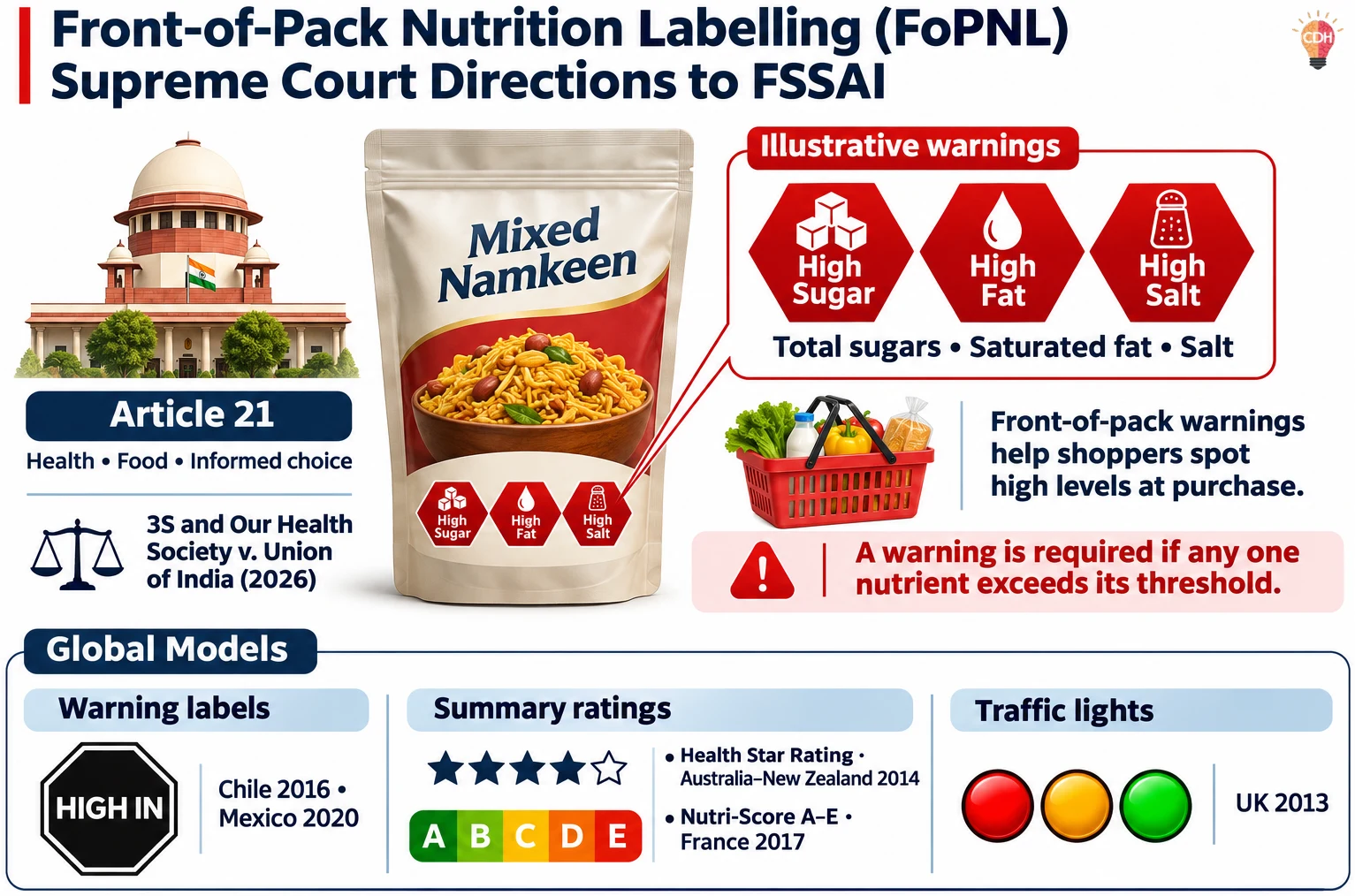
(SOCIAL JUSTICE) (NOA) In 3S and Our Health Society v. Union of India (2026), a Bench of Justices J.B. Pardiwala and K. Vinod Chandran directed the FSSAI to strengthen Front-of-Pack Nutrition Labelling (FoPNL) so that shoppers can spot unhealthy packaged food at a glance.
FoPNL is a supplementary label on the principal display panel, the face of the pack a shopper sees first. It flags nutrients of concern at the point of purchase, unlike the detailed nutrition table at the back.
What the Court Directed
- Nutrients to flag: total sugars, saturated fat and salt, instead of the added sugar and added fat used in the ICMR’s Dietary Guidelines for Indians, 2024.
- Separate hexagons: one hexagon per nutrient, with a standardised pictogram and the words “High Sugar”, “High Fat” or “High Salt”, replacing a single combined symbol.
- Single trigger: a product crossing the limit for even one nutrient must carry the warning.
- Constitutional basis: the rights to health, food and informed choice flow from Article 21 and place a positive duty on the State.
How India Reached Here
2018: draft rules propose red HFSS coding ➜ 2020: Labelling Regulations drop red coding ➜ 2022: star-based Indian Nutrition Rating proposed ➜ 2026: Court orders warning hexagons
Global Models
| Model | Example | How it works |
|---|---|---|
| Warning labels | Chile (2016), Mexico (2020) | Mandatory black octagon “High in” for each nutrient over the limit |
| Summary ratings | Health Star Rating, Australia–New Zealand (2014); Nutri-Score, France (2017) | Voluntary overall grade (stars or A to E) |
| Traffic lights | United Kingdom (2013) | Voluntary red, amber or green for fat, saturated fat, sugars and salt |
Warning labels are generally considered easier for consumers to read quickly than summary ratings, which can let a high-sugar product score well on its other attributes. The ruling moves India towards the warning model.
📖 Read More: Health and Nutrition • Food Processing Industry
3. Six Brownfield Urea Plants Cleared Under NIPU-2026
The Six Plants
| Plant | State | Ownership | Nature of project |
|---|---|---|---|
| MFL, Madras | Tamil Nadu | PSU | Replaces a unit over 60 years old |
| NFL, Nangal | Punjab | PSU | Replaces a plant about 50–55 years old |
| KFL, Shahjahanpur | Uttar Pradesh | Cooperative | Expands a unit commissioned in 1995 |
| Matix, Panagarh | West Bengal | Private | Built on a 2017 plant |
| CFCL, Gadepan | Rajasthan | Private | Expands a complex running since 1994 |
| IIPL, Jagdishpur | Uttar Pradesh | Private | Adds capacity at a 1988 plant |
NIPU-2026 at a Glance
- Approval: cleared by the Cabinet Committee on Economic Affairs on 15 July 2026; it succeeds the New Investment Policy (NIP)-2012.
- Nodal body: Department of Fertilizers, Ministry of Chemicals and Fertilizers.
- Target: about 10 million tonnes of new capacity through roughly 8–9 gas-based plants (greenfield, brownfield, revival and revamp).
- Assured returns: a Return on Equity (RoE) band of 12% (floor) to 16% (ceiling), with subsidy benchmarked to the Import Parity Price.
- Transparency: fixed and variable costs are separated in subsidy calculations; foreign-exchange risk on fixed costs is reduced.
Urea: The Basics
- Chemistry: CO(NH₂)₂, made from ammonia and carbon dioxide; natural gas is the main feedstock in India.
- Nutrient value: about 46% nitrogen, the highest among common solid nitrogen fertilisers.
- Role in plants: drives leaf growth, chlorophyll formation and protein synthesis.
- Overuse: skews soil nutrient balance, pollutes groundwater and releases nitrous oxide, a potent greenhouse gas.
Natural gas ➜ Ammonia + CO₂ ➜ Urea plant ➜ Subsidised sale to farmers
📖 Read More: Agriculture and Allied Sectors • Modern Agricultural Practices
4. Landmine Casualties Rise as Mine Ban Treaty Weakens
(INTERNATIONAL RELATIONS) (TH) The 28th Landmine Monitor report, released by the International Campaign to Ban Landmines (ICBL) on 24 November 2026, found that casualties from landmines and explosive remnants of war (ERW) in 2025 were the highest since 2020, about 6,929. Conflicts in Myanmar and Syria drove the rise.
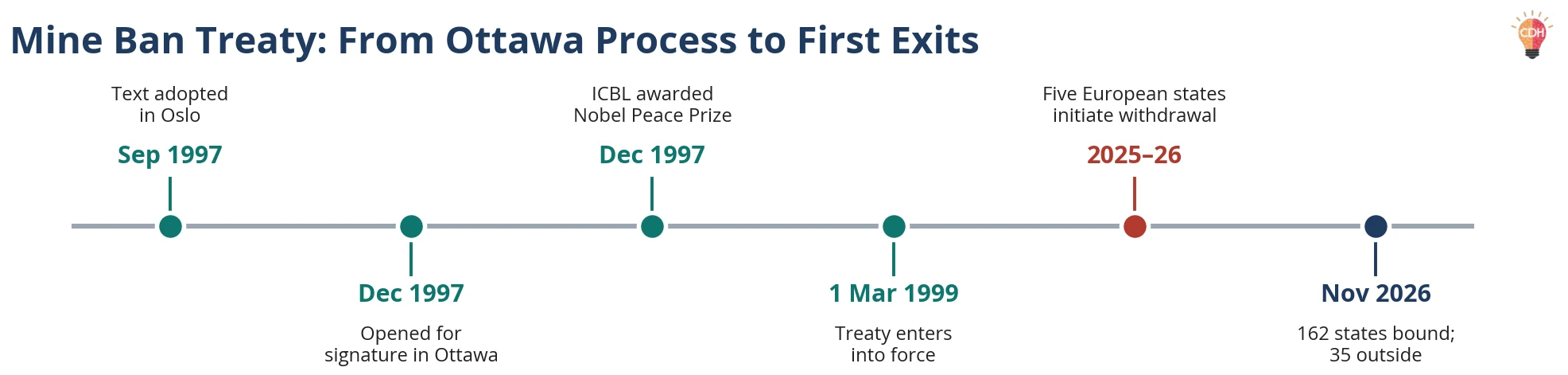
The finding comes as the 1997 Mine Ban Treaty faces its first-ever withdrawals. Five European states, Estonia, Finland, Latvia, Lithuania and Poland, began exiting in 2025–26, citing the security threat from the Russia–Ukraine war.
The Ottawa Convention
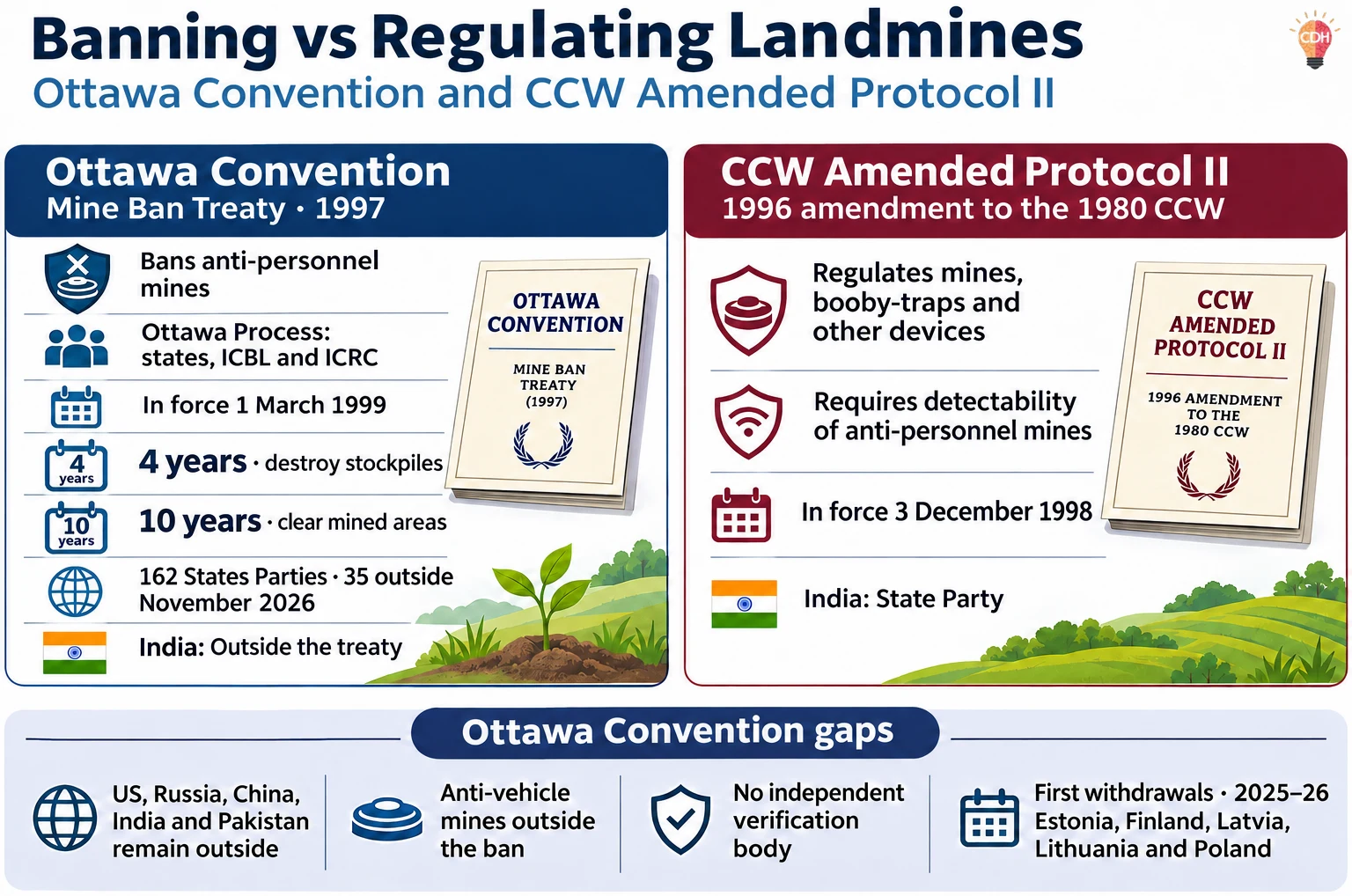
- Full name: Convention on the Prohibition of the Use, Stockpiling, Production and Transfer of Anti-Personnel Mines and on their Destruction; also called the Mine Ban Treaty.
- Origin: the Ottawa Process, a partnership of states, the ICBL and the ICRC that worked outside the usual UN negotiating track.
- Key dates: adopted in Oslo (September 1997), opened for signature in Ottawa (December 1997), in force from 1 March 1999. The ICBL and Jody Williams won the 1997 Nobel Peace Prize.
- Obligations: destroy stockpiles within 4 years, clear mined areas within 10 years, assist victims and report transparently.
- Membership: 162 countries are bound and 35 remain outside; Lebanon joined on 1 May 2026, alongside recent accessions by the Marshall Islands and Tonga.
Gaps in the Treaty
- Not universal: the US, Russia, China, India and Pakistan remain outside.
- Narrow scope: covers only victim-activated anti-personnel mines, not anti-vehicle or command-detonated mines such as Claymores.
- Retention clause: Article 3 lets states keep mines for training.
- Weak verification: no independent inspection body; compliance rests on self-reporting.
- Funding shortfall: many states miss the 10-year clearance deadline and seek extensions.
India’s Position
India has not joined the treaty, citing defence needs along long, contested land borders with China and Pakistan, neither of which is a party. It supports eventual elimination of anti-personnel mines but balances this against security.
| Feature | Ottawa Convention (1997) | CCW Amended Protocol II (1996) |
|---|---|---|
| Framework | Ottawa Process, outside the UN track | Under the UN Convention on Certain Conventional Weapons, 1980 |
| Approach | Total ban on anti-personnel mines | Regulates mines, booby-traps and other devices |
| Entry into force | 1 March 1999 | 3 December 1998 |
| Key requirement | Destroy stockpiles and clear mined land | Anti-personnel mines must be detectable |
| India | Not a party | State Party (all five CCW protocols) |
- Demining partner: India has helped clear mines in Sri Lanka and Afghanistan (including along the Zaranj–Delaram road) and trained foreign personnel in mine clearance.
- Concern: the report lists India among non-member states reportedly producing anti-personnel mines and notes improvised mines used by non-state armed groups.
📖 Read More: The United Nations • Explosives • Key Terms in International Relations
5. US Proposes 25% Section 301 Tariff on India
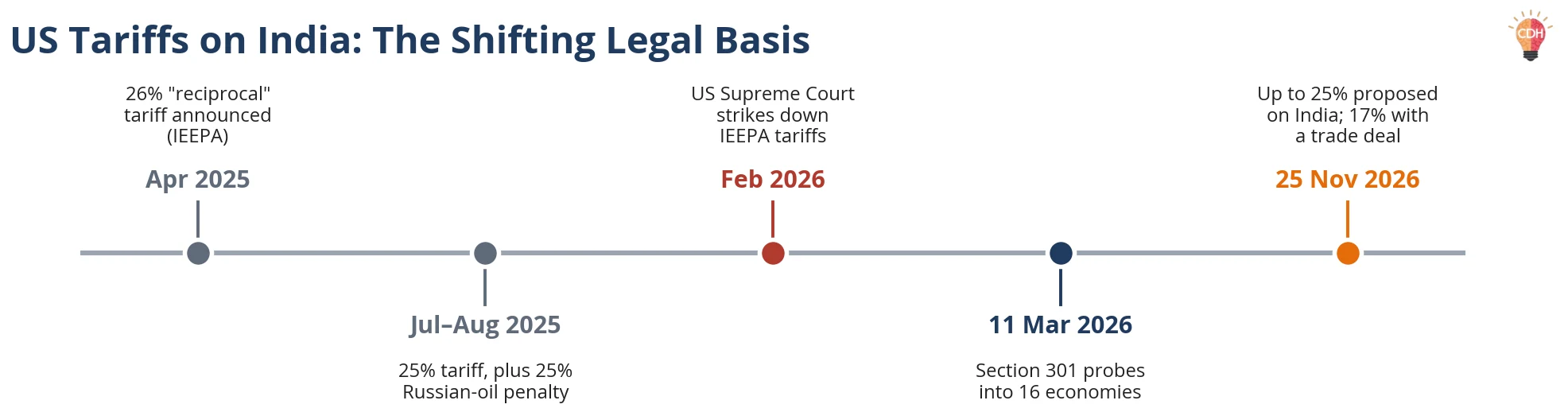
(INTERNATIONAL RELATIONS) (IE) On 25 November 2026, the Office of the US Trade Representative (USTR) proposed tariffs of up to 25% on Indian goods under Section 301 of the US Trade Act of 1974. The rate would fall to 17% if India signs a formal trade deal with the US.
Background
- Investigations: the USTR began probes into 16 economies on 11 March 2026, covering alleged “forced labour” and “industrial overcapacity”. Tariffs are now proposed on 14, including India, China and the EU; Mexico and Norway are spared for now.
- Changed legal route: the earlier “Liberation Day” reciprocal tariffs (April 2025) used the International Emergency Economic Powers Act (IEEPA), which the US Supreme Court struck down in February 2026. Section 301 lets the USTR act against “unreasonable” foreign practices.
- US allegations against India: industrial subsidies such as Make in India and the PLI scheme, weak labour protection, state-directed lending, market barriers and reliance on non-market inputs.
Impact on Indian Exports
| Category | Treatment |
|---|---|
| Generic pharmaceuticals, smartphones | Exempt (India’s two largest exports to the US) |
| Apparel, gems and jewellery, shrimp, solar modules, medical devices, engineering goods | Up to 25% without a deal |
| Steel, aluminium, automobiles (Section 232 goods) | Excluded; existing Section 232 duties continue |
At 17%, India would keep a slight edge over competitors such as Bangladesh, Cambodia, Indonesia, Malaysia and Thailand. India has rejected the overcapacity charge and wants differences settled within the ongoing India–US Bilateral Trade Agreement talks.
📖 Read More: India’s Foreign Economic Policy • International Economic Organisations
6. Suryakiran XX: India–Nepal Army Exercise Begins
(INTERNATIONAL RELATIONS) (PIB) The 20th edition of Exercise Suryakiran, the joint military exercise of the Indian Army and Nepal Army, began on 25 November 2026 at the Nepal Army Battle School, Saljhandi, Nepal. It runs till 8 December 2026.
- Format: annual bilateral exercise, first held in 2011, hosted alternately by India and Nepal.
- Contingents: 334 personnel each, from India’s Kumaon Regiment and Nepal’s Shri Jawla Dal Battalion.
- Focus: counter-insurgency and counter-terrorism in difficult terrain, joint tactical and heliborne operations, Humanitarian Assistance and Disaster Relief (HADR) and medical training.
- Significance: builds interoperability and trust between two armies with deep historical ties, including Gorkha recruitment into the Indian Army.
📖 Read More: India and Nepal
7. Solomon Islands Picks Australia as Primary Security Partner
(GEOGRAPHY) (TH) On 25 November 2026, Prime Ministers Anthony Albanese and Matthew Wale signed the Australia–Solomon Islands Treaty. It names Australia the Solomons’ “primary security partner” and rules out any foreign military or security base, amid reports that Honiara will end its 2022 security pact with China.
Place in Focus: Solomon Islands
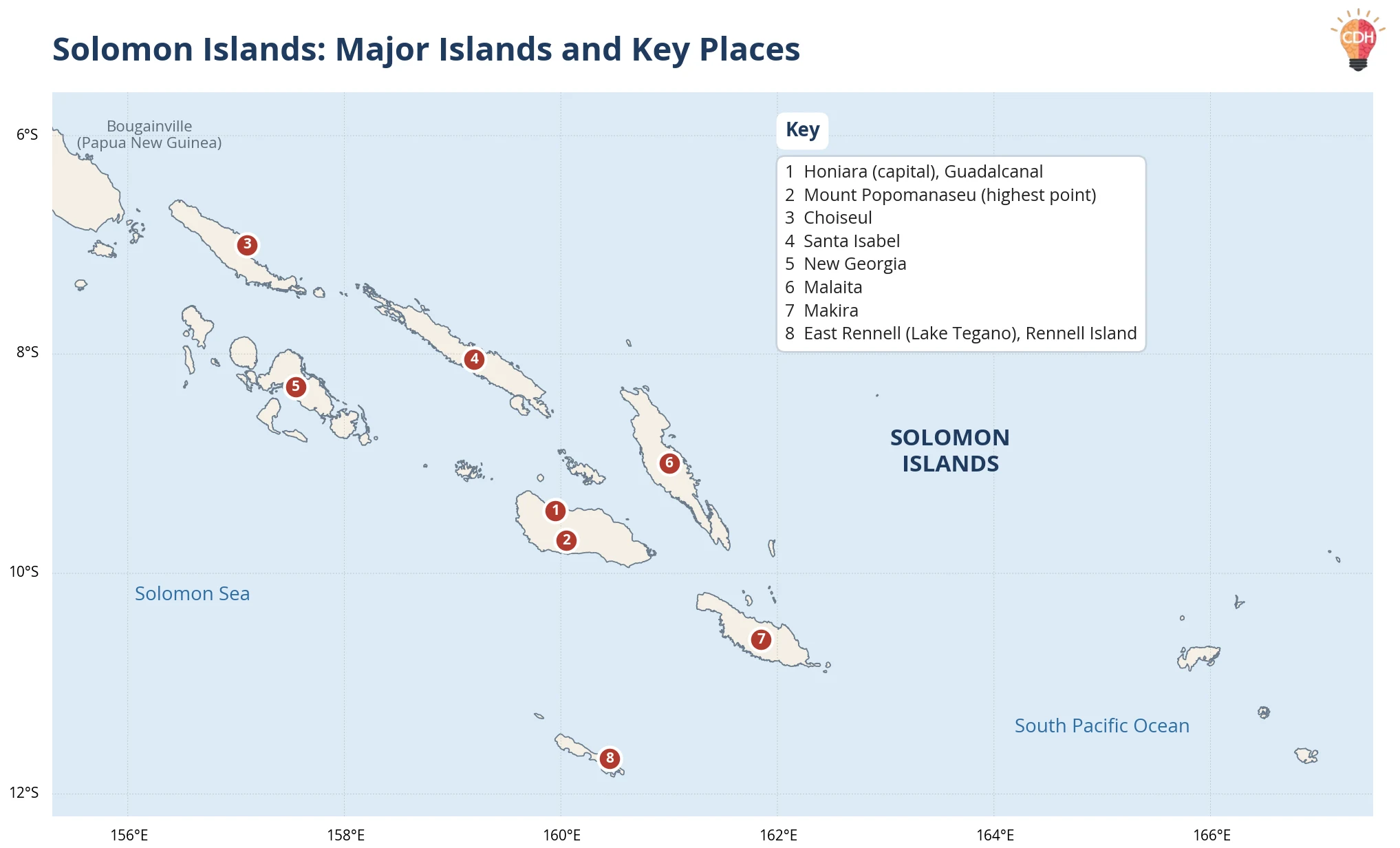
- Location: a Melanesian archipelago in the south-western Pacific Ocean, about 2,000 km north-east of Australia, east of Papua New Guinea and north-west of Vanuatu. Capital: Honiara.
- Islands: six major islands, Choiseul, New Georgia, Santa Isabel, Guadalcanal (largest), Malaita and Makira, plus over 900 smaller ones.
- Physiography: a double chain of rugged volcanic islands; outer islands are low coral atolls. Highest point: Mount Popomanaseu on Guadalcanal.
- Heritage: East Rennell, on the world’s largest raised coral atoll, holds Lake Tegano, the largest lake in the insular Pacific; on the List of World Heritage in Danger since 2013.
Strategic Context
- RAMSI (2003–2017): Australia-led regional mission under the Pacific Islands Forum’s Biketawa Declaration to restore order after ethnic conflict.
- China tilt: switched recognition from Taiwan to China in 2019; signed a security agreement with China in April 2022.
- Memberships: Commonwealth (independent from Britain in 1978), Pacific Islands Forum (18 members, HQ Suva; India a dialogue partner), Melanesian Spearhead Group and FIPIC.
- India link: the Forum for India–Pacific Islands Cooperation (FIPIC), launched in Suva in 2014, connects India with 14 Pacific Island countries.
📖 Read More: India and Australia Relations • India and South-East Asia Policy
8. Wayanad to Host India’s First Mountain Ecology Congress
(ENVIRONMENT) (DTE) Processual Mountains 2026, billed as India’s first Mountain Ecology Congress, will be held on 10–12 December 2026 at the Pookode campus of Kerala Veterinary and Animal Sciences University, Wayanad. Its theme is “Reimagining Life and Livelihoods in the Mountainscapes”.
- Organisers: Hume Centre for Ecology and Wildlife Biology, KVASU and Asar Social Impact Advisors; about 500 researchers, policymakers and indigenous representatives.
- Aim: link science, indigenous knowledge and policy for the Western Ghats and the Himalayas, and shift from project-wise to cumulative landscape-level environmental assessment.
- Timing: coincides with International Mountain Day on 11 December.
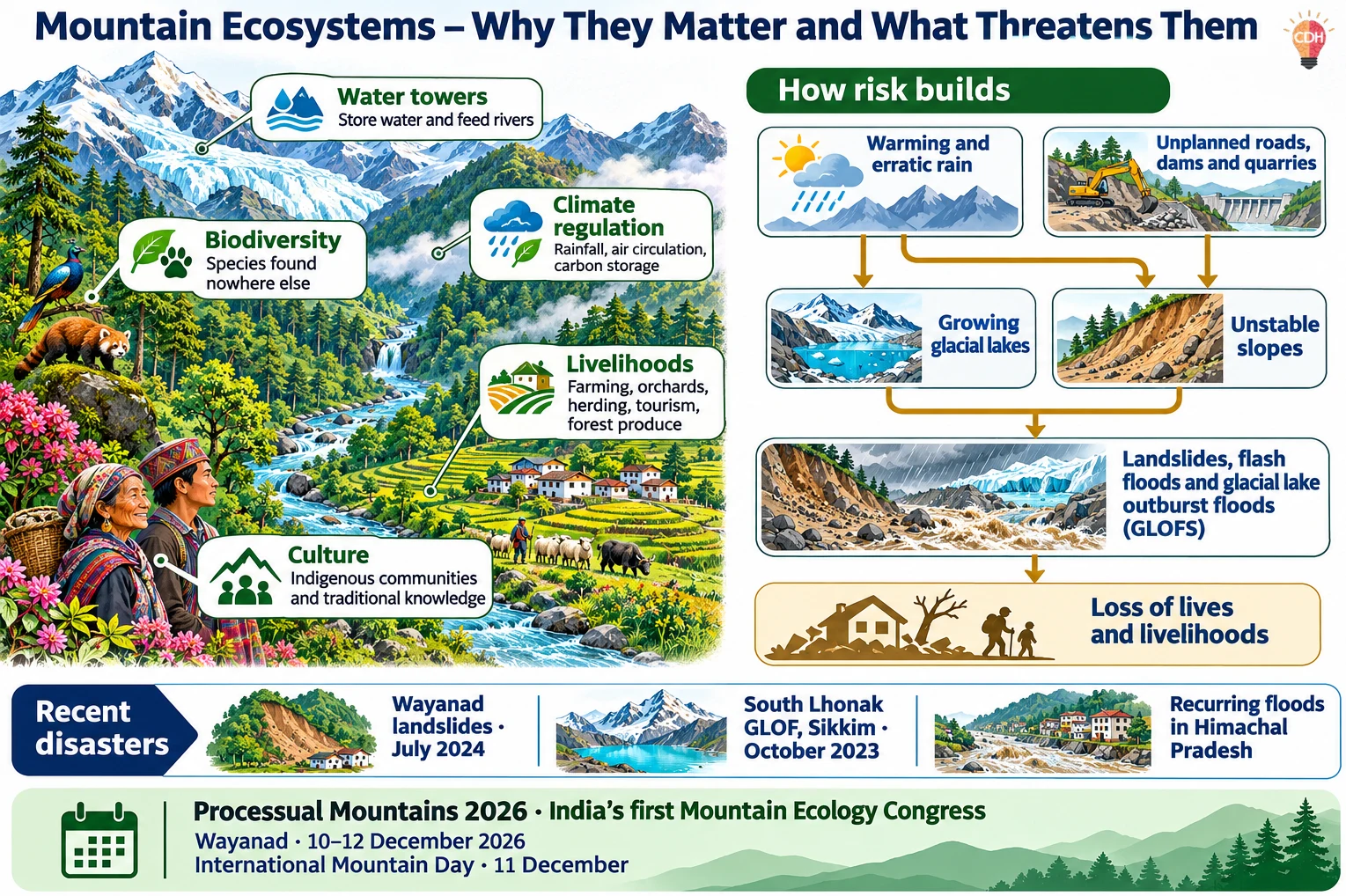
Why Mountains Matter
| Service | Role |
|---|---|
| Water towers | Store water and feed major rivers (see Himalayan river system) |
| Biodiversity | High endemism and unique ecosystems |
| Climate regulation | Shape rainfall, air circulation and carbon storage |
| Livelihoods | Farming, horticulture, pastoralism, tourism and forest produce |
| Culture | Indigenous communities and traditional knowledge |
Threats to Indian Mountains
Warming and erratic rain ➜ Unplanned roads, dams, quarries ➜ Slope instability ➜ Landslides, flash floods, GLOFs ➜ Loss of lives and livelihoods
- Recent disasters: the Wayanad landslides (July 2024) after extreme rainfall on deeply weathered slopes; the South Lhonak GLOF, Sikkim (October 2023); and recurring floods in Himachal Pradesh.
- Other pressures: unregulated tourism, habitat fragmentation and weak recognition of community rights.
📖 Read More: Landslides: A Natural Hazard • Major Glaciers of Himalayas • Classification of Mountains
9. Olive Ridleys: India’s Most Widespread Marine Turtle
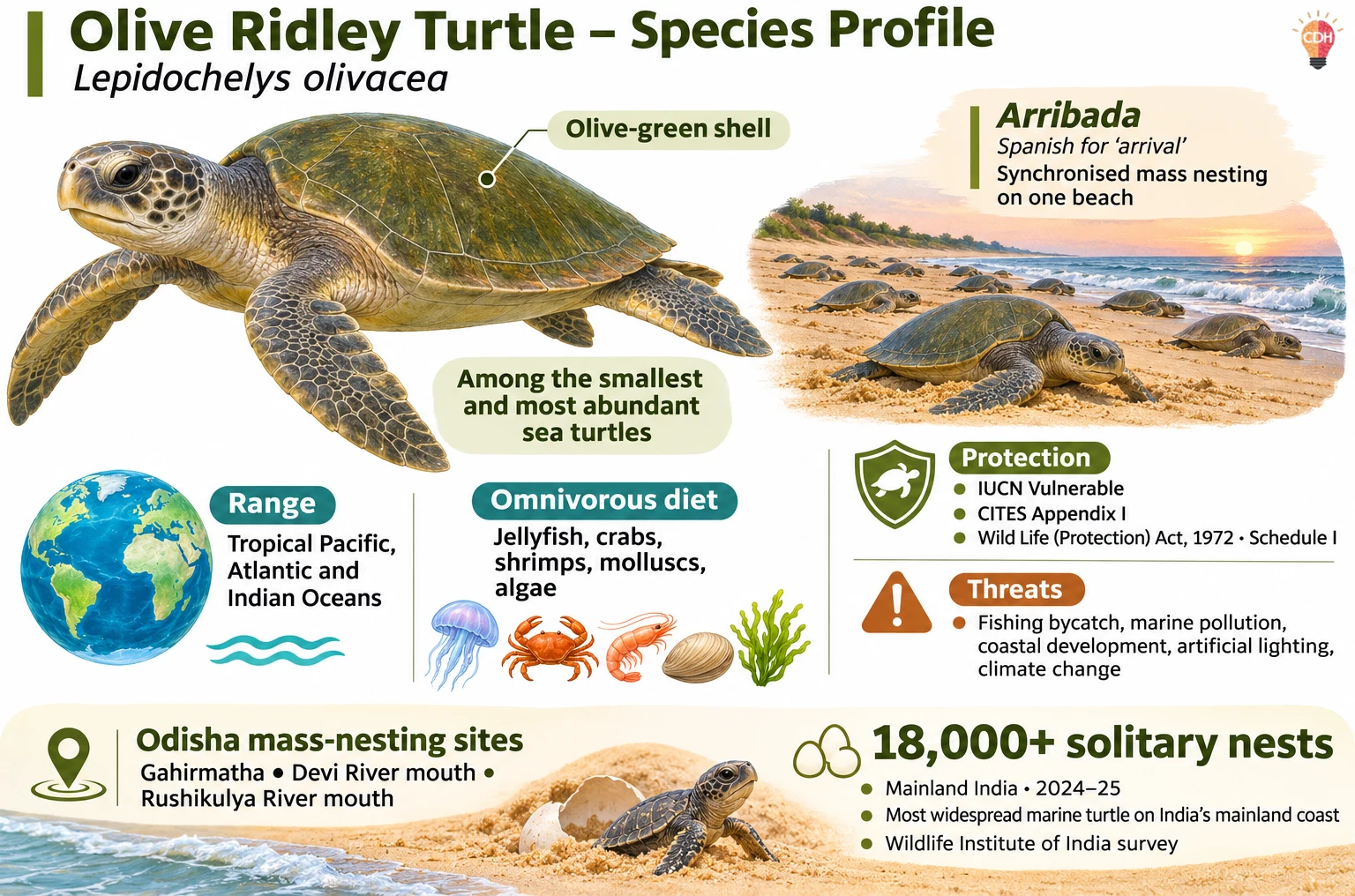
(ENVIRONMENT) (IE) A pan-India, multi-season assessment by the Wildlife Institute of India found Olive Ridley turtles to be the most widespread marine turtle on India’s mainland coast, with over 18,000 solitary nests in 2024–25. Leatherback, Green and Hawksbill turtles followed.
About the Survey
- Coverage: 360 beach stretches over about 1,300 km in coastal states, Lakshadweep and the Andaman and Nicobar Islands (December 2022 to May 2025).
- Method: nest counts used to estimate the number of nesting females, since turtles cannot be counted directly.
- Great Nicobar: 643 Leatherback nests at Galathea Bay in 2023–24 and 478 in 2024–25; the bay is the proposed site of a transhipment port.
- Advice: more on-site protection of eggs rather than relying only on hatcheries, and flipper tagging for tracking.
Species Profile
| Feature | Details |
|---|---|
| Name | Olive Ridley (Lepidochelys olivacea); named after its olive-green shell |
| Size | Among the smallest sea turtles, yet the most abundant |
| Behaviour | Arribada (Spanish for “arrival”): synchronised mass nesting |
| Distribution | Tropical Pacific, Atlantic and Indian Oceans |
| Diet | Omnivorous: jellyfish, crabs, shrimps, molluscs, algae |
| Status | IUCN: Vulnerable | CITES: Appendix I | Wild Life (Protection) Act, 1972: Schedule I |
| Threats | Fishing bycatch, pollution, coastal development, artificial lighting, climate change |
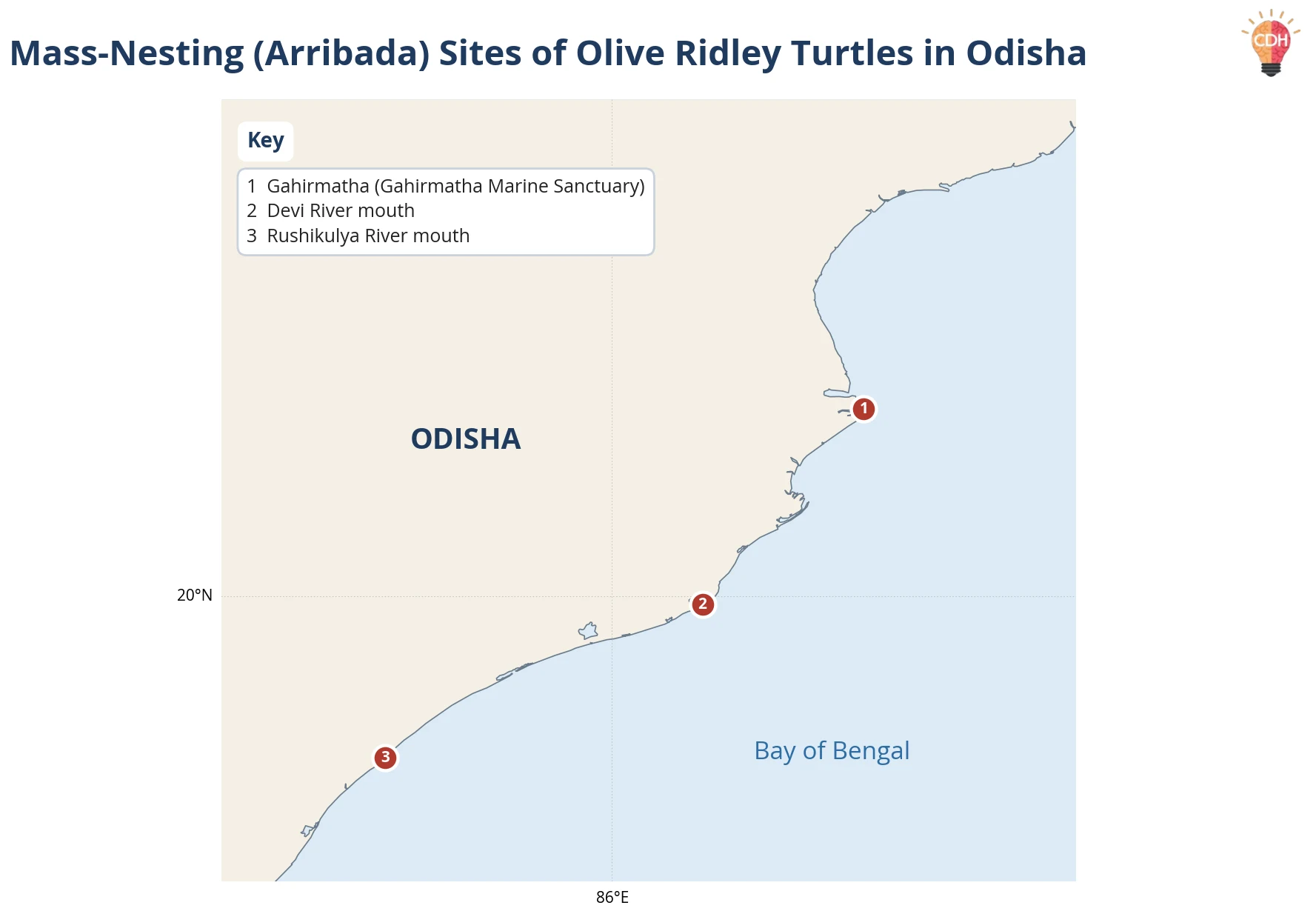
Gahirmatha Marine Sanctuary in Odisha was established in 1997 chiefly to protect Olive Ridleys; the Rushikulya and Devi river mouths are the other major arribada sites.
📖 Read More: Conservation of Major Indian Wildlife Species • Wild Life (Protection) Act, 1972 • Species of Conservation Concern
10. India Pavilion Wins Visitors’ Lion at Venice Biennale
- The pavilion: India’s official national presence at Venice, staged only in 2011, 2019 and 2026. This year’s group show was titled “Geographies of Distance: Remembering Home”.
- Organisers: commissioned by the National Gallery of Modern Art (NGMA), Ministry of Culture; the Indira Gandhi National Centre for the Arts (IGNCA) was the executing agency.
- Why a Visitors’ Lion: the jury normally awards the Golden Lion; in 2026 the jury resigned before the opening, and the Biennale replaced it with public-vote prizes.
Know the Institutions
| Body | Key facts |
|---|---|
| Venice Biennale | Founded 1895; called the “Olympics of the art world”; also runs the Architecture Biennale (since 1980) and the Venice International Film Festival |
| NGMA | Set up in 1954 at Jaipur House, New Delhi; subordinate office of the Ministry of Culture with branches in Mumbai and Bengaluru |
| IGNCA | Set up in 1987 as an autonomous trust under the Ministry of Culture for research and dissemination in the arts |
📖 Read More: Modern and Contemporary Indian Art • Awards and Honours in Art and Culture