
Modified Concept of Midland Basin (1943)
Let us begin with a small historical context.
During World War I, Halford Mackinder gave us the famous Heartland Theory, where he emphasized land power — especially the vast landmass of Central Eurasia — as the key to global dominance.
But by 1943, the world was no longer the same.
- World War II was ongoing.
- Technological advancements had changed the nature of warfare — now sea and air power were as crucial as land control.
- Global alliances were shifting.
In this new geopolitical environment, Mackinder revisited and refined his earlier theory. This led to the conceptualization of the Midland Basin.
🧭 What is the Midland Basin?
Mackinder now recognized a new geostrategic core — not in Central Asia — but in the North Atlantic Region.
He observed:
“The two sides of the Atlantic — North America and Western Europe — were now deeply connected by sea and air communication, and together, they formed an unmatched combination of industrial and military power.”
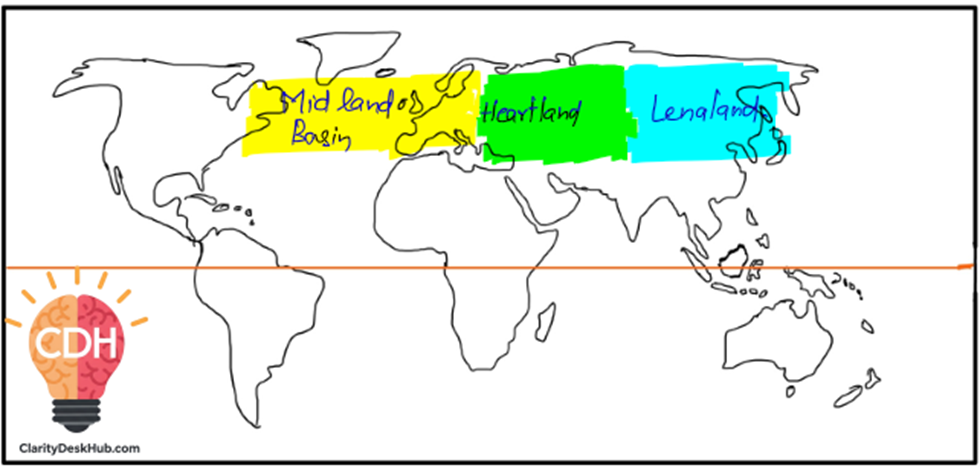
So, he proposed a new core area called the Midland Basin, which included:
- Eastern United States
- Western Europe
- The North Atlantic Ocean (as the bridge linking the two)
This area, according to Mackinder, was now a new centre of geopolitical gravity.
🗺️ Key Modifications in Mackinder’s Thought
🔹 Exclusion of Eastern USSR:
- Mackinder removed the Soviet Union’s eastern parts (east of Yenisei River) from the Heartland.
- He renamed this eastern zone as “Lenaland” — indicating its reduced geopolitical significance in his revised vision.
🔹 New Geopolitical Centres:
- After Germany’s fall in WWII, Mackinder predicted the emergence of two global power centres:
- The Heartland Basin — still centered in Central Eurasia
- The Midland Basin — the transatlantic alliance of the US and Western Europe
He envisioned that these two regions would define the post-war global order.
📊 Evaluation of Mackinder’s Revised Model
Let’s now critically evaluate Mackinder’s modified theory.
✅ Strengths
- Innovative Geo-political Lens:
Mackinder was among the first to connect geography with international politics, making geopolitics a scientific and analytical field. - Remarkably Foresighted:
- Predicted both World Wars
- Anticipated power blocs (like NATO) after WWII
❌ Criticisms of Mackinder’s Theory
Let’s group the criticisms for easier understanding:
A. Dilution Through Revisions
- One major criticism is that Mackinder kept modifying his theory.
- Each revision shifted focus — from Heartland to Midland — leading to internal inconsistency.
- Critics argue that the original theory was more coherent, and these changes diluted its core idea.
B. Over-Simplification of History
- Mackinder presented history as a binary conflict:
Land power vs. Sea power
But in reality:
- History is shaped by a complex interplay of:
- Physical factors (like climate)
- Socio-economic conditions
- Cultural and ideological differences
C. Overestimation of the Heartland
Mackinder overestimated the strategic advantages of the Heartland:
- He assumed it was flat and easy to control, but:
- In reality, much of the Heartland has rugged terrain
- It suffers from harsh continental climate and is sparsely populated
- He also believed it was geographically isolated, but:
- Modern air power and missiles make no place truly isolated
- Bering Strait and Arctic routes allow access even to the Heartland
His view was likely based on the Mercator map, which exaggerates polar areas, giving a distorted strategic perception.
D. Irrelevance in the Contemporary World
In today’s era, geopolitics is no longer driven solely by land or sea dominance.
Modern factors include:
- Trade wars and cyber warfare
- Weapons of mass destruction (WMDs)
- Climate change negotiations
- Rise of Asia (India, China, ASEAN countries) as new global hubs
- Non-state actors like:
- Terrorist groups
- Drug cartels
- Supra-national organizations (UN, WTO, IMF)
- Multinational Corporations (MNCs) with more economic clout than some countries
All of this has added layers of complexity to global geopolitics — making simple territorial theories insufficient.
🧠 Conclusion: Mackinder’s Lasting Legacy
Despite its limitations, Mackinder’s modified theory remains a milestone in geopolitical thought.
- It teaches us how space and power interact.
- It reminds us that geography is not neutral — it shapes politics, strategy, and conflict.
- Even today, conflicts over Central Asia, Ukraine, and Arctic navigation routes reflect echoes of Mackinder’s vision.
Like all great thinkers, Mackinder’s strength was not just in what he got right — but in opening a new way of thinking.