
Numismatic Sources of Indian Art and Culture
Introduction
Coins are not just pieces of metal. They are miniature documents of history. They speak — of kings, of trade, of religion, of art, of political authority, and even of technological capability. If inscriptions are the “written voice” of history, coins are its circulating memory.
What is Numismatics?
Numismatics is the scientific study of coins.
For UPSC, remember this term clearly — because coins are not merely economic instruments. They provide evidence about → Economic history, Trade networks, Religious beliefs, Artistic development, Political authority, Metallurgical technology
Coins are often more reliable than literary sources because they are contemporary and harder to manipulate later.
Evolution of Coinage in India
Let us now move chronologically. Always remember — in Art & Culture, chronology gives clarity.
🟤 Punch-Marked Coins (600 BCE – 200 BCE)
Historical Context
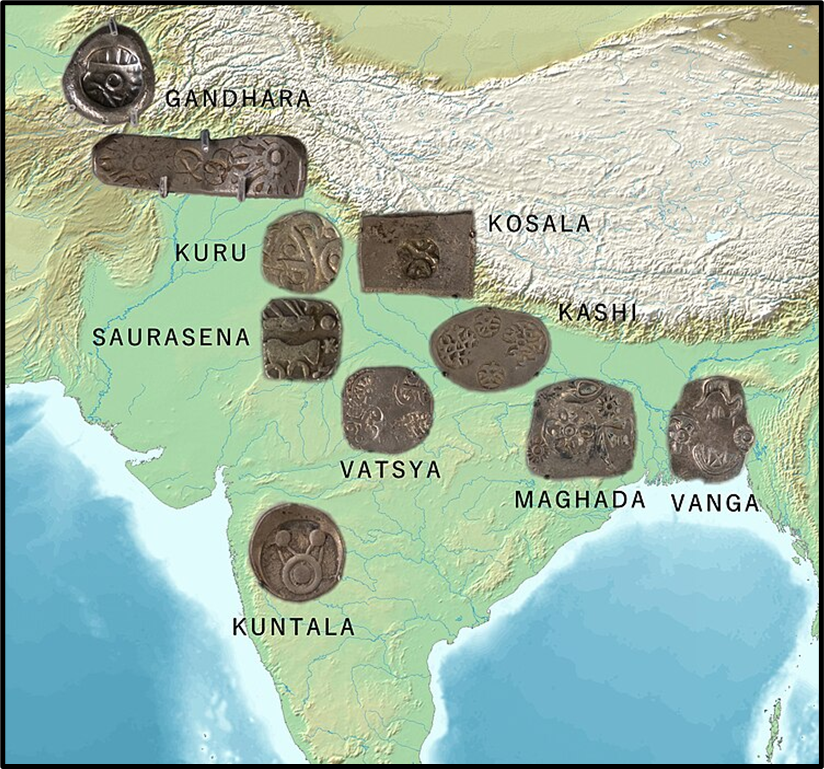
These are the earliest coins of India, emerging around the 6th century BCE, during the age of the Mahajanapadas.
Think of this period → Urbanization increasing; Trade expanding; State formation consolidating
Naturally, barter became insufficient — and coinage emerged.
Key Features
- Irregular in shape
- Made primarily of silver, sometimes copper
- Multiple symbols punched using separate dies
- No portraits of rulers
- No inscriptions
Because they were marked using punches, they are called Punch-Marked Coins.
Symbols Used
Geometric patterns; Sun symbols; Animals; Religious motifs → These symbols reflected contemporary beliefs and authority marks.
Names
Often referred to by weight standards, such as Karshapana
Notice something important here — these coins emphasize utility over artistry.
Art is minimal. Authority is symbolic, not personal.
🟤 Mauryan Coinage (322 BCE – 185 BCE)
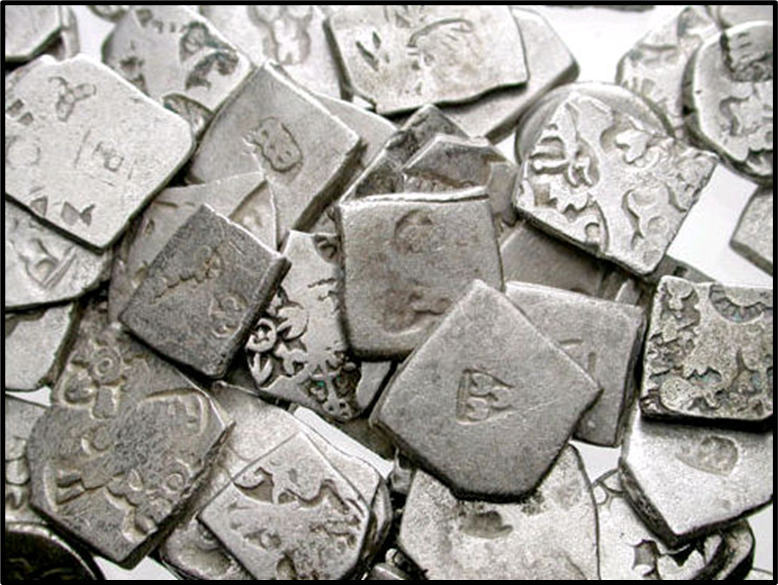
Under the Mauryan Empire, coinage became more standardized.
What Changed?
- Standardized weight system
- Greater administrative control
- Retained punch-marked style
This tells us something profound — the Mauryan state was bureaucratically advanced.
Symbols
- Sun, Tree-in-railing, Royal insignia
Coins now reflect centralized imperial authority.
Names
- Pana, Karshapana
Metal
- Mainly silver, Some copper
Here, coinage begins to reflect state power more clearly.
🟤 Indo-Greek Coins (2nd Century BCE – 1st Century CE)
Now comes a revolutionary change.
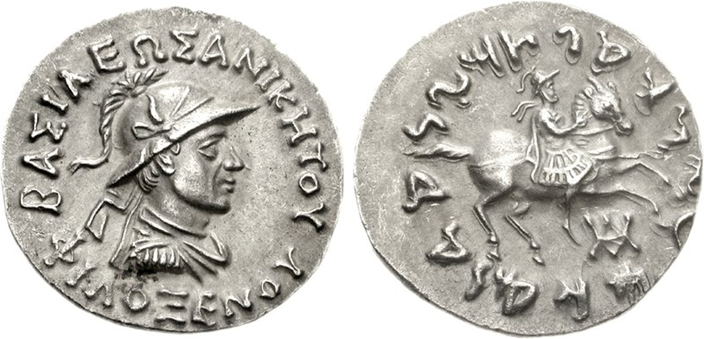
The Indo-Greeks, who ruled northwestern India, introduced major innovations.
Why Are They Important?
Because they introduced three major features:
- Gold coins
- Bilingual inscriptions (Greek and Brahmi/Kharosthi)
- Portraits of rulers
For the first time, coins carried → The king’s name; His realistic image
This was a huge shift from symbolic authority to personalized kingship.
Artistic Merit
- High-relief portraits
- Realistic facial features
- Hellenistic artistic influence
You must understand this clearly — Indo-Greek coinage marks the beginning of numismatic artistry in India.
Notable Rulers
- Menander (Milinda); Demetrius
Metals
- Silver, Copper, Some gold
These coins influenced later dynasties significantly.
By Classical Numismatic Group, CC BY-SA 3.0, via Wikimedia Commons
🟤 Saka (Western Kshatrapa) Coinage
Before moving to Kushans, remember an important fact:
The Sakas (Western Kshatrapas) issued the earliest dated coins in India.
Dates mentioned in the Saka Era (beginning 78 CE)
This introduces chronological precision into Indian coinage. For UPSC Prelims, this fact is extremely important.
🟤 Kushan Coinage (1st – 3rd Century CE)
Under the Kushans, coinage reached an extraordinary stage. Why?
Because:
- Massive trade with Central Asia and Rome
- Political expansion
- Gold inflow
Features
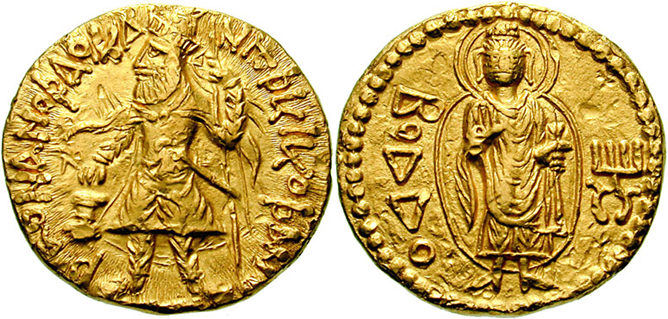
- Large number of copper coins
- Beautiful gold coins called Dinars
- Depictions of rulers like Kanishka
- Deities from → Hindu pantheon, Buddhist pantheon, Greek pantheon
This reflects religious syncretism.
Artistic Significance
- Iconography became elaborate. Coins now depicted → Shiva, Buddha, Greek gods
- This tells us → Coinage is not just economic — it is ideological.
- The Kushans used coins to project → Divine legitimacy, Cultural inclusiveness, Imperial power
🟤 Satavahana Coinage (1st Century BCE – 2nd Century CE)
Historical Context
After the decline of the Mauryan Empire, political power fragmented. In the Deccan region, the Satavahanas emerged as a dominant force.
Geographically, they ruled → Between the Vindhyas and the Pennar River, covering large parts of the Deccan plateau
Their coinage reflects → Regional adaptation, Trade integration, Political assertion
General Characteristics: A Regional Adaptation Model
Unlike the Mauryas or Guptas, the Satavahanas did not issue a uniform imperial coinage.
Instead, they issued → Different metals; Different shapes; Different textures; Regional variations
This shows administrative flexibility and regional integration.
Regional Metal Usage
- Bronze & brass → Nevasa and Nasik regions
- Lead → Deccan region (very distinctive feature)
- Copper → Square coins
- Lead coins → Mostly circular
Lead coinage is particularly significant. No other major North Indian dynasty used lead so extensively.
This reflects:
- Availability of local resources
- Adaptation to regional trade patterns
Potin and the Elephant-Type Coins
One of the most important features:
Potin Coins
Potin is an alloy of → Copper, Tin, Lead
Satavahanas used potin to issue a universal series featuring → Elephant symbol; Ujjain symbol
The Elephant-type Potin coins are the most common Satavahana coins.
Why elephant?
Because it symbolised → Royal authority; Strength; Possibly military power
Symbolism and Religious Motifs
Satavahana coins display remarkable symbolic diversity:
- Elephant, Bull, Lion, Horse
- Ship (very important — indicates maritime trade)
- Lakshmi (standing or seated)
- Hills; Human figures; Stupa and Chaitya motifs
This tells us something very important:
Satavahana coinage reflects both Brahmanical and Buddhist influences.
The ship symbol clearly suggests:
- Active participation in maritime trade
- Contact with Roman world and Southeast Asia
Silver Series and Overstriking
One of the most fascinating aspects:
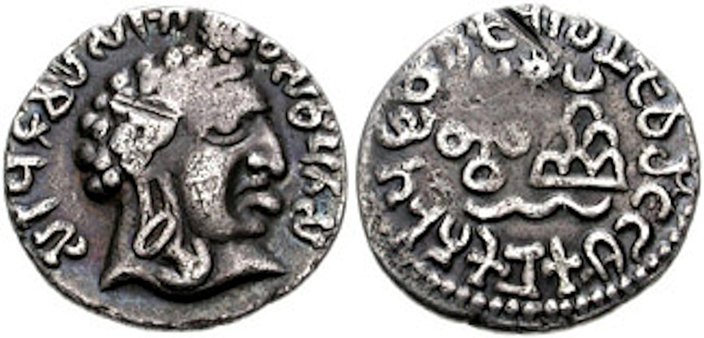
Gautamiputra Satakarni overstruck the silver coins of the Western Kshatrapa ruler Nahapana.
What does this mean?
Overstriking means → Taking an existing coin; Stamping your authority over it
This is not just economic reuse — it is political symbolism.
It declares → “Your authority is erased. Mine stands above.”
This is numismatic propaganda.
Inscriptions
Satavahana coins carried legends in → Brahmi script; Prakrit language
Silver coins even carried → Southern Dravidian language resembling Tamil on reverse
Some coins had → Bilingual legends (inspired by Saka Kshatrapas)
Thus, we see → Cultural interaction, Linguistic diversity, Administrative sophistication
🟡 Gupta Coinage (4th – 6th Century CE)
Why Gupta Coinage Is Special
Gupta coinage represents → The artistic zenith of ancient India; Metallurgical excellence; Political confidence
It is rightly called the Golden Age of Indian Coinage.
Origin and Inspiration
Initially, Gupta coins:
- Imitated Kushan weight standards
- Adopted similar techniques
- Followed certain design elements
But very soon, they developed a distinct identity.
Why So Many Gold Coins?
Because → Flourishing trade, Political stability, Economic prosperity
Who Issued First?
Most scholars believe:
Samudragupta was the first major Gupta ruler to issue coins.
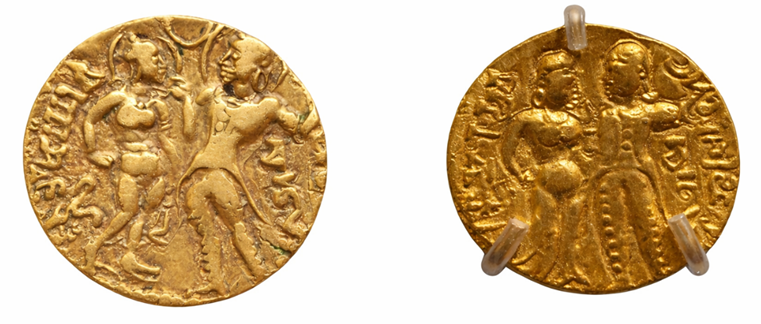
However, the famous Chandragupta I–Kumaradevi type coins were probably issued by Samudragupta to commemorate:
- His father Chandragupta I’s marriage
- With the Licchchhavi princess Kumaradevi
Marriage becomes political capital — and is immortalized on coins.
General Pattern of Gupta Coins
Obverse → Portrait of king; Reverse → Goddess (often Lakshmi)
This shows → Divine legitimacy; Royal authority; Religious patronage
Features of Gupta Coinage
- Largest number of gold coins in ancient India
- Called Dinaras
- Regular size and weight
- High gold purity
Silver Coins
- Called Rupakas
- Issued after Chandragupta II defeated the Western Kshatrapas.
- They imitated Western Kshatrapa coinage — but now under Gupta authority.
Copper Coins
Very few in number.
This suggests:
- Rural self-sufficient economy
- Smaller transactions conducted through cowrie shells
This observation matches the Chinese traveller Fa-Hien, who noted cowries were used for small exchanges.
Types of Gupta Coins
Gupta coins are thematic.
Important Types:
- King and Queen Type
(Marriage of Chandragupta I and Kumaradevi) - Standard Type
(King holding a sceptre) - Archer Type
(King with bow) - Ashvamedha Type
(Horse sacrifice ritual) - Lyricist Type
(King playing vina — shows artistic inclination)
Look at this carefully.
Coins now reveal → Military power; Religious ritual; Cultural refinement; Musical interests
They are miniature biographies of kings.
🟢 South Indian Coinage (Cholas, Cheras, Pandyas)
Now we move to the South Indian dynasties.
Names of Coins → Kasu (gold); Pon (gold); Varaha (gold)
Metals Used → Gold, Silver, Copper
Features
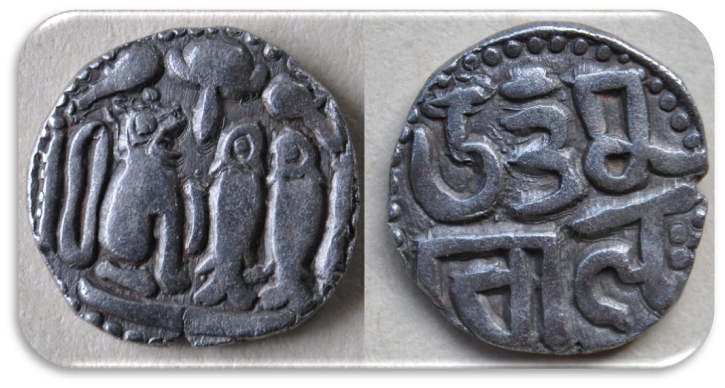
South Indian coins frequently displayed → Chola tiger emblem; Pandya fish symbol; Chera bow symbol; Temple motifs
Unlike Gupta coins (which emphasized portraiture), South Indian coins emphasized → Dynastic insignia, Symbolic identity
These emblems functioned like royal logos.
Economic Role
South Indian coinage supported → Maritime trade; Southeast Asian connections; Indian Ocean commerce
Particularly under the Cholas, trade networks extended to → Srivijaya, Southeast Asia
Thus, coinage reflects economic expansion.
By Jean-Michel Moullec CC BY 2.0, via Wikimedia Commons
🟣 Coinage in the Medieval Period (13th – 18th Century CE)
🟢 Delhi Sultanate Coinage (13th – 16th Century CE)
A Shift in Aesthetic Philosophy
With the establishment of the Delhi Sultanate, coinage underwent a fundamental transformation.
Why?
Because Islamic theology discouraged → Human figures, Animal depictions
Thus, unlike Gupta coins (which showed kings and goddesses), Sultanate coins emphasized → Persian calligraphy, Quranic inscriptions, Geometric patterns
The artistry shifted from imagery to script.
Muhammad of Ghur and Transitional Coinage
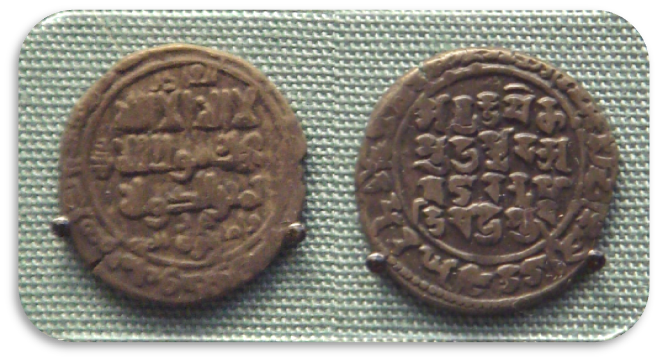
After conquering Delhi, Muhammad of Ghur issued coins called Dehliwal.
Interestingly:
- One side: Seated Goddess Lakshmi
- Other side: Devanagari legend “Sri Mahamada Sama”
This was strategic accommodation.
It shows → Political legitimacy often requires cultural adaptation.
He used existing iconography to gain acceptance among the local population.
By Uploadalt – Own work, CC BY-SA 3.0, via Wikimedia Commons
Iltutmish and Independent Sultanate Coinage
The real foundation of Sultanate coinage begins with Iltutmish.
He introduced → Tanka (silver), Jital (copper).
These became the standard currency system.
Metals Used → Silver, Copper, occasionally billon (silver + copper alloy)This marks the beginning of a structured Islamic monetary system in India.
Muhammad bin Tughlaq and Token Currency
Now we encounter one of the most fascinating episodes in Indian economic history.
Muhammad bin Tughlaq introduced token currency.
What did he do?
- Issued bronze/copper coins
- Declared them equivalent to silver Tanka
Why?
There are two views:
- Barani’s view: Treasury was empty due to → Military campaigns; Sultan’s generosity
- Modern view → Global silver shortage; Forced monetary innovation
Why Did It Fail?
Because:
- Concept of token currency was new
- No effective control over minting
- People began forging coins
- State failed to regulate
Fake coins flooded the market. Eventually, the Sultan had to withdraw them.
Yet, His Legacy?
Despite failure, Muhammad bin Tughlaq is called “The Prince of Moneyers”
Because he:
- Issued coins of multiple denominations
- Improved calligraphy
- Experimented boldly with monetary theory
He was ahead of his time — but administratively weak in enforcement.
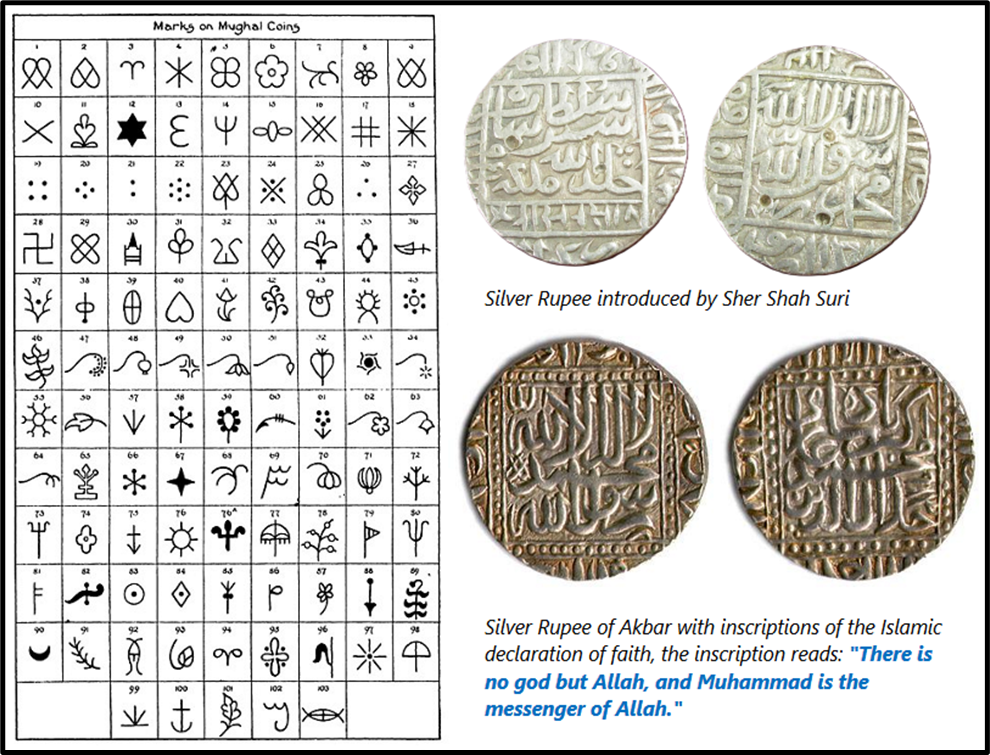
🟡 Mughal Coinage (16th – 18th Century CE)
The Mughal period represents refinement and standardization.
Major Coin Types → Mohur (gold); Rupiya (silver); Dam (copper)Remember this clearly for Prelims.
Sher Shah Suri’s Contribution
Before Akbar, Sher Shah Suri issued the silver Rupiya. This Rupiya became the precursor to the modern Rupee
This is one of the most important economic continuities in Indian history.
Artistic Excellence
Mughal coins are masterpieces of → Balanced proportions; Intricate Persian calligraphy; Refined geometric layouts
Human figures were mostly absent, but elegance was supreme.
Akbar’s Innovations
Akbar introduced → Ilahi coins; Din-i-Ilahi influenced inscriptions
He experimented with →Religious symbolism; Zodiac motifs (in some issues)
Coinage became:
- A medium of imperial ideology
- A reflection of syncretism
Administrative Standardization
Under the Mughals → Uniform weight standards; Centralized mint control; Wide circulation
This facilitated → Inter-regional trade; Economic integration of India
Mughal currency became stable and reliable.
🔵 Coinage in the Colonial Period (18th – 20th Century CE)
Now we enter industrial modernity.
Coinage becomes → Mechanized, Standardized, Politically symbolic
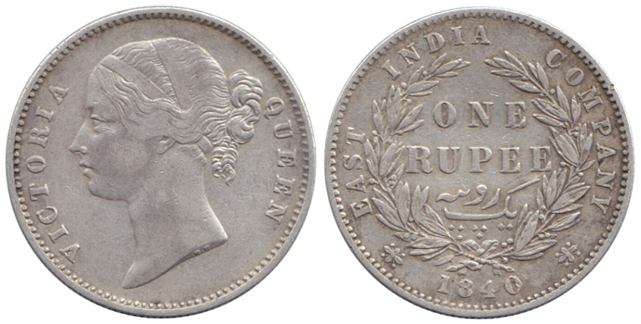
🟤 East India Company Coins (18th – 19th Century CE)
Initially, the Company:
- Continued Mughal style coins
- Used Persian inscriptions
- Minted coins in the name of Mughal emperor
Why? → To maintain legitimacy.
Important Coins
- Arcot Rupee (silver)
- Pagoda (gold)
Coins often included → English inscriptions; Regional language inscriptions
This shows → Political control combined with cultural adaptation.
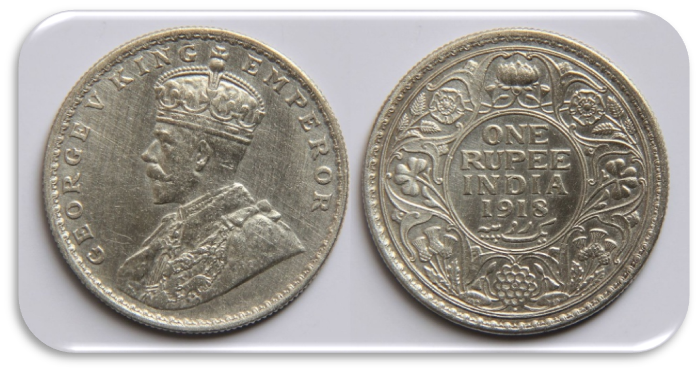
⚫ British Indian Coinage (1858 – 1947)
After 1858, when Crown rule began, coinage was fully standardized.
Features → Portraits of British monarchs; English inscriptions; Uniform denominations
Names included → Anna (copper); Rupee (silver); Panam/Fanam; Sovereign (gold)
Metallurgical Shift
Over time → Silver reduced; Nickel alloys introduced; Gold sovereigns standardized
Industrial minting ensured → Precision, Uniformity, Large-scale circulation
🧠 Comparative Analysis Across Eras
| Period | Artistic Focus | Ideological Emphasis | Economic Significance |
|---|---|---|---|
| Ancient | Portraits, deities | Divine kingship | Trade expansion |
| Sultanate | Calligraphy | Islamic legitimacy | Monetary reform |
| Mughal | Refined script | Imperial sovereignty | Economic integration |
| Colonial | Monarch portraits | Colonial authority | Global market integration |
📌 Larger Conceptual Evolution
Observe the trajectory:
- Punch-marked → Anonymous authority
- Indo-Greek → Personalized kingship
- Gupta → Divine royal symbolism
- Sultanate → Script replaces imagery
- Mughal → Elegant imperial standardization
- British → Industrial colonial uniformity
Coins evolve from:
Sacred symbolism → Imperial theology → Bureaucratic precision
Final Reflection
If we step back and look at the entire journey:
Indian coinage is not just monetary history.
It is:
- A reflection of political power
- A record of religious philosophy
- A measure of economic health
- A mirror of artistic evolution
- A testimony to technological progress
From irregular silver pieces of the Mahajanapadas to machine-minted colonial rupees — coinage in India captures over 2500 years of civilizational transformation.