
Principles of Classification of Organisms
When we look at nature, we see an immense diversity—millions of organisms, each different in structure, function, and behavior. If we try to study them without any order, it becomes chaotic.
So, classification is essentially a scientific method of bringing order to this diversity. It means grouping organisms into categories based on observable similarities and differences.
This idea is not new. Even ancient thinkers like Aristotle tried to classify animals based on their habitats—land, water, and air. Though primitive, it laid the foundation for modern biological classification.
Scientific Bases of Classification
Modern biology does not rely on a single feature. Instead, classification is done using multiple scientific criteria. Let us understand each one:
(A) Organisation of Nucleus
This is one of the most fundamental criteria because it relates to cell structure, the basic unit of life.
- Prokaryotes
These organisms have an unorganised nucleus. Their genetic material is not enclosed within a nuclear membrane.
→ Examples: Bacteria, Archaea - Eukaryotes
These have a well-defined, membrane-bound nucleus.
→ Examples: Plants, Animals
👉 This distinction is crucial because it represents a major evolutionary divide in life forms.
(B) Number of Cells
Now, let us move from the nucleus to the entire organism.
- Unicellular Organisms
Life is confined to a single cell, which performs all functions.
→ Examples: Bacteria, Amoeba - Multicellular Organisms
Many cells work together, showing division of labour.
→ Examples: Plants, Animals
👉 This reflects increasing complexity—from simplicity to specialization.
(C) Mode of Nutrition
This tells us how organisms obtain energy, which is central to survival.
1. Autotrophs (Self-feeders)
They produce their own food.
- Photoautotrophs: Use sunlight (photosynthesis) → Plants, algae
- Chemoautotrophs: Use chemical energy → Nitrogen-fixing bacteria
2. Heterotrophs (Dependent feeders)
They depend on others for food.
Types include:
- Herbivores → eat plants
- Carnivores → eat animals
- Omnivores → eat both
- Detritivores → feed on dead matter
- Parasites → live on hosts
- Saprotrophs → decompose organic matter externally
👉 This classification shows ecological roles and energy flow in ecosystems.
(D) Level of Organisation
Now we look at how body structures are arranged.
- Cellular Level → Single cell performs all functions (e.g., Amoeba)
- Tissue Level → Cells form tissues (e.g., Sponges)
- Organ Level → Tissues form organs (e.g., Flatworms)
- Organ System Level → Organs work together (e.g., Humans)
👉 This represents a clear evolutionary progression toward complexity.
(E) Evolutionary Basis
This is a more advanced and scientific approach.
- Primitive (Lower) Organisms: Simple structure, little change over time
- Advanced (Higher) Organisms: Complex structure, evolved features
👉 Modern classification heavily relies on evolutionary relationships, meaning organisms are grouped based on common ancestry.
Taxonomic Classification
Now we move from criteria to a formal system.
What is Taxonomy?
- Taxonomy is the science of → Naming organisms, Defining them and Classifying them
- It uses multiple parameters → External morphology, Internal structure, Cellular organisation, Development patterns and Ecological roles
Key Concepts
- Taxon (plural: taxa)
A unit of classification (like species, genus, etc.) - Systematics
Study of diversity and evolutionary relationships over time
👉 If taxonomy is about naming and grouping, systematics is about understanding relationships.
Taxonomic Hierarchy (From Broad to Specific)
Think of this as a pyramid, where each level becomes more specific.
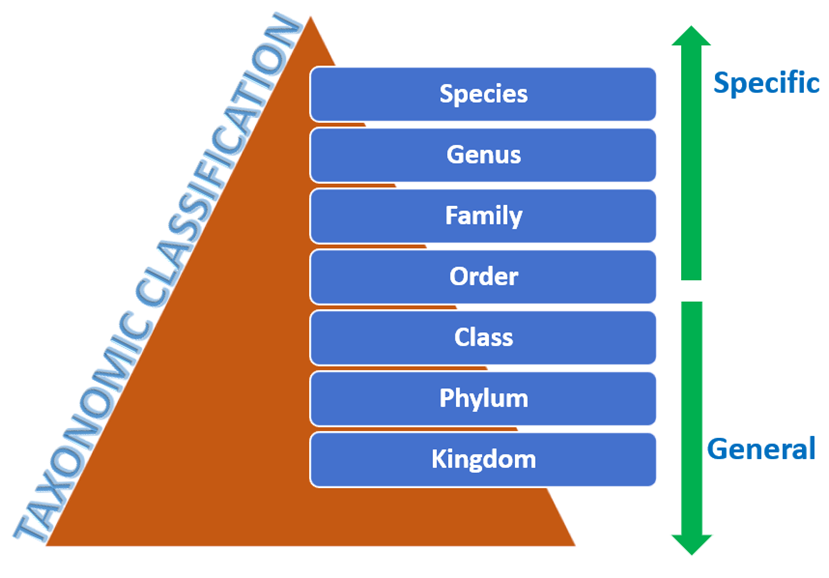
| Taxonomic Rank | Definition / Key Feature | Level of Specificity | Example |
| Kingdom | The highest and most general rank; groups organisms based on very broad characteristics. | Most general | Animalia |
| Phylum / Division | Groups organisms within a kingdom based on major body plans or structural features. (Phylum for animals, Division for plants) | Very broad | Chordata |
| Class | Further divides phyla/divisions into groups with more specific similarities. | Broad | Mammalia |
| Order | Groups related classes into more refined categories. | Moderate | Carnivora |
| Family | Divides orders into groups of closely related organisms. | More specific | Felidae |
| Genus | Groups species that are very similar and closely related. | Highly specific | Panthera |
| Species | The most specific rank; organisms that can interbreed and produce fertile offspring. | Most specific | Panthera leo |
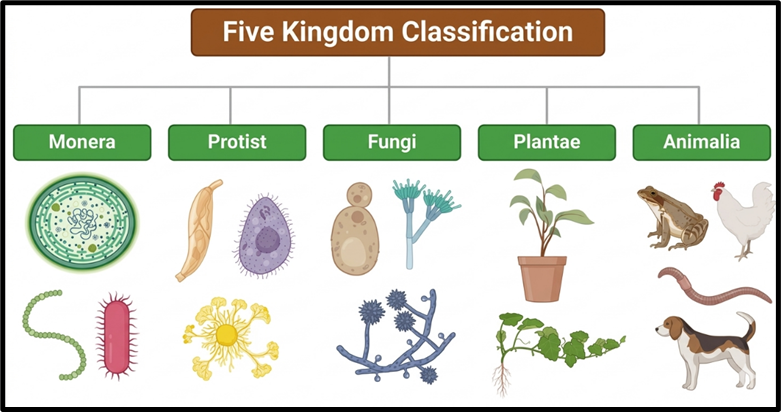
Five Kingdom Classification by Robert Whittaker
Imagine trying to organize all living beings on Earth—from bacteria to humans—into a meaningful system. This is exactly what Whittaker did in 1969.
He proposed a Five Kingdom Classification, which is widely accepted because it is based on multiple scientific criteria:
- Cell structure (prokaryotic/eukaryotic)
- Body organisation (unicellular/multicellular)
- Mode of nutrition (autotrophic/heterotrophic)
- Reproduction
- Phylogenetic relationships (evolutionary connections)
👉 On this basis, all organisms are divided into five kingdoms:
Monera, Protista, Fungi, Plantae, Animalia
| Feature | Monera | Protista | Fungi | Plantae | Animalia |
| Cell Type | Prokaryotic | Eukaryotic | Eukaryotic | Eukaryotic | Eukaryotic |
| Cell Wall | Non-cellulosic (polysaccharide + amino acids) | Present in some | Present (chitin) | Present (cellulose) | Absent |
| Nuclear Membrane | Absent | Present | Present | Present | Present |
| Body Organisation | Unicellular | Unicellular / simple multicellular | Multicellular (except yeast) | Multicellular | Multicellular |
| Mode of Nutrition | Autotrophic (photosynthetic/ chemosynthetic) & Heterotrophic | Autotrophic & Heterotrophic (holozoic, saprotrophic, parasitic, symbiotic) | Heterotrophic (saprophytic, parasitic, symbiotic) | Primarily autotrophic (photosynthetic), some heterotrophic | Heterotrophic (holozoic, parasitic, etc.) |
| Reproduction | Asexual (binary fission) | Both asexual & sexual | Both (spores) | Sexual & asexual | Primarily sexual |
| Locomotion | Generally absent | Present (cilia/flagella in many) | Absent | Absent | Present |
| Special Features | Simplest organisms; no true nucleus | Mostly aquatic; diverse forms | Hyphae form mycelium; no chlorophyll | Alternation of generations | Nervous system present |
| Examples | Cyanobacteria, Mycoplasma | Algae, Diatoms, Protozoa | Yeast, Mushroom, Penicillium | Moss, Ferns, Flowering plants | Humans, Insects, Animals |
Viruses, Viroids, Prions and Lichens
In the framework of the Robert Whittaker’s Five Kingdom Classification, certain biological entities—namely viruses, viroids, prions, and even lichens—do not fit neatly into the traditional categories of living organisms.
This is primarily because some of them lack a true cellular structure, which is considered a fundamental criterion for life. These acellular entities exist at the boundary of life and non-life, challenging our conventional understanding of biology.
While lichens represent a fascinating example of symbiosis, viruses, viroids, and prions are unique infectious agents with distinct structural and functional characteristics.
Comparative Table:
| Feature | Viruses | Viroids | Prions | Lichens |
| Discovery | Discovered by Martinus Willem Beijerinck | Discovered by Theodor Otto Diener | Identified by Stanley Prusiner | Known since early botanical studies |
| Nature | Non-cellular, nucleoprotein infectious agents | Smallest infectious agents (RNA only) | Infectious misfolded proteins | Symbiotic association of algae & fungi |
| Cellular Structure | Absent (acellular) | Absent | Absent | Present (composite organism) |
| Genetic Material | Either DNA or RNA (never both) | Only RNA (no protein coat) | No nucleic acid (only protein) | Both partners have cellular structure |
| Protein Coat | Present (capsid made of capsomeres) | Absent | Not applicable | Not applicable |
| Size | Smaller than bacteria | Smaller than viruses | Comparable to viruses | Macroscopic (visible) |
| Mode of Life | Obligate intracellular parasites | Obligate parasites (mainly plants) | Infectious protein agents | Mutualistic symbiosis |
| Reproduction | Replicate inside host cells using host machinery | Replicate inside host cells | Induce misfolding of normal proteins | Reproduce via vegetative propagation |
| Host Range | Plants, animals, bacteria (bacteriophages), fungi | Mainly plants | Animals (including humans) | Independent composite organism |
| Diseases Caused | Mumps, influenza, AIDS, smallpox | Potato spindle tuber disease | BSE (mad cow disease), CJD | Not pathogenic |
| Special Features | Inert outside host; filterable | Naked RNA; low molecular weight | No genetic material; protein-only infection | Pollution indicators; sensitive to SO₂ |