
Communism in Russia since 1953
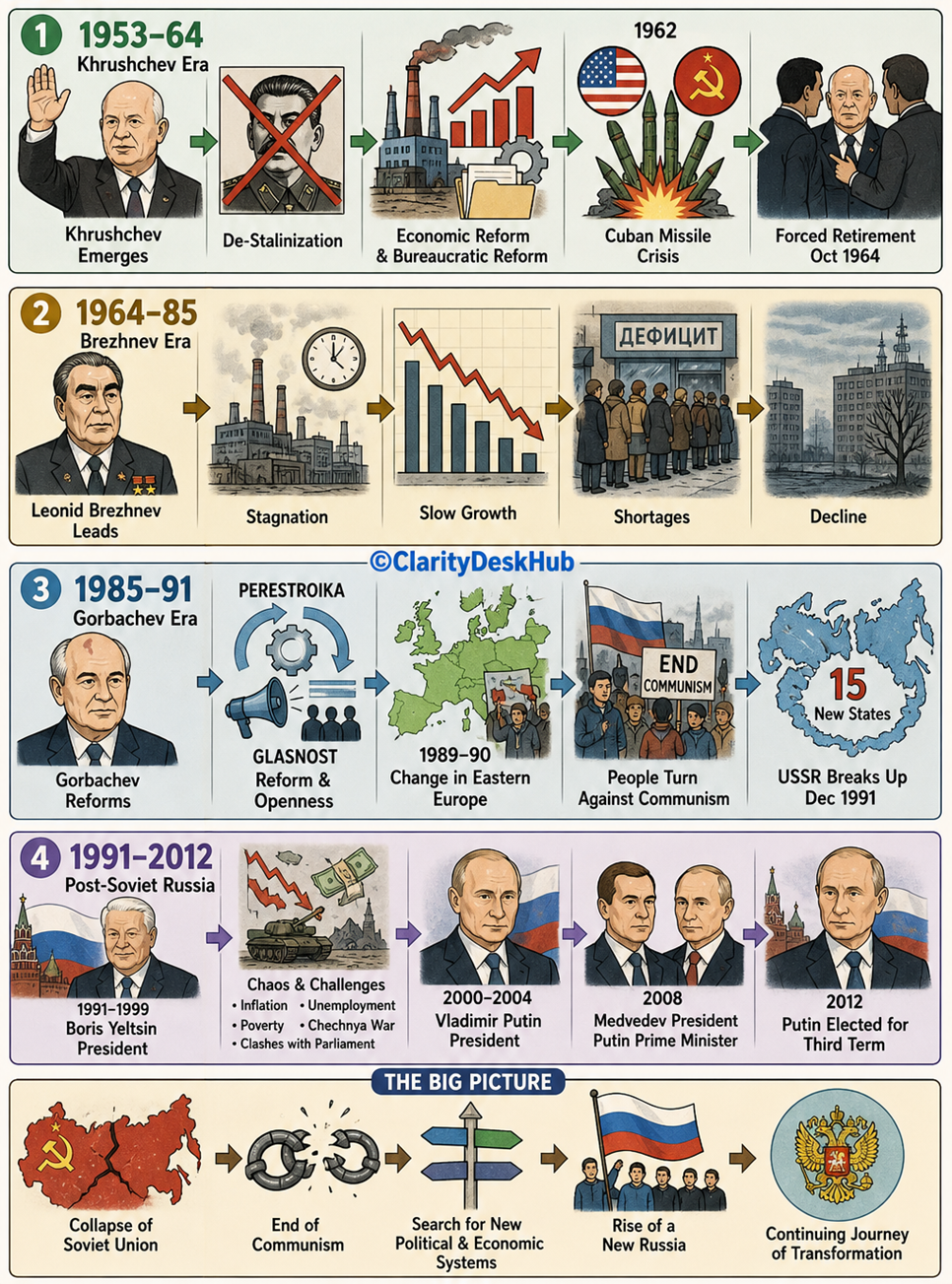
The Khrushchev Era, 1953–64
Imagine a room that has been kept under a suffocating, frozen silence for decades. Suddenly, the windows are thrown open. There is fresh air, but there is also a storm. This, in essence, was the Khrushchev era. It was a period of “thaw” after the long, dark winter of Stalinism.
The Power Vacuum and the Rise of Khrushchev (1953–1957)
When Joseph Stalin passed away in 1953, the Soviet Union faced a “Succession Crisis” reminiscent of 1924. Stalin was a banyan tree under which nothing grew; he had stifled any potential rival.
The Collective Leadership Phase
Initially, no single leader dared to claim absolute power. A Collective Leadership was formed:
- Malenkov (Administration)
- Khrushchev (Party Secretary)
- Beria (Secret Police)
- Molotov and Bulganin (Diplomacy and Defense)
The Elimination of Rivals
Khrushchev, much like Stalin before him, used his position as Party Secretary to masterfully outmaneuver others.
- The Fall of Beria: The leadership feared Beria’s control over the secret police. In a rare moment of unity, they had him executed—the last “bloody” removal of a high-ranking official.
- The Displacement of Malenkov: By 1955, Khrushchev sidelined Malenkov over industrial policy disagreements. Crucially, Malenkov was allowed to retire, not executed. This signaled a shift toward a more “civilized” political culture.
De-Stalinization: The “Secret Speech” of 1956
The most defining moment of Khrushchev’s career was his speech at the 20th Party Congress. This was a political earthquake.
Key Elements of the Speech:
- Attack on the “Cult of Personality”: He condemned Stalin for placing himself above the Party.
- Exposure of Purges: He revealed the horrors of the 1930s executions and criticized Stalin’s incompetence during WWII.
- Ideological Shift: He proposed that there are “different roads to socialism” and advocated for “Peaceful Coexistence” with the West to avoid nuclear catastrophe.
The “Why” Behind the Attack:
Why would a man who flourished under Stalin attack him?
- Political Strategy: By blaming his seniors (Molotov, Malenkov), he washed his own hands of the bloodletting.
- Systemic Reform: He genuinely believed Stalinism was a bottleneck to Soviet progress. He wanted to return to a “Leninist” path—rule by the Party, not a tyrant.
Domestic Policies: The “Thaw” and Economic Experiments
Khrushchev inherited an economy that was militarily strong but consumer-poor. His mission was to make communism “comfortable.”
A. Industrial Reform
He shifted focus from heavy industry to consumer goods (TVs, fridges, washing machines).
- Decentralization: He created over 100 Regional Economic Councils to break the stifling control of Moscow bureaucrats.
- The Space Race: Under his watch, the USSR achieved the ultimate prestige—Yuri Gagarin becoming the first human in space (1961).
B. The Agricultural Gamble: The Virgin Lands Scheme
Khrushchev, the “peasant’s son,” felt he knew farming best.
- The Scheme: He opened up massive tracts of land in Siberia and Kazakhstan for cultivation.
- Initial Success vs. Eventual Failure: While production spiked by 56% by 1958, the lack of fertilizers and poor soil quality eventually led to “dust bowl” conditions.
- By 1963, the USSR—the land of the proletariat—was forced to import grain from its capitalist arch-rival, the USA. This was a massive blow to his prestige.
C. Social and Cultural “Thaw”
- Meaning of Thaw: The “Thaw” refers to Khrushchev’s limited liberalization of Soviet political and cultural life after the rigid repression of Stalin’s era.
- Intellectual Freedom: Works like Solzhenitsyn’s One Day in the Life of Ivan Denisovich were published, exposing the GULAGs.
- GULAGs were forced labour camps used to imprison and exploit political opponents and civilians under harsh conditions, especially during Stalin’s rule.
- Limits of Liberty: The “Thaw” had boundaries. If you criticized Stalin, you were a hero; if you criticized the Party, you were an outcast.
- His crackdown on the Orthodox Church and the violent suppression of the Novocherkassk strike (1962) proved that the iron fist was still there, even if it wore a velvet glove.
Foreign Affairs: A Balancing Act
Khrushchev’s foreign policy was a paradox of “Peaceful Coexistence” and “Nuclear Brinkmanship.”
- The Hungarian Uprising (1956): When Hungary took “different roads to socialism” too literally and tried to leave the Soviet bloc, Khrushchev crushed them with tanks.
- The Cuban Missile Crisis (1962): The world held its breath as Khrushchev and Kennedy stared into the nuclear abyss. Khrushchev’s eventual withdrawal of missiles was seen by his hardline colleagues as a “humiliating retreat.”
- The Sino-Soviet Split: His “revisionism” led to a bitter divorce with Mao’s China, splitting the communist world in two.
The Downfall (1964) and Legacy
In October 1964, the Central Committee did what would have been impossible under Stalin: they voted him out.
Why did he fall?
- Economic Failures: The agricultural crisis and grain imports.
- Military Discontent: Cuts in conventional defense spending.
- Bureaucratic Resentment: His decentralization threatened the “privileges” of the elite.
- Erratic Personality: His famous “shoe-banging” at the UN and impulsive decision-making (like awarding the Order of Lenin to Egypt’s Nasser) made him look like a liability.
Historiographical Perspective: “The Heroic Failure”
How should we remember him?
- Alec Nove emphasizes the rise in living standards as his greatest feat.
- Martin McCauley views him as a “Heroic Failure”—a man with a noble vision who was sabotaged by a greedy bureaucracy.
- Dmitri Volkogonov notes that Khrushchev’s greatest achievement was making the system “human” enough that it could never fully return to the dark days of Stalinism.
Conclusion: Khrushchev was a complex man—part reformer, part autocrat. He didn’t destroy the communist system, but he did something more profound: he removed the fear that held it together. He proved that while you can command a person through terror, you must eventually feed and respect them to lead them.
After the “thaw” and the unpredictability of the Khrushchev years, the Soviet Union entered a long, heavy period that historians call the “Era of Stagnation” (Zastoy).
If Khrushchev was the leader who tried to change the system from within, Leonid Brezhnev was the leader who chose to freeze the system in time. Let us analyze this era where, on the surface, everything looked stable, but underneath, the foundations of the Soviet empire were rotting.
Stagnation of USSR, 1964-86
The Brezhnev Era (1964–1982): Stability at the Cost of Progress
Following the 1964 coup against Khrushchev, power was initially shared among a “Troika” (Brezhnev, Kosygin, and Podgorny). However, by 1977, Brezhnev emerged as the undisputed leader.
The Philosophy of “Stability of Cadres”
Brezhnev’s primary goal was to keep the Nomenklatura (the ruling elite and bureaucracy) happy. Khrushchev had annoyed them with constant reshuffling; Brezhnev promised them job security.
- Consequence: This led to a “Gerontocracy”—a government run by elderly men who refused to retire and had no incentive to innovate. The bureaucracy became bloated, corrupt, and resistant to any change.
Economic Paradox: Military Might vs. Empty Plates
The most critical aspect of this period was the economic decline. While the USSR appeared as a global superpower, its internal engine was failing.
A. The “Guns vs. Butter” Dilemma
Brezhnev’s priority was military parity with the USA.
- The Success: By the early 1970s, the USSR caught up with the US in intercontinental missiles (ICBMs) and developed Anti-Ballistic Missile (ABM) systems.
- The Cost: This came at a staggering price. The best minds and resources were diverted to the defense sector, leaving civilian industries (consumer goods, technology) starved of investment.
B. The Agricultural Crisis
Agriculture remained the “Achilles’ heel” of the Soviet system.
- Efficiency Gap: In 1980, one American farmer could feed 75 people; one Soviet farmer could only feed 10.
- Humiliation: Disastrous harvests in 1981–82 forced the USSR to buy wheat from its ideological enemy, the United States. A superpower that couldn’t feed itself was a superpower on borrowed time.
The Brezhnev Doctrine: Policing the Eastern Bloc
In foreign policy, Brezhnev was a hardliner. He believed that the Soviet Union had the right to maintain the “purity” of communism in its satellite states.
- The 1968 Invasion of Czechoslovakia: When the Czech leader Dubček tried to introduce “Socialism with a human face” (liberal reforms), Soviet tanks rolled in to crush the movement.
- The Brezhnev Doctrine: This policy stated that the USSR would intervene in any socialist country where “capitalism” or “liberalism” threatened the regime.
- The Afghan Trap (1979): The ultimate application of this doctrine was the invasion of Afghanistan. It became the Soviet “Vietnam”—a long, bloody, and expensive war that drained the treasury and moral authority of the state.
Social Suppression and the “Psychiatric” Weapon
While Brezhnev improved living standards by providing single-family flats and social security, he was intolerant of dissent.
A. The End of the “Thaw”
Khrushchev’s openness was reversed. Writers like Alexander Solzhenitsyn were expelled, and historians were banned.
- Samizdat: Since people couldn’t publish openly, they started “self-publishing” (Samizdat)—hand-typing and secretly circulating banned literature.
B. The Use of “Creeping Schizophrenia”
The KGB developed a chilling method to handle dissenters: instead of prison, they sent them to psychiatric hospitals.
The logic was sinister: “In a socialist paradise, only a madman would oppose the government.”
Prominent intellectuals like Andrei Sakharov (the father of the Soviet hydrogen bomb) became the face of the human rights movement, putting international pressure on Brezhnev.
The Final Years: The “Parade of Funerals” (1982–1985)
When Brezhnev died in 1982, the USSR was led by two men who were physically as stagnant as the economy.
- Yuri Andropov (1982–1984): The former KGB chief tried to reform the system. He launched anti-corruption drives and disciplined lazy workers. However, his kidneys failed, and he died within 15 months.
- Konstantin Chernenko (1984–1985): An elderly “Brezhnevite” who was terminally ill when appointed. He was a “stop-gap” leader who did nothing to address the looming crisis.
Critical Analysis: The Historiographical Perspective
Historians often debate if the collapse of the USSR was inevitable.
- The “Structuralist” view suggests that by 1985, the system was so decayed that it was beyond saving. The economic inefficiency, the military overstretch in Afghanistan, and the corruption of the Nomenklatura had created a “dead end.”
- Dmitri Volkogonov’s Perspective: He argues that Chernenko’s reign symbolized the total lack of positive ideas. The party was intellectually bankrupt.
Interlinkage: This period of stagnation created the “Pressure Cooker” effect. By ignoring problems for 20 years, Brezhnev ensured that when the next leader (Mikhail Gorbachev) finally tried to open the lid, the entire system would explode.
Summary
| Feature | Khrushchev Era (1953-64) | Brezhnev Era (1964-82) |
| Leadership Style | Impulsive, Reformist, “Thaw” | Conservative, Stagnant, “Stability” |
| Economy | Experimental (Virgin Lands) | Centralized, Military-heavy |
| Dissent | Relatively tolerated (at times) | Crushed (Psychiatric hospitals) |
| Foreign Policy | Peaceful Coexistence | Brezhnev Doctrine (Invasion) |
By 1985, the Soviet Union was a giant with feet of clay. It had thousands of nuclear missiles but not enough bread; it had a massive empire but a demoralized population. The stage was now set for the final act of the Cold War.
If the Brezhnev era was a frozen lake, Mikhail Gorbachev was the man who tried to melt the ice, only to realize the ice was the only thing holding the structure together.
Let’s analyze the “Gorbachev Phenomenon” (1985–1991)—a period where a leader’s noble intentions led to the unintended suicide of a superpower.
Gorbachev And the End of Communist Rule
The Arrival of a “Gifted Revolutionary” (1985)
In March 1985, the Kremlin’s “parade of funerals” ended with the appointment of Mikhail Gorbachev. At 54, he was energetic, tech-savvy, and intellectually vibrant. He inherited a “Command Economy” that was sinking under its own weight.
Gorbachev’s philosophy was simple yet radical: He didn’t want to kill Communism; he wanted to save it by making it humane and democratic. He introduced two pillars of reform that became household words globally:
- Glasnost (Openness): Transparency in government and freedom of speech.
- Perestroika (Restructuring): Overhauling the stagnant economic and political machinery.
Glasnost: Breaking the Silence
Gorbachev realized that without the “truth,” there could be no progress. He opened the floodgates of information.
- Human Rights: Dissidents like Andrei Sakharov were brought back from exile. Executed leaders from the Stalin era (like Bukharin) were “rehabilitated.”
- Cultural Explosion: Long-banned films and books were released. History was no longer a state secret.
- The Chernobyl Test (1986): When the nuclear reactor exploded, the government eventually discussed the disaster with unprecedented frankness. This was the ultimate “litmus test” for Glasnost.
- The Logic: Use the media to expose corruption and inefficiency so that the people would support his reforms against the lazy bureaucracy.
Perestroika: The Economic and Political Gamble
A. Economic Restructuring
Gorbachev tried to inject a “dose of capitalism” into the socialist veins.
- Private Enterprise: Small family businesses (cafes, repair shops) and cooperatives were allowed for the first time since the 1920s.
- State Enterprise Law (1987): Factories were told to move away from “quotas” and start listening to “customers.”
- The Failure: It was a “half-way house.” It wasn’t a full market economy, nor was it a controlled one. This led to massive inflation, shortages of basic goods like soap and bread, and the first major strikes since 1917 (The Siberian Miners’ Strike of 1989).
B. Political Democratization
Gorbachev realized the Communist Party was the biggest hurdle. He created the Congress of People’s Deputies (1989)—the first truly elected parliament.
- The Rise of Yeltsin: These elections allowed “radicals” like Boris Yeltsin to enter the mainstream. In 1990, Gorbachev was elected President of the USSR, but for the first time, the Communist Party’s “monopoly on power” was officially abolished.
The Three-Way Conflict: Why Policies Failed
Gorbachev found himself caught in a “Trident” of opposition:
- The Radicals (The Yeltsin Camp): They felt Gorbachev was moving too slowly. They wanted a full-blown Western-style market economy and complete independence for the republics.
- The Conservatives (The Hardliners): Men like Ligachev felt Gorbachev was destroying the Party and the country. They controlled the army and the KGB.
- The People: They were frustrated. Glasnost gave them the right to complain, but Perestroika failed to put bread on their tables.
The “Nationalist” Explosion: The Break-up of the USSR
One of the most unintended consequences of Glasnost was the rise of Nationalism. Once the fear of the KGB was removed, the 15 republics of the USSR began to demand their own identity.
- Ethnic Conflicts: Violence broke out between Christian Armenia and Muslim Azerbaijan over the Nagorno-Karabakh region. Moscow, for the first time, seemed powerless to stop it.
- The Baltic Challenge: Lithuania, Latvia, and Estonia—taken by Stalin in 1940—declared their independence in 1990.
- The Russian Factor: Boris Yeltsin was elected President of the Russian Republic. He became a rival power center to Gorbachev, arguing that Russia should keep its own wealth rather than subsidize the Soviet Union.
Critical Analysis: The Gorbachev-Yeltsin Rivalry
The tragedy of the USSR’s end was largely a clash of two personalities:
- Gorbachev was the Reformer: He wanted a “voluntary union” and a reformed Communist Party. He was a man of the system trying to fix it.
- Yeltsin was the Revolutionary: He had lost faith in the Party. He wanted to dismantle the Union entirely and build a new Russia.
Interlinkage: The economic misery (queues for soap) fueled the political unrest (strikes), which in turn fueled nationalist demands (independence). Gorbachev’s “humanism” prevented him from using the massive Soviet army to crush these movements, which eventually led to his own political eclipse.
Note: Think of Gorbachev as a surgeon who opens up a patient for a minor repair, only to find that the patient’s entire body is riddled with cancer. By the time he starts the surgery, the patient (the USSR) begins to fall apart on the operating table.
What happens next? We will see the final collapse, the failed coup, and the birth of modern Russia next.
The August Coup of 1991: The Final Blow
By 1991, the Soviet Union was in a state of “Terminal Crisis.” Gorbachev was trapped between the Radicals (who wanted faster change) and the Conservatives (who wanted to go back to Stalinist control).
A. The Trigger: The New Union Treaty
Gorbachev realized the 15 republics were slipping away. To save the Union, he proposed a “Voluntary Union” where republics would be largely independent but still linked to Moscow. The signing was set for August 20, 1991.
B. The Event: 18–21 August 1991
The “Hardliners” (Vice-President Yanayev and others) saw this treaty as the death warrant of the USSR.
- The Arrest: While Gorbachev was on holiday in Crimea, the hardliners placed him under house arrest.
- The Resistance: This is where Boris Yeltsin became a global icon. He stood on a tank outside the Russian Parliament (“The White House”), condemning the coup.
- The Failure: The army was divided. Soldiers refused to fire on their own people. By August 21, the coup collapsed.
C. The Consequences: A Shift in Power
- Gorbachev’s Eclipse: Though he returned to Moscow, he was a “President without a Country.” Yeltsin was now the true hero.
- The End of the Party: The Communist Party (CPSU) was disgraced because its leaders had led the coup. Yeltsin banned the Party in the Russian Federation.
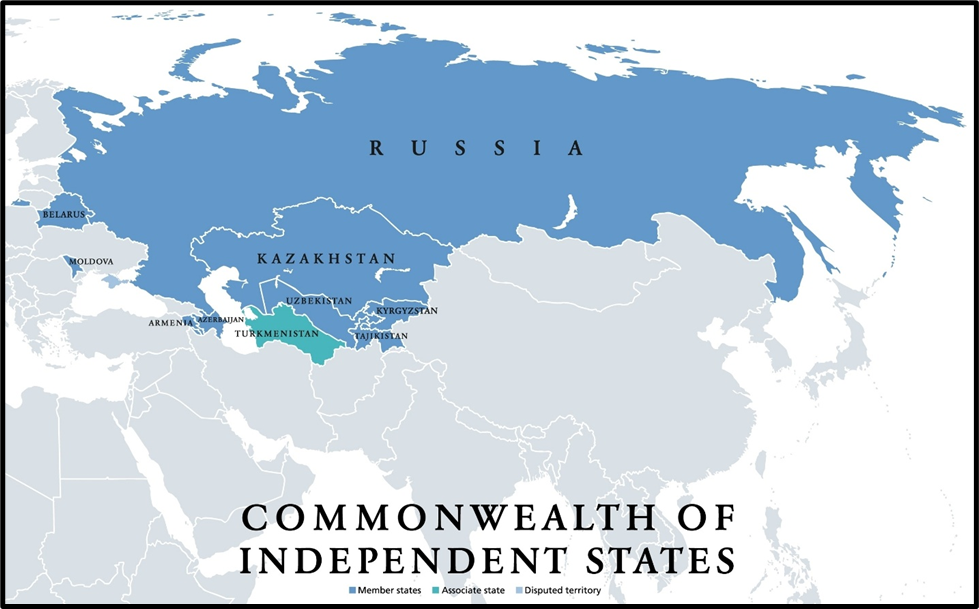
- The Birth of the CIS: On December 25, 1991, the USSR was officially replaced by the Commonwealth of Independent States (CIS). Gorbachev resigned, and the Soviet flag was lowered from the Kremlin for the last time.
Analytical Assessment: Mikhail Gorbachev
How do we judge a man who ended the Cold War but lost his own country?
The Successes:
- Universal Freedoms: He gave Russia more freedom (speech, religion, press) than it had ever known in its long history.
- Global Peace: He ended the nuclear arms race and allowed Eastern Europe to become free without a single Soviet bullet being fired.
The Failures:
- Economic Mismanagement: He tried to reform the economy but ended up creating shortages and inflation.
- The Nationalities Blind Spot: He completely underestimated the power of ethnic nationalism. He thought people were “Soviet” first; he realized too late they were “Lithuanian” or “Ukrainian” first.
The Great Debate: Was Communism Reformable?
This is a favorite question for historians and political scientists. Could the USSR have survived if Gorbachev had been different?
A. The “China Model” Argument
Many argue that if Russia had followed China’s path—reforming the Economy first while keeping tight Political control—the system might have survived.
- Gorbachev’s Error: He opened the political doors (Glasnost) before fixing the kitchen (Economy). People were free to complain about being hungry, which made the government look weak.
B. The “Sawing off the Branch” Theory
As Vladimir Bukovsky noted, Gorbachev’s only tool for power was the Communist Party. By introducing democracy, he was essentially “sawing off the branch he was sitting on.” Once the Party lost its monopoly, the glue that held 15 diverse republics together dissolved.
The Legacy of 74 Years of Communism (1917–1991)
We must look at the Soviet era with “Multi-dimensional Neutrality.” It wasn’t all dark, but the light came at a heavy price.
The Positive Legacy:
- Social Mobility: It allowed millions of peasants and workers to become doctors, engineers, and scientists.
- Defeat of Fascism: The USSR played the most vital role in defeating Hitler and the Nazis in WWII.
- Stability: For a few decades (under Brezhnev), it provided a basic, guaranteed standard of living and state-funded arts and sciences.
The Negative Legacy:
- Totalitarian Scars: It left behind a rigid, over-centralized bureaucracy that hated initiative.
- Economic Ruin: The obsession with the military left the civilian economy 20 years behind the West.
- Environmental Disaster: Rapid, forced industrialization (like Chernobyl) left a scarred landscape.
Final Critical Insight
The fall of the Soviet Union teaches us a vital lesson in governance: Stability without Reform leads to Stagnation, but Reform without Control leads to Chaos.
Gorbachev tried to transition from a “Command System” to a “Democratic System” in a country that had no historical experience with democracy. He was a man of high character who fell victim to the very freedoms he created.
As we close this chapter, the question shifted from “Will Communism survive?” to “Can Boris Yeltsin’s new Russia survive the transition to Capitalism?” But that, as they say, is another story.
Summary:
- The Coup: A desperate attempt by the “Old Guard” that only accelerated the end.
- The Comparison: Russia chose political reform first (failed); China chose economic reform first (succeeded).
- The End: The USSR didn’t fall to a foreign invader; it collapsed under the weight of its own internal contradictions.
Do you think the “China Model” would have worked in a country as ethnically diverse and geographically massive as the Soviet Union?
We now enter a very dark, chaotic, and almost “filmy” chapter of modern history. If the Gorbachev era was a controlled demolition that went wrong, the Boris Yeltsin Era (1991–1999) was the “Wild West” of capitalism.
Imagine a country where, overnight, everything that was “public property” is suddenly up for grabs. Imagine a grandmother’s life savings becoming enough to buy only a loaf of bread within months. This was the reality of the Russian “Transition.” Let’s analyze this “Savage Era” of capitalism.
The Aftermath of Communism
“Shock Therapy”: The Economic Heart Attack (1992)
Boris Yeltsin inherited a bankrupt nation. To fix it, he turned to a young economist, Yegor Gaidar, and Western “Monetarist” advisors. Their solution was “Shock Therapy.”
The Logic:
The idea was to kill the “Command Economy” instantly. On January 1, 1992, 90% of price controls were removed. The theory was: prices would rise, then stabilize, and the market would find its balance in six months.
The Reality:
- Hyperinflation: Prices didn’t just rise; they exploded—30 times higher in one year.
- The Wipeout of the Middle Class: People who had worked 40 years for their pensions found their savings were now worthless.
- “Dermocracy”: The word for democracy in Russian is Demokratiya. Because of the misery, Russians began calling it Dermokratiya (Dermo meaning “sh*t”). For the common man, “Democracy” became synonymous with “Poverty and Chaos.”
The Rise of the “Oligarchs”: The Great Theft
How did a few men become billionaires while the nation starved? This happened through the Voucher Privatization scheme.
- The Voucher: Every citizen was given a voucher worth 10,000 roubles (their “share” of the USSR’s wealth).
- The Manipulation: Because people were hungry, they sold these vouchers to “managers” and “financiers” for a bottle of vodka or a little cash.
- The Result: By 1995, a small clique of “Robber Barons”—the Oligarchs—owned 80% of Russia’s wealth. They didn’t build new factories; they just stripped the assets and moved the money to Swiss bank accounts. This was “Deformed Capitalism.”
The 1993 Constitutional Crisis: “Civil War” in Moscow
Russia had no experience with democracy. The President (Yeltsin) and the Parliament (The Supreme Soviet) were at each other’s throats.
- The Conflict: Parliament tried to impeach Yeltsin; Yeltsin tried to dissolve Parliament.
- The Storming of the “White House”: In October 1993, hardline deputies barricaded themselves in the Parliament building. Yeltsin did the unthinkable: he ordered tanks to fire on his own Parliament.
- Consequence: Yeltsin won, but the image of tanks firing on the “cradle of democracy” left a permanent scar. He pushed through a new Constitution that gave the President massive powers—powers that would later be used by his successors.
The First Chechen War (1994–1996): A Superpower Humiliated
Chechnya, a tiny Muslim republic in the Caucasus, declared independence. Stalin had brutally deported the Chechens in 1944; they had a long memory of Russian cruelty.
- Yeltsin’s Blunder: He thought a “quick little war” would boost his popularity.
- The Reality: The Russian army, once the terror of the world, was now underfunded and demoralized. The Chechen rebels fought a brilliant guerrilla war in the ruins of their capital, Grozny.
- The Humiliation: Russia lost 20,000 men and was forced to sign a ceasefire in 1996. It was a sign that the Russian state was failing even in its basic duty: military defense.
The 1996 Election: The “Lesser of Two Evils”
By 1996, Yeltsin’s approval rating was 3%. He was sick, alcoholic, and hated. Yet, he won the election. How?
- The Opponent: The Communist Party leader, Zyuganov.
- The Fear Factor: Yeltsin’s team used the media (owned by the Oligarchs) to remind people of Stalin’s purges. They told the public: “Yeltsin is a drunk, but the Communists will bring back the GULAGs.”
- The Result: Russians “gritted their teeth” and voted for Yeltsin. It wasn’t a vote for Yeltsin; it was a vote against a return to the 1930s.
Critical Analysis: Historiographical Perspective
When we look back at the early 1990s, we see a “Clash of Realities.”
- The Western Perspective: They saw Yeltsin as a hero who destroyed Communism. They ignored the poverty because “Freedom” was supposedly more important.
- The Russian Perspective: They saw a leader who allowed the “Mafia” to take over the country and allowed the West to treat Russia like a “defeated colony.”
Interlinkage: The chaos of the Yeltsin era—the hunger, the crime, the humiliation in Chechnya, and the rise of the Oligarchs—created a massive psychological hunger in the Russian people for “Order” (Poryadok).
This is the most important link: Without the “Chaos” of Yeltsin, you cannot understand the “Rise” of Vladimir Putin. The people were tired of “freedom” that felt like “starvation”; they were ready for a “strongman” who would bring back bread and pride.
Key Terms to Remember:
- Shock Therapy: Sudden shift to market economy.
- Oligarchs: Powerful billionaires who influenced politics.
- Duma: The lower house of the Russian parliament.
- Grozny: The capital of Chechnya, destroyed during the war.
We will see how this hunger for order led to the “Putin Era” shortly!
How do you view Yeltsin’s decision to shell his own Parliament? Was it a “necessary evil” to prevent a Communist comeback, or was it the moment Russian democracy died at birth?
We have now reached a very critical juncture in modern Russian history. If the previous era was about the “Agony of Democracy,” the upcoming era is about the “Restoration of the State.”
To understand Vladimir Putin, you must first understand the absolute despair of the late Yeltsin years. People didn’t just want a leader; they wanted a “Poryadok”—a sense of order. Let’s analyze how a relatively unknown security officer became the architect of 21st-century Russia.
The Sunset of Yeltsin and the 1998 Catastrophe
By 1996, Yeltsin had won a second term, but he was a broken man—physically ill and politically isolated.
A. The 1998 Financial Meltdown
Just when it seemed the economy might stabilize, a “perfect storm” hit:
- The Asian Financial Crisis: Markets in Thailand and South Korea crashed, making investors terrified of “emerging markets” like Russia.
- The Oil Crash: Oil prices plummeted. Since Russia’s budget relied almost entirely on energy exports, the government went bankrupt.
- The Result: The Rouble was devalued, and millions of Russians saw their life savings vanish for the second time in a decade.
B. The Primakov “Threat”
In desperation, Yeltsin appointed Evgeny Primakov as Prime Minister. Primakov was honest and competent. He stabilized the economy and started fighting corruption.
- The Paradox: Primakov became too popular (70% approval). The corrupt “Family” around Yeltsin feared that if Primakov became President, they would all go to jail. Consequently, Yeltsin sacked him in 1999, plunging his own popularity to a record low of 2%.
The Rise of Vladimir Putin: From Shadow to Center Stage
In August 1999, Yeltsin appointed Vladimir Putin—then head of the FSB (formerly KGB)—as Prime Minister. To the world, he was a “grey nobody.” But two events changed everything:
A. The 1999 Apartment Bombings
Terrorist bombs blew up residential buildings in Moscow, killing over 200 people in their sleep. The nation was paralyzed by fear.
- The Response: Putin, unlike the bumbling Yeltsin, spoke with a cold, ruthless determination. He promised to “wipe out the terrorists in the outhouse.” He launched the Second Chechen War.
- The Political Result: The war turned Putin into a national hero overnight. He appeared as the “Protector” the people had been praying for.
B. The Masterful Transition
On December 31, 1999, Yeltsin resigned suddenly. As per the constitution, Putin became Acting President. This gave him the “incumbency advantage” for the March 2000 elections, which he won easily.
Putin’s First Term (2000–2004): The “Dictatorship of Law”
Putin’s mission was simple: Vertical of Power (Vertikal Vlasti). He wanted to reclaim the power that had been stolen by the Oligarchs and regional governors.
A. Taming the Oligarchs
Putin famously told the billionaires: “You can keep your money, but stay out of my politics.” Those who refused were destroyed:
- Gusinsky & Berezovsky: Their TV channels were seized by the state, and they were forced into exile.
- Mikhail Khodorkovsky: The richest man in Russia was arrested in 2003 and jailed. This sent a chilling message to the elite: The State is back.
B. The “Luck” of the Economy
Putin was also extremely lucky. During his first term, world oil prices began a massive, decade-long climb.
- The Surplus: For the first time, Russia had a budget surplus. Wages were paid on time, and pensions were increased. For the average Russian, Putin equaled Bread and Stability.
C. The Authoritarian Drift
While the economy flourished, democracy began to shrink:
- Media Control: By taking over TV stations, the Kremlin ensured that only “positive” news reached the masses.
- The Security State: Putin trebled the budget for the secret police (FSB) and filled government posts with Siloviki (people from security backgrounds).
Crises and “Controlled Democracy”
Putin’s first term wasn’t without tragedy. The sinking of the Kursk Submarine (2000) and the Moscow Theatre Hostage Crisis (2002) showed the ruthless side of his administration. In the theatre crisis, the use of toxic gas killed 129 hostages, leading to heavy criticism.
However, Putin cleverly used these crises to argue that Russia needed a “stronger” state, not a “more liberal” one.
The 2004 Landslide:
By the 2004 election, Putin had created “Managed Democracy.”
- He founded the Rodina party just to steal votes from the Communists.
- He controlled the media so effectively that his rivals had no platform.
- He won 71% of the vote. International observers began to worry that the “democratic experiment” in Russia was being replaced by a new kind of “Enlightened Autocracy.”
Critical Analysis: The Trade-off
Historians often debate the “Putin Bargain.”
- The Bargain: The Russian people gave up their Political Freedoms (free press, protest, competitive elections) in exchange for Economic Stability (pensions, order, national pride).
- Historiographical Perspective: Critics see this as the death of democracy. Supporters, however, argue that Western-style democracy in the 90s brought only hunger and crime, and Putin was simply “saving” Russia from total collapse.
Interlinkage: Putin’s first term was about domestic consolidation. Having secured the “Home Front” and tamed the Oligarchs, he was now ready to turn his gaze toward the “Near Abroad” and challenge the Western-led global order.
Key Concept to Remember:
- Managed Democracy: A system where the outward forms of democracy (elections, parliament) exist, but the outcome is predetermined by the state.
Follow-up Question for Thought:
If you were a Russian citizen in 2000, having seen your life savings disappear twice in ten years, would you have prioritized “Free Speech” or “Financial Stability”?
We are now entering the final, most contemporary phase of our analysis: the consolidation of power under Vladimir Putin and the brief period of “Tandemocracy” with Dmitri Medvedev.
If the first Putin term was about “restoring order,” the second term and the transition were about “projecting power” and defining a unique Russian path that often baffled the West.
The Security State and the “Price of Order” (2004–2008)
By 2004, Putin had stabilized the economy, but the “ghost” of Chechnya still haunted Russia.
The Beslan Tragedy (2004)
The siege of a school in Beslan was a trauma that changed the Russian psyche. Over 300 died, including 186 children.
- The State’s Response: Instead of liberalizing, Putin used this as a catalyst to strengthen the FSB and centralize power further. He introduced tougher anti-terror laws and even authorized overseas assassinations.
- Critical Analysis: Critics like Alexander Litvinenko and journalist Anna Politskovskaya argued that the state was becoming a “Mafia State” or a “Police State.” Both were eventually murdered—Litvinenko by radioactive Polonium in London. These events signaled to the world that the Kremlin would not tolerate dissent, even beyond its borders.
The Petro-State: Wealth without Reform
While the political atmosphere grew colder, the economy was “burning hot” due to rising oil prices.
- The Boom: Oil went from $28/barrel in 2000 to over $60 by 2006. Russia became the world’s gas giant and second-largest oil exporter.
- The Reserve Fund vs. Social Sector: Putin made a strategic choice. Instead of pouring all the money into the crumbling education and health systems (the National Priority Projects), he built a massive $90-billion Reserve Fund.
- The Wisdom: This fund saved Russia during the 2008 global financial crisis.
- The Cost: Education and health standards remained far below Soviet-era peaks. Professors earned less than the national average. This created a “Dual Russia”—a wealthy state with a struggling social infrastructure.
The “Tandemocracy” (2008–2012)
The Russian Constitution forbade a third consecutive term. Putin, ever the master of “Legalistic Maneuvers,” found a solution: The Tandem.
A. The Seat Swap
Putin stepped down to become Prime Minister and handpicked his loyal ally, Dmitri Medvedev, to be President. Their slogan, “Together We Win,” told the people that the “Putin System” wasn’t going anywhere.
B. The South Ossetia War (2008)
Medvedev’s first major test was the war with Georgia. Russia’s swift military victory reasserted its dominance in the “Near Abroad” (former Soviet territories). It sent a clear message to NATO: The Caucasus is Russia’s backyard.
C. The Limits of “Modernization”
Medvedev talked about “diversification” (reducing dependence on oil) and “fighting corruption.” However, by 2011, he admitted that corruption remained an “unconquered monster.” The system was too rigid for the kind of “softening” Medvedev hinted at.
The “Great Return” and Managed Democracy (2011–2012)
In September 2011, the “Tandem” dropped the act. Medvedev announced he wouldn’t run again and proposed Putin for the Presidency.
- The Backlash: This “musical chairs” style of politics led to the “Dissenters’ Marches” in Moscow. For the first time, the urban middle class protested against “Electoral Fraud.”
- The Result: Despite a dip in popularity (the United Russia party fell below 50% in the Duma), Putin won the 2012 Presidential election with 63% of the vote.
Putin’s Iron Grip and the Annexation of Crimea (2012–2021)
Putin’s return in 2012 ended any pretence of liberalisation. Around 50 anti-democratic laws were adopted between 2012 and 2018, targeting NGOs, the press, and political activists.
In 2014, he annexed Crimea from Ukraine and backed separatists in the Donbas, triggering Western sanctions and beginning a slow-burning conflict.
In 2020, a constitutional amendment reset his previous terms, allowing him to remain in power potentially until 2036. Opponents were poisoned, jailed, or exiled. The system had become personal, permanent, and total.
The Ukraine War and Its Fallout (2022–2025)
In February 2022, Russia launched a full-scale invasion of Ukraine — the biggest conflict in Europe since World War II — resulting in a refugee crisis and hundreds of thousands of deaths. The expected swift victory never came.
Sanctions battered the economy, the ICC issued an arrest warrant for Putin, and in 2023 mercenary chief Prigozhin launched a brief mutiny before dying in a suspicious plane crash. Navalny died in prison in February 2024, leaving the opposition movement effectively destroyed.
Putin won the 2024 election with 87% of the vote, his highest ever, with no credible opposition remaining.
By 2025, peace talks brokered by Trump produced no ceasefire. Russia is now economically dependent on China, demographically weakened, and more isolated than at any point since the Soviet collapse — the ultimate irony for a leader who built his entire legacy on restoring Russian greatness.