
Morphology of Animals
Morphology is the study of the form, structure, and appearance of organisms, including both:
- External features → shape, size, colour, segmentation
- Internal structures → organs, systems, arrangement
Think of morphology as answering the question:
👉 “How is the body of an organism designed, and why?”
To understand evolutionary diversity, we study three representative animals:
- Earthworm → simple invertebrate
- Cockroach → advanced invertebrate (arthropod)
- Frog → vertebrate (higher organization)
🪱 Earthworm
Earthworms represent a segmented body plan with efficient adaptation to soil life.
Habitat & General Features
- Found in moist topsoil
- Reddish-brown in colour
- Move by burrowing and feeding on soil
- Their waste is called worm castings (improves soil fertility)
👉 Common species: Pheretima and Lumbricus
Body Structure
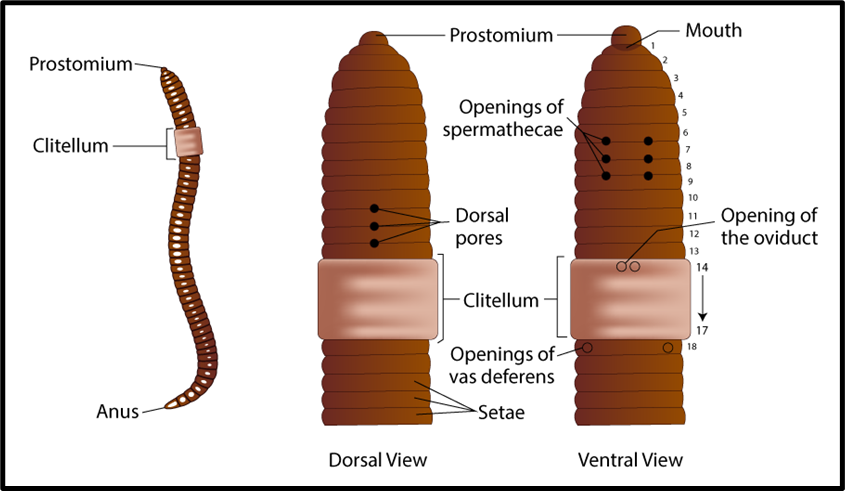
Earthworms have a long cylindrical body divided into more than 100 segments (metameres).
Key Structural Features:
| Structure | Description | Function / Significance |
| Prostomium | Sensory lobe present at the anterior (front) end | Helps in movement and environmental sensing |
| Peristomium | First body segment surrounding the mouth | Contains the mouth and aids in feeding |
| Clitellum | Thick, glandular band in mature worms | Divides body into preclitellar, clitellar, and postclitellar regions; important in reproduction (cocoon formation) |
| Setae | Minute bristle-like structures present in each segment | Facilitate locomotion by anchoring the body to soil |
| Nephridiopores | Numerous tiny pores distributed over the body surface | Help in excretion by eliminating metabolic wastes |
| Dorsal Blood Vessel | Longitudinal blood vessel running along the dorsal (upper) side | Responsible for circulation of blood along the body |
Reproductive Nature
- Earthworms are hermaphrodites
→ Each individual has both male and female reproductive organs
👉 Evolutionary significance: Ensures reproduction even in isolated conditions.
🪳 Cockroach
Cockroaches show a higher level of organization among invertebrates.
General Characteristics
- Colour: Brown or black
- Habit: Nocturnal omnivores
- Thrive in damp environments
- Act as disease vectors
👉 Common species: Periplaneta americana
Body Organization
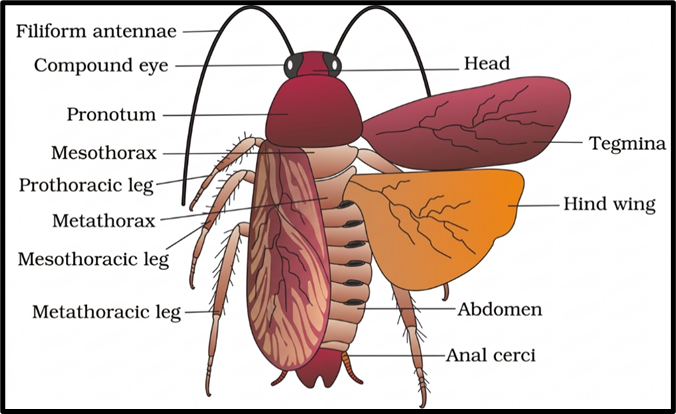
The body is divided into three regions:
| Region | Function |
| Head | Sensory & feeding |
| Thorax | Locomotion |
| Abdomen | Reproduction |
Exoskeleton
- Made of chitin
- Composed of hardened plates called sclerites
- Connected by flexible membranes → allows movement
👉 Important concept: Exoskeleton provides protection + support
Head Features
- Triangular and highly mobile
- Formed by 6 fused segments
- Contains:
- Compound eyes → wide vision
- Antennae → sensing environment
Thorax Structure
Divided into → Prothorax, Mesothorax, Metathorax
Each segment has → One pair of walking legs
Wings:
- Forewings (mesothorax) → leathery, protective
- Hind wings (metathorax) → transparent, used for flight
Abdomen & Sexual Differences
In Females:
- Boat-shaped sternum
- Forms a pouch for reproductive organs
In Males:
- Genital pouch contains → Anus, Genital pore and Reproductive structures
- Presence of anal styles (absent in females)
👉 Both sexes have anal cerci (sensory appendages)
🐸 Frog
Frogs represent a major evolutionary step—vertebrates with amphibious life.
General Characteristics
- Class: Amphibia
- Nature: Poikilotherm (cold-blooded)
→ Body temperature varies with environment
👉 Example: Rana tigrina
Adaptations for Survival
Skin:
- Smooth and moist due to mucus
- Helps in → Respiration, Water absorption
👉 Frogs do not drink water—they absorb it through skin
Behavioural Adaptations:
- Aestivation → summer sleep
- Hibernation → winter sleep
👉 Helps survive extreme conditions
Camouflage:
- Ability to change colour
- Protects from predators (mimicry)
Body Structure
Unlike many animals:
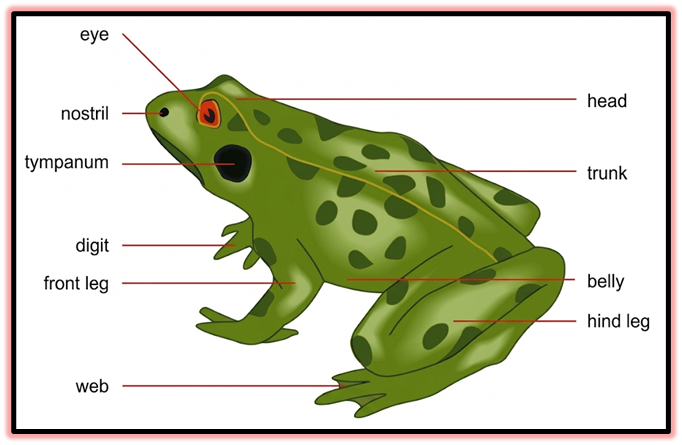
- Body divided into → Head and Trunk
- No neck and no tail (in adults)
Sensory Organs
- Nostrils → above mouth
- Bulging eyes → protected by Nictitating membrane
- Tympanum (ear) → detects sound
Limbs & Movement
| Limb Type | Features | Function |
| Forelimbs | 4 digits | Support & walking |
| Hind limbs | 5 webbed digits | Jumping & swimming |
👉 Hind limbs are long and muscular → powerful leaps
Sexual Dimorphism
Difference between males and females:
| Feature | Male | Female |
| Vocal sacs | Present | Absent |
| Copulatory pad | Present (forelimb) | Absent |
👉 Vocal sacs help males produce sound during mating