Coordination in Plants
Unlike animals, plants do not have a nervous system or muscles. So the obvious question is: How do they respond to their environment?
The answer lies in chemical and physical coordination mechanisms. Plants sense stimuli like light, gravity, touch, water, and chemicals—and respond in a highly organized way.
Broadly, plant responses are of two types:
- Immediate responses (without growth)
- Growth-based responses (tropisms)
⚡ Immediate Response to Stimulus (Without Growth)
Think of this as a quick reaction system—similar to reflexes in animals, but without nerves.
A classic example is the touch-sensitive plant, Mimosa pudica.
- When touched, its leaves fold instantly.
- This is NOT due to growth, but due to changes in water content (turgor pressure) in specialized cells.
- These cells either swell or shrink, leading to movement.
- The signal travels via electro-chemical signals inside the plant.
👉 Key Insight:
Even without a nervous system, plants use electrical signaling + water movement to produce rapid responses.
🌿 Movement Due to Growth (Tropism)
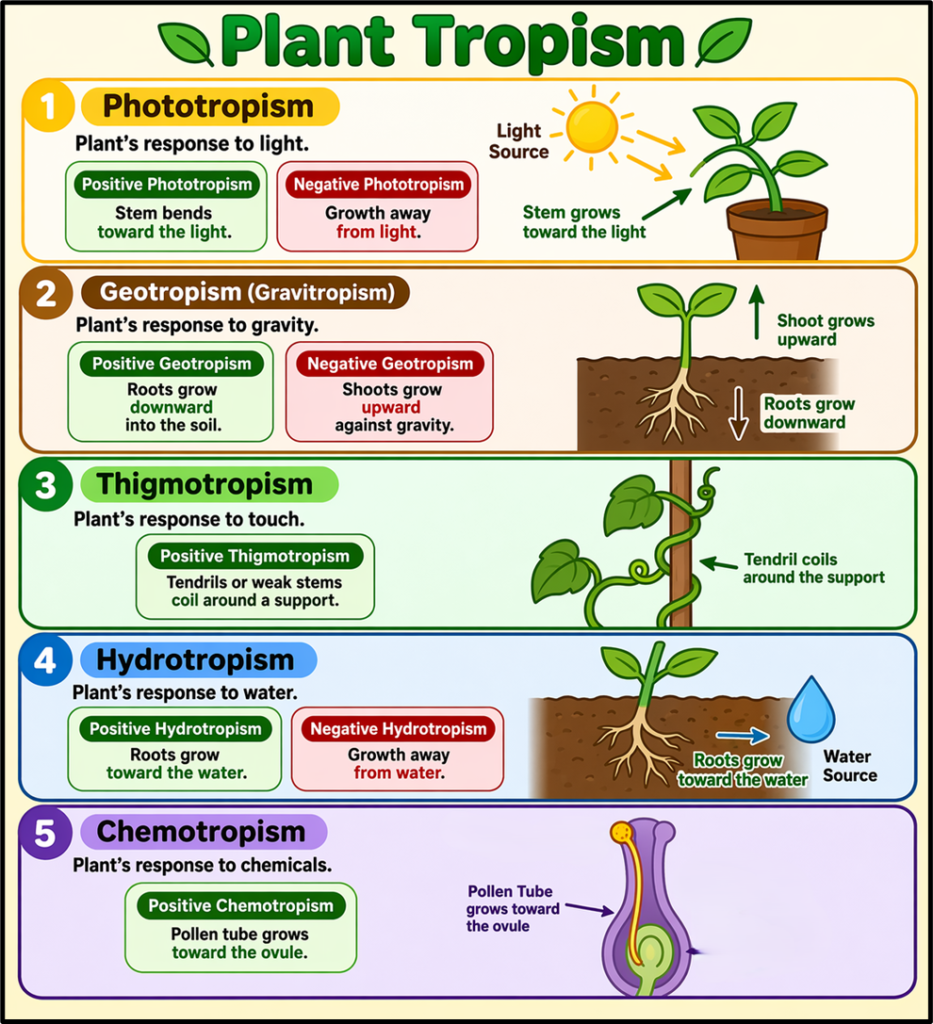
Now comes a deeper, slower, and more strategic type of response—Tropism.
👉 Tropism = Directional growth of a plant in response to a stimulus.
This is not instant. It involves cell growth and elongation, so it takes time but leads to permanent changes.
Types of Tropism
☀️ Phototropism (Response to Light)
- Shoots grow towards light (positive phototropism).
- Roots may grow away from light.
- Controlled by redistribution of Auxins.
👉 Why important?
To maximize photosynthesis.
🌍 Geotropism (Response to Gravity)
- Roots grow downward → Positive geotropism
- Shoots grow upward → Negative geotropism
👉 Ensures proper anchorage and access to nutrients.
💧 Hydrotropism (Response to Water)
- Roots grow towards areas with higher water concentration.
👉 Critical for survival, especially in dry conditions.
🧪 Chemotropism (Response to Chemicals)
- Growth in response to chemicals.
- Example: Pollen tube growing towards the ovule during fertilization.
🤝 Thigmotropism (Response to Touch)
- Seen in climbing plants and tendrils.
- When they touch a support, they coil around it.
👉 Helps plants grow vertically and access sunlight efficiently.
🌼 Plant Hormones: The Real Controllers
Now, the big question—who controls all these responses?
Answer: Plant Hormones (Phytohormones)
They are chemical messengers that regulate growth, development, and responses.
🌿 Major Plant Hormones
| Hormone | Key Function |
| Auxins | Promote cell elongation, control phototropism, help in root development |
| Gibberellins | Stimulate stem elongation, seed germination, fruit growth |
| Cytokinins | Promote cell division, delay ageing (anti-senescence) |
| Abscisic Acid (ABA) | Growth inhibitor, induces seed dormancy, causes leaf fall (senescence) |