Evolution
If heredity explains how traits are passed down through generations, evolution explains how these traits change over millions of years, giving rise to entirely new species.
Evolution is simply: the change in heritable characteristics of biological populations over successive generations.
💡 Evolution is not about an individual organism changing during its lifetime. It is about POPULATIONS changing across GENERATIONS through differential reproduction. A single giraffe’s neck doesn’t grow longer — but over millions of years, giraffes with longer necks survived better and reproduced more, gradually shifting the entire population towards longer necks.
Theories of Origin of Life
1. Panspermia
This hypothesis proposes that life originated elsewhere in outer space and reached Earth via comets, asteroids, or meteorites. While intriguing, this doesn’t explain the ultimate origin of life — just relocates the question to another planet.
2. Spontaneous Generation (Abiogenesis — now disproven)
The ancient belief that living organisms could spontaneously arise from non-living matter (e.g., maggots from decaying meat, mice from grain). Louis Pasteur’s famous swan-neck flask experiments definitively refuted this idea — demonstrating that life only comes from pre-existing life (biogenesis).
Charles Darwin’s Theory of Evolution — Natural Selection
The most celebrated and well-supported theory of evolution. Darwin’s ideas were inspired by his observations during his voyage on the HMS Beagle, particularly the diverse finch populations of the Galápagos Islands — each species had evolved a different beak shape adapted to its specific food source.
His landmark book ‘On the Origin of Species’ (1859) laid out this theory comprehensively.
Six Key Components of Darwin’s Theory
- Variation: Within any population, individuals differ in their traits — size, behaviour, colour, etc.
- Overproduction: Most species produce far more offspring than can possibly survive, given limited resources.
- Struggle for Existence: Competition for limited resources (food, space, mates) means only SOME offspring survive.
- Survival of the Fittest: Individuals with traits better suited to their environment are more likely to survive and reproduce. ‘Fittest’ = BEST ADAPTED, not necessarily strongest!
- Inheritance: Advantageous traits are inherited by offspring, increasing their frequency in the next generation.
- Speciation: Over many generations, accumulated changes can make a population so different from its ancestors that it forms a new species entirely.
💡 Important distinction: Darwin believed in GRADUAL evolution. Hugo de Vries proposed that mutation (a single large genetic change) causes speciation — he called this ‘saltation.’
Evidences of Evolution
Science does not merely claim evolution happens — it provides multiple, independent lines of evidence:
- Fossils: The biological ‘history books’ preserved in rock layers. Different rock strata contain different life forms, showing how species changed over geological time. E.g., dinosaurs in Mesozoic layers, absent in recent layers.
- Comparative Anatomy — Homologous Structures: The forelimbs of whales, bats, cheetahs, and humans are structurally similar (same bones) despite having different functions (swimming, flying, running, grasping). This indicates a common ancestor — a process called divergent evolution.
- Comparative Anatomy — Analogous Structures: Bird wings and butterfly wings serve the same function (flying) but have completely different structural origins. This indicates convergent evolution — unrelated species evolving similar solutions to similar environmental challenges.
- Biochemical Evidence: Strikingly similar proteins and DNA sequences across diverse organisms point to shared ancestry. E.g., cytochrome-c protein is almost identical in humans and chimpanzees.
- Artificial Selection: Humans have selectively bred animals and plants for desired traits — creating dramatically different dog breeds from a wolf ancestor, or varied crops from wild plants. This demonstrates that selection pressure CAN shape populations over generations.
- Industrial Melanism: Pre-industrialisation England had mostly light-coloured moths on light-coloured trees. After industrialisation, soot darkened the trees, favouring darker moths (better camouflage). Light moths became easy prey for birds, and dark moths flourished. This is natural selection in action — observable within decades!
- Anthropogenic Selection: Overuse of pesticides and antibiotics has driven the rapid evolution of resistant pests and bacteria — showing evolution can happen in SHORT timeframes under strong selection pressure.
Adaptive Radiation
Adaptive Radiation is the process by which a single ancestral species rapidly diversifies into multiple species, each adapted to a different ecological niche or habitat.
- Darwin’s Finches (Galápagos Islands): All descended from one ancestral finch species, but evolved into ~15 species with different beak shapes adapted to different food sources — seeds, insects, cacti, etc.
- Australian Marsupials: From a single marsupial ancestor, numerous species evolved to fill roles occupied by placental mammals elsewhere — kangaroos (grazers), marsupial moles (burrowers), Tasmanian wolves (predators).
💡 When multiple adaptive radiations happen in similar isolated environments, it can lead to CONVERGENT EVOLUTION — unrelated species evolve similar traits due to similar environmental pressures. E.g., Placental wolf and Tasmanian wolf (marsupial) look remarkably similar but evolved independently.
Hardy-Weinberg Principle — When Evolution is NOT Happening
The Hardy-Weinberg Principle describes the conditions under which evolution does NOT occur. It states that allele and genotype frequencies in a population will remain constant from generation to generation — i.e., the population is in genetic equilibrium — if ALL of the following conditions are met:
| Assumption (Condition) | What it Means |
| No mutations | Gene pool is not altered by new mutations |
| Random mating | Individuals mate randomly — no preference for any genotype |
| No natural selection | All genotypes have equal chances of survival and reproduction |
| Large population size | Prevents genetic drift (random changes in allele frequencies due to chance) |
| No migration | No gene flow — individuals don’t move into or out of the population |
💡 Hardy-Weinberg Principle is best understood as a NULL HYPOTHESIS for evolution: if these conditions are met, evolution won’t occur. Any deviation from equilibrium = evolution is happening. Factors that CAUSE evolution include mutation, natural selection, genetic drift, gene flow, and non-random mating.
A Brief Timeline of Evolution on Earth
| Time Period | Event |
| ~2000 Million Years Ago (mya) | First cellular life forms appeared on Earth. Some early cells could produce oxygen (proto-photosynthesis). |
| ~500 mya | Invertebrates appeared and dominated. Multi-cellular life flourished. |
| ~350 mya | Jawless fish evolved — the beginning of vertebrate life. |
| ~320 mya | Plants first colonised the land. Animals followed. |
| ~300 mya | Lobefin fish (with lobe-like fins) evolved into the first amphibians — ancestors of frogs and salamanders. |
| ~200+ mya | Reptiles dominated the Earth. They evolved thick-shelled eggs suitable for dry land. |
| ~200–65 mya | Age of Dinosaurs. Largest reptiles in Earth’s history. |
| ~65 mya | Mass extinction event — dinosaurs went extinct (possibly due to asteroid impact + climate changes). |
| After 65 mya | Age of Mammals. Small, shrew-like creatures diversified into the rich mammal diversity we see today. |
| ~15 mya | Primates like Dryopithecus (ape-like) and Ramapithecus (more human-like) appeared. |
| ~3–4 mya | Australopithecines appeared in Africa — bipedal, small-brained, stone tool users. |
| ~2 mya | Homo habilis — the first ‘handy man.’ Larger brain than Australopithecines, omnivorous. |
| ~1.5 mya | Homo erectus — first hominin to migrate OUT of Africa. First to control fire. |
| ~100,000–40,000 years ago | Neanderthals in Europe and Asia. Larger brains than modern humans; sophisticated tools; cared for sick; buried dead. |
| ~200,000 years ago | Homo sapiens emerged in Africa. Migrated globally. Developed complex culture, language, art, music. |
| ~10,000 years ago | Agricultural revolution — shift from hunting-gathering to farming, leading to settled civilisations. |
Origin and Evolution of Humans
Human evolution is one of the most fascinating and well-studied chapters in the history of life. Here’s the key terminology and the evolutionary lineage:
Key Taxonomic Groups
| Term | Who It Includes | Key Trait |
| Primates | Monkeys, apes, humans | Fingerprints, grasping hands, forward-facing eyes, complex social behaviour |
| Hominoids | All apes — great apes + lesser apes (gibbons) | General group of apes |
| Hominids | Great apes + humans | Bipedal; can stand upright |
| Hominins | Modern humans + their extinct ancestors | The direct human evolutionary lineage |
- Closest living relatives of humans: Chimpanzees and Bonobos (share ~98.7% of DNA with humans).
- First Ramapithecus fossils: Discovered in the Siwalik Hills of northern India.
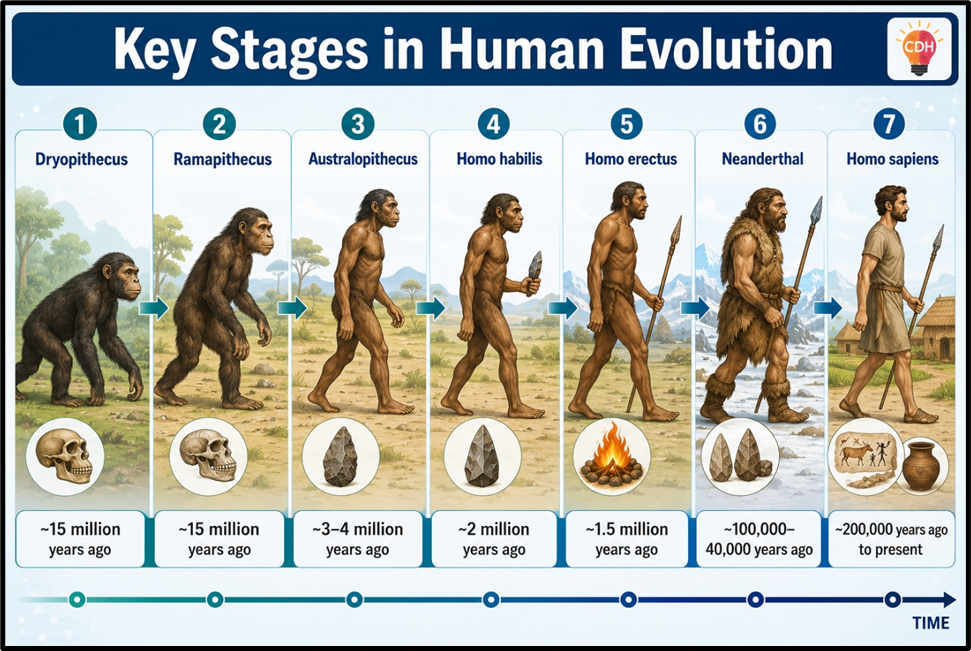
Key Stages in Human Evolution
| Species | Time Period | Key Features |
| Dryopithecus | ~15 million years ago | More ape-like; walked like gorillas/chimps. |
| Ramapithecus | ~15 million years ago | More human-like; hairy; fossils found in Siwalik Hills, India. |
| Australopithecus | ~3–4 million years ago | Bipedal; small brain; stone tools; ate fruits/vegetables (some meat). |
| Homo habilis | ~2 million years ago | First true human-like species; larger brain; omnivorous; ‘Handy Man.’ |
| Homo erectus | ~1.5 million years ago | First to migrate out of Africa; first to control FIRE; robust structure. |
| Neanderthal | ~100,000–40,000 years ago | Larger brain than Homo sapiens; cold-climate adapted; complex tools; buried dead; coexisted with Homo sapiens. |
| Homo sapiens | ~200,000 years ago to present | Emerged in Africa; migrated globally; developed language, art, culture; agricultural revolution ~10,000 years ago. |