
Gravitation and Planetary Motion
Have you ever wondered why the Moon keeps going around the Earth, or why an apple always falls down and never sideways? The answer, as Isaac Newton famously realised, lies in a single invisible thread that holds the universe together — Gravitation.
Let us understand this force, the way nature herself has stitched it into every corner of the cosmos.
Newton’s Law of Universal Gravitation
Gravitation is the non-contact force by which all objects with mass attract one another. It is one of the four fundamental forces of nature — the others being the electromagnetic force, the strong nuclear force, and the weak nuclear force.
Among all four, gravitation is the weakest, yet it is gravitation alone that governs the large-scale structure and dynamics of the entire universe. Tiny in the laboratory, but titanic at the cosmic scale — that is the paradox of gravity!
Think of it this way: You, this document, the Earth, the Moon, and the most distant galaxy in the observable universe — every one of you is gravitationally ‘chatting’ with every other object. The conversation becomes very faint over great distances, but it never truly stops.
Isaac Newton formally stated this relationship in his Law of Universal Gravitation:
“Every particle in the universe attracts every other particle with a force that is directly proportional to the product of their masses and inversely proportional to the square of the distance between their centres.”
The Mathematical Expression
Mathematically, the gravitational force F between two objects is given by:
F = G × (m₁ × m₂) / r²
| Symbol | Quantity | Value / Unit |
| F | Gravitational force between the two objects | Newton (N) |
| G | Universal Gravitational Constant | 6.674 × 10⁻¹¹ N·m²/kg² |
| m₁, m₂ | Masses of the two objects | Kilogram (kg) |
| r | Distance between the centres of the objects | Metre (m) |
Key insight: G is a universal constant — the same everywhere in the universe. But ‘g’ (small g), the acceleration due to gravity, changes from place to place on Earth. Never confuse the two!
Characteristics of Gravitational Force
Now that we know the formula, let us examine the personality traits of gravitational force. Understanding these characteristics helps you answer MCQs and analytical questions quickly.
1. Universal Force: Gravitational force acts between any two objects with mass, regardless of their size, composition, or distance. It is omnipresent — found everywhere in the universe.
2. Always Attractive: Unlike electric or magnetic forces (which can attract or repel), gravity is exclusively attractive. It always pulls objects towards each other — it never pushes.
3. Mutual Force: According to Newton’s Third Law, the force exerted by object A on object B is equal in magnitude and opposite in direction to the force exerted by B on A. Both experience equal gravitational pull.
4. Directly Proportional to Mass: F ∝ m₁ × m₂. The heavier the objects, the stronger the gravitational pull. This is why the Sun, being enormously massive, holds all the planets in its grip.
5. Inversely Proportional to Square of Distance: F ∝ 1/r². As distance doubles, gravity becomes four times weaker. This is called the Inverse Square Law and it also applies to light, sound intensity, and electric force.
6. Acts Over Infinite Distances: Technically, gravity extends infinitely. However, as distance grows, the force becomes negligibly small — but never exactly zero.
7. Weakest Fundamental Force: Compared to the strong nuclear force (which holds atomic nuclei together) and the electromagnetic force (which holds electrons to nuclei), gravity is enormously weaker. Yet it rules the cosmos because it is the only force that acts at astronomical distances.
8. Independent of Medium: Gravity needs no medium to propagate. It works perfectly well through a vacuum — this is why the Earth and Moon attract each other across empty space.
9. Responsible for Celestial Phenomena: The evolution, structure, and motion of all celestial bodies — stars, galaxies, black holes, tides — are governed by gravitation.
Gravity of the Earth
When we talk specifically about the gravitational force exerted by the Earth on objects near its surface, we call it ‘gravity’ or Earth’s gravity. It is this force that keeps us rooted to the ground, that shapes rain into falling drops, and that gives weight to every object we can hold. Gravity is basically gravitation’s local avatar — the result of the Earth’s enormous mass interacting with everything around it.
Acceleration due to Gravity (g)
When you drop a stone, it does not fall at a constant speed — it keeps speeding up as it falls. This constant rate of speeding up is called the acceleration due to gravity, denoted by ‘g’.
Near the Earth’s surface, g ≈ 9.8 m/s². This means every second, the falling object gains 9.8 m/s of speed due to gravity alone.
| Characteristic | Detail |
| Direction | Always vertically downward, towards the Earth’s centre |
| Value (surface) | ≈ 9.8 m/s² |
| Same for all objects? | Yes — in the absence of air resistance, a feather and a stone fall with the same g (Galileo’s insight) |
| Location-dependent? | Yes — g varies with altitude, latitude, and depth |
Factors Affecting the Value of ‘g’
Remember: g is not a fixed value everywhere on Earth. Here is what changes it:
1. Altitude: As you go higher above the Earth’s surface, you are moving farther from the Earth’s centre, so g decreases. Mountaineers weigh slightly less at high altitudes! Mathematically, g decreases as 1/r², following the inverse square law.
2. Latitude: The Earth is not a perfect sphere — it bulges at the equator and is flattened at the poles. So the equator is farther from the Earth’s centre than the poles.
Additionally, the Earth’s rotation creates a centrifugal effect that further reduces the apparent gravity at the equator.
Result: g is greatest at the poles and least at the equator.
3. Earth’s Mass Distribution (Local Variations): Dense materials like rocks in mountain ranges exert more gravitational pull than less-dense ocean water. This creates local anomalies in g.
4. Depth: As you go deeper inside the Earth, the mass of Earth ‘above’ you counteracts the pull, and the effective mass pulling you down decreases. So g also decreases with depth. At the Earth’s exact centre, g would be zero!
Quick memory trick: Altitude ↑ → g ↓ | Depth ↑ → g ↓ | Latitude ↑ (towards poles) → g ↑ | At poles: g is maximum | At equator: g is minimum.
Effects of Gravity on the Earth
1. Keeps us grounded: Without gravity, we would float off into space.
2. Falling of objects: All objects are pulled towards the Earth.
3. Tides: The gravitational pull of the Moon and, to a lesser extent, the Sun causes oceanic tides. This is why tides are higher during Full Moon and New Moon (when the Sun, Earth, and Moon are aligned).
4. Formation of atmosphere: Earth’s gravity holds the atmospheric gases close to the planet. Without it, our atmosphere — and life itself — would drift away into space.
5. Earth’s shape: Gravity shaped the Earth into a nearly spherical form (technically an oblate spheroid, squished slightly at the poles).
6. Plate tectonics: Gravitational forces play a role in driving the movement of tectonic plates.
7. Orbital motion: Gravity keeps the Moon, artificial satellites, and the International Space Station (ISS) in orbit around the Earth.
8. Weather patterns: Atmospheric air masses move under the combined influence of gravity and other forces, giving rise to weather systems.
Mass and Weight
One of the most common conceptual confusions — in everyday life and in exams 😊 — is between Mass and Weight. They are related, but fundamentally different. Let us clear this up once and for all.
Mass
Mass is the measure of the amount of matter in an object. It is a scalar quantity (has magnitude only, no direction).
The SI unit of mass is kilogram (kg).
Mass is intrinsic — it does not change no matter where you are. Your mass is the same on Earth, on the Moon, on Mars, or floating in deep space.
Mass also determines inertia: the heavier (more massive) an object, the harder it is to start or stop its motion.
Inertial Mass vs. Gravitational Mass: Inertial mass measures resistance to acceleration. Gravitational mass measures how strongly an object interacts with a gravitational field. Remarkably, these two are numerically equal — a profound fact that Einstein built his General Theory of Relativity upon (the Equivalence Principle).
Weight
Weight is the force exerted on an object due to gravity. Since it is a force, it is a vector quantity (has both magnitude and direction — always directed towards the centre of the gravitating body). The SI unit of weight is Newton (N). The formula is simple:
Weight (W) = Mass (m) × Acceleration due to gravity (g)
Since ‘g’ varies with location, your weight changes depending on where you are. On the Moon (where g ≈ 1.63 m/s², about 1/6th of Earth’s), you would weigh roughly one-sixth of your Earth weight — but your mass remains exactly the same!
| Feature | Mass | Weight |
| Definition | Amount of matter in an object | Force due to gravity on the object |
| Nature | Scalar quantity | Vector quantity (has direction) |
| SI Unit | Kilogram (kg) | Newton (N) |
| Role of Gravity | Independent of gravity | Directly depends on ‘g’ |
| Variation | Constant everywhere in universe | Changes with location (Earth, Moon, space, etc.) |
| Zero possible? | Mass can never be zero for matter | Weight can be zero (in zero-gravity conditions) |
Weightlessness (Zero Gravity)
Weightlessness is a condition where a person or object experiences no apparent weight, even though gravity is still acting on them. The key word is ‘apparent’ — the normal force (the support force that creates the sensation of weight) simply disappears.
This happens in three scenarios:
- Free fall on Earth: If you are inside an elevator whose cable snaps, you and the elevator fall together at the same acceleration ‘g’. There is no normal force — you feel weightless.
- Astronauts in space: The ISS and its crew are in continuous free fall around the Earth. They are not ‘beyond gravity’ — they are simply falling sideways fast enough to keep missing the Earth. This is called orbital free fall.
- Artificial environment: Specially designed aircraft (sometimes called ‘vomit comets’) fly in parabolic arcs that simulate weightlessness for brief periods — used for astronaut training.
Kepler’s Laws of Planetary Motion
Before Newton derived his law of gravitation, Johannes Kepler, the German astronomer, had already painstakingly described how planets move — purely from astronomical observations, without understanding the underlying force.
Kepler gave us three laws, and Newton later showed that all three are natural consequences of his Law of Universal Gravitation. This is a beautiful story of empirical observation meeting theoretical explanation!
Kepler’s First Law — Law of Ellipses (Law of Orbits)
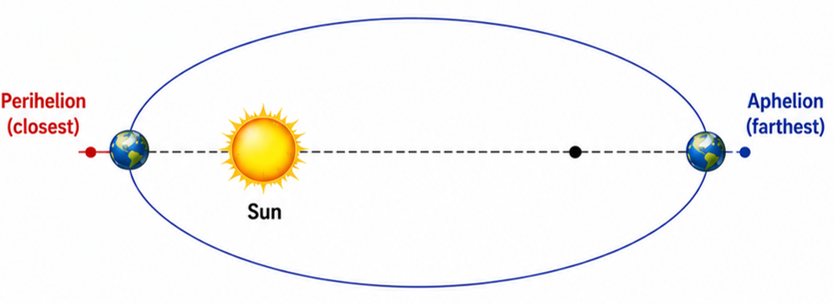
“The orbit of a planet around the Sun is an ellipse, with the Sun located at one of the two foci.”
This means planets do not move in perfect circles — they move in ellipses. The Sun sits at one focus of the ellipse, not at the centre. The other focus is an empty point in space.
As a result, the distance between a planet and the Sun changes continuously as the planet travels in its orbit.
- Perihelion: The point in the orbit where the planet is closest to the Sun.
- Aphelion: The point in the orbit where the planet is farthest from the Sun.
- Earth is at perihelion around January 3 and at aphelion around July 4 — so we are actually closest to the Sun in the middle of the Northern Hemisphere’s winter!’
Kepler’s Second Law — Law of Equal Areas
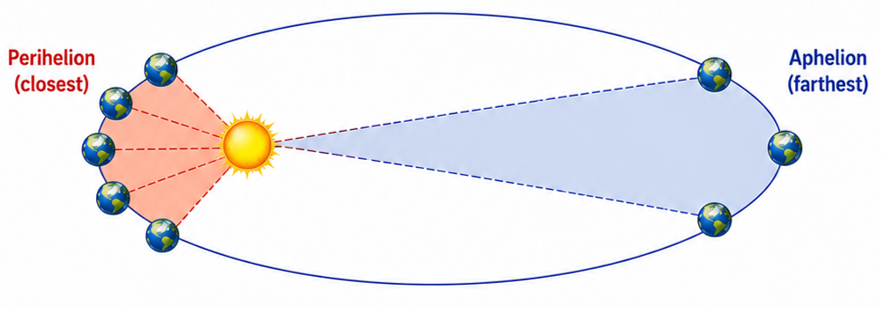
“A line segment joining a planet and the Sun sweeps out equal areas in equal intervals of time.”
This law tells us that a planet does not move at a constant speed along its orbit. When it is closer to the Sun (at perihelion), it moves faster; when it is farther away (at aphelion), it moves slower. This is a consequence of the conservation of angular momentum.
Think of a spinning ice skater pulling in their arms — they speed up. Similarly, a planet ‘pulls in’ towards the Sun and speeds up.
Implication: This is why Earth moves fastest around January (perihelion) and slowest around July (aphelion). The orbital speed of a planet is NOT constant — it depends on its distance from the Sun.
Kepler’s Third Law — Law of Harmonies (Law of Periods)
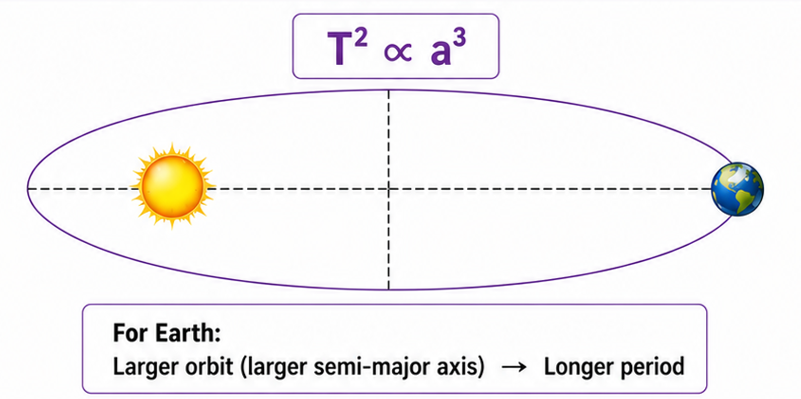
“The square of the orbital period of a planet is proportional to the cube of the semi-major axis of its orbit.”
Mathematically: T² ∝ a³, where T = orbital period and a = semi-major axis of the ellipse.
Simply put: planets farther from the Sun take longer to complete one orbit. Mercury (closest) completes its orbit in just 88 Earth-days, while Neptune (farthest) takes about 165 Earth-years!
| Kepler’s Law | Statement (in brief) | Key Implication |
| 1st Law (Law of Orbits) | Orbits are ellipses, Sun at one focus | Distance between planet and Sun varies — perihelion & aphelion exist |
| 2nd Law (Law of Areas) | Equal areas swept in equal time intervals | Orbital speed is variable — faster near Sun, slower far away |
| 3rd Law (Law of Periods) | T² ∝ a³ (period squared ∝ semi-major axis cubed) | Planets farther from Sun have longer orbital periods |
Orbital Speed vs. Orbital Velocity — A Quick Distinction
- Orbital Speed: A scalar quantity showing only how fast an object moves in its orbit (magnitude only). Determined by the balance between gravitational pull and the object’s inertia.
- Orbital Velocity: A vector quantity — it includes both the magnitude (orbital speed) and the direction of motion at every point in the orbit. Since the direction keeps changing in a curved orbit, the orbital velocity is constantly changing even if speed stays the same.
2 Comments