
International & Regional Agencies & Forums
Beyond the United Nations, a dense web of plurilateral, regional and issue-based forums now shapes global order. India engages each through a consistent logic — using multilateral platforms to amplify its voice, protect strategic autonomy, advance the Global South, and hedge against a rising China. A recurring theme is India’s evolution from a rule-taker into a rule-shaper.
Global Judicial Institutions
International Criminal Court (ICC)
Established by the Rome Statute (adopted 1998, in force 1 July 2002) and seated at The Hague, the ICC is the world’s first permanent court to try individuals — not states — for genocide, war crimes, crimes against humanity and the crime of aggression.
It is a court of last resort, stepping in only when national systems are unable or unwilling to prosecute. Around 123 states are parties, though major powers remain outside.
India’s Position — Neither Signed nor Ratified
- Subordination to the UNSC — the Council can refer or defer cases, opening the door to political interference.
- Binding non-parties violates the principle (under the Vienna Convention) that a state cannot be forced into a treaty it has not accepted.
- Exclusion of terrorism and use of nuclear weapons as crimes, both proposed by India.
- Article 8 definition of war crimes covers “armed conflict not of an international character” — India fears misuse over Kashmir. India therefore remains only an observer.
International Court of Justice (ICJ)
The ICJ, successor to the Permanent Court of International Justice, was created by the UN Charter in 1945 as the UN’s principal judicial organ. Seated at The Hague with 15 judges, it settles disputes between states and gives advisory opinions. Only states — not individuals — may be parties.
India’s landmark use of the ICJ was the Kulbhushan Jadhav case (2017). After Pakistan sentenced Jadhav to death by a military court while repeatedly denying consular access, India invoked the Vienna Convention on Consular Relations (VCCR), 1963. The ICJ granted provisional measures staying the execution and later held that Pakistan had violated the VCCR, ordering effective review of the conviction.
ICC vs ICJ — At a Glance
| Aspect | ICC | ICJ |
| Established | 2002 (Rome Statute) | 1945 (UN Charter) |
| Tries | Individuals for international crimes | States in legal disputes |
| Judges | 18, elected for 9 years | 15, elected for 9 years |
| Enforcement | Relies on state cooperation (no police) | State compliance; UNSC can enforce |
| India | Not a party (observer) | UN member; used it (Jadhav case) |
The ‘G’ Groupings — Plurilateral Economic Diplomacy
G7 / G8
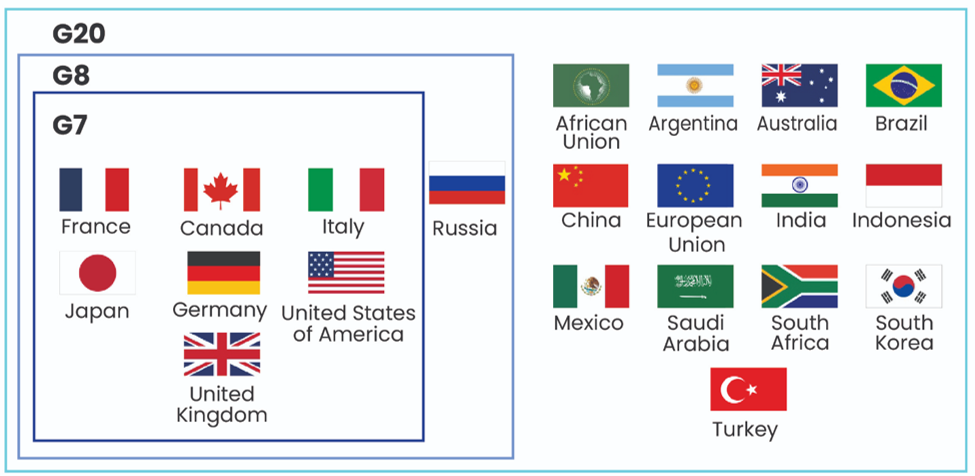
Born of the 1973 oil shock, six industrialised democracies formed the G6 (1975); Canada joined to make the G7 (1976), and Russia’s entry created the G8 (1998). After Russia’s annexation of Crimea (2014) it was suspended, reverting to the G7.
It has no charter or secretariat — only annual summits of advanced democracies. Its share of world GDP has fallen from over 60% (1970s) to ~26%, fuelling charges that it is anachronistic. India is not a member but attends as a regular outreach/guest invitee, claiming a rightful place as the world’s largest democracy.
G20
Founded in 1999 after the Asian financial crisis, the G20 unites 19 countries plus the EU (and, since 2023, the African Union), representing about 85% of global GDP and two-thirds of humanity. Unlike the G7, it bridges developed and emerging economies.
Its rotating presidency is guided by a Troika of past, present and incoming chairs.
- India’s 2023 Presidency (theme Vasudhaiva Kutumbakam, “One Earth, One Family, One Future”) delivered a consensus New Delhi Declaration.
- Secured the African Union’s permanent membership, launched the India–Middle East–Europe Economic Corridor (IMEC) and the Global Biofuel Alliance, and mainstreamed Digital Public Infrastructure (DPI).
G77
Formed in 1964 at the first UNCTAD by 77 developing nations, the G77 is the largest Global South coalition in the UN, promoting South–South cooperation and equitable global economic order.
A founding member, India uses it — alongside the LMDC and BASIC groups — to demand climate finance and technology transfer and to defend sovereignty over natural resources. Its weakness is that it is loosely knit, with members often diverging in climate talks.
BRICS
Coined by economist Jim O’Neill (2001), the grouping of Brazil, Russia, India, China held its first summit in 2009 (Yekaterinburg); South Africa joined in 2011 to make BRICS. It seeks a multipolar order and greater weight for emerging economies. Recent expansion added Egypt, Ethiopia, Iran and the UAE (2024) and Indonesia (2025) as members, plus partner states.
Bretton Woods & Global Economic Institutions
World Bank
Established at the 1944 Bretton Woods Conference as the IBRD, the World Bank Group (HQ Washington, 189 members) fights poverty and funds long-term development. It has five arms — IBRD, IDA, IFC, ICSID and MIGA — of all of which India is a member.
India received its first loan in 1948 and is among the largest borrowers, funding projects from rural roads to solar parks. Its central criticism is unbalanced representation — voting follows capital ($1 = 1 vote), giving rich nations disproportionate control — plus intrusive loan conditionalities.
International Monetary Fund (IMF)
Also born at Bretton Woods (1944), the IMF promotes monetary cooperation, exchange-rate stability and balance-of-payments support. It works on a quota system: a member’s quota (based on economic size) sets its voting power and access to finance.
A founding member, India moved from borrower to contributor — its 1991 crisis prompted IMF-backed reforms, and it has taken no assistance since 1993. After the 2010/2015 quota reforms, India is now the 8th-largest quota holder (~2.75%).
Reform of the US-dominated voting structure (the US holds an effective veto) remains India’s key demand.
World Trade Organization (WTO)
Successor to the GATT (1948), the WTO (1995) is the rules-based body governing global trade, built on non-discrimination (MFN & National Treatment) and a binding Dispute Settlement Mechanism.
India, a member since inception, defends public stockholding for food security (invoking the “peace clause”), S&D treatment for developing countries, and easier movement of professionals (Mode 4). The WTO is currently weakened by a paralysed Appellate Body (US blocking appointments).
South Asia & the Neighbourhood
SAARC
Proposed by Bangladesh’s Ziaur Rahman, the South Asian Association for Regional Cooperation was founded in 1985 (Dhaka), HQ Kathmandu, with eight members (Afghanistan joined 2007).
It aims at economic cooperation and poverty alleviation, barring bilateral disputes from its agenda. Yet it has become a “talk shop”, crippled by the India–Pakistan trust deficit; no summit has been held since 2014 (the 2016 Islamabad summit collapsed after the Uri attack).
- Achievements: SAPTA/SAFTA, the South Asian University, a SAARC Satellite and the COVID-19 Emergency Fund (2020).
- India’s response is “SAARC Minus One” — routing regional integration through BBIN and BIMSTEC to bypass Pakistan.
BIMSTEC
The Bay of Bengal Initiative for Multi-Sectoral Technical and Economic Cooperation (1997) links seven states — Bangladesh, Bhutan, India, Myanmar, Nepal, Sri Lanka, Thailand — as a bridge between South and Southeast Asia. HQ Dhaka; a Charter (in force 2024) gave it legal personality.
It is central to India’s Act East Policy and SAGAR vision, advancing connectivity via the Kaladan project and Trilateral Highway. Its long-pending FTA (under negotiation since 2004) and low intra-regional trade remain key gaps.
IORA & the Mekong-Ganga Cooperation
- The Indian Ocean Rim Association (IORA, 1997) — now 23 member states — promotes maritime safety and the Blue Economy across the Indian Ocean. India chaired it in 2013 and pushes Maritime Domain Awareness.
- The Mekong–Ganga Cooperation (MGC, 2000) connects India with Cambodia, Laos, Myanmar, Vietnam and Thailand, integrating the Northeast with the Mekong region under Act East.
Gulf Cooperation Council (GCC)
Formed in 1981, the GCC unites Saudi Arabia, UAE, Oman, Kuwait, Bahrain and Qatar for economic and security integration. For India it is vital for energy security, a large diaspora and remittances, and — increasingly — defence and strategic partnerships.
The Gulf now views India as a stable democracy and skilled-manpower hub, not merely a labour supplier, even as India balances ties with Iran and Israel.
Indo-Pacific & Trade Architecture
ASEAN — from Look East to Act East
The Association of Southeast Asian Nations (1967) is central to India’s eastward strategy. India moved from a Sectoral Dialogue Partner (1992) under the Look East Policy to a full Strategic Partner, concluding an FTA in goods (2010) and services (2014).
The Act East Policy added a strategic layer — engagement via the East Asia Summit (EAS) and ADMM-Plus — under the banner of the 3 Cs: Connectivity, Commerce and Culture. Tariff barriers and connectivity gaps remain irritants.
RCEP — India’s Principled Exit
The Regional Comprehensive Economic Partnership is a mega-FTA of the 10 ASEAN states plus China, Japan, South Korea, Australia and New Zealand.
India negotiated for years but formally withdrew in November 2019, fearing a flood of cheap Chinese imports, a widening trade deficit, harm to MSMEs, dairy and agriculture, and inadequate safeguards. RCEP came into force in 2022 without India, though the door to later accession remains open.
APEC & QUAD
- APEC (1989) — a 21-economy Asia-Pacific trade forum. India remains an observer; membership is limited chiefly by geography and reservations over its tariffs.
The Quadrilateral Security Dialogue (QUAD) unites four Indo-Pacific democracies — USA, Japan, Australia and India. Formed in 2007 and revived in 2017, it promotes a free, open and rules-based Indo-Pacific and cooperates on maritime domain awareness, vaccines, critical technology, semiconductors and infrastructure.
Crucially, India keeps the QUAD non-military — declining a formal alliance (it stayed out of AUKUS) to preserve strategic autonomy, even as China dismisses it as an “Asian NATO”.
Strategic & Non-Proliferation Regimes
Shanghai Cooperation Organisation (SCO)
Rooted in the Shanghai-5 (1996) border-confidence group, the SCO was formed in 2001 and now has ten members, including Iran (2023) and Belarus (2024). India and Pakistan joined as full members at the Ufa Summit (2015/2017).
It combats the “three evils” — terrorism, separatism and extremism — through its Regional Anti-Terrorist Structure (RATS). For India it is a gateway to Central Asia and its Connect Central Asia Policy, though China’s dominance and Pakistan’s presence complicate consensus.
NATO
The North Atlantic Treaty Organization (1949) is a collective-defence military alliance — an attack on one is an attack on all under Article 5 (invoked only once, after 9/11). Post-Cold War eastward expansion now numbers 32 members (Finland 2023, Sweden 2024), a core grievance behind Russia’s confrontation over Ukraine.
India is not a member; a stronger NATO–US–Europe axis brings opportunities (technology, counter-terror) but also challenges (pressure on India’s Russia ties and strategic autonomy).
Nuclear Security Summit (NSS)
Launched after Obama’s 2009 Prague speech, the NSS (2010–2016) was a summit series to prevent nuclear material from reaching non-state actors. It introduced “gift basket” and “house gift” diplomacy for voluntary progress.
India participated throughout, contributed to the Nuclear Security Fund, set up a Global Centre for Nuclear Energy Partnership (GCENEP), and affirmed the IAEA’s central role.
Multilateral Export Control Regimes
Four informal regimes govern trade in sensitive dual-use technologies to prevent WMD proliferation. India has steadily gained entry, strengthening its non-proliferation credentials despite being outside the NPT:
| Regime | India | Mandate |
| MTCR (Missile Technology Control Regime) | Member (2016) | Curbs export of missiles & UAVs able to carry WMD (500 kg / 300 km) |
| Wassenaar Arrangement | Member (2017) | Controls conventional arms & dual-use goods and technologies |
| Australia Group | Member (2018) | Prevents proliferation of chemical & biological weapons |
| Nuclear Suppliers Group (NSG) | Blocked | Rules governing nuclear commerce; India’s bid stalled by China (NPT-status objection, clubbing with Pakistan) |
Membership of the NSG would give India’s civil-nuclear programme a firmer legal foundation, access to uranium and technology, and a say in framing nuclear-commerce rules — hence its continued push despite Chinese opposition.
Conclusion — India’s Multilateral Signature
Across this crowded institutional landscape, India follows a coherent grand strategy of multi-alignment: it participates in Western-leaning (QUAD, G7 outreach) and non-Western (BRICS, SCO) forums simultaneously, refusing binding blocs that compromise strategic autonomy.
It builds issue-based, hybrid coalitions (G77, BASIC, G4) to advance the Global South, and turns to sub-regionalism (BIMSTEC, BBIN, IORA) where larger bodies stall.
RULE-TAKER (Cold War) ▶ RULE-SHAPER (today) ▶ aspiring RULE-MAKER
The through-line is India’s transformation from a passive rule-taker into an active rule-shaper — leveraging every platform to secure energy, trade, security and prestige, while consistently championing a reformed, more representative and multipolar global order.
2 Comments