
UPSC CURRENT AFFAIRS — 21 OCTOBER 2026
1. CJI Keeps a Neutral Distance
(POLITY AND GOVERNANCE) (TH) Chief Justice of India Surya Kant declined a request from Opposition leaders for a meeting on allegations against the Chief Election Commissioner’s conduct during the Special Intensive Revision (SIR) of electoral rolls. His letter stressed that the judiciary must keep a neutral distance and cannot blur constitutional lines.
Separation of powers in India
India follows a functional separation of powers rather than a rigid one. Each organ has its own sphere, but checks and balances link them. Courts have treated separation of powers as part of the basic structure laid down in Kesavananda Bharati (1973) (see landmark judgements).
Legislature makes laws ➜ Executive implements ➜ Judiciary interprets & reviews ➜ Checks and balances
Constitutional safeguards for judicial independence
| Provision | What it does |
| Article 50 | Directs the State to separate the judiciary from the executive in public services |
| Articles 124 & 217 | Appointment and tenure of Supreme Court and High Court judges |
| Article 121 | Bars Parliament from discussing a judge’s conduct, except on a removal motion |
| Article 211 | Same bar for state legislatures |
Security of tenure, salaries charged on the Consolidated Fund and the power to punish for contempt add further protection (see Independence of the Supreme Court).
Why neutrality matters
- Nemo judex in causa sua: No one should judge a matter in which they have an interest — and justice must also be seen to be done.
- Political litigation: Courts regularly hear election and constitutional disputes, so perceived closeness to any side erodes trust.
- Right channel: Grievances reach courts through petitions, not private meetings, so institutional distance does not block access to justice.
📖 Read More: Supreme Court • Important Cases and Judgements • Judicial Review
2. Adultery and Military Discipline
(POLITY AND GOVERNANCE) (IE) An Army Major has challenged a show-cause notice for dismissal over alleged extramarital affairs, including with the wives of fellow officers. The case shows that adultery, no longer a crime for civilians, can still end a military career.
Legal position
Joseph Shine (2018): Section 497 IPC struck down ➜ 2023 clarification: Armed Forces Acts unaffected ➜ Article 33: rights may be restricted for discipline ➜ Army can still act
- Joseph Shine v. Union of India (2018): Decriminalised adultery for civilians.
- 2023 clarification: A five-judge Constitution Bench held the ruling does not affect the Army, Navy and Air Force Acts.
- Article 33: Parliament may restrict fundamental rights of armed forces members to keep discipline (see Armed Forces).
Provisions used
| Provision | Content |
| Section 45, Army Act 1950 | Conduct unbecoming of an officer |
| Section 63, Army Act 1950 | Acts prejudicial to good order and military discipline |
| Section 19 of the Army Act read with Army Rule 14 | Administrative termination without court-martial, when trial is ‘inexpedient or impracticable’ |
Routes of appeal
| Action | First remedy | Further |
| Court-martial verdict | AFT — Section 15, AFT Act 2007 | Supreme Court (Sections 30–31 or Article 136) |
| Show-cause / termination | AFT — Section 14 (original jurisdiction) | Supreme Court |
📖 Read More: Armed Forces and Internal Security • Important Cases and Judgements
3. SCO Heads of Government Meet in Dushanbe
(INTERNATIONAL RELATIONS) (PIB) (TH) Defence Minister Rajnath Singh represented India at the 25th SCO Council of Heads of Government (CHG) meeting in Dushanbe, Tajikistan, on 20 October 2026. He called for dismantling the entire ecosystem of terrorism, with no double standards and no place for those who finance or shelter terrorists.
Key takeaways
- Terrorism: Collective action against financing, support and safe havens.
- Economy: India backed the Action Plan (2026–2030) of the Programme of Multilateral Trade and Economic Cooperation.
- Connectivity: Support for the INSTC and Chabahar Port, but projects must respect sovereignty and territorial integrity — a pointed reference to CPEC.
- Institutions: Welcomed the Bishkek Summit decision to make the Universal Centre (Tashkent) and Anti-Drug Centre (Dushanbe) permanent SCO bodies.
- Culture: India will host the first SCO Civilisational Dialogue Forum by the end of 2026.
SCO at a glance
| Feature | Details |
| Founded | 2001, Shanghai; successor to the Shanghai Five (1996) |
| Members (10) | China, Russia, Kazakhstan, Kyrgyzstan, Tajikistan, Uzbekistan; India & Pakistan (2017); Iran (2023); Belarus (2024) |
| Permanent bodies | Secretariat (Beijing); Regional Anti-Terrorist Structure, RATS (Tashkent) |
| Apex body | Council of Heads of State; CHG is second and adopts the budget |
Why SCO matters for India
Counter-terror cooperation (RATS) ➜ Access to Central Asia ➜ Energy & connectivity ➜ Strategic autonomy
The SCO gives India a seat at a Eurasian table alongside its Quad engagement, though India–China–Pakistan rivalries limit consensus (see India and the SCO).
📖 Read More: Shanghai Cooperation Organisation (SCO) • India and Central Asia • India–Iran Relations • Countering Terrorism in India
4. China Curbs Tunnel-Boring Machine Exports
(INTERNATIONAL RELATIONS) (TH) China’s Commerce Ministry announced on 19 October that tunnel-boring machines (TBMs) and related items will need export licences from 18 November 2026, citing national security. It also tightened rules on certain dredgers and drones. India relies on imported TBMs for metros, rail corridors and border tunnels.
What is covered
| Item | Measure |
| Tunnel-boring machines & related items | New export controls — described as ‘dual-use’ |
| Certain dredgers | Existing controls adjusted |
| Drones | UAV autopilots, engines; UAVs with 3+ hours endurance or 300+ km range |
Why India is exposed
- Past delays: Since 2024, India has faced customs hold-ups for TBMs — even German-designed machines made in China (report).
- Projects at risk: Metro networks, high-speed rail and strategic tunnels in the Himalaya.
- Pattern: Earlier curbs on gallium, germanium, graphite and rare earths show supply chains used as leverage.
De-risking options
Domestic heavy-engineering capacity ➜ Local plants by global OEMs ➜ Diversified suppliers ➜ Resilient infrastructure pipeline
- Localise: Encourage foreign TBM makers to manufacture in India.
- Partner: Use groupings such as the Minerals Security Partnership and Quad for critical minerals and technology.
📖 Read More: India–China Relations • Critical Minerals • Infrastructure Sector
5. UDAN Turns Ten
(ECONOMICS) (PIB) The Regional Connectivity Scheme–UDAN (Ude Desh ka Aam Nagrik) completes ten years on 21 October 2026. Launched under the National Civil Aviation Policy 2016, it aims to make flying affordable on unserved and underserved routes. A Modified UDAN scheme began on 4 July 2026.
Ten years in numbers
| Indicator | Achievement |
| Regional routes | 687 |
| Aerodromes | 95, incl. 17 heliports and 2 water aerodromes |
| Flights / passengers | 3.68 lakh flights; 1.72 crore passengers |
| Operational airports | 74 (2014) → 166 (2026) |
| VGF disbursed | ₹5,091.23 crore (to 15 Oct 2026) |
| Aviation jobs | ~3 million (2014) → ~7.7 million (2026) |
| North-East | 90 priority routes; 12 of 52 identified aerodromes operational |
How UDAN works
Airline bids for route ➜ Fare cap on half the seats ➜ Viability Gap Funding ➜ State & airport concessions
- Fare cap: About ₹2,500 for a one-hour (≈500 km) flight on roughly half the seats.
- VGF sharing: Centre 80 : State 20 (90 : 10 for North-East), financed through a levy on major routes.
- Concessions: Lower VAT on ATF, free land and security from states; waived landing and parking fees.
Modified UDAN (2026–27 to 2035–36)
| Component | Outlay |
| Total | ₹28,840 crore |
| 100 airports from unserved airstrips | ₹12,159 crore |
| O&M support for ~441 aerodromes (3 years) | ₹2,577 crore |
| 200 helipads | ₹3,661 crore |
| Viability Gap Funding | ₹10,043 crore |
Persistent challenges
- Route survival: Many routes close once subsidies end; a 2023 CAG audit found few routes continued beyond the concession period.
- Fleet and airports: Aircraft shortages and day-only (VFR) airports disrupt schedules.
- Heliports: Several were chosen without demand assessment and remain underused.
📖 Read More: Infrastructure Sector of Indian Economy • Service Sector of Indian Economy
6. Who Owns India’s Tech Value?
(ECONOMICS) (IE) India had 21.9 million developers in 2025, up from 4.5 million in 2020, yet seed funding fell 37% to $698 million in the first nine months of 2026 while early-stage funding rose 27% to $4.2 billion. The gap raises a question: does India own what its developers build?
Four layers of value
| Layer | Does India capture it? |
| Jobs and salaries | Yes — the industry employs about 5.8 million; GCCs alone about 2.36 million |
| Profits and enterprise value | Largely — Indian IT firms keep margins at home |
| High-value work | Increasingly — GCCs now run product engineering, AI and R&D |
| Products, IP, ownership | Weak — software products are only $16.1 bn of a $282.6 bn industry |
Talent ➜ Services ➜ High-value capability ➜ Ownership (the missing step)
Why ownership lags
- Seed squeeze: Investors favour proven traction, but product ownership begins when ideas are unproven.
- Opportunity cost: High GCC salaries make founding a start-up riskier.
- Thin domestic capital: Pension funds and insurers commit little to venture funds.
- Low private R&D: Business funds a far smaller share of R&D than in leading economies (see S&T challenges).
Policy levers
- Seed support: Startup India Seed Fund and Fund of Funds for early-stage risk capital (see Startup India).
- Deep tech: Design-Linked Incentive for chip design and IP (see Semiconductors).
📖 Read More: Service Sector of Indian Economy • Startup India Scheme • Semiconductor Industry
7. Ramesh Chand Panel on Sugarcane
(ECONOMICS) (PIB) The Centre has set up a committee under Prof. Ramesh Chand, former NITI Aayog Member, to examine demands of sugarcane farmers from Karnataka and Maharashtra. It will look at farmers’ returns, the sugar price floor and transparency at mills.
Terms of reference
- Farmers’ returns: Demand for higher remunerative prices, considering cultivation costs.
- Ex-mill Minimum Selling Price (MSP) of sugar: Revision in light of costs, market prices and mill viability.
- Sugar recovery: Independent, transparent testing and reporting.
- Weighment: Calibration, inspection and verification at mills.
- Mechanised harvesting: Weight deductions and actual losses, if any.
The committee includes the Agriculture Commissioner and Joint Secretaries for Sugar and Legal Metrology (notification).
Price chain
FRP (Centre, on CACP advice) ➜ State Advised Price (some states) ➜ Cane payment to farmer ➜ Sugar MSP for mills
| Concept | Key fact |
| Fair and Remunerative Price (FRP) | Approved by the CCEA; linked to a basic recovery rate |
| Sugar MSP | ₹29/kg (2018) → ₹31/kg (Feb 2019), unchanged since |
| Major states | Uttar Pradesh, Maharashtra, Karnataka |
Why it matters
- Cane arrears: A frozen sugar price squeezes mills, delaying payments to farmers.
- Ethanol: Diversion to ethanol supports blending targets and mill finances (see Sugar Industry).
- Water: Sugarcane is water-intensive, raising sustainability concerns in drought-prone areas (see Sugarcane).
📖 Read More: Sugarcane • Sugar Industry • Agricultural Pricing
8. India Hosts 61st CIML Meeting
(ECONOMICS) (PIB) India will host the 61st meeting of the International Committee of Legal Metrology (CIML) for the first time, in New Delhi from 26–28 October 2026. The Department of Consumer Affairs is organising it with the International Organization of Legal Metrology (OIML); over 100 delegates are expected.
Key terms
| Body / term | Meaning |
| Legal metrology | Legal requirements for measurements and measuring instruments, ensuring fair trade |
| OIML | Intergovernmental body set up in 1955, headquartered in Paris; India is a member |
| CIML | OIML’s principal decision-making body |
| OIML-CS | Certification system allowing mutual acceptance of test results for instruments |
- Programme: A seminar on ‘Evolutions in Legal Metrology’ (26 Oct) and an OIML Strategy Workshop (27 Oct).
- Previous meeting: The 60th CIML met in Paris in October 2025.
Why it matters
Harmonised standards ➜ Fewer duplicate tests ➜ Lower technical barriers to trade ➜ Export competitiveness
In India, legal metrology is governed by the Legal Metrology Act, 2009, which also underpins consumer protection at the point of sale (see Consumer Protection).
📖 Read More: Consumer Protection • Government Institutions in Indian Economy
9. NPPA Caps Anti-Cancer Drug Margins
(SOCIAL JUSTICE) (DD) The National Pharmaceutical Pricing Authority (NPPA) has capped trade margins on 137 non-scheduled anti-cancer drugs at 30%, which could cut maximum retail prices by up to 70%. Revised prices take effect on 9 November 2026 under a gazette notification of 17 October.
What is covered
- Immunotherapies such as pembrolizumab and durvalumab.
- Targeted and supportive drugs such as osimertinib, denosumab, pegfilgrastim and bevacizumab.
About NPPA
| Feature | Details |
| Status | Independent pricing regulator, set up by government resolution (1997) |
| Ministry | Attached office of the Department of Pharmaceuticals, Ministry of Chemicals and Fertilizers |
| Legal basis | Drugs (Prices Control) Order, 2013, issued under the Essential Commodities Act, 1955 |
| Functions | Fixes ceiling prices of scheduled drugs; monitors non-scheduled drug prices |
Manufacturer price ➜ Trade margin (now capped at 30%) ➜ Retail MRP ➜ Lower out-of-pocket cost
Why it matters
- Financial burden: Cancer treatment is a major cause of catastrophic health spending.
- Trade margin rationalisation: Targets excessive distributor and retail mark-ups rather than manufacturers’ prices (see Drug regulation).
📖 Read More: Drugs and Pharmaceuticals Industry • Health and Nutrition
10. No Added Sugar in Infant Foods
(SOCIAL JUSTICE) (NOA) The Food Safety and Standards Authority of India (FSSAI) has issued a draft amendment to the Food Safety and Standards (Foods for Infant Nutrition) Regulations, 2020, proposing to ban added sucrose and fructose in food for infants up to six months. Comments are invited within 60 days.
Why the change
- Early exposure: Added sugars shape taste preferences and raise childhood obesity risk.
- Nutrition first: Products should meet infant needs without unnecessary sugars.
- Exclusive breastfeeding: Recommended for the first six months, making sweetened substitutes undesirable (see Health and Nutrition).
Sucrose vs fructose
| Feature | Sucrose | Fructose |
| Type | Disaccharide (glucose + fructose) | Monosaccharide |
| Common name | Table sugar | Fruit sugar |
| Sources | Sugarcane, sugar beet | Fruits, honey |
| Absorption | Broken down first | Absorbed directly |
| Sweetness | Less sweet | Sweeter |
Draft notification ➜ 60-day public comments ➜ FSSAI review ➜ Final regulation
📖 Read More: Health and Nutrition
11. India at the 5th Asian Para Games
(SOCIAL JUSTICE) (DD) Ravi Baby Sahana and Prachi Pandey became India’s first para table tennis medallists in the standing category at the 5th Asian Para Games in Aichi-Nagoya, Japan (18–24 October 2026). India won five bronze medals in the sport, beating its previous tally of two.
- Other medallists: Bhavina Patel, Sonalben Patel and Jehan Madan also won bronze.
- Class 9 / Class 6: Standing classes for athletes with impairments of legs or arms.
- Last edition: India won a record 111 medals (29 gold) at Hangzhou 2023.
Para sport improves visibility and inclusion of persons with disabilities, in line with the Rights of Persons with Disabilities Act, 2016 (see Vulnerable Sections).
📖 Read More: Vulnerable Sections and Social Justice
12. Aditya-L1 Maps the Corona’s Motion
(SCIENCE AND TECHNOLOGY) (TH) Scientists at the Indian Institute of Astrophysics (IIA) have produced Doppler velocity images of the solar corona using the Visible Emission Line Coronagraph (VELC) on Aditya-L1. The images can show whether a coronal mass ejection is heading towards Earth — information not available until now.
The science
Plasma moves in corona ➜ Spectral lines shift (Doppler effect) ➜ Velocity map ➜ Direction of CME
- Doppler effect: Apparent change in wavelength due to relative motion — like a train’s rising and falling pitch.
- Sign convention: Positive velocity means plasma moving away; negative means moving towards the observer.
- Unique capability: Only VELC can currently make such images, using visible-light spectroscopy from L1.
Coronal Mass Ejections (CMEs)
CMEs are huge eruptions of magnetised plasma from the corona. Earth-directed CMEs can trigger geomagnetic storms that disrupt satellites, radio links and power grids (see Solar atmosphere).
Aditya-L1 at a glance
| Feature | Details |
| Launch | 2 September 2023, PSLV-C57 |
| Orbit | Halo orbit around Sun–Earth L1 (Jan 2024), ~1.5 million km from Earth |
| Payloads | 7 — remote sensing (VELC, SUIT, SoLEXS, HEL1OS) and in-situ (ASPEX, PAPA, magnetometer) |
| VELC built by | IIA, Bengaluru, with ISRO |
📖 Read More: Aditya-L1 • The Sun: Structure and Atmosphere • Solar, Lunar and Planetary Exploration
13. Martian Analogue Sites in Tamil Nadu
(SCIENCE AND TECHNOLOGY) (TH) A Kerala University team has identified two hydrous sulphate minerals — melanterite at Neyveli and gypsum in the Tiruchirappalli Badlands and Chile’s Atacama Desert — that mirror conditions inferred on Mars. The sites can serve as Martian analogues for planetary research.
| Mineral | Site | What it records |
| Melanterite | Neyveli, Tamil Nadu | Short-lived wet, acidic, oxidising conditions |
| Gypsum | Tiruchirappalli Badlands; Atacama Desert | Past water environments |
- Tools: Laser Raman spectrometer supported under DST-FIST.
- Why analogues: Orbital data alone cannot fully characterise Martian minerals; Earth sites allow ground truthing.
- Use: Guide future missions to spots likely to preserve signs of past habitability (see Mars missions).
📖 Read More: Solar, Lunar and Planetary Exploration • Planets of Our Solar System
14. Three New Centipedes in the Western Ghats
(ENVIRONMENT) (DTE) Researchers from the Zoological Survey of India (Western Ghats Regional Centre) and Malabar Christian College, Kozhikode, have described three new centipede species of the genus Rhysida, raising India’s count of the genus to 23.
| Species | Named after | Identifying feature |
| Rhysida quadrispinosa | Four spines on hind legs | 18-segmented antennae |
| Rhysida coorgensis | Coorg, Karnataka | Dorsal markings, spine arrangement |
| Rhysida neyyarensis | Neyyar Wildlife Sanctuary, Kerala | Two tarsal spurs on legs 1–19 |
- Centipedes: Class Chilopoda, phylum Arthropoda; one pair of legs per body segment (see Kingdom Animalia).
- Ecology: Predators of insects and small invertebrates in leaf litter and soil.
- Hotspot: The Western Ghats are one of India’s biodiversity hotspots.
📖 Read More: Biodiversity Hotspots • Kingdom Animalia • Wildlife Sanctuaries in India
15. Heat Storms: Heat Waves Gone Global
(GEOGRAPHY) (TH) Researchers analysing hourly global temperatures since 1960 have proposed the term ‘heat storm’ for vast, long-lasting heat events. The largest on record, named ‘Vera’, lasted 367 days over 2023–24 and covered nearly 85% of the globe.
| Feature | Heat wave | Heat storm |
| Scale | City, region or a few countries | Continents, much of the globe |
| Duration | Days to weeks | Months to more than a year |
| Naming | Rarely named | Named, like cyclones |
- Heat cascade: Heat storms that follow one another or overlap.
- Longer events: Average duration grew from about two months in the 1960s to nine months in the early 2000s.
- Why name them: Naming helps the public grasp risk; heat kills nearly half a million people a year (see Impact of Global Warming).
📖 Read More: Impact of Global Warming
16. Venezuela in the Map
(GEOGRAPHY) (HT) During his India visit, US Secretary of State Marco Rubio said in Mumbai that he would encourage Reliance’s Jamnagar refinery to process more Venezuelan crude. Venezuela holds the world’s largest proven oil reserves, mostly very heavy oil.
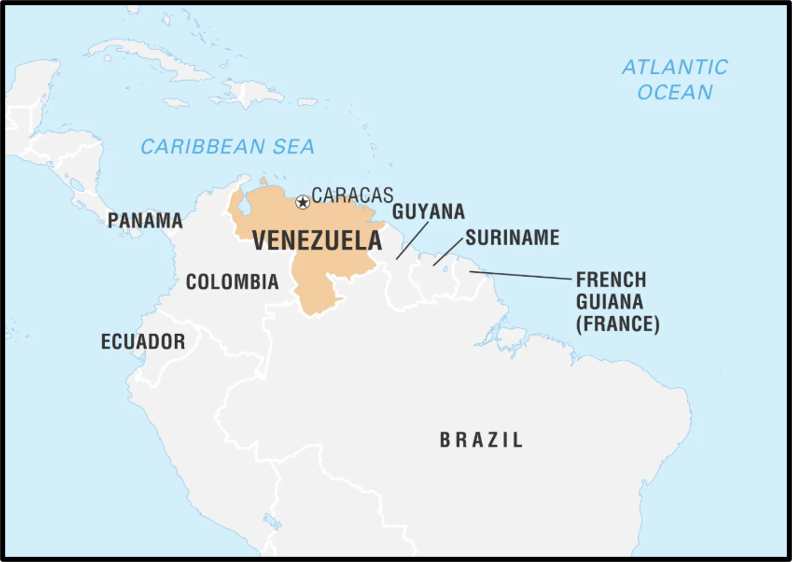
Mapping Venezuela
| Feature | Details |
| Location | Northern South America; Caribbean Sea and Atlantic to the north |
| Capital | Caracas |
| Neighbours | Colombia, Brazil, Guyana |
| Oil regions | Orinoco Heavy Oil Belt; Lake Maracaibo Basin |
| Landmarks | Angel Falls (979 m, highest uninterrupted fall) on Auyán-tepui; Mount Roraima; Llanos grasslands |
| Casiquiare | Natural link between Orinoco and Amazon basins |
Why heavy crude needs special refineries
Heavy, sour crude (Merey: API 15–18, 2–3% sulphur) ➜ Complex refinery (coker, hydrocracker) ➜ Petrol, diesel ➜ High margins
- Orinoco belt: About 90% of the world’s extra-heavy oil in place (USGS, 2003).
- Jamnagar: Nelson complexity index of 21.1, able to process 200+ crude grades (see Refining industry).
For India, Venezuelan crude is one way to diversify supply (see India–Venezuela Relations).
📖 Read More: Political Map of South America • India and Venezuela Relations • Oil and Energy Diplomacy
17. Three Indian Sites on UNESCO’s Tentative List
(HISTORY) (UNESCO) Three Indian sites submitted on 28 September 2026 are now on UNESCO’s World Heritage Tentative List: the Karst-mud-volcano Complex of Baratang, the Andaman Subduction Volcanoes and the Sirpur Cultural and Archaeological Landscape. A tentative listing is a mandatory step before nomination.
| Site | Category & criteria | Highlights |
| Baratang karst-mud-volcano complex, Andaman | Natural — (viii)(ix)(x) | Limestone caves; non-magmatic mud volcanoes (‘jalki’) along fault zones |
| Andaman Subduction Volcanoes (Barren & Narcondam) | Natural — (vii)(viii)(ix)(x) | Barren: only active volcano in the subcontinent; Narcondam: endemic hornbill |
| Sirpur, Mahasamund (Chhattisgarh) | Cultural — (ii)(iv) | Capital of South Kosala; Laxman Temple, Buddhist viharas, Mahanadi ghats |
Mud volcano vs volcano
Over-pressured shale & gas ➜ Rise along faults ➜ Cool mud, water, methane emitted ➜ No molten magma
- Setting: The Andaman arc lies where the Indian Plate subducts beneath the Burma microplate (see Andaman and Nicobar Islands).
- Sirpur: Shows 5th–12th century Shaiva, Vaishnava and Buddhist coexistence under the Sharabhapuriya and Panduvamshi dynasties (see Buddhist architecture).
📖 Read More: Indian Sites in the Tentative List of UNESCO • Indian Islands • Karst Topography
18. Kambala Debuts at Mysuru Dasara
(HISTORY) (TH) Coastal Karnataka’s buffalo race, Kambala, made its first appearance at the Mysuru Dasara, with 150 pairs of buffaloes racing at Sathagalli.
- What: Buffalo race on slushy paddy-field tracks in Dakshina Kannada and Udupi (Tulu Nadu), held after harvest.
- Tradition: Thanks local deities for good crops and protection of cattle.
- Law: After a 2014 ban, Karnataka amended the Prevention of Cruelty to Animals Act, 1960 (2017); on 18 May 2023 a five-judge Constitution Bench upheld the state laws protecting Jallikattu, Kambala and bullock-cart races.
The case shows the balance between cultural rights and animal welfare (see India’s Wildlife Laws).
📖 Read More: India’s Wildlife Laws, Policies and Institutions
19. Police Commemoration Day 2026
(INTERNAL SECURITY) (DD) Police Commemoration Day is observed on 21 October to honour police personnel who died on duty. The Prime Minister and Home Minister paid tribute; the Home Minister also flagged off a motorcycle rally on the theme ‘Fight Against Drugs’.
- Origin: On 21 October 1959, ten police personnel were killed in an ambush by Chinese troops at Hot Springs, Ladakh.
- National Police Memorial: Dedicated in Chanakyapuri, New Delhi, on 21 October 2018.
- Police as a state subject: Entry 2, State List — reform depends largely on states (see Police Reforms).
Law and order ➜ Crime control ➜ Disaster response ➜ Internal security
📖 Read More: State Police and Police Reforms • Armed Forces and Internal Security