
UPSC CURRENT AFFAIRS — 29 OCTOBER 2026
1. Genome Editing and Apomixis for Staple Crops
(SCIENCE AND TECHNOLOGY) (TH) Former Principal Scientific Adviser K. VijayRaghavan argues that genome editing and apomixis can renew India’s rice and wheat, which occupy more than half of the country’s farmland, provided plant-science research regains its appeal for students and the seed system adapts.
Why Rice and Wheat Need New Tools
Today’s varieties were designed when the cost of excess fertiliser, indiscriminate pesticide use and cheap water and power were not fully anticipated. Climate stress, soil salinity and falling groundwater now demand crops that give more with fewer inputs (Biotechnology in Agriculture).
Genome Editing: What India Has Done
In 2025 India released two rice varieties made with CRISPR-Cas9 using the SDN-1 and SDN-2 approaches (Mongabay India). Both are non-transgenic: no foreign gene is inserted.
| Variety | Developer | Base variety | Claimed advantage (as reported) |
| DRR Dhan 100 (Kamala) | ICAR-Indian Institute of Rice Research, Hyderabad | Samba Mahsuri (BPT-5204) | Earlier maturity and about 20% more grain |
| Pusa DST Rice 1 | ICAR-Indian Agricultural Research Institute, New Delhi | Cotton Dora Sannalu (MTU 1010) | Better yield under saline and alkaline soils |
Yield figures are the developers’ claims from field trials; they have not been independently confirmed. In 2022 India exempted SDN-1 and SDN-2 edited plants from the stricter biosafety rules that apply to GM crops, as many agricultural countries have done.
SDN-1, SDN-2 and Transgenics Compared
| Type | What happens | Foreign DNA? |
| SDN-1 | Cell repairs a cut at a chosen site by itself, producing small random changes | No |
| SDN-2 | A supplied template guides a precise, small change | No (template is not retained) |
| SDN-3 / transgenic GM | A large gene or a gene from another species is inserted | Yes |
Apomixis: Fixing Hybrid Vigour
Apomixis is asexual seed formation: the seed is a clone of the mother plant. If engineered into cereals, a farmer could save and resow seed from a high-yielding hybrid without losing its vigour, which today fades in the next generation. Laboratory work on synthetic apomixis in rice has reported a high share of clonal seed, but it is still far from the farm.
Hybrid plant ➜ Synthetic apomixis ➜ Clonal seed ➜ Farmer saves seed ➜ Hybrid vigour retained
Challenges
- Talent: anti-GMO rhetoric has pushed students from plant research to other life sciences that use similar methods.
- Biology: bread wheat is hexaploid (three sub-genomes), so editing it is harder than editing rice.
- Regulation: countries treat genome-edited crops differently, which complicates trade and acceptance.
- Seed system: public institutions such as the National Seeds Corporation and growing private investment must be balanced so farmers keep access and choice (Agriculture and Allied Sectors).
Way Forward
Fund basic research in plant genetics, physiology and host-pathogen interactions; keep a science-based, case-by-case regulatory path; and strengthen public breeding so that new traits reach small farmers (Basics of Biotechnology).
📖 Read More: Biotechnology in Agriculture • Basics of Biotechnology • Agriculture and Allied Sectors of Indian Economy
2. Disinvestment as a Fiscal and Reform Strategy
(ECONOMICS) (TH) With the Centre’s 14 October approval of the IDBI Bank strategic sale, collections under disinvestment and asset monetisation are set to exceed the FY27 budget target of ₹80,000 crore. The article argues for a demand-led, time-bound ‘Privatisation 2.0’ framework.
Where the Numbers Stand
| Item | Figure (2026-27) |
| Raised, April–September (disinvestment plus monetisation) | ₹62,124 crore |
| Of which, disinvestment | ₹55,757 crore |
| Full-year budget target | ₹80,000 crore |
| NMP 2.0 target, FY26–30 | ₹16.72 lakh crore (Phase 1 achieved about 90% of its goal) |
Until October, receipts came mainly through Offer for Sale (OFS), which widens ownership without changing how a company is run. The IDBI deal is the first strategic sale since Air India in 2022.
Disinvestment, Privatisation and Monetisation
| Route | Meaning |
| Minority sale | Government sells part of its stake but keeps control (e.g. OFS) |
| Strategic sale | Management control passes to a private buyer, so it amounts to privatisation |
| Asset monetisation | Ownership stays with the State; the right to operate an asset is leased for a fixed period (National Monetisation Pipeline) |
Policy Logic
- The 2021 New Public Sector Enterprise Policy keeps only a ‘bare minimum presence’ of PSEs in strategic sectors.
- The LIC IPO of 2022 brought many first-time retail investors into the market.
- Sale proceeds ease pressure on the deficit at a time when net tax revenue grew only 3.4% in April–August 2026 and capital expenditure rose over 18%; the fiscal deficit had reached 42% of the budget estimate (Fiscal Policy).
Reform Suggestions in the Article
- Choose PSEs on a demand basis: test investor interest first and prioritise those drawing strong bids.
- Run a rolling three-year privatisation pipeline so investors have time for due diligence.
- As an interim step, a CII analysis suggests that cutting the Government’s stake to 51% in 95 listed PSEs could fetch about ₹9 lakh crore.
Caution: asset sales are one-off receipts. They cushion the deficit but cannot replace durable revenue or spending discipline (Reforms and Disinvestment in PSU Sector).
📖 Read More: Reforms and Disinvestment in PSU Sector • Fiscal Policy • Public Expenditure Management
3. Tobacco-Free Youth: The ‘Say No to Tobacco’ Pledge
(SOCIAL JUSTICE) A national pledge drive urges students and young people to stay away from tobacco, linked to the 60-day Tobacco-Free Youth Campaign (now in its fourth edition). The goal is to stop initiation, since most users start in adolescence.
Why Focus on Youth?
The Global Youth Tobacco Survey 2019 found that 8.4% of students aged 13–15 currently use tobacco products and that the average age of first use is 10 (AIR report on the 3.0 campaign). Nicotine addiction set in early is hard to reverse (Tobacco).
Campaign Design
- A 60-day campaign run by the education and health ministries, in schools and higher education institutions.
- A pledge, a quiz and school challenge on MyGov, and counselling for students who want to quit tobacco or other substances.
- Educational institutions are declared tobacco-free after meeting set criteria.
Legal and Policy Framework
| Instrument | Key provisions |
| COTPA, 2003 | Bans sale of tobacco products to anyone under 18 and sale within 100 yards of educational institutions; bans smoking in public places; restricts advertising |
| WHO FCTC | International treaty on tobacco control: tax, packaging warnings, smoke-free places, cessation support |
Way Forward
- Enforce the 100-yard rule around schools, including loose-cigarette sales.
- Combine pledges with cessation services and peer-led programmes.
- Address new nicotine products and social-media marketing aimed at the young (Health and Nutrition).
📖 Read More: Tobacco • Health and Nutrition
4. PM Viksit Gram Swaraj Yojana: Planning Panchayats
(POLITY AND GOVERNANCE) (PMI) The Union Cabinet has approved the Pradhan Mantri Viksit Gram Swaraj Yojana (PM VGSY), a Centrally Sponsored Scheme for 2026-27 to 2030-31 with an outlay of ₹7,395.55 crore, to help Panchayats plan holistically and use Finance Commission grants well.
Key Features
| Feature | Detail |
| Period | 2026-27 to 2030-31, matching the Sixteenth Finance Commission cycle |
| Outlay | ₹7,395.55 crore: Centre ₹4,869.48 crore, States ₹2,526.07 crore |
| Beneficiaries | About 32 lakh elected representatives and functionaries across over 2.55 lakh Panchayats and traditional local bodies |
| Coverage | All States and UTs, including traditional local bodies in non-Part IX areas such as those under the Sixth Schedule |
| Posts | No permanent posts; need-based contractual staff at State, district and block levels |
What It Will Do
- Holistic plans: support 2.55 lakh Gram Panchayat Development Plans every year on the eGramSwaraj portal, combining village priorities, departmental schemes and available funds (E-Governance).
- Awareness: each outreach exercise to reach at least 1 crore citizens through Gram Sabhas and digital platforms, including PANCHAM, an AI-enabled platform in 17 languages.
- Capacity building: training and digital handholding for elected representatives and staff.
- Audit and revenue: at least 2.55 lakh online audit plans a year through AuditOnline, and better mobilisation of own-source revenue.
Village needs + schemes + funds ➜ eGramSwaraj plan ➜ Gram Sabha discussion ➜ Spending ➜ Online audit
Why It Matters
The Sixteenth Finance Commission has recommended about ₹4.35 lakh crore in grants for rural local bodies over 2026-27 to 2030-31. Panchayats often lack the capacity to convert grants into well-planned projects, and weak finances and functions remain a core challenge for the third tier (Finances and Functional Challenges of PRIs).
Implementation
States submit Annual Action Plans, which a Central Empowered Committee appraises. Existing scheme delivery by departments continues; the new scheme adds a common planning and information layer (Panchayati Raj and Decentralisation).
📖 Read More: Panchayati Raj and Decentralisation in India • Finances and Functional Challenges of PRIs • 16th Finance Commission
5. Khelo India Sports Goods Manufacturing Scheme
(ECONOMICS) (PMI) The Cabinet has approved the Khelo India Sports Goods Manufacturing Scheme with an outlay of ₹1,856.67 crore for 2026 to 2033-34, announced in Union Budget 2026-27, to build a globally competitive sports-goods industry and cut import dependence.
Components
| Component | What it offers |
| Sports Goods Manufacturing Zones | Cluster-based zones with testing, design and prototyping centres, built by convergence with the BHAVYA scheme and NICDC industrial parks |
| Anchor Investment Support and Turnover Linked Support | Incentives for leading manufacturers and brands to set up in the zones, and for higher production; combined outlay ₹1,130 crore |
| Existing clusters | Common facilities and shared infrastructure to help MSMEs |
| Certification | ₹105 crore to obtain and renew certification from international sports federations |
| Innovation | Centres of Excellence in leading institutions, convergence with the Anusandhan National Research Foundation, start-up support |
| Skills and markets | Skilling with the skills ministry; branding and market development using the Export Promotion Mission |
Why It Matters
- Sports goods are labour-intensive, so manufacturing zones create jobs, especially in MSME clusters.
- Certified equipment helps Indian brands qualify for international tournaments and exports (Make in India).
- Domestic production supports Khelo India and Fit India by lowering the cost of equipment for athletes and schools (Governance of Sports in India).
The challenge is execution: quality standards, raw-material costs and competition from established exporters will decide whether India moves up the global value chain.
📖 Read More: Governance of Sports in India • Ministry of Youth Affairs and Sports • Make in India Initiative
6. Container Manufacturing Promotion Scheme
(ECONOMICS) (PMI) The Cabinet has approved the Container Manufacturing Promotion Scheme (CMPS) with an outlay of ₹10,000 crore up to FY 2039-40, to build a domestic shipping-container industry, reduce import dependence and strengthen supply-chain resilience.
Why Containers?
India depends heavily on imported containers. A TEU (twenty-foot equivalent unit) is the standard measure of container capacity. Domestic production would cut costs and protect trade from supply shocks (Major Ports of India).
Components
| Component | Outlay | Purpose |
| Interest Subvention Assistance | ₹859 crore | 3% a year subvention on term loans for greenfield units and brownfield expansion |
| Operational Expenditure Assistance | ₹8,891 crore | Support for each container made to global shipping standards and sold, to bridge the cost gap |
| Testing and certification | ₹150 crore | Common facilities such as dynamic longitudinal impact testing |
Expected Impact
- Annual capacity to rise about ten-fold, to 7.5 lakh TEUs.
- About 3,000 direct and over 50,000 indirect jobs, with demand for corner castings, specialised steel, wooden flooring and paints.
- Potential to turn India into an export hub for quality containers.
Success depends on low-cost steel supply, quality certification acceptable to global shipping lines, and port and rail links that make Indian-made boxes competitive at the container ports (Make in India).
📖 Read More: Major Ports of India • Make in India Initiative
7. INS Sahyadri at Busan: India–Korea Naval Exercise
(INTERNAL SECURITY) (PIB) INS Sahyadri, an indigenously built guided-missile stealth frigate, reached Busan on 26 October 2026 for the India–Republic of Korea Navy (IN-RoKN) bilateral exercise, aimed at interoperability and maritime cooperation in the Indo-Pacific.
How the Exercise Runs
Port call at Busan ➜ Harbour phase ➜ Sea phase with ROKS Munmu the Great
- Harbour phase: professional interactions, cross-deck visits, cross-training and sports; the Commanding Officer calls on senior RoKN officials.
- Sea phase: coordinated activities between INS Sahyadri and ROKS Munmu the Great to improve operational coordination.
Why It Matters
- It builds familiarity between the Indian Navy and a technologically advanced partner, in line with India’s Act East and Indo-Pacific outlook (India and South Korea Relations).
- Shows an indigenously designed Shivalik-class warship in a partner’s waters, supporting defence exports and Make in India.
- Joint exercises are a core tool of maritime diplomacy and sea-lane security (Naval Defence).
📖 Read More: India and South Korea Relations • Naval Defence
8. DA and DR Raised to 63%
(ECONOMICS) (PMI, IE) The Cabinet has approved an additional instalment of Dearness Allowance (DA) for Central Government employees and Dearness Relief (DR) for pensioners, raising the rate from 60% to 63% of basic pay or pension with effect from 1 July 2026.
The Numbers
| Item | Detail |
| Increase | 3 percentage points, from 60% to 63%, effective 1 July 2026 |
| Beneficiaries | About 48.54 lakh employees and 68.71 lakh pensioners |
| Annual cost to the exchequer | ₹10,016.10 crore (DA plus DR) |
| Previous revisions | 58% from July 2025; 60% from January 2026 (approved April 2026) |
How DA Is Set
Labour Bureau CPI-IW each month ➜ 12-month average ➜ Formula based on 7th Pay Commission ➜ DA rate ➜ Revised twice a year
DA compensates for inflation and is revised, in general, twice a year with effect from 1 January and 1 July. The rate is based on the Consumer Price Index for Industrial Workers (CPI-IW), a consumer price index compiled by the Labour Bureau.
Economic Angle
- Higher DA raises the salary and pension bill, adding to committed expenditure (Public Expenditure Management).
- The wage boost supports festival-season consumption, but States usually follow with their own hikes, widening the combined fiscal impact (Fiscal Policy).
📖 Read More: Public Expenditure Management • Fiscal Policy
9. Talacauvery Sanctuary: Poachers Held
(ENVIRONMENT) (DH) Forest personnel arrested eight persons and seized a gun in a raid at the Talacauvery Wildlife Sanctuary in Kodagu, Karnataka; one suspect escaped. The case highlights poaching pressure on Western Ghats protected areas.
About the Sanctuary
| Feature | Detail |
| Location | Kodagu district, Karnataka; borders hills in Kasaragod district, Kerala |
| Area and year | About 105 sq km; established 1987 (Wikipedia) |
| Significance | Includes the headwaters of the Kaveri, which rises at Talakaveri on the Brahmagiri range |
| Wildlife | Asian elephant, tiger, clawless otter, stripe-necked mongoose, mouse deer; birds such as the Malabar trogon |
Legal Position
- The Wild Life (Protection) Act, 1972 prohibits hunting of wild animals (Section 9), with higher penalties for Schedule I species.
- Sanctuaries are declared by the State Government under Section 18, and entry and activities are regulated.
- Illegal firearms also bring the Arms Act into play.
Way Forward
- Stronger anti-poaching camps, patrolling and intelligence in forest-edge villages.
- Livelihood support and community participation to reduce hunting for meat (Wildlife Sanctuaries in India).
- Better coordination across the Karnataka–Kerala boundary landscape (Conservation of Major Indian Wildlife Species).
📖 Read More: Wildlife Sanctuaries in India • Conservation of Major Indian Wildlife Species • Biodiversity Conservation
10. Cyclone Arnab: Landfall and El Niño’s Role
(GEOGRAPHY) (IE) Cyclone Arnab, the first tropical cyclone of 2026 in the North Indian Ocean, crossed the Andhra Pradesh and Yanam coast in the early hours of 28 October as a very severe cyclonic storm with winds of 125–135 km/h. It stayed strong for hours after landfall; El Niño is linked to its fast build-up and track.
Timeline
Low pressure, south-east Bay of Bengal (23 Oct) ➜ Cyclone Arnab (26 Oct) ➜ Very severe (peak within a day) ➜ Landfall about 1 am on 28 Oct ➜ Severe ➜ Remnants recurve northwards
Why It Intensified So Fast
- Warm ocean: sea temperatures of 26°C or more down to 50–100 m supply heat and moisture. Rapid intensification is a sharp rise in wind speed within a day.
- El Niño: in El Niño years, cyclones in the Bay of Bengal tend to form closer to the equator, so they head for Andhra Pradesh and Tamil Nadu rather than Odisha and West Bengal. Cyclone Hudhud (2014) was another El Niño-year example (El Niño).
- Faster track: IMD advanced its landfall forecast by several hours as the system moved quicker than expected.
Unusual Landfall
Cyclones normally weaken once over land. Arnab kept the same intensity for at least six hours after landfall and remained nearly stationary near Narsapur and Yanam, prolonging the impact. Rainfall included 217 mm at Visakhapatnam, 147 mm at Kalingapatam and 118 mm at Kakinada.
Impact and Response
- Over 1.8 lakh people were evacuated in Andhra Pradesh and Odisha; trees, poles and power lines were damaged.
- Red alerts for Odisha and Andhra Pradesh; orange for Chhattisgarh.
- Weakened remnants are forecast to bring 115–204 mm of rain over Telangana, Chhattisgarh, Jharkhand, Bihar, Gangetic West Bengal, eastern Madhya Pradesh and eastern Uttar Pradesh.
- Early warning, evacuation and State disaster authorities, supported by the NDRF, are central (NDMA). A storm surge on a low coast is the main threat to life (Cyclones: A Natural Hazard).
Climate change and warming seas may raise the share of intense storms (Impact of Global Warming); local planning for coastal infrastructure and mangrove buffers is therefore crucial.
📖 Read More: Cyclones: A Natural Hazard • Environmental Impacts of Tropical Cyclones • National Disaster Management Authority
11. India’s Emerging Space Technologies
(SCIENCE AND TECHNOLOGY) (PIB) ISRO is advancing heavier and partly reusable launchers, indigenous propulsion, in-orbit docking and new satellites to support Gaganyaan and the planned Bharatiya Antariksh Station, as the Department of Space targets a US$44 billion space economy by 2033.
Foundations and Ecosystem
- INCOSPAR was set up in 1962, the first sounding rocket flew from Thumba in 1963, and ISRO was formed in 1969.
- The Indian Space Policy 2023 and IN-SPACe opened satellite, launch and service activities to private firms.
- NewSpace India Limited has signed 118 technology-transfer agreements covering 83 ISRO technologies; cumulative investment in space start-ups reached about US$618.5 million by 31 March 2026.
Next Generation Launch Vehicle (NGLV)
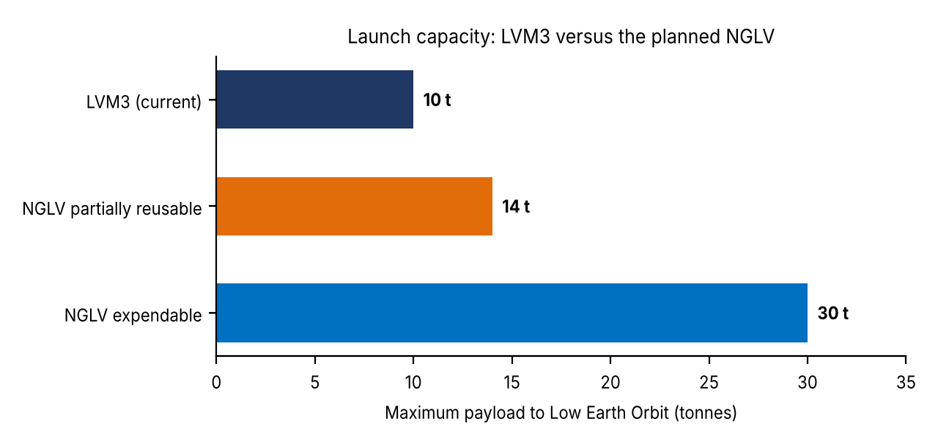
The Union Cabinet approved NGLV development in September 2024 with ₹8,240 crore, including three developmental flights. It is designed for 30 tonnes to Low Earth Orbit, three times the 10 tonnes of LVM3, and a partially reusable version for 14 tonnes is being developed (Propulsion Systems in Space Technology).
Today’s Launch Vehicles
| Vehicle | Capability |
| SSLV | Small satellites; up to 500 kg to a 500-km planar orbit |
| PSLV | Workhorse; up to 1,750 kg to a 600-km sun-synchronous orbit and 1,425 kg to sub-GTO |
| GSLV | Indigenous cryogenic stage; communication satellites of about the 2-tonne class |
| LVM3 | Heavy-lift; 4-tonne class to GTO and 10-tonne class to LEO (Orbits in Space Technology) |
Technologies Under Development
| Technology | Status |
| Reusable launch vehicle | Three RLV landing experiments completed on 2 April 2023, 22 March 2024 and 23 June 2024; LEX-03 tested autonomous landing in difficult cross-range and wind conditions |
| Scramjet | Air-breathing engine that burns fuel in supersonic airflow; flight-tested on 28 August 2016 at Mach 6, making India the fourth country to do so |
| Electric propulsion | 1,000-hour life test of a 300 mN stationary plasma thruster completed on 27 March 2025; specific impulse at least six times that of chemical systems; to be validated on TDS-01 |
| Space docking (SpaDeX) | First docking on 16 January 2025, then undocking and a second autonomous docking; essential for the space station and sample-return missions |
| Radioisotope heaters and generators | ISRO and the Department of Atomic Energy are working on requirements for future lunar and Mars missions |
Navigation and Earth Observation
- NavIC: regional navigation covering India and about 1,500 km beyond, with a civilian Standard Positioning Service and an encrypted Restricted Service.
- NISAR: launched on 30 July 2025 on GSLV-F16; the first mission to use two radar frequencies (NASA L-band and ISRO S-band) to map land, ice and ground deformation.
Priorities now: sustained funding, a deeper private supply chain, and quick translation of demonstrations into operational systems (Aerospace and Outer Space Diplomacy).
📖 Read More: Propulsion Systems in Space Technology • Orbits in Space Technology • Aerospace and Outer Space Diplomacy
12. Manastu Space Gets ₹116 Crore for Green Propulsion
(SCIENCE AND TECHNOLOGY) (DD) The Technology Development Board (TDB), under the Department of Science and Technology, has agreed to provide ₹116 crore from the Research, Development and Innovation (RDI) Fund to Navi Mumbai-based Manastu Space Technologies to develop an indigenous green propulsion system for satellites and launch vehicles.
Project Snapshot
| Feature | Detail |
| Project cost | ₹277.63 crore |
| TDB assistance | ₹116 crore through Optionally Convertible Debt, which can convert into equity under set conditions |
| Thrust range | 5 millinewtons to 300 newtons, from small satellites to launch-vehicle needs |
| Propellant | Hydrogen peroxide-based green propellant with additives, with an integrated engine and catalyst |
| Components | Engines, propellant feed systems, ultra-high-temperature ceramic catalyst |
| Readiness | Aims to move from TRL 6 to TRL 9; the technology has already been demonstrated in space |
Why ‘Green’ Propulsion?
Conventional satellite thrusters often use toxic hydrazine, which needs careful handling. Hydrogen-peroxide-based propellants are less hazardous, improving safety and cost (Propulsion Systems in Space Technology).
Institutions Behind It
- The Technology Development Board is a statutory body under the Technology Development Board Act, 1995.
- The RDI Fund (₹1 lakh crore over six years, approved in 2025) works through the Anusandhan National Research Foundation, with TDB as a second-level fund manager.
- The project helps cut reliance on imported propulsion technology.
📖 Read More: Propulsion Systems in Space Technology • Orbits in Space Technology
13. Green Hydrogen and the National Mission
(SCIENCE AND TECHNOLOGY) (PIB) A government backgrounder reviews progress under the National Green Hydrogen Mission (NGHM): electrolyser manufacturing incentives, pilot projects in steel, transport and shipping, green hydrogen hubs and a certification system, towards at least 5 million tonnes a year by 2030 and net zero by 2070.
What Is Green Hydrogen?
Hydrogen made by splitting water with renewable electricity. Its climate impact depends on how it is made: fossil routes emit carbon, renewable electrolysis emits far less.
Solar / wind power ➜ Electrolyser: 2H₂O ➜ 2H₂ + O₂ ➜ Purify, dry, compress ➜ Fertiliser, refining, steel, transport, shipping
- Hydrogen forms at the cathode and oxygen at the anode; a membrane keeps the gases apart.
- India’s Green Hydrogen Standard (2023): up to 2 kg CO₂-equivalent per kg of hydrogen, well-to-gate, averaged over 12 months.
The Mission in Numbers
| Element | Detail |
| Approved | January 2023; outlay ₹19,744 crore; MNRE is the nodal ministry |
| Target | At least 5 million tonnes a year by 2030, up to 10 million with exports; over 6 lakh jobs |
| SIGHT programme | ₹17,490 crore to 2029–30; incentives to 15 companies for 3,000 MW a year of electrolyser capacity |
| Steel pilots | ₹455 crore to 2029–30; five projects, including ₹84 crore to test 100% hydrogen injection |
| Mobility | 12 projects: 70 hydrogen vehicles (27 buses, 43 trucks) |
| Hubs | Deendayal (Kandla), V.O. Chidambaranar (Tuticorin) and Paradip ports |
| Skilling | 8,149 candidates trained and 7,248 certified across 14 States and UTs |
India’s first indigenous hydrogen train was inaugurated on 17 July 2026 on the Jind–Sonipat section in Haryana.
Enablers
- A 25-year waiver of inter-State transmission charges for green hydrogen and ammonia plants commissioned by 31 December 2030.
- Certification scheme under the Bureau of Energy Efficiency; standards for green ammonia and methanol.
- Applications: fertilisers, refineries, steel through direct reduced iron, heavy transport using fuel cells (hydrogen vehicles), shipping fuels and storage.
Challenges
- High production cost and uncertain demand until buyers sign long-term contracts.
- Storage, transport and refuelling infrastructure, and safety standards.
- Reliable low-cost renewable power and water availability (Hydrogen Economy, Measures to Boost Renewable Energy).
📖 Read More: National Green Hydrogen Mission • Hydrogen Economy • Measures to Boost Renewable Energy
14. DAC Clears ₹2.12 Lakh Crore Procurement
(INTERNAL SECURITY) (TH) The Defence Acquisition Council (DAC), chaired by Defence Minister Rajnath Singh, on 26 October 2026 granted Acceptance of Necessity (AoN) for capital acquisitions worth about ₹2.12 lakh crore for the three Services, with about 82% to be sourced from Indian industry.
What Is an AoN?
AoN is the first formal approval in the acquisition process. It says a proposal is needed; it is not a contract. Later steps include issuing a request for proposal, trials, price negotiation, financial sanction and contract signing.
Services propose need ➜ DAC grants AoN ➜ Request for proposal ➜ Trials and evaluation ➜ Price negotiation ➜ Sanction and contract
Main Proposals
| Service | Items cleared |
| Army | High Mobility Vehicles, self-propelled tracked guns, Gun Shot Response Systems, Light Multi-Role Helicopters (shared with the IAF), VSHORADS, platform-based counter-drone systems, long-range unmanned aerial systems, surveillance UAVs, Integrated Surveillance and Strike Systems, long-range kamikaze drones |
| Navy | Active offboard decoy systems against anti-ship missiles, with other platform proposals |
| Air Force | Helicopters, air-defence systems, weapons and mobile X-band Doppler weather radars |
Significance
- A high domestic share supports Aatmanirbhar Bharat, lowers import dependence and strengthens the industrial base (Make in India).
- The counter-drone and short-range air-defence emphasis reflects lessons from recent drone-heavy conflicts (Air Defence).
- Self-propelled guns and mobility vehicles improve the speed and survivability of mechanised forces (Armed Forces and Internal Security).
Watch-points: the long gap between AoN and delivery, trials and costs, and whether private firms can scale production on time.
📖 Read More: Armed Forces and Internal Security • Air Defence • Make in India Initiative
15. ITBP Marks Its 65th Raising Day
(INTERNAL SECURITY) (PIB) The Prime Minister greeted personnel of the Indo-Tibetan Border Police (ITBP) on its Raising Day on 24 October 2026, praising the Himveers for their valour and sacrifice in guarding the India–China frontier.
Profile of the Force
| Feature | Detail |
| Raised | 24 October 1962, in the aftermath of the India–China War |
| Parent ministry | Ministry of Home Affairs; a Central Armed Police Force |
| Law | Indo-Tibetan Border Police Force Act, 1992 |
| Border | About 3,488 km, from the Karakoram Pass in Ladakh to Jarep La (Jachep La) in Arunachal Pradesh |
| Motto | Shaurya – Dridhata – Karm Nishtha (valour, steadfastness, commitment to duty) |
Under the ‘One Border, One Force’ principle, a post-Kargil reform, ITBP replaced the Assam Rifles on the border in Sikkim and Arunachal Pradesh in 2004 (Wikipedia).
Roles
- High-altitude border guarding at posts up to 18,800 feet, where winter temperatures plunge to about −30°C and snowfall exceeds ten feet.
- Preventing cross-border crime, smuggling and illegal entry.
- Search and rescue and disaster relief in the Himalayas.
- Internal security and counter-insurgency duties, including operations against Left-Wing Extremism.
A single force for a single border improves command, but infrastructure, road connectivity and housing at remote posts remain key needs (Border Security).
📖 Read More: Border Security • Armed Forces and Internal Security