
Coral Bleaching
Imagine a beautiful underwater garden filled with colourful corals, bustling with marine life. Suddenly, this vibrant ecosystem turns pale, as if all life is draining away. This is coral bleaching, a phenomenon that signals extreme distress in coral reefs.
What is Coral Bleaching?
Coral bleaching occurs when corals lose their symbiotic algae, called zooxanthellae. These microscopic algae provide corals with:
- Food (through photosynthesis), and
- Colour (giving corals their bright hues).
When stressed, corals expel these algae, leading to:
- Loss of colour → Corals appear white or “bleached.”
- Loss of food → Corals weaken, and if stress continues, they die.
Causes of Coral Bleaching
Corals are extremely sensitive to changes in their environment. Here’s what triggers bleaching:
1. Global Warming
- Corals thrive within a narrow temperature range (23-29°C).
- Rising sea temperatures due to climate change stress corals, forcing them to expel zooxanthellae.
- Even a 1-2°C rise can cause widespread bleaching!
2. Ocean Acidification
- Excess CO₂ dissolves in seawater, forming carbonic acid, which:
- Lowers pH levels → Oceans become more acidic.
- Weakens coral skeletons, making them more fragile.
3. Silt Deposition from Rivers
- Increased glacial melting (due to climate change) leads to more silt (fine soil particles) flowing into the ocean.
- This clogs coral pores, blocking sunlight and reducing oxygen supply.
4. Freshwater Dilution (Due to Heavy Rainfall)
- More rainfall = More freshwater in oceans, reducing salinity (salt content).
- Corals are adapted to a specific salinity level; lower salinity stresses them, leading to bleaching.
5. El Niño Events
- El Niño causes unusual warming of ocean waters, leading to:
- Extreme sea temperature rise → Mass coral bleaching.
- Lower upwelling of nutrients, reducing coral health.
6. Subaerial Exposure (Temporary Exposure to Air)
- If corals are suddenly exposed above water due to:
- Extreme low tides, or
- Tectonic uplift (land rising due to earthquakes, etc.),
- They dry out and bleach.
7. Eutrophication (Nutrient Overload in Water)
- Excess fertilizers from agriculture run into oceans, increasing nutrient levels.
- This causes algae overgrowth, blocking sunlight and choking corals.
8. Marine Pollution
- Oil spills, industrial waste, sewage discharge, and plastic pollution degrade coral health.
- Toxins poison corals and their zooxanthellae, leading to bleaching.
9. Coral Mining & Destruction
- Corals are often mined for:
- Decorative purposes (jewelry, souvenirs).
- Building materials (used in cement and construction).
- Mining directly kills corals, while dredging disturbs the ecosystem.
Why Should We Care?
Coral reefs are not just pretty underwater structures—they are essential for marine life and humans! 🌏
Ecological Importance
- 25% of all marine species depend on coral reefs.
- They act as barriers against coastal erosion and protect shorelines from storms and tsunamis.
Economic & Human Impact
- Reefs support fishing & tourism industries.
- Their destruction leads to loss of livelihood for millions.
Can Coral Bleaching Be Reversed?
🔄 If stressors disappear quickly, corals can recover by reabsorbing zooxanthellae.
❌ If stress continues, corals die, leading to irreversible reef loss.
Australia’s Great Barrier Reef
- The Great Barrier Reef, with over 2,900 individual coral reefs, is the world’s largest reef system, located in the Coral Sea, off Queensland, Australia.
- It is the largest single structure made by living organisms and is visible from outer space.
- The reef is a habitat for the dugong (sea cow) and green turtle. It was inscribed as a World Heritage Site in 1981.
- According to IUCN, the Great Barrier Reef is in a “critical state and deteriorating” due to climate change and warming waters.
- Its conservation status has been downgraded from “significant concern” to “critical” because of frequent mass bleaching events (four in the past six years).
- An UN-backed mission has recommended that the reef be added to the list of endangered World Heritage sites (not yet implemented).
The Threat of Coal Mining
- Australia is one of the largest exporters of fossil fuels. The reef faces threats from coal mining, gas extraction, and port construction for mining ships.
- In 2018, the Australian government approved Adani’s $16.5 billion Carmichael coal-mining project in the Galilee Basin, Queensland — one of the largest untapped coal reserves.
- The mine is connected to Abbot Port (operated by Adani) and produces thermal coal (for power generation) and metallurgical coal (for steel making). The project sparked massive protests.
- In February 2023, Australia — highly dependent on coal for electricity — rejected a new coal mining application for the first time, citing its potential harm to the Great Barrier Reef.
- The proposed open-pit mine would have damaged fragile seagrass meadows, vital feeding grounds for dugongs.
Biorock Technology for Coral Restoration
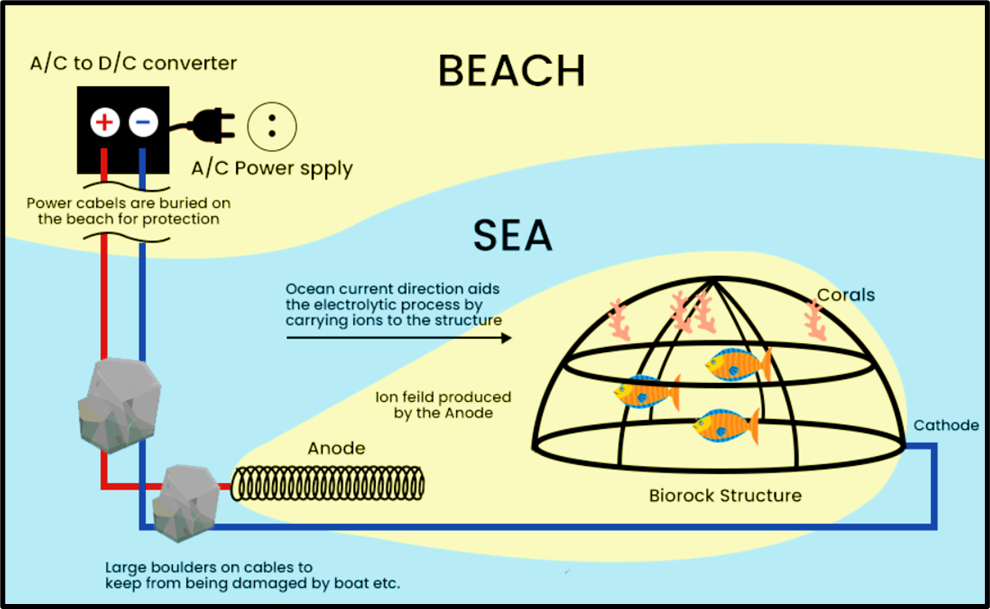
- The Zoological Survey of India attempted coral reef restoration using biorock technology in the Gulf of Kachchh.
- Biorock is formed by mineral accretion (electro-accumulation of minerals) on steel structures placed on the seabed and connected to a power source (e.g., floating solar panels).
- A small electric current flows between the anode (+) and cathode (–) on the sea floor.
- This causes calcium ions to combine with carbonate ions, depositing calcium carbonate (CaCO₃) on the cathode. The electro-accumulated CaCO₃ is termed biorock.
- Fragments of broken corals are tied to the biorock structure. Coral larvae adhere to the CaCO₃ and grow faster, as they need not expend energy building their skeletons.
Final Thought ⏳
Coral bleaching is a warning sign from the ocean—a cry for help. If we don’t act now, we may lose these natural wonders forever.
What Can We Do?
- Reduce carbon emissions (limit global warming).
- Prevent marine pollution (reduce plastic waste, regulate industrial discharge).
- Protect coastal ecosystems (stop deforestation & unsustainable fishing practices).
Saving coral reefs isn’t just about preserving beauty—it’s about securing our planet’s future! 🌍✨