
Communication Types
| Aspect | Wired Communication | Wireless Communication |
| Medium | Physical cables (optical fibre, twisted pair, coaxial) | Electromagnetic waves (radio, microwave, infrared) |
| Speed | Generally higher and more consistent | Variable; depends on signal strength and congestion |
| Stability | Highly stable; low interference | More prone to interference and fluctuations |
| Latency | Lower (especially fibre) | Higher (very high in satellite) |
| Mobility | No mobility (fixed connection) | High mobility (especially mobile internet) |
| Security | More secure (physical access required to tap) | Comparatively vulnerable; requires strong encryption |
| Installation | Higher cost (laying cables/fibre) | Lower cost; faster deployment |
| Coverage | Limited to cable-laid areas | Wider coverage including remote regions |
| Examples | Ethernet LAN, Fibre Broadband, BharatNet, cable TV | Wi-Fi, Bluetooth, 4G/5G, Satellite links |
Wireless Communication Technologies — Comparison
| Technology | Medium | Range | Speed | Key Features & Uses |
| Radio Waves | EM waves (low frequency) | 100s–1000s km | Low-Moderate | Penetrates buildings; reflects via ionosphere. Used in AM/FM radio, TV broadcasting. |
| Microwaves | High-frequency EM waves | Line-of-sight (few km–100 km) | High | Requires antennas/towers. Used in mobile networks, satellite communication. |
| Infrared (IR) | Near-visible light | Very short (few metres) | Moderate | Cannot pass through walls; line-of-sight only. Used in TV remotes, sensors. |
| Li-Fi (Visible Light) | Visible light spectrum | Very short (room-based) | Very high (Gbps) | Secure, no RF interference. Used in high-speed indoor internet, hospitals, aircraft. |
| Wi-Fi | Radio waves (2.4/5 GHz) | ~20–100 metres | High (Mbps) | Wireless LAN; IEEE 802.11 standards. Used in homes, offices, public spaces. |
| Bluetooth | Radio waves (2.4 GHz) | ~10–100 metres | Low-Moderate | Low power; PAN use. Used in headphones, smartwatches, file transfer. |
| Satellite | Microwaves via satellites | Global | Moderate-High | Wide coverage; higher latency (lower with LEO like Starlink). GPS, TV, remote areas. |
Radio Signals
Radio signals are electromagnetic waves used to transmit information wirelessly through the air. Everything from your FM radio to your 5G mobile internet to GPS navigation runs on radio signals.
The entire spectrum of frequencies used for communication is called the Radio Spectrum — one of India’s most precious and contested national resources (remember 2G spectrum auctions!).
How Radio Signals Work — The Complete Cycle
| Flowchart: Radio Signal Journey |
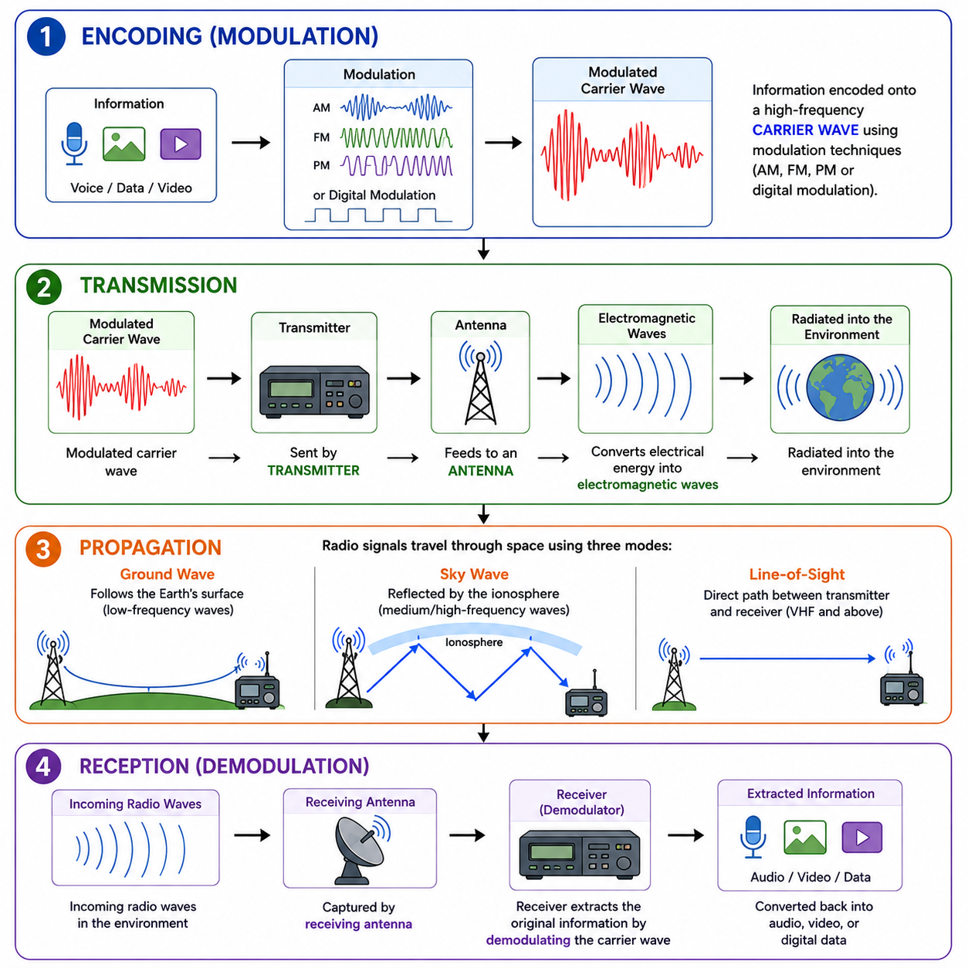
| 1. ENCODING (MODULATION): Information (voice/data/video) is encoded onto a high-frequency CARRIER WAVE using modulation techniques — AM (Amplitude Modulation), FM (Frequency Modulation), PM (Phase Modulation), or digital modulation. 2. TRANSMISSION: The modulated carrier wave is sent by a TRANSMITTER → feeds to an ANTENNA → which converts electrical energy into ELECTROMAGNETIC WAVES → radiated into the environment. 3. PROPAGATION: Radio signals travel through space using three modes: • Ground Wave: Follows the Earth’s surface (low-frequency waves) • Sky Wave: Reflected by the ionosphere (medium/high-frequency waves) • Line-of-Sight: Direct path between transmitter and receiver (VHF and above) 4. RECEPTION (DEMODULATION): A RECEIVING ANTENNA captures incoming radio waves → receiver EXTRACTS the original information by DEMODULATING the carrier wave → converts back into audio, video, or digital data. |
Types of Radio Waves Based on Frequency
| Band | Full Form | Frequency Range | Key Uses |
| LF | Low Frequency | 30–300 kHz | Long-distance communication, maritime navigation |
| MF | Medium Frequency | 300 kHz – 3 MHz | AM radio broadcasting |
| HF | High Frequency | 3–30 MHz | Shortwave radio, long-distance (ionospheric reflection) |
| VHF | Very High Frequency | 30–300 MHz | FM radio, television broadcasting |
| UHF | Ultra High Frequency | 300 MHz – 3 GHz | Mobile phones, TV, GPS |
| SHF | Super High Frequency (Microwave) | 3–30 GHz | Satellite communication, radar, Wi-Fi, 5G |
| EHF | Extremely High Frequency (Millimetre waves) | 30–300 GHz | Advanced 5G, high-speed data transfer, research |
The Ionosphere and Radio Communication
The Ionosphere is a layer of the Earth’s upper atmosphere (approximately 60–1000 km above the surface) that is ionised by solar UV and X-ray radiation, creating a high concentration of charged particles (ions and free electrons).
It plays a critical role in long-distance radio communication by reflecting or refracting certain radio waves back toward Earth — allowing signals to travel far beyond the line of sight without satellites.
| Frequency Range | Interaction with Ionosphere | Result / Application |
| Low (LF) & Medium Frequency (MF) | Reflected by the ionosphere | Used for long-distance radio — AM broadcasting |
| High Frequency (HF) | Strongly refracted/reflected | Enables shortwave communication across continents |
| VHF and above | Pass through the ionosphere | Used for satellite, TV, and mobile communication |
Factors Affecting Radio Signals in the Ionosphere
- Day-Night Variation: Strong solar radiation during day → higher ionisation → better radio wave reflection. At night, some layers (D layer) weaken or disappear → poorer reflection.
- Solar Activity (Sunspots): High solar activity → stronger ionisation → improved long-distance communication. Low solar activity → weaker ionisation → poor signals.
- Multiple Ionospheric Layers — D, E, F:
- D Layer (60–90 km): Weakest; absorbs low-frequency waves; disappears at night.
- E Layer (90–150 km): Reflects some medium-frequency waves; weakens at night.
- F Layer (150–400+ km): Strongest; splits into F1 and F2 during day; most important for long-distance HF communication.
- Solar Flares & Geomagnetic Storms: Solar flares — sudden bursts of radiation — can disrupt radio signals. Geomagnetic storms (solar wind + Earth’s magnetic field) can cause communication blackouts and GPS errors.
Li-Fi (Light Fidelity) — The Future of Indoor Wireless
You are familiar with Wi-Fi — wireless internet using radio waves. Now imagine internet using visible light from an LED bulb. That is exactly what Li-Fi (Light Fidelity) is.
It is a form of Visible Light Communication (VLC) — and it is theoretically 100 times faster than Wi-Fi. Of course, it comes with its own limitations.
| How Li-Fi Works — Step by Step |
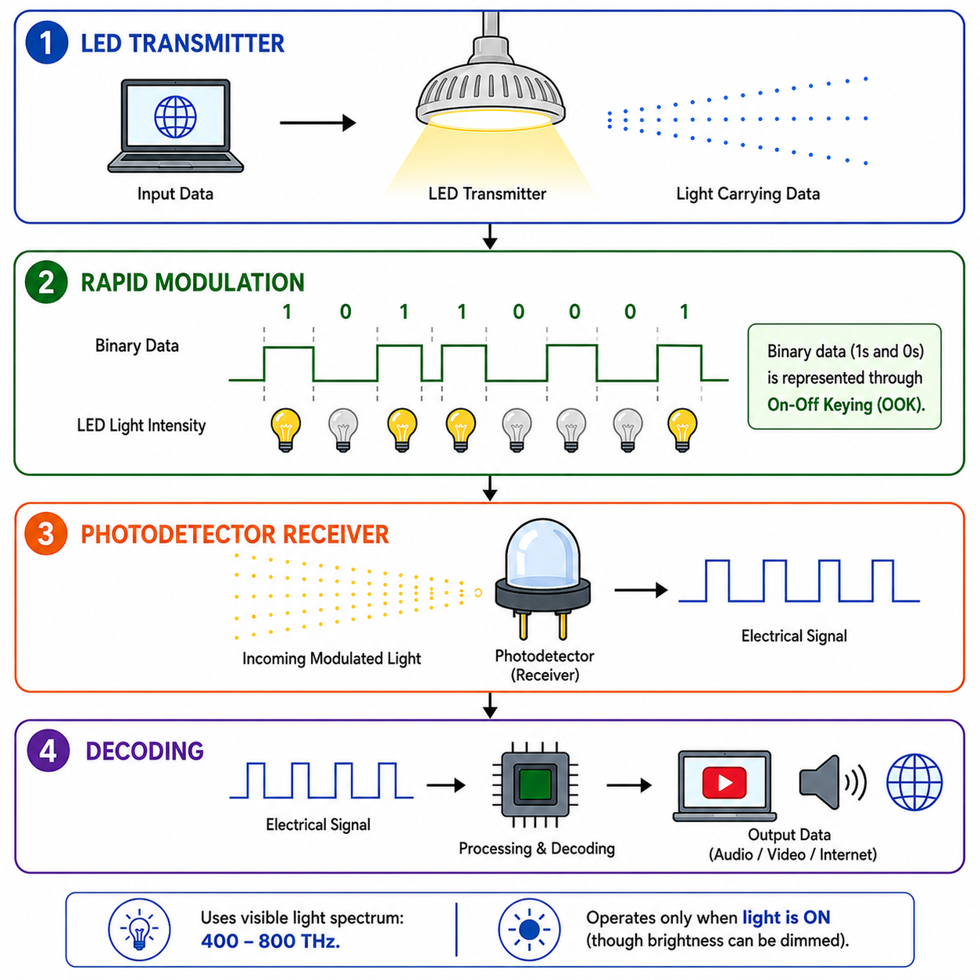
| 1. LED TRANSMITTER: The LED light source acts as a transmitter, emitting light that carries data signals. 2. RAPID MODULATION: Data is encoded by RAPIDLY MODULATING the intensity of the LED light — so fast that the human eye cannot perceive it. Binary data (1s and 0s) is represented through On-Off Keying (OOK). 3. PHOTODETECTOR RECEIVER: A photodetector (such as a photodiode) captures the light signal and converts variations in light intensity into electrical signals. 4. DECODING: The electrical signal is processed and decoded, converting it back into usable audio, video, or internet data. Uses visible light spectrum: 400–800 THz. Operates only when light is ON (though brightness can be dimmed). |
Advantages and Disadvantages of Li-Fi
| Advantages of Li-Fi | Disadvantages of Li-Fi |
| Very high data speeds (often >1 Gbps) — far exceeding Wi-Fi | Requires a continuous light source — stops if light is turned off |
| Enhanced security — light cannot penetrate walls, reducing unauthorised access | Limited coverage — cannot pass through walls or opaque barriers |
| No radio-frequency interference — ideal for hospitals, aircraft, MRI rooms | Performance disrupted by obstacles, shadows, or strong ambient sunlight |
| Uses a vast, unlicensed spectrum (visible light) — no congestion | Still in early deployment stages — limited commercial adoption |
Li-Fi vs Wi-Fi — Quick Reference
| Feature | Li-Fi | Wi-Fi |
| Medium | Visible light (LED) | Radio waves (2.4/5 GHz) |
| Speed | Very high (Gbps — up to 100x faster than Wi-Fi) | Moderate to high (Mbps) |
| Range | Short — room-based only | Wider — through walls |
| Penetration | CANNOT pass through walls | CAN pass through walls |
| Security | High (light cannot escape room) | Moderate (radio waves travel through walls) |
| Interference | No RF interference | Subject to RF interference |
| Best Use Cases | Hospitals, aircraft, data centres, underwater comms | Homes, offices, public spaces |