
Iran-Iraq War
We now turn our attention to one of the longest and most brutal conventional conflicts of the 20th century: the Iran–Iraq War. In the study of geopolitics, this is a classic example of a war where “everyone lost.” It was a collision of two egos—Saddam Hussein and Ayatollah Khomeini—and a clash of two distinct visions for the Middle East.
The Genesis of the Conflict: Fear and Ambition
To understand why Iraq invaded Iran in September 1980, we must look at the “Psychology of Survival” of Saddam Hussein.
The Threat of Revolutionary Islam
In 1979, the Iranian Revolution brought Ayatollah Khomeini to power. This wasn’t just a change in government; it was an Islamic earthquake. Khomeini wanted to export his “Islamic Republic” model. Saddam Hussein, who led a secular (non-religious) Ba’athist regime, was terrified.
While Iraq was ruled by Sunnis, it had a Shia majority (roughly 60% of the population at the time). Saddam feared that Khomeini’s fiery rhetoric would incite an uprising among Iraqi Shias. To prevent this, he chose the path of “pre-emptive aggression.”
Territorial and Ethnic Rivalries
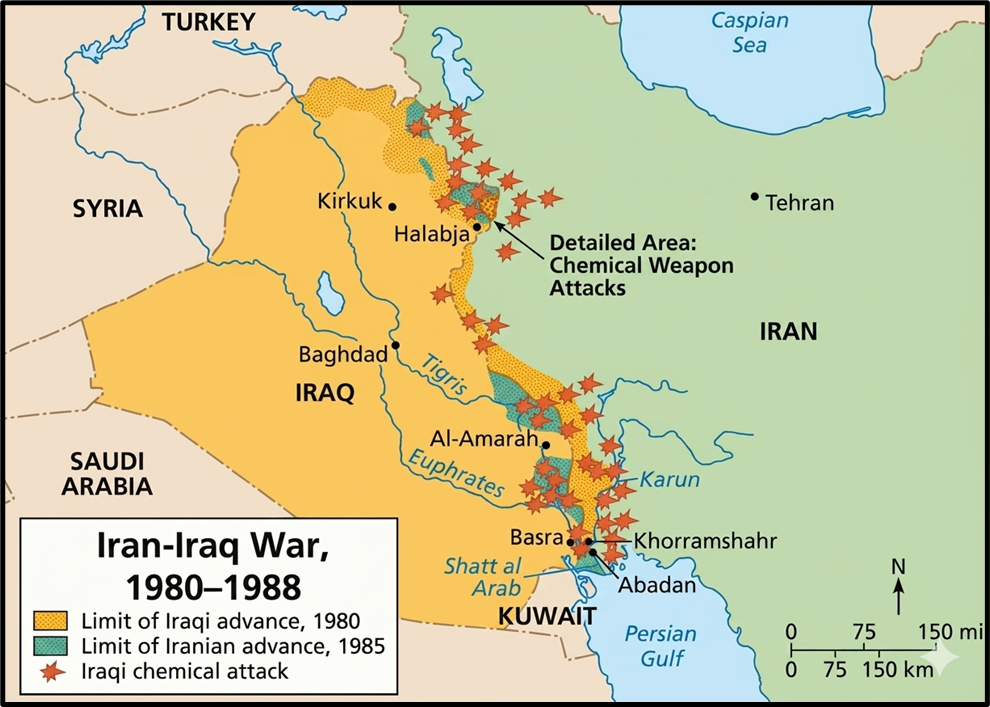
Beyond religion, there was a deep-seated ethnic divide: Persian vs. Arab. Saddam claimed the Iranian province of Khuzestan, which was oil-rich and populated by ethnic Arabs. He also sought full control of the Shatt-el-Arab waterway, a strategic 200km river that serves as the main outlet for oil exports for both nations. Saddam believed that Iran was in chaos after its revolution and that a “quick victory” would establish him as the undisputed leader of the Arab world.
The Brutal Stalemate: 1980–1988
Saddam’s “quick victory” turned into an eight-year nightmare. This war was a strange mix of World War I tactics and modern weaponry.
- Human Wave Attacks: Iran, lacking the sophisticated hardware of the Iraqi army, relied on the “fanaticism” of its Revolutionary Guards. They used “Human Wave” tactics—thousands of young men, often poorly armed, charging across minefields to overwhelm Iraqi positions. They sought martyrdom, fueled by the belief that they were fighting a “holy war” against a godless regime.
- The War of the Tankers: As the land war ground to a halt, both sides began attacking each other’s oil tankers in the Persian Gulf. This “Tanker War” was an attempt to cut off the economic lifeblood of the enemy.
- The “War of the Cities”: In a desperate attempt to break civilian morale, both sides launched missiles at each other’s capitals—Tehran and Baghdad. Thousands of civilians perished in these barrages.
Global Repercussions: A World on Edge
The Iran–Iraq War was not just a local feud; it threatened the global energy supply.
- The Arab Split: The Arab world was deeply divided. Conservative monarchies like Saudi Arabia and Kuwait poured billions of dollars into Iraq, fearing that a Khomeini victory would destabilize their own thrones.
- Conversely, states like Syria and Libya supported Iran, largely out of their own personal rivalry with Saddam Hussein.
- Superpower Involvement: This war saw the rare spectacle of the USA and USSR both leaning toward the same side (Iraq) at various points, though they also sold weapons to both.
- The US, in particular, was so concerned about an Iranian victory that they provided intelligence and “re-flagged” Kuwaiti tankers with American flags to protect them from Iranian attacks.
- The Energy Crisis: The constant threat to the Persian Gulf brought American, British, and French warships into the region, raising the stakes of a potential global conflict.
The End of the War: “The Poisoned Chalice”
By 1988, both nations were economically and physically exhausted. Iraq’s second city, Basra, was nearly captured, and Iran’s economy was in ruins.
The United Nations finally brokered a ceasefire in August 1988. Ayatollah Khomeini, who had famously sworn to fight until Saddam was destroyed, described accepting the peace as “drinking from a poisoned chalice.”
Critical Analysis: The Futility of the Conflict
When the guns fell silent in 1988, the borders returned exactly to where they were in 1980. Nothing had changed geographically, but the cost was staggering:
- Casualties: Estimates suggest over 1 million people died (roughly 400,000–600,000 for Iran and 250,000–400,000 for Iraq).
- Economic Ruin: Both countries had spent hundreds of billions of dollars, turning once-prosperous nations into debtor states.
From a historiographical perspective, the Iran–Iraq War was a “zero-sum game.” It didn’t solve the religious or ethnic tensions; it only deepened them. For Saddam Hussein, the massive debt he owed to Kuwait after this war would lead directly to his next fatal mistake: the invasion of Kuwait in 1990.