
Italy 1918-45
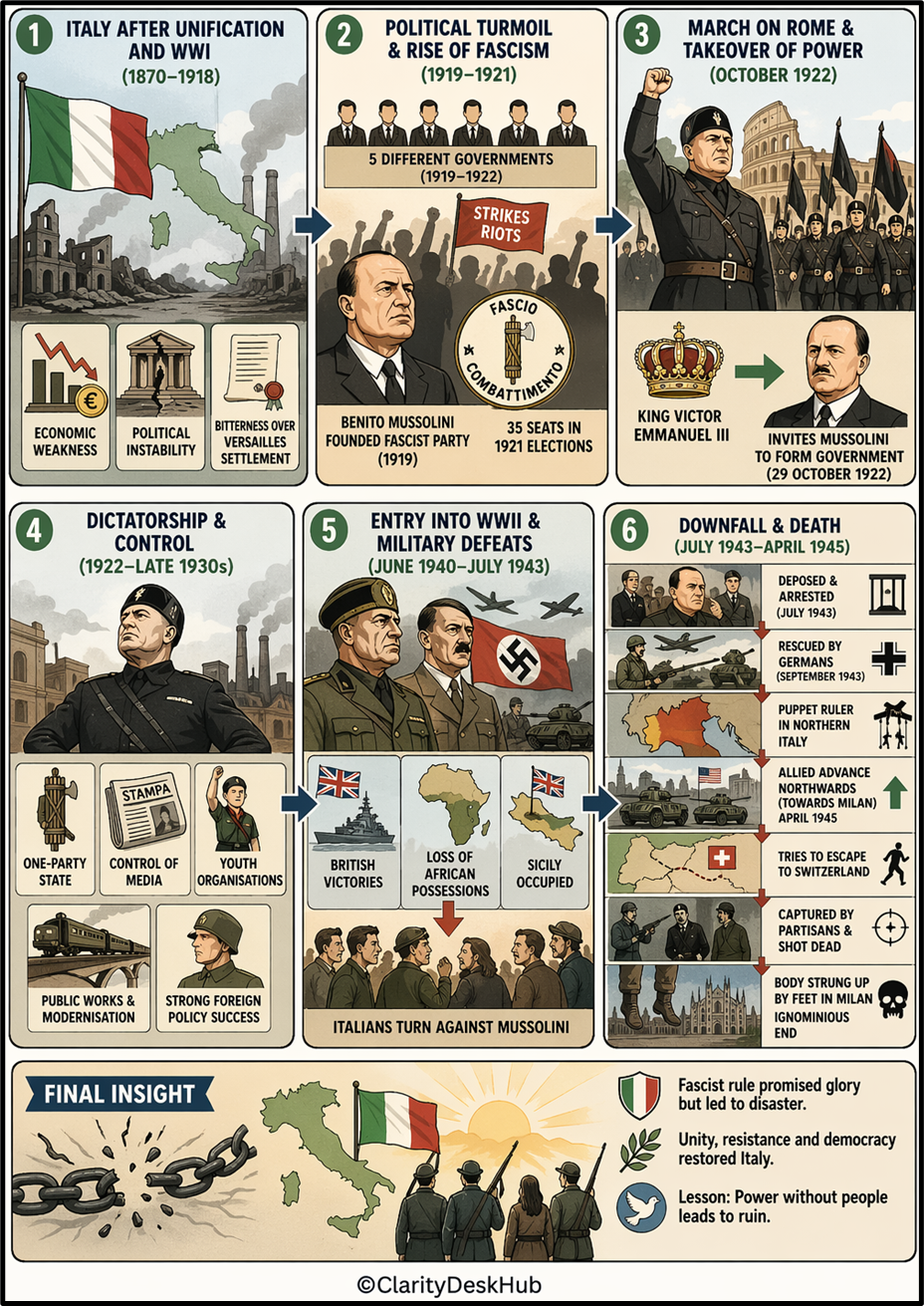
In this section, we are going to understand one of the most intriguing chapters of 20th-century history. Usually, when we think of a “Dictator,” we imagine someone who snatched power through a bloody coup. But the story of Benito Mussolini is different. It is a story of a “Mutilated Victory,” a paralyzed democracy, and a leader who mastered the art of political opportunism.
Let us look at why Italy, a country on the winning side of World War I, eventually handed its soul to Fascism.
The Psychology of a “Mutilated Victory”
To understand Mussolini’s rise, we must first understand the state of the Italian mind in 1919. Imagine a soldier returning from the front after losing 700,000 of his brothers-in-arms. He expects a hero’s welcome and the “spoils of war” promised by the Allies—territories like Dalmatia, Adalia, and a protectorate over Albania.
But when the Versailles Settlement was signed, Italy felt cheated. While they received some areas like Trentino and Trieste, many other promised lands were given to the new state of Yugoslavia. This sense of betrayal gave birth to the term Vittoria Mutilata (Mutilated Victory). It wasn’t just a loss of land; it was a loss of national dignity.
This frustration was personified by the romantic poet Gabriele d’Annunzio, who, with a group of volunteers, occupied the port of Fiume. When the Italian government eventually used the army to remove him in 1920 to restore international order, they were seen as “national traitors” attacking a “national hero.” The government’s authority didn’t just crumble; it became an object of contempt.
The Economic Quagmire and the “Red Scare”
History teaches us that bread and butter often dictate the fate of empires. Post-war Italy was an economic wreck. The government was drowning in debt, primarily to the USA. The value of the Lira plummeted—from 5 to the dollar in 1914 to 28 in 1921. Note that earlier, currency of Italy was Lira, till 2002, and after that it was replaced by Euro.
When inflation rises fivefold and 2.5 million ex-servicemen find themselves unemployed, the ground becomes fertile for radicalism.
Between 1919 and 1920, Italy witnessed the Biennio Rosso (the Two Red Years). There were massive strikes, factory occupations in Turin, and land seizures by socialist leagues in the south. For the wealthy elite and the middle class, this looked like the beginning of a Bolshevik revolution similar to Russia’s.
Interestingly, the formation of the Italian Communist Party in 1921 actually weakened the Left by splitting its votes, but it heightened the fear of revolution among the property owners. They needed a “Bulwark against Communism,” and Mussolini was more than happy to play that role.
The Paralysis of the Parliamentary System
Why didn’t the democratic government stop this? The answer lies in the technicalities of the electoral system. Italy had introduced Proportional Representation, which, while fair on paper, led to a fragmented parliament. By 1921, there were at least nine major parties, including Liberals, Socialists, and the Catholic Popular Party.
No single party could form a majority. Italy saw five different coalition cabinets come and go in quick succession. When a government changes every few months, it cannot implement consistent policies. The common man, tired of the “talking shops” in Rome, began to crave a “Strong Man” who could actually get things done. Mussolini’s critique of the “feeble” parliamentary system resonated because the system was, in fact, failing to govern.
P.S: Proportional Representation is an electoral system where seats in parliament are allocated to parties in proportion to the votes they receive.
The Metamorphosis of Mussolini
Benito Mussolini was a political chameleon. He started as a radical Socialist and editor of Avanti, but he was expelled for supporting Italy’s entry into WWI. In 1919, he founded the fasci di combattimento (fighting groups). Initially, his program was quite “Leftist”—anti-monarchy, anti-Church, and anti-big business.
However, after failing to win a single seat in 1919, he performed a brilliant political U-turn. He reinvented himself as the defender of private property and enterprise. He replaced his socialist rhetoric with extreme nationalism. His “Blackshirt” squads began attacking socialist headquarters and breaking strikes.
By late 1921, he had secured the backing of big business, the blessing of Pope Pius XI, and the cautious approval of the King by dropping his republican stance.
Key Concept: The word fasces refers to a bundle of rods with an axe, an ancient Roman symbol of power. Mussolini wasn’t just offering a policy; he was offering a return to the “glory of Rome.”
The “March on Rome” and the King’s Dilemma
By October 1922, the stage was set. The Socialists had called for a general strike, which failed. Mussolini seized the moment, posing as the “Saviour of the Nation.” He organized the March on Rome, where 50,000 Blackshirts converged on the capital.
Technically, the Italian Army could have crushed these poorly armed squads easily. Prime Minister Luigi Facta wanted to declare a state of emergency.
But King Victor Emmanuel III refused to sign the decree. Why?
- He doubted the army’s loyalty (many officers were pro-Fascist).
- He feared a bloody civil war.
- He was worried his cousin, the Duke of Aosta (a Fascist supporter), might replace him.
On October 30, 1922, the King invited Mussolini—who had been waiting nervously in Milan—to form a government. Mussolini arrived by train, not as a conqueror, but as an appointee.
The “heroic seizure of power” was largely a myth created for propaganda; in reality, it was a legal appointment born out of the King’s fear and the elites’ desperation.
Defining the Fascist Identity
Once in power, Mussolini transformed Italy into a One-Party State. To understand what Fascism stood for, we can look at its core pillars:
- The Corporate State: A system where the government controlled the economy through “corporations” of workers and employers, effectively stripping labor unions of their power.
- Autarky: A drive for economic self-sufficiency, ensuring Italy didn’t rely on imports.
- Cult of the Leader: The elevation of Mussolini as Il Duce (The Leader), a charismatic figure who was “always right.”
- Militarism: The belief that “Peace is absurd.” Fascism thrived on the glorification of war and the use of modern propaganda—parades, songs, and uniforms—to mobilize the masses.
In summary, Mussolini did not “steal” Italy; he “inherited” it because the existing democratic structures were too weak to hold the weight of post-war crises, and the traditional elites were too afraid of a Red Revolution to notice they were inviting a Black one.
Now, after understanding how Mussolini reached the gates of power, we must now analyze how he actually sat on the throne and redesigned the Italian state. It is a classic study in political science: how a leader uses democratic tools to dismantle democracy itself.
Mussolini didn’t become a dictator on day one. It was a gradual, calculated process—a “creeping” dictatorship that moved from a fragile coalition to a total monopoly on power.
The Legal Facade: From Premier to Strongman (1922–1924)
Initially, Mussolini was merely the Prime Minister of a coalition where only four out of twelve ministers were Fascists. He had to walk a tightrope. However, he cleverly secured “special powers” from the King for a year to “deal with the crisis.”
His first move was to legitimize his street thugs, the Blackshirts, by turning them into a formal state militia (the MVSN).
The real masterstroke was the Acerbo Law of 1923. Imagine a rule where the party getting the most votes—even if just a plurality—automatically gets two-thirds of the seats in Parliament.
In the 1924 elections, through a mix of genuine desire for stability and widespread fraud and violence, the Fascists secured a massive majority. The stage was now set for the transition from a “government” to a “regime.”
The Matteotti Crisis: The Point of No Return
Every dictatorship faces a “crisis of conscience” moment. For Mussolini, it was the murder of Giacomo Matteotti, a socialist leader who dared to expose the election fraud in Parliament. When Matteotti was kidnapped and stabbed to death, Italy was shocked. Mussolini’s popularity plummeted, and for a moment, it seemed the regime might collapse.
However, the opposition failed to unite. This “paralysis of the opposition” allowed Mussolini to recover. He realized that as long as the King and the elites feared Communism more than they disliked Fascist violence, his position was safe.
By 1925-26, he felt secure enough to drop the mask. He passed laws making the Prime Minister responsible only to the King (not Parliament) and gave himself the power to rule by decree. The electorate was slashed from 10 million to just 3 million of the wealthiest citizens.
The “Corporate State”: An Economic Mirage
Mussolini introduced a unique concept called the “Corporate State.” He claimed this would end class struggle by organizing employers and workers into 22 “corporations.” In theory, they were supposed to settle disputes peacefully for the nation’s sake. In reality, it was a sophisticated tool for control.
Strikes were banned, and Fascist-controlled unions were the only ones allowed to negotiate. To keep the workers quiet, Mussolini offered “bread and circuses”—free Sundays, annual paid holidays, and cheap tours.
But the analytical truth is that the big industrialists kept their freedom by funding the Fascist party, while the workers lost their voice. It was less about economic efficiency and more about domesticating the labor force.
Indoctrinating the Next Generation: “Believe, Obey, Fight”
Mussolini knew that to sustain Fascism, he had to capture the minds of children. Education became a factory for Fascist loyalty. Teachers wore uniforms and took oaths of allegiance. Textbooks were rewritten to glorify the “brilliance” of the Duce and the greatness of ancient Rome.
Organizations like the GIL and the “Sons of the Wolf” (for boys as young as 6) were created to military-style discipline into the youth. The slogan was simple: Libro e moschetto, fascista perfetto (Book and rifle, perfect Fascist). The goal was to replace individual thinking with a collective, militant national identity centered on total obedience.
The Lateran Treaty: Reconciling with the Cross
One of Mussolini’s most significant political achievements was the Lateran Treaty of 1929. Since 1870, there had been a deep rift between the Italian state and the Papacy. Mussolini, despite being a personal atheist, recognized that he could not rule a Catholic nation while at war with the Pope.
By recognizing Vatican City as a sovereign state and making Catholicism the official state religion, Mussolini won the Church’s endorsement. This gave him immense legitimacy among the conservative masses.
For the Pope, Mussolini was a “man sent by Providence” because he was the strongest wall against the “Godless” Communists.
The Dark Shift: The Introduction of Racial Laws
For many years, Mussolini showed little interest in anti-Semitism. There were even Jewish members in the Fascist party. However, after the 1935 invasion of Abyssinia, Italy found itself isolated from Britain and France and pushed into the arms of Hitler.
To prove his loyalty to the “Rome-Berlin Axis,” Mussolini cynically adopted racial policies. In 1938, the Charter of Race was published, claiming Italians were “Aryans” and Jews were inferior.
This was a tactical move to please Hitler, but it was deeply unpopular with the Italian public and the Pope. It marked the beginning of a darker, more radical phase of Fascism that ultimately led Italy into the catastrophe of World War II.
Critical Analysis: Was it Truly Totalitarian?
In history, we often debate if Mussolini’s Italy was “Totalitarian” (total control over all life) like Nazi Germany or Stalin’s Russia.
The nuanced answer is: No, it was more Authoritarian. Mussolini never managed to eliminate the two “rival” centers of power: the King and the Church. The King remained the Head of State and eventually used his power to dismiss Mussolini in 1943. The Church provided an alternative focus of loyalty for the people.
Unlike Hitler, who replaced the state with the Party, Mussolini often used the traditional state machinery (the civil service and the army) to rule.
He created a “cult of personality” where “Mussolini is always right,” but beneath the propaganda, the old structures of Italy remained partially intact. His regime was a “Dictatorship by Consent” that functioned as long as things were going well, but crumbled the moment the pressure of war was applied.
What do you think was the biggest mistake Mussolini made in his transition from a “popular leader” to a “dictator”—was it the murder of Matteotti or the alliance with Hitler? We shall explore that in a while.
So, after looking at how Mussolini consolidated his power, the most natural question that arises in the mind is: “What was in it for the common man?” Dictatorships rarely survive on fear alone; they usually offer a “grand bargain”—give up your freedom in exchange for security, pride, and prosperity.
Mussolini promised to rescue Italy from the “inefficiency” of democracy. Let us analyze whether he actually delivered or if he was, as his critics called him, a “political windbag.”
The Economic Vision: “Battles” and Autarky
Mussolini viewed economics not as a science of numbers, but as a theatre of war. He launched various “Battles” to achieve Autarky (self-sufficiency), believing a “warrior nation” should never depend on others for bread or coal.
The Battle for the Lira and Wheat
Mussolini wanted a strong currency for national prestige. In 1926, he artificially revalued the Lira. While this made importing raw materials cheaper for big industries like steel, it was a disaster for exporters. Italian goods became too expensive for the world, leading to wage cuts for workers even before the 1929 Depression hit.
Then came the “Battle for Wheat.” To stop importing grain, farmers were pushed to grow wheat everywhere.
Statistically, it looked like a win—imports dropped by 75%. But look at the analytical cost: Italy’s climate in the south is better for orchards and livestock. By forcing wheat growth, Mussolini ruined the more lucrative fruit and dairy exports. It was a classic case of political ego overriding economic logic.
The Battle for Births: A Social Failure
In 1927, Mussolini decided Italy needed 60 million people to be a global power. He taxed bachelors, gave medals to large families, and banned abortions. He wanted “12 children per family.” This was a complete failure. Despite the incentives, the birth rate actually fell. It turns out, you can control the Parliament, but you cannot dictate the private choices of families through state decrees.
Infrastructure and the “Trains on Time” Myth
If you visit Italy today, you will still see the massive railway stations and stadiums built during this era. Mussolini launched a massive public works programme to reduce unemployment.
- Land Reclamation: The draining of the Pontine Marshes near Rome was his crown jewel. It turned malarial swamps into fertile farmland and new towns.
- Modernization: He built motorways (Autostrade), bridges, and schools.
The famous saying that “Mussolini made the trains run on time” became the ultimate symbol of Fascist efficiency. While it was partly propaganda—the improvements had often started before him—it created an illusion of a disciplined, functioning state that many Italians, weary of post-war chaos, found comforting.
Dopolavoro: The “After-Work” State
To compensate workers for the loss of their trade unions and the right to strike, Mussolini created the Dopolavoro (After-Work) organization. It was a stroke of genius in social control. It provided:
- Cheap holidays, cruises, and mountain tours.
- Access to theatres, libraries, and brass bands.
- Mobile cinemas that traveled to rural areas (conveniently playing propaganda).
This was genuinely popular. It gave the working class a taste of the “middle-class lifestyle.” However, historians argue it was a “hollow popularity.” It made people tolerate the regime, but it didn’t necessarily make them “true believers” in Fascist ideology.
The Analytical Reality: Inefficiency and Inequality
When we peel back the layers of propaganda, the “Fascist Miracle” starts to look like a facade. There were three fundamental failures that Mussolini could never solve:
The North-South Divide
Italy remained a “Dualist Economy.” The industrial North thrived under government subsidies, but the South remained trapped in medieval poverty. By 1940, the wealthiest 1% still owned 40% of the land. The “Corporate State” did nothing to redistribute wealth; it merely protected the interests of the elite.
The Great Depression and Dependency
When the 1929 Wall Street Crash happened, Italy’s exports collapsed and unemployment soared to 1.1 million. Mussolini’s refusal to devalue the Lira until 1936 meant that Italian workers suffered more than most. Paradoxically, his drive for “independence” made Italy more dependent on Nazi Germany for coal, oil, and steel as the 1930s progressed.
The Cancer of Corruption
Perhaps the greatest failure was the regime’s internal rot. Mussolini tried to do everything himself—he held multiple cabinet posts and refused to delegate. But one man cannot watch every official.
Historiographical Perspective: Historian Dennis Mack Smith notes that officials often “pretended” to obey orders. Immense sums of money intended for land reclamation or welfare disappeared into the pockets of corrupt Fascist bosses (ras). Only about one-tenth of the land reclamation was ever actually completed.
Conclusion: A Verdict on the Fascist Experiment
Was Fascism beneficial? In the short term, it provided a sense of national pride and physical order. The infrastructure was real, and the reconciliation with the Church was a masterstroke.
But analytically, the costs were devastating. By destroying the right to strike and the free press, Mussolini removed the “feedback loops” that keep a government honest. The economy became a rigid, corrupt machine that looked strong on the outside but was hollow within.
When the real test of World War II came, the “Warrior Nation” discovered it had neither the steel nor the coal to back up its Duce’s rhetoric.
Table: Italian Iron and Steel Output (Million Tons)
| Country | Iron 1918 | Iron 1930 | Iron 1940 | Steel 1918 | Steel 1930 | Steel 1940 |
| Italy | 0.3 | 0.5 | 1.0 | 0.3 | 0.5 | 1.0 |
| Belgium | – | 3.4 | 1.8 | – | 3.4 | 1.9 |
| Germany | 11.9 | 9.7 | 13.9 | 15.0 | 11.5 | 19.0 |
| USA | 39.7 | 32.3 | 43.0 | 45.2 | 41.4 | 60.8 |
Look at the table above—even a tiny nation like Belgium was matching Italy’s steel production. This shows that despite the “Battles” and the slogans, Mussolini’s Italy remained a second-tier industrial power disguised in a first-tier uniform.
A quick question for you to ponder: If Mussolini had avoided the alliance with Hitler and stayed out of the war, do you think his “Authoritarian model” would have eventually evolved into a stable democracy, or was it destined to collapse under its own corruption?
Opposition and Downfall
Now, we have arrived at the final act of this historical drama. We have seen the rise and the “golden years” of Mussolini. Now, we must analyze the “Sunset of the Dictator.” It is often said that the seeds of a dictator’s downfall are sown at the height of his power. In Mussolini’s case, his downfall was not just a military defeat; it was a total collapse of the “Fascist Myth.”
The Mask of Stability: Why was there no Resistance?
You might wonder, if the economy was struggling and the “Battles” were failing, why did the Italians not revolt sooner?
The answer lies in a combination of State Terror and Social Resignation. While Mussolini’s political police (OVRA) were not as systematically genocidal as Hitler’s Gestapo, they were effective enough to drive any serious opposition underground.
Furthermore, Mussolini had the support of the “Traditional Elites.” The King, the aristocracy, and the wealthy industrialists saw him as their “Insurance Policy” against Communism. For them, a bit of Fascist corruption was a small price to pay to keep their properties safe from a Bolshevik revolution.
The media, entirely under state control, continued to project the image of a “Superhuman Duce,” and the average Italian, historically used to changing regimes, simply accepted his fate with a sense of resignation.
The Great Miscalculation: Italy as a German Satellite
The turning point was 1938. When Mussolini introduced the Racial Laws and began sacking Jewish officials, the Italian public felt a deep sense of unease. This wasn’t “Italian”; it felt like a forced imitation of German Nazism. The “Warrior Nation” was becoming a puppet of Berlin.
The ultimate disaster, however, was Italy’s entry into World War II in 1940. Mussolini wanted the “glory” of conquest but had failed to modernize the Italian military. While he spoke of “Roman Legions,” his soldiers were equipped with obsolete rifles from the First World War.
Italy had no heavy tanks and barely 1,000 planes. By declaring war on the USA in 1941, Mussolini horrified his own industrialist supporters, who knew Italy could never match the American industrial machine. The “Great Charismatic Leader” had finally lost his grip on reality.
The Internal Collapse: Hunger and the Coup
By 1943, the “Grand Bargain” had failed. Instead of glory, the Italians got British bombing raids, food rationing, and a 30% drop in real wages. In March 1943, the unthinkable happened: massive strikes broke out in Milan and Turin—the first in over twenty years. The people were no longer afraid; they were hungry.
When the Allies captured Sicily in July 1943, the Fascist leadership realized the game was up. In a dramatic meeting of the Fascist Grand Council, Mussolini’s own lieutenants turned against him. They passed a vote of no confidence, and the next day, King Victor Emmanuel III—who had facilitated Mussolini’s rise in 1922—dismissed him and had him arrested.
The most striking thing about Mussolini’s fall was how quietly it happened. There were no mass protests to save him; the “Fascist State” evaporated almost overnight.
Historiographical Perspectives: Was Fascism an Accident?
How should we remember this era? Historians are divided into two main schools of thought:
- The “Aberration” Theory: Scholars like Benedetto Croce argued that Fascism was a “moral infection” or a “temporary parenthesis” in Italian history. In this view, Mussolini was a “confidence trickster” who hijacked a normal country and led it astray. Once he was gone, Italy simply returned to its natural democratic path.
- The “Natural Growth” Theory: Historians like Renzo De Felice argue that Fascism wasn’t an accident. It grew naturally out of Italy’s social tensions and the rise of a new middle class seeking power. They argue that Mussolini actually modernized Italy’s backward economy to some extent, though critics like Martin Blinkhorn remind us that this “modernization” came at a brutal human cost.
The Revisionist Debate
In recent years, a “Revisionist” trend (led by writers like Nicholas Farrell) suggests that Mussolini might have been a “great man” who was simply handled poorly by British and French diplomacy.
They argue that if Britain hadn’t pushed him away during the Abyssinian crisis, he might have stayed on the Allied side. However, most historians find this unconvincing, as Mussolini’s ideology was fundamentally rooted in expansion and violence—he was bound to clash with the democratic powers eventually.
Final Synthesis: The Lesson of the Duce
So, the story of Mussolini is a warning. It shows how a society, when gripped by fear and economic despair, can trade its liberty for the promise of a “Strong Man.” Mussolini’s tragedy (and Italy’s) was that he mistook Propaganda for Power. He built a state made of cardboard but painted it to look like steel. When the rain of war came, the cardboard melted.
The most lasting legacy of Mussolini isn’t his motorways or his “Battles,” but the realization that a government that cannot tolerate criticism eventually loses its ability to see the truth.
Looking back at this entire journey, do you think Mussolini’s greatest failure was his Ideology (Fascism itself) or his Character (his inability to delegate and his obsession with personal glory)? Think.