
Energy Technologies
Renewable Energy
Let us begin with the most basic question: what exactly makes an energy source “renewable”?
Imagine two buckets of water. One is filled once and, as you keep using it, slowly empties and is gone forever — that is a fossil fuel like coal or petroleum. The other sits under a gently flowing tap that keeps refilling it as fast as you draw from it — that is renewable energy.
Formally:
| Definition: Renewable energy refers to energy derived from natural sources that are replenished continuously — sunlight, wind, flowing water, biomass, the heat of the Earth, and the tides. |
Notice the keyword — “replenished continuously”. Nature keeps refilling the bucket. The Sun will rise tomorrow, the wind will blow, rivers will flow, and crops will grow again next season. This single idea is the soul of the entire section.
Key Features of Renewable Energy
Before we study each source individually, let us understand the character of renewable energy as a family. What traits do all these sources share?
- Inexhaustible source: they come from natural processes (sunlight, wind, water, biomass) that are continuously replenished and simply do not run out.
- Environmentally friendly: they produce little to no greenhouse gas emissions, helping mitigate climate change and reduce pollution.
- Sustainable in nature: they meet present energy needs without compromising the ability of future generations to meet theirs — the very definition of sustainability.
- Low operating cost: after the initial setup, maintenance and running costs are generally low compared to fossil fuels.
- Decentralised production: they can be generated locally — rooftop solar, a village biogas plant — reducing transmission losses and improving rural access.
- Scalability and flexibility: they work from the tiny (a household) to the enormous (a utility-scale plant).
- Intermittency (a characteristic limitation): some sources — solar, wind — are variable and depend on the weather, so they need storage or backup. Note this honestly; the examiner loves a balanced answer.
- Technology-driven: rapid advances in storage, smart grids and efficiency keep improving their viability and adoption.
Why Does India Need Renewable Energy?
A thoughtful student now asks: “Sir, this sounds good — but why the urgency?” Excellent question. The need flows from several directions at once:
- Environmental protection: reduces greenhouse gases, controls air pollution, minimises the degradation caused by fossil fuels.
- Combating climate change: helps meet the Paris Agreement, move towards net-zero emissions, and reduce global-warming risks.
- Energy security: reduces dependence on imported fossil fuels, ensures stable supply, and shields against price fluctuations.
- Economic benefits: generates employment, promotes domestic manufacturing, lowers long-term costs.
- Supports a green economy: creates whole new industries — solar, wind, biofuels — and their jobs.
- Sustainable development: advances the SDGs, ensures clean energy access (SDG 7), promotes intergenerational equity.
- Rural development & access: enables rural electrification, supports agriculture, improves quality of life.
- Depletion of fossil fuels: fossil reserves are finite; rising demand makes renewables a necessary long-term alternative.
- Technological advancement: drives innovation in storage, smart grids and green hydrogen.
- Health benefits: by cutting air pollution, it lowers respiratory and cardiovascular disease.
| Fix this in memory: Whenever an answer asks “why renewable energy”, remember the three pillars — Environment, Economy, Energy Security (the three E’s). Almost every point above hangs from one of these three hooks. |
Solar Energy
| Definition: Solar energy is energy derived from the Sun’s radiation, harnessed and converted into electricity or heat using technologies such as photovoltaic cells and solar thermal systems. |
The Sun is the ultimate power station. In roughly one hour, the solar energy reaching the Earth exceeds what all of humanity consumes in a year. Our challenge is not availability — it is capturing and converting that energy usefully. There are two broad ways to do this, and you must never confuse the two.
Read in detail: Solar Energy – CDH IAS
Wind Energy
| Definition: Wind energy is the energy obtained from the kinetic energy of moving air (wind), converted into mechanical or electrical energy using wind turbines. |
Read in Detail: Wind Energy – CDH IAS
Hydropower
| Definition: Hydropower is energy generated from the movement (kinetic energy) of flowing or falling water, converted into electricity using turbines and generators. |
Hydropower is the grand old veteran of renewable energy — reliable, mature, the backbone of many power grids.
The physics is beautifully simple: water high in a reservoir holds potential energy; let it fall, and that becomes kinetic energy; let that moving water push a turbine, and we have electricity. Its uses go beyond power — irrigation support, flood control and water-supply management ride along.
How a Hydropower Plant Works
| Water at height (dam/reservoir) or a flowing river holds potential + kinetic energy |
▼
| Water is released (storage) or diverted (run-of-the-river) |
▼
| Flowing water gains kinetic energy as it moves downward |
▼
| Moving water rotates the turbine blades |
▼
| The turbine drives a generator → electricity |
Components of a Hydropower Plant
- Dam/reservoir: stores the water.
- Penstock: the channel/pipeline carrying water to the turbine.
- Turbine: converts water energy into mechanical energy.
- Generator: converts mechanical energy into electricity.
- Transformer: steps up the voltage for transmission.
The Three Types of Hydropower
Size and design change everything — cost, ecological footprint, social impact. In India, the dividing line of 25 MW is the one to remember.
Large Hydropower (generally above 25 MW in India)
| Advantages of Large Hydropower | Limitations of Large Hydropower |
| Base-load power — continuous, reliable electricity | High initial cost & long construction time |
| Low operating cost after installation | Displacement of people — rehabilitation & resettlement |
| Supports grid stability — load balancing, peak response | Environmental impact on river ecosystems & aquatic life |
| Multipurpose — irrigation, flood control, water supply | Siltation reduces storage capacity & efficiency over time |
Small Hydropower (up to 25 MW in India)
| Advantages of Small Hydropower | Limitations of Small Hydropower |
| Environment-friendly — low impact, minimal displacement | Limited output — cannot meet large-scale demand |
| Decentralised — suits micro-grids & local supply | Seasonal — output varies with rainfall |
| Lower cost & shorter project timelines | Site-specific — needs adequate flow & gradient |
| Improves rural electrification in remote regions | — |
Run-of-the-River Hydropower (little or no storage)
Here electricity is generated from the natural flow of a river, with little or no storage. It is gentle on the environment but, precisely because it stores no water, its output rises and falls with the river.
| Advantages of Run-of-the-River | Limitations of Run-of-the-River |
| Environment-friendly — less displacement & damage | Seasonal variability — depends on river flow & rainfall |
| Low cost & shorter timelines | No storage — limited control over supply |
| Ideal for hilly, river-rich regions | Variable, lower power output |
| Largely maintains natural river continuity | May still affect aquatic ecosystems |
Quick comparison — the three at a glance
| Feature | Large Hydro | Small Hydro | Run-of-the-River |
| Capacity | > 25 MW | Up to 25 MW | Small / variable |
| Storage | Large reservoir | Limited | Little or none |
| Environmental impact | Higher | Lower | Low |
| Displacement | Significant | Minimal | Least |
| Best suited for | Base-load & multipurpose | Local / micro-grids | Hilly, river-rich areas |
Bioenergy
| Definition: Bioenergy is energy derived from biomass (organic matter) — plants, agricultural waste, animal waste, municipal waste — converted into heat, electricity, or fuels. |
Here is an idea that should genuinely delight you. Every plant is a tiny solar battery: through photosynthesis it captures sunlight and locks it away as chemical energy inside its own body.
When we burn wood, ferment sugarcane, or digest cow dung, we are simply unlocking that stored sunlight. So bioenergy is, once again, the Sun’s energy — this time routed through living matter.
Working Principle of Bioenergy
| Biomass stores chemical energy captured from sunlight (photosynthesis) |
▼
| It is converted through combustion, fermentation, or digestion |
▼
| Energy released is used as heat, electricity, or fuel |
Sources of Biomass
- Agricultural residues: crop waste, straw and husk left after harvest.
- Animal waste: chiefly dung, used to produce biogas.
- Forest residues: wood, leaves and other forest biomass.
- Municipal solid waste (MSW): organic waste from households and cities.
- Energy crops: crops like sugarcane and corn grown specifically for fuel.
Forms of Bioenergy
| Form | Examples | How it is produced | Main uses |
| Gaseous biofuels | Biogas, Bio-CNG | Anaerobic digestion of organic waste | Cooking, electricity, transport (Bio-CNG) |
| Liquid biofuels | Bioethanol, Biodiesel | Fermentation & transesterification | Transport — blended with petrol/diesel |
| Solid biomass | Wood, crop residues, pellets | Direct combustion | Heat and electricity |
Biomass Conversion Technologies
The same biomass can be treated three different ways, and the amount of oxygen we allow decides the outcome. Watch this logic — it is elegant, and it is examinable.
- Combustion — burning biomass with oxygen. End products: heat, steam, ash. Used for electricity (steam turbines) and heating.
- Gasification — partial oxidation (limited oxygen). End product: syngas (CO + H₂ + CH₄) plus CO₂, water vapour, N₂. Used for power, industrial fuel and chemicals.
- Pyrolysis — heating biomass in the absence of oxygen. End products: biochar (solid), bio-oil (liquid), syngas (gas). Bio-oil/syngas give fuel; biochar enriches soil and locks away carbon.
| Memory hook: Full oxygen → Combustion. Limited oxygen → Gasification. Zero oxygen → Pyrolysis. More oxygen means more complete burning; less oxygen means we capture useful gases and solids instead of just heat. |
Advantages & Disadvantages of Bioenergy
| Advantages | Disadvantages |
| Renewable — biomass is continuously available | Emissions present — still releases CO₂ & pollutants |
| Waste utilisation — agri/animal/municipal waste to energy | Feedstock availability — needs a continuous supply |
| Reduces pollution — curbs open burning of residues | Land-use issues — energy crops may compete with food |
| Carbon-neutral potential — CO₂ released ≈ CO₂ absorbed | Lower efficiency than fossil fuels |
| Supports rural economy & farmer income | Storage & transport — biomass is bulky, hard to handle |
| Versatile — yields gas, liquid fuels and electricity | Deforestation risk from excessive biomass use |
Geothermal Energy
| Definition: Geothermal energy is the energy obtained from the heat stored inside the Earth, used to generate electricity or provide heating. |
Beneath our feet, the Earth is a furnace. Dig deep enough and the temperature keeps rising. Geothermal energy taps this in-built heat — no fuel to buy, no smoke to emit, and — unlike solar and wind — it runs day and night, giving steady base-load power. Applications: electricity, space heating, greenhouses, industrial use.
Working Principle of Geothermal Energy
| Heat from the Earth’s interior heats underground water |
▼
| This produces steam or hot water |
▼
| Steam is brought to the surface through wells |
▼
| It rotates turbines connected to a generator → electricity |
Types of Geothermal Power Plants
- Dry Steam Plants: use natural steam directly to drive turbines.
- Flash Steam Plants: use high-pressure hot water that flashes into steam when pressure drops.
- Binary Cycle Plants: use moderate-temperature water to heat a second fluid with a lower boiling point, which then drives the turbine.
| India connection: Geothermal in India is still in early stages. Promising sites: Puga Valley (Ladakh), Manikaran (Himachal Pradesh), and the Cambay Basin (Gujarat). These place-names are worth remembering. |
Advantages & Disadvantages of Geothermal Power
| Advantages | Disadvantages |
| Renewable and sustainable | Location-specific — limited suitable sites |
| Provides continuous base-load power | High initial cost (drilling, exploration) |
| Low emissions compared to fossil fuels | Risk of land subsidence or minor seismic activity |
| Requires less land area | Possible release of small amounts of toxic gases |
Tidal Energy
| Definition: Tidal energy is energy obtained from the rise and fall of sea levels (tides) — caused by the gravitational pull of the Moon and Sun — used to generate electricity. |
What makes tidal energy special is that it is utterly predictable. We can calculate the tides years in advance, because they follow the clockwork of the Moon and Sun. Solar depends on clouds, wind on weather — but the tide will come in tomorrow whether or not the sky is clear.
Working Principle of Tidal Energy
| Tides cause water levels to rise and fall |
▼
| Moving water during tides flows through turbines |
▼
| Turbines rotate and drive a generator → electricity |
Types of Tidal Energy Systems
- Tidal Barrage: a dam-like structure across an estuary, using the difference between high-tide and low-tide levels.
- Tidal Stream (Turbine): underwater turbines placed in fast-moving tidal currents.
- Tidal Lagoon: an enclosed coastal area that captures tidal water for power generation.
Advantages & Disadvantages of Tidal Energy
| Advantages | Disadvantages |
| Renewable & predictable — tides are regular | High initial cost |
| No fuel cost | Limited to coastal regions |
| Low emissions | Environmental impact on marine ecosystems |
| Long lifespan of installations | — |
Biofuels
| Definition: Biofuels are fuels derived from biological sources — plants, algae, animal waste — through biological and chemical processes such as fermentation, transesterification, and anaerobic digestion. |
The central promise of a biofuel: the CO₂ released when we burn it is partly offset by the CO₂ the plant absorbed while growing. This near-closed carbon loop is what makes biofuels cleaner than fossil fuels, at least in principle.
Read in Detail: Biofuels – CDH IAS
Non-Renewable Energy
The definition first: Non-renewable energy resources are those that exist in finite quantities and cannot be replenished within a human timescale. They are formed over millions of years through geological processes.
Notice the phrase human timescale. Technically, coal is still forming somewhere right now — but it will take millions of years. From the point of view of a human life, or even of a whole civilisation, it is gone the moment we burn it. That is why we call it non-renewable.
Why do these still dominate global energy? Three honest reasons: high energy density (a small lump of coal holds a lot of punch), reliability (no waiting for the sun or wind), and established infrastructure (the entire world’s machinery was built around them). The two sources are fossil fuels and nuclear energy.
Fossil Fuels — What Are They, Really?
Here is a thought that should genuinely amaze you. Fossil fuels are formed from the remains of ancient plants and animals, buried under layers of earth and subjected to heat and pressure over millions of years.
So when you fill petrol in your bike, you are, quite literally, burning sunlight that some prehistoric plant captured hundreds of millions of years ago. The fuel in your tank is ancient, fossilised solar energy. That is why they are called fossil fuels.
- They are the primary source of global energy and central to industrial development.
- Three types: Coal, Petroleum (crude oil), and Natural Gas. We will take them one by one.
Coal — the Black Diamond
Coal is a solid fossil fuel formed from the remains of ancient vegetation that accumulated in swampy environments and underwent carbonisation under heat and pressure over millions of years. It is the most abundant fossil fuel and, for India especially, the backbone of the energy mix.
- Composition: mainly carbon and hydrogen; the impurities are oxygen, nitrogen, sulphur, moisture and ash. Remember that word impurities — those impurities are exactly what will cause coal’s pollution problems later.
Read in Detail: Coal – CDH IAS
Petroleum (Crude Oil) — Black Gold
If coal came from ancient plants in swamps, petroleum came from ancient marine life in the sea. Petroleum is a liquid fossil fuel formed from the remains of marine organisms over millions of years under heat and pressure in the absence of oxygen.
- Composition: mainly hydrocarbons (alkanes, cycloalkanes, aromatics); impurities are sulphur, nitrogen, oxygen, metals, salts and water.
Read in Detail: Petroleum and Mineral Oil – CDH IAS
Natural Gas — the Cleanest Fossil Fuel
The third sibling, and the best-behaved of the family. Natural gas is a gaseous fossil fuel primarily composed of methane (~70–95%), found in underground reservoirs alone or alongside petroleum. It also contains ethane, propane, butane and small amounts of CO₂, nitrogen and hydrogen sulphide.
Read in Detail: Natural Gas – CDH IAS
Nuclear Energy — a Brief Introduction
The last member of the non-renewable family is fundamentally different from the other three. It does not come from dead plants or animals; it comes from the atom itself. Nuclear energy is obtained from atomic nuclei.
- Types: Nuclear fission (splitting nuclei — used in power plants) and nuclear fusion (joining nuclei — still experimental).
- Key fuels: Uranium-235, Plutonium-239, and Thorium-232 (the last being especially important for India).
Closing Thought — The Inheritance We Are Spending
So we have met the four members of the non-renewable family — coal, petroleum, natural gas, and the atom. Step back and you will see a clear ladder of cleanliness: coal is the dirtiest, petroleum sits in the middle, natural gas is the cleanest fossil fuel, and nuclear emits no CO₂ at all (though it carries its own burden of waste).
Energy Storage
Formally: energy storage refers to technologies that capture energy produced at one time and store it for use at a later time. Why do we need it? Five clean reasons:
- Intermittency of renewables: solar and wind are not continuous — storage time-shifts energy from generation to use.
- Grid stability: maintains frequency and voltage, preventing blackouts.
- Peak-demand management: stores energy in low-demand hours, releases it at peak to balance load.
- Electrification of transport: batteries power electric vehicles.
- Energy access: reliable electricity for remote and off-grid areas.
| The mental map for this topic Four families of storage, by what physically holds the energy: (1) Electrochemical — batteries; (2) Mechanical — pumped hydro, compressed air, flywheels; (3) Thermal — heat/cold; (4) Hydrogen. Then a few emerging stars. |
Battery Technologies (Electrochemical Storage)
Batteries store energy as chemistry. The trick in every battery is the same: ions shuttle back and forth between two electrodes — an anode and a cathode — through an electrolyte.
Charging pushes them one way; discharging lets them flow back, and that flow is the electric current. The only real differences between battery types are which ion does the shuttling and what the electrodes are made of.
Battery Energy Storage Systems (BESS)
A Battery Energy Storage System (BESS) is a technology that stores electrical energy in rechargeable batteries and supplies it back to the grid or consumers whenever required. It acts as a large rechargeable power bank for the electricity grid.
- It is a key enabler for integrating renewable energy sources such as solar and wind into the power system.
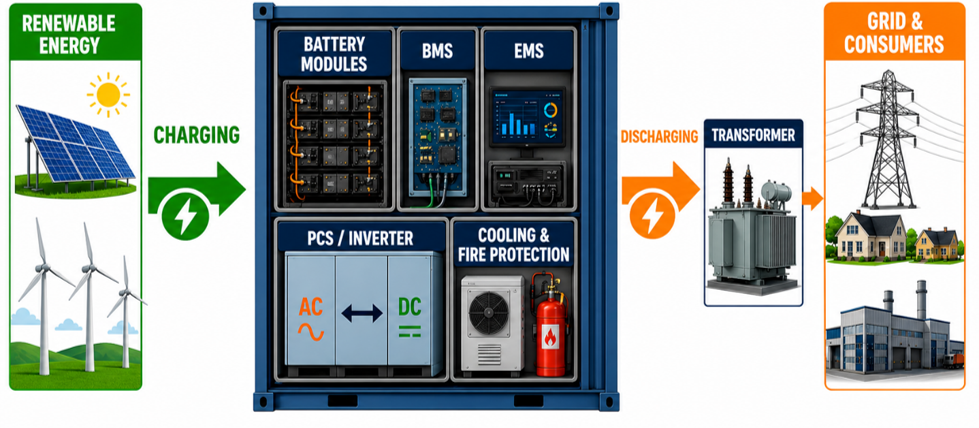
Major Components
- Battery cells/modules (commonly Lithium-ion)
- Battery Management System (BMS)
- Power Conversion System (PCS/Inverter)
- Energy Management System (EMS)
- Cooling and fire protection system
- Transformer and grid connection equipment
- An inverter, which converts the direct current from the batteries into the alternating current of the electricity grid (and vice versa);
- A transformer, which adapts the system’s voltage to that of the grid
- BESS technology is based on the use of electrochemical batteries, which can store the energy produced by renewable energy plants.
Advantages
- Grid Stability: Balances supply-demand fluctuations while supporting voltage and frequency regulation.
- Energy Security: Provides reliable backup power during outages and reduces dependence on imported fossil fuels.
- Peak Load Management: Meets peak electricity demand and reduces stress on the transmission network.
- Environmental Benefits: Facilitates clean energy adoption and helps reduce greenhouse gas emissions.
- Economic Benefits: Lowers electricity procurement costs and delays the need for new generation and transmission infrastructure.
BESS in India
- National Programme on Battery Energy Storage Systems (2023): Approved by the Union Cabinet. Supports deployment of 4,000 MWh of Battery Energy Storage Systems. Implemented through Viability Gap Funding (VGF). Encourages private sector participation. Helps integrate renewable energy and improve grid reliability.
- Production Linked Incentive (PLI) Scheme for Advanced Chemistry Cell (ACC) Manufacturing
- National Mission on Transformative Mobility and Battery Storage.
- PM Surya Ghar: Muft Bijli Yojana (distributed storage opportunities)
- Green Energy Corridor projects
Challenges for India
- Import Dependence: Heavy reliance on imported battery materials and critical minerals like lithium, cobalt, nickel, and graphite.
- Limited Domestic Ecosystem: Lack of a strong domestic manufacturing base for advanced energy storage technologies.
- Recycling Challenges: Developing recycling infrastructure and ensuring safe disposal of used batteries remain key concerns.
- Financial and Cost Barriers: High initial investment requirements and challenges in financing large-scale storage projects.
- Technical Limitations: Battery degradation over time, limited storage duration, and the need for improved safety standards.
- Infrastructure Issues: Challenges related to land availability, transmission connectivity, and grid integration.
Types of Battery Technologies
Lithium-ion Batteries (Li-ion)
The reigning champion — in your phone, your laptop, and almost every EV. Li-ion batteries work on the movement of Li⁺ ions between two electrodes. During charging, Li⁺ moves from cathode to anode (where it is stored); during discharging, it flows back to the cathode, producing current.
| Charging: Li⁺ ions move CATHODE → ANODE (stored in graphite) |
| ▼ |
| Discharging: Li⁺ ions move ANODE → CATHODE → produces electric current |
- Components: Anode = graphite; Cathode = lithium metal oxide (LiCoO₂, LiFePO₄); Electrolyte = lithium salt in organic solvent.
- Applications: EVs, smartphones, laptops, grid storage (BESS).
- Advantages: high energy density (more energy in less space); high efficiency (~90–95%); lightweight and compact; low self-discharge.
- Limitations: expensive (depends on lithium and cobalt); safety risk of thermal runaway (overheating/fire); recycling is complex.
Sodium-ion Batteries (Na-ion)
The promising challenger. It works just like Li-ion, but shuttles Na⁺ ions instead. Why does that matter? Because sodium is everywhere — it is in common salt — whereas lithium and cobalt are scarce and geopolitically sensitive.
- Applications: grid-scale storage, backup power, emerging EVs.
- Advantages: sodium is abundant and cheap; lower cost than Li-ion; better low-temperature performance; cuts dependence on critical minerals.
- Limitations: lower energy density; larger sodium ion → lower efficiency; technology still maturing.
Solid-State Batteries
The likely future of EVs. The big idea is in the name — replace the flammable liquid electrolyte with a solid one. This makes the battery far safer and allows a lithium-metal anode for higher energy density.
- Applications: future EVs, aerospace, defence, high-performance electronics.
- Advantages: safer (no leakage/fire), higher energy density, faster charging potential, longer lifespan.
- Limitations: high manufacturing cost, technical challenges (interface resistance), still under development.
Flow Batteries (Redox Flow)
A clever design for the grid. Here the energy lives in liquid electrolytes stored in external tanks; the liquids are pumped through a cell stack to generate electricity. The beauty? To store more energy, you just use a bigger tank.
- Types: vanadium redox flow; zinc–bromine flow.
- Applications: grid-scale storage, renewable integration.
- Advantages: long cycle life, easily scalable, ideal for long-duration storage.
- Limitations: low energy density, high initial cost, large space requirement.
Comparison of Battery Technologies
| Parameter | Li-ion | Na-ion | Solid-state | Flow |
| Energy density | High | Medium | Very High | Low |
| Power density | High | Moderate | High | Moderate |
| Cost | High | Low | Very High | High |
| Raw materials | Limited (Li, Co) | Abundant (Na) | Limited (Li-based) | Moderate (vanadium) |
| Safety | Moderate (thermal runaway) | Better than Li-ion | Very High (non-flammable) | Very High |
| Efficiency | ~90–95% | ~85–90% | High (expected) | ~70–85% |
| Cycle life | Moderate (1000–3000) | Moderate | High | Very High |
| Charging speed | Fast | Moderate | Very Fast (potential) | Slow |
| Scalability | Limited (cost) | Good | Limited (early) | Excellent |
| Maturity | Mature | Emerging | Developing | Semi-mature |
| Environment | Recycling issues | Lower impact | Depends on materials | Relatively eco-friendly |
Mechanical Energy Storage
Forget chemistry for a moment. You can also store energy as plain old physics — as height, as compression, as spin. These mechanical methods are often cheaper and longer-lasting than batteries, and they handle the really big, grid-scale jobs.
Pumped Hydro Storage (PHS)
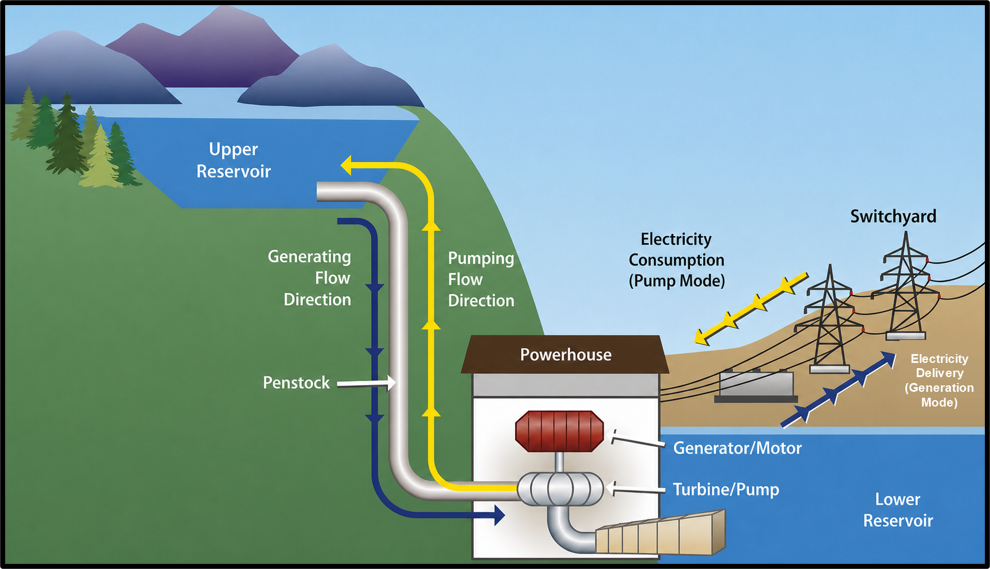
The workhorse — the most widely used large-scale storage in the world. The idea is almost childishly simple: use cheap surplus electricity to pump water uphill; later, when you need power, let it flow back down through turbines. A giant water battery.
| Low demand: pump water from LOWER reservoir → UPPER reservoir |
| ▼ |
| Peak demand: release water DOWN through turbines → electricity |
- Efficiency ~70–80%, lifespan 40–60 years. Applications: grid balancing, large-scale storage.
- Advantages: high capacity & reliability, proven technology, ideal for grid balancing.
- Limitations: needs suitable geography, high initial cost, environmental concerns (land use, ecosystem).
Types of PSPs
- Open-loop PSP: Uses one reservoir connected to a natural river or lake system.
- Closed-loop PSP: Uses two reservoirs that are isolated from natural water bodies, reducing environmental impacts.
Major Pumped Storage Projects in India
- Tehri Pumped Storage Project – Uttarakhand – Under development.
- Purulia Pumped Storage Project (PSP) – West Bengal – Operational.
- Kadamparai Pumped Storage Project (PSP) – Tamil Nadu – Operational.
- Sardar Sarovar Pumped Storage Project (PSP) – Gujarat – Proposed/Planned.
- Sharavathy Pumped Storage Project (PSP) – Karnataka – Proposed expansion.
- Koyna Hydroelectric Project – Maharashtra – Operational; expansion under consideration.
Compressed Air Energy Storage (CAES)
Same logic, different medium. Compress air using electricity, store it in underground caverns, then release it to drive turbines. Often combined with natural gas to improve efficiency.
- Applications: grid-scale storage, backup power.
- Advantages: lower cost than batteries, large capacity.
- Limitations: needs specific geological formations, lower efficiency (~40–70%), some designs use fossil fuel.
Flywheel Energy Storage
The sprinter of the family. Store energy as rotational kinetic energy in a spinning rotor — electricity speeds it up; slowing it down releases energy. Very fast response, ideal for short bursts.
- Applications: short-duration storage, frequency regulation, power-quality management.
- Advantages: long life (no chemical degradation), high efficiency (~85–95%), rapid delivery.
- Limitations: high self-discharge, limited storage duration, high cost.
Thermal Energy Storage
Sometimes the energy we want to store is heat itself. Thermal energy storage stores energy as heat or cold for later use — especially valuable for solar thermal power, where the sun’s heat can be banked for after sunset. Three methods, distinguished by the physics they exploit:
- Sensible heat storage: raise a material’s temperature without any phase change (water, sand, molten salts). Simple, low-cost, widely used — but lower energy density and heat loss over time. Used in hot-water tanks and solar thermal plants.
- Latent heat storage: store energy during a phase change (solid ↔ liquid) using Phase Change Materials / PCMs (paraffin wax, salt hydrates). High energy density and near-constant temperature — but costly materials and stability issues over cycles. Used in building heating/cooling and solar storage.
- Thermochemical storage: store energy in reversible chemical reactions — energy absorbed on charging, released when the reaction reverses. Very high energy density and long-term storage with minimal loss — but complex, costly, still developing.
| A one-line way to remember the three Sensible = just get it HOT (temperature rises, no phase change). Latent = MELT it (energy hides in the phase change). Thermochemical = REACT it (energy locked in a reversible chemical bond). Energy density rises as you go down this list — and so does the cost and complexity. |
Hydrogen Energy Storage
Recall from the Hydrogen Economy section — hydrogen is an energy carrier. That makes it a natural way to store energy too: convert surplus renewable electricity into hydrogen, keep it, and convert it back later.
Hydrogen energy storage uses hydrogen as an energy carrier to store and deliver energy — a key piece of the green hydrogen economy. But how do you actually keep a gas that is the lightest, most slippery element there is? Three ways:
- Compressed hydrogen gas: stored under high pressure (350–700 bar) in special cylinders. Simple, widely used, quick refuelling — but low energy density by volume and high-pressure safety concerns. Used in fuel-cell vehicles.
- Liquid hydrogen: cooled to –253°C and stored cryogenically. Higher energy density than gas, good for transport — but liquefaction is energy-hungry, suffers boil-off losses, and needs expensive cryogenic systems. Used in space and rockets.
- Solid-state (material-based): hydrogen absorbed into materials like metal hydrides (e.g., MgH₂) or metal-organic frameworks (MOFs). Safer (low pressure), high volumetric density — but heavy materials, slow release, high cost.
Emerging Technologies
Finally, three exciting newcomers worth a line each in any answer on the future of storage:
- Supercapacitors: store energy as electrostatic charge at the electrode-electrolyte interface (an electric double-layer), with some pseudocapacitance from fast surface redox. Very fast charge/discharge, high power density, long cycle life, ~95–98% efficiency — but low energy density and high self-discharge. Used in regenerative braking, power backup, grid stabilisation.
- Graphene batteries: use graphene in electrodes to boost conductivity and surface area → faster charging, higher energy density, lightweight, longer life. Still costly and hard to scale; under development. For next-gen EVs and electronics.
- Gravity-based storage: lift heavy masses (water, blocks, weights) with surplus electricity; lower them to regenerate power. Long lifespan, low environmental impact, no chemical degradation — but site-specific, high infrastructure cost, lower energy density. For grid-scale renewable integration.
One Comment