
UPSC CURRENT AFFAIRS — 26 NOVEMBER 2026
1. Ending Violence Against Women: Laws Strong, Enforcement Weak
(SOCIAL JUSTICE) (HT) The International Day for the Elimination of Violence against Women was observed on 25 November 2026. India marked it with the launch of Nayi Chetna 5.0, a Violence-Free Village MoU and the #NumberSaveKiya? drive urging women to save the Women Helpline (181) and Emergency Response Support System (112) numbers.
About the Day
- Origin: honours the Mirabal sisters, political activists killed in the Dominican Republic on 25 November 1960.
- UN recognition: the Declaration on the Elimination of Violence against Women was adopted in 1993; the UN General Assembly designated 25 November as the international day in December 1999.
- 16 Days of Activism: runs from 25 November to 10 December (Human Rights Day); orange is the UNiTE campaign colour.
The Indian Picture
| Indicator | Data |
|---|---|
| Crimes against women (NCRB, 2024) | 4.41 lakh cases, down 1.5% from 2023; crime rate 64.6 per lakh women (66.2 in 2023) |
| Largest category | Cruelty by husband or relatives |
| Highest numbers / rates | Uttar Pradesh recorded the most cases; Delhi and Telangana had rates about double the national average |
| Spousal violence (NFHS-6) | More than 1 in 5 ever-married women aged 18–49 report it; higher in rural than urban areas |
For the campaign details of Nayi Chetna 5.0 and the Violence-Free Village MoU, see our 24 November notes.
Why Violence Persists
- Under-reporting: stigma, fear and long trials keep most survivors away from the police.
- Enforcement gaps: low awareness of remedies, unsafe public spaces and weak gender sensitisation of police.
- Workplace law gaps: women in the informal sector are largely outside the reach of the POSH Act committees.
- Digital abuse: deepfakes, cyberstalking and online harassment are growing faster than police capacity.
- Legal grey zones: courts differ on whether transgender women are covered by the BNS definition of “woman”, creating unequal protection.
What Can Help
Survivor-centred policing ➜ Fast-track courts ➜ One-stop centres and legal aid ➜ Economic independence ➜ Safe transport and hostels
Ending violence is a constitutional duty under Articles 14, 15 and 21. Laws need to be matched by trained police, quick trials, safe infrastructure and women’s economic agency.
📖 Read More: National Commission for Women • Role of Women and Women’s Organisations
2. Naxal-Free India: How the Red Corridor Was Dismantled
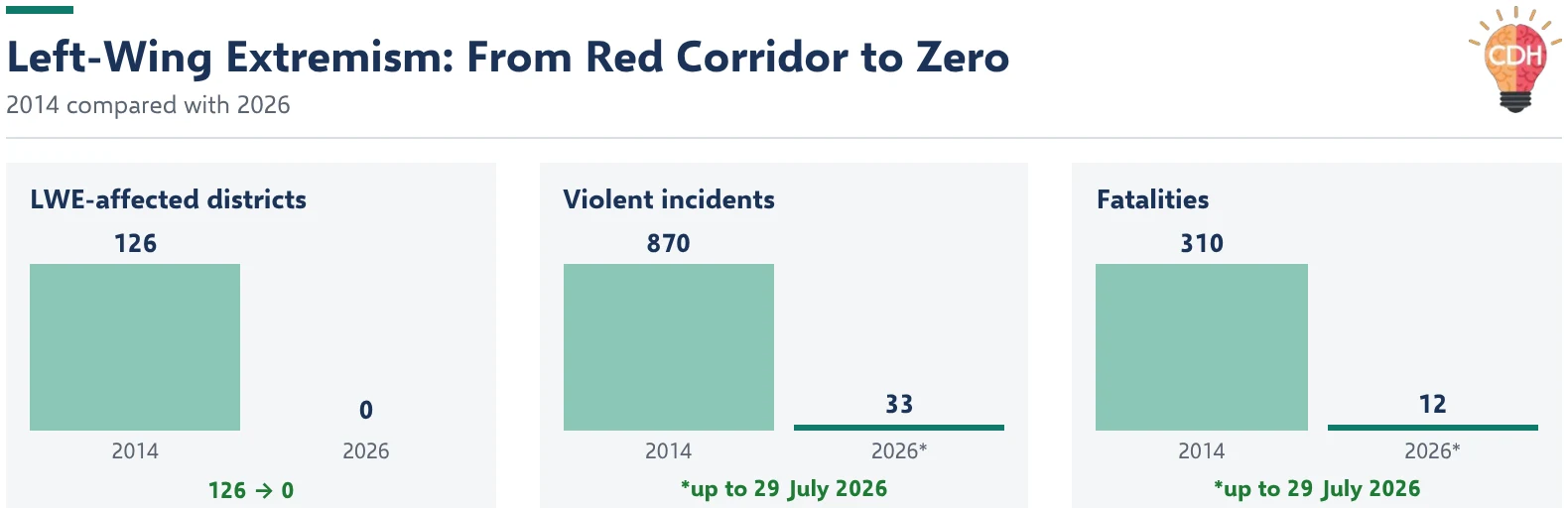
(INTERNAL SECURITY) (PIB) The Union Government highlighted India becoming effectively free from Left-Wing Extremism (LWE) on 31 March 2026, with no district now classified as LWE-affected. The target had been set on 24 August 2024.
From Naxalbari to the Red Corridor
- Origins: the 1967 Naxalbari uprising in West Bengal; groups merged into the CPI (Maoist) in 2004.
- Peak: 2010 saw 1,936 incidents; the 2004–14 decade recorded 17,542 incidents, 5,019 civilian and 1,913 security-force deaths.
- Roots: governance gaps, tribal land alienation and the “resource curse” of mineral-rich forests.
The Four-Pronged Strategy
| Prong | Key measures |
|---|---|
| Security | National Policy and Action Plan (2015); 668 new security camps and 615 fortified police stations; CoBRA, DRG and Greyhounds trained together; “Trace, Target, Neutralise” operations such as Operation Black Forest; all Polit Bureau and Central Committee members (41 since 2014) neutralised |
| Development | 15,189 km of roads; mobile coverage in 96% of villages in the worst-hit areas; 1,804 bank branches and 6,025 post offices; EMRS, ITIs and a super-speciality hospital at Jagdalpur |
| Rights and entitlements | 21,26,273 title deeds under the Forest Rights Act, 2006; surrender grants of ₹5 lakh (senior cadres) and ₹2.5 lakh (others) plus ₹10,000 a month for 36 months |
| Perception management | Outreach on welfare schemes; Tribal Youth Exchange Programme; Civic Action Programme by CAPFs |
- Funding the fight: a dedicated NIA vertical targets Naxal finances; Special Central Assistance (2017) fills local infrastructure gaps.
- Milestone: for the first time in 47 years, the CRPF lost no personnel on duty in a year.
Consolidating the Gains
- 38 “Legacy and Thrust” districts still receive security and development support to prevent relapse.
- Seva Dera Kendras: one-third of security camps are being turned into integrated service centres.
- Remaining risks: underground support networks, gaps in PESA rules, mining without meaningful Gram Sabha consent, and limited processing of minor forest produce.
📖 Read More: Countering Left-Wing Extremism • Understanding Left-Wing Extremism • Forest Rights and Conservation Strategies
3. Time to Reset PMJJBY and PMSBY
The Two Schemes
| Feature | PMJJBY | PMSBY |
|---|---|---|
| Cover | Term life: death from any cause | Accident: death or disability |
| Sum assured | ₹2 lakh | ₹2 lakh (death/total disability); ₹1 lakh (partial disability) |
| Age | 18–50 at entry; renewable up to 55 | 18–70 |
| Mode | Annual (1 June–31 May), auto-debit from bank or post office account | Same |
| Special condition | 30-day lien for non-accidental death for new subscribers | Only specified accidental outcomes |
Where They Fall Short
- Lapses: PMJJBY had about 26.79 crore cumulative enrolments but only 12.55 crore active policies (February 2026, Lok Sabha reply). Many lapse because accounts lack balance on the auto-debit date.
- Inflation: the ₹2 lakh cover has been unchanged since 2015.
- Age cap: PMJJBY entry stops at 50, leaving older informal workers out.
- Low penetration: insurance penetration was about 3.7% of GDP in FY25, roughly half the global average.
Reforms Already Under Way
- Sabka Bima Sabki Raksha (Amendment of Insurance Laws) Act, 2025: raises FDI in insurers from 74% to 100%, creates a Policyholders’ Education and Protection Fund and strengthens IRDAI.
- Bima Trinity: Bima Sugam (marketplace), Bima Vistaar (simple bundled cover) and Bima Vahak (women agents).
- GST: individual life and health policies have been exempted from GST.
Suggested Reset
Inflation-linked cover ➜ Grace period and retry debits ➜ UPI AutoPay renewals ➜ Death-registry linkage for claims
These schemes deliver the welfare goals of Articles 38, 39 and 41. Fixing renewals and cover is key to the target of “Insurance for All by 2047” and deeper financial inclusion.
📖 Read More: Financial Inclusion in India • National Pension System
4. ₹11,000-Crore Push for Construction Equipment Manufacturing
(ECONOMICS) (PIB) The Union Cabinet approved the Scheme for Enhancement of Construction and Infrastructure Equipment (CIE) Manufacturing Ecosystem with an outlay of ₹11,000 crore, to be run by the Ministry of Heavy Industries.
| Feature | Details |
|---|---|
| Aim | Boost domestic manufacturing of CIE and components; set up a dedicated CIE testing facility |
| Equipment | Ship-to-shore cranes, tunnel boring machines, hydraulic excavators, off-highway trucks |
| Sales-linked incentive | 13% to 8% (graded) of incremental sales for OEMs and component makers, over five years |
| Testing facility | Grant of up to ₹375 crore as Viability Gap Funding |
| Duration | Eight years from FY 2026-27 |
2 years gestation (FY27–FY28) ➜ 5 years incentives (FY29–FY33) ➜ Final settlement year (FY34)
Why It Matters
- Market size: India’s CIE industry is already the world’s third largest (after China and the US), worth about ₹97,500 crore in FY25 and projected to reach about ₹2,28,100 crore by FY30.
- Import substitution: high-end items such as tunnel boring machines and port cranes are largely imported.
- Infrastructure push: roads, ports, metros and housing need reliable, locally serviced equipment.
- Testing: a domestic test centre cuts certification costs and time for exporters.
The scheme follows the logic of the PLI schemes and Make in India: reward added output, not just investment.
📖 Read More: Schemes under the Ministry of Heavy Industries • Infrastructure Sector of the Indian Economy
5. Postal Operations Scheme Extended With ₹1,141 Crore
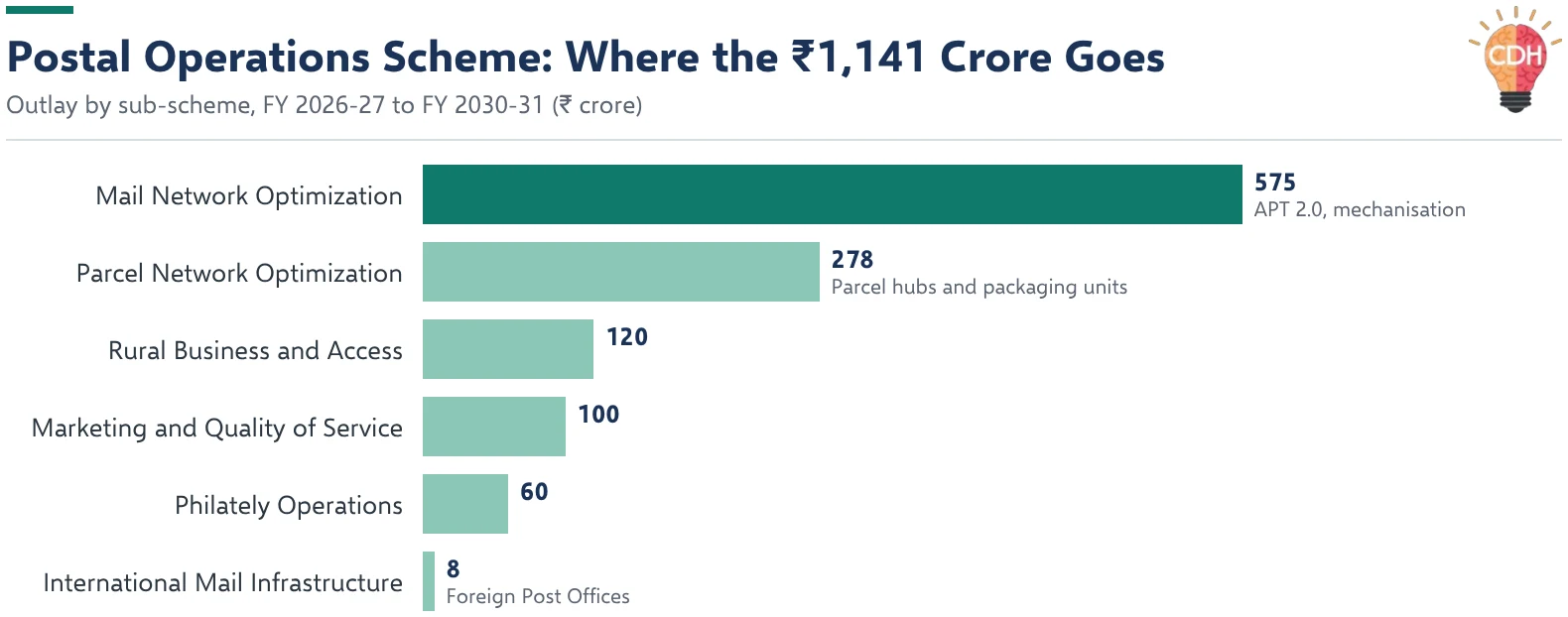
(POLITY AND GOVERNANCE) (PIB) The Union Cabinet approved the continuation of the Central Sector Scheme “Postal Operations” for the 16th Finance Commission cycle (FY 2026-27 to FY 2030-31) with an outlay of ₹1,141 crore, to modernise India Post for e-commerce, logistics and digital services.
India Post at a Glance
- Network: about 1.65 lakh post offices, of which 1,49,655 are rural — one of the world’s largest postal networks.
- Services: Post Office Savings Bank, India Post Payments Bank, Postal Life Insurance, Aadhaar services, Post Office Passport Seva Kendras and Dak Ghar Niryat Kendras for rural exporters.
- Outreach: Dak Chaupal camps and the SPARSH scholarship for young philatelists.
Why It Matters
- E-commerce: parcel hubs and packaging units help India Post compete in last-mile logistics.
- Financial inclusion: rural post offices remain the nearest bank for many villages.
- Governance: post offices deliver citizen services where other offices are absent.
📖 Read More: Schemes under the Ministry of Communications • Digital India Programme
6. National Milk Day: India’s Dairy Story in Numbers
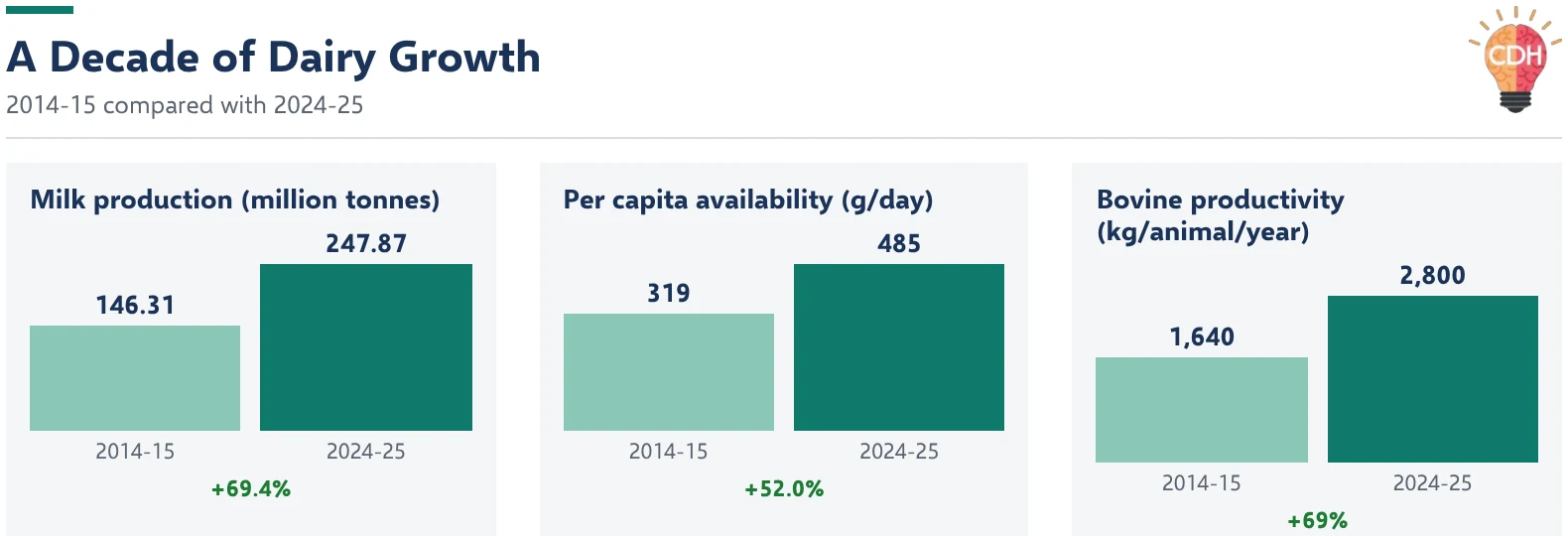
(ECONOMICS) (PIB) National Milk Day is observed on 26 November, the birth anniversary of Dr. Verghese Kurien, the “Father of India’s White Revolution”. This year’s national event was held in Patna, Bihar.
Status of the Sector
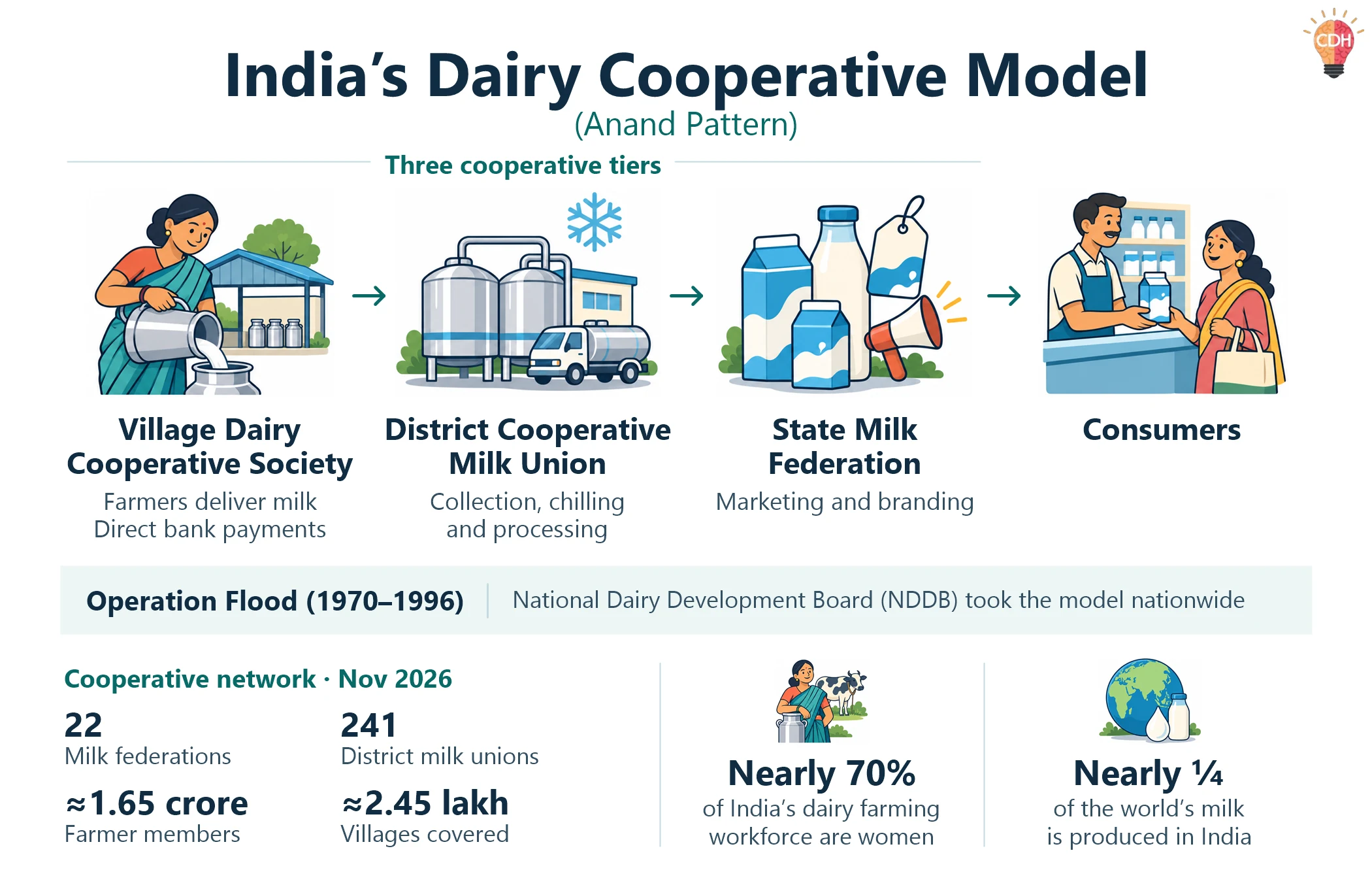
- World leader: India produces nearly one-fourth of the world’s milk.
- Top States: Uttar Pradesh (15.66%), Rajasthan (14.82%), Madhya Pradesh (9.12%), Gujarat (7.78%) and Maharashtra (6.71%) — together 54.09%.
- Livelihoods: dairying supports 8.5 crore rural households; women make up nearly 70% of the workforce.
- Exports: about 97,525 tonnes of dairy products worth US$407 million in 2025-26.
The Cooperative Backbone
Built on the Anand pattern and scaled up by Operation Flood (1970–1996) under the NDDB, the network now has 22 federations, 241 district unions and about 1.65 crore farmer members across 2.45 lakh villages.
Key Government Initiatives
| Initiative | Focus |
|---|---|
| Rashtriya Gokul Mission (2014, revised 2025) | Indigenous breeds; sex-sorted semen, IVF; 50,023 MAITRIs trained |
| National Programme for Dairy Development | Procurement, chilling, testing and processing infrastructure |
| AHIDF | 3% interest subvention for eight years on processing and cold chain |
| LHDCP / NADCP | 4,019 Mobile Veterinary Units; FMD outbreaks down from 132 (2019) to 40 (2025) |
| White Revolution 2.0 | 75,000 new dairy cooperative societies by 2028-29; 24,097 formed so far |
| Bharat Pashudhan | 12-digit Pashu Aadhaar ear tags; 39.42 crore issued |
Challenges
- Low yield per animal, fodder shortages and heat stress from climate change.
- Gaps in chilling and processing; milk adulteration and testing capacity.
- Diseases such as FMD and brucellosis.
📖 Read More: Livestock Resources and White Revolution • Dairy Farming • Cooperatives in India
7. Floriculture: India’s Blooming Sunrise Industry
Key Facts
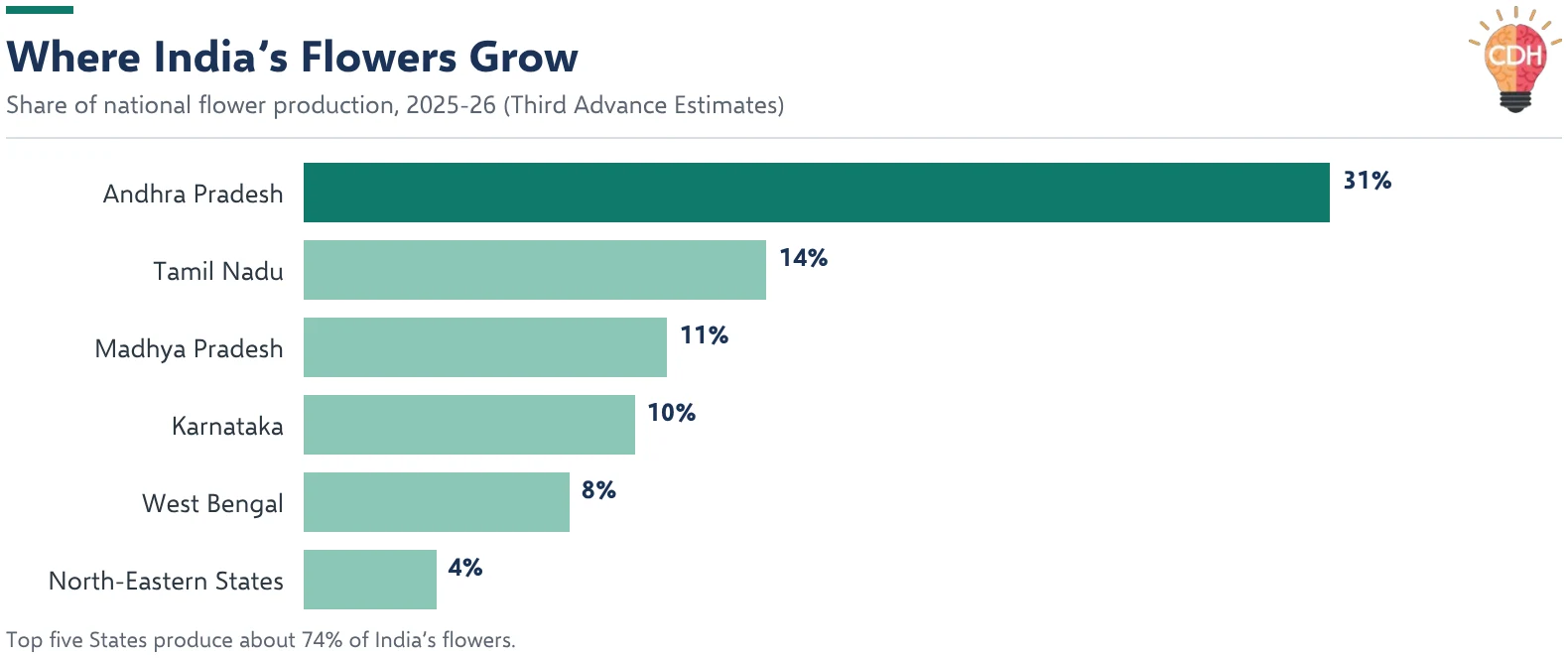
- Scale (2025-26): about 4.10 lakh hectares and 48.82 lakh tonnes of flowers — 36.53 lakh tonnes loose and 12.29 lakh tonnes cut flowers.
- Exports: floriculture and seed exports rose from US$216.74 million (FY22) to US$258.26 million (FY26); the US is the top buyer, followed by the Netherlands.
- Dry flowers form a major share of exports because of their longer shelf life.
- North-East: the first export of anthuriums from Mizoram to Singapore took place in February 2025.
| Category | Examples | Main use |
|---|---|---|
| Loose flowers | Marigold, jasmine | Garlands, worship; exported mainly to Gulf markets |
| Cut flowers | Rose, gerbera, carnation, orchid, lily | Bouquets; often grown in greenhouses for export |
| Others | Cut foliage, potted plants, dry flowers | Décor and landscaping |
Support Systems
- MIDH (National Horticulture Mission, HMNEH and National Horticulture Board) and APEDA for exports.
- CSIR Floriculture Mission (2021): over 2,208 hectares in 399 clusters; tulips at Palampur and eustoma in Sambalpur.
- CSIR Aroma Mission (2017): over 51,000 hectares of aromatic crops.
📖 Read More: Horticulture • Specialized Horticulture
8. SAMAVESH and e-Anudaan: One Window for Welfare
(SOCIAL JUSTICE) (NOA) The Ministry of Social Justice and Empowerment launched SAMAVESH and a new e-Anudaan portal on 25 November 2026, bringing its schemes and partner organisations onto common digital platforms.
| Portal | What it does |
|---|---|
| SAMAVESH (Single Access Mechanism for All Verticals of Empowerment and Social Harmony) | AI-enabled single gateway to the Department’s schemes; common login, less paperwork; AI chatbot “Samajik Sahayak” in 22+ languages |
| e-Anudaan | Online grant-in-aid portal for NGOs and institutions; covers schemes for drug de-addiction, senior citizens, SMILE and SHRESHTA |
Linked Systems
- BHASHINI (MoU) for multilingual access.
- National Skill Development Corporation (MoU) for skilling under the grant-in-aid component of PM-AJAY.
- DigiLocker for documents and PFMS for fund flows; NGOs need a NGO Darpan ID.
Schemes in Focus
- NAPDDR: National Action Plan for Drug Demand Reduction (de-addiction centres).
- SMILE: support for transgender persons (e.g. Garima Greh shelters) and people engaged in begging.
- AVYAY: Atal Vayo Abhyuday Yojana for senior citizens.
- SHRESHTA: fees for meritorious SC students in top residential schools.
Single-window access and digital grant tracking reflect the shift to faceless, transparent e-governance in welfare delivery.
📖 Read More: Schemes under the Ministry of Social Justice and Empowerment • Senior Citizens, PwDs, LGBTQIA+ and Minorities
9. ICCAT Tightens Rules on Shark Finning
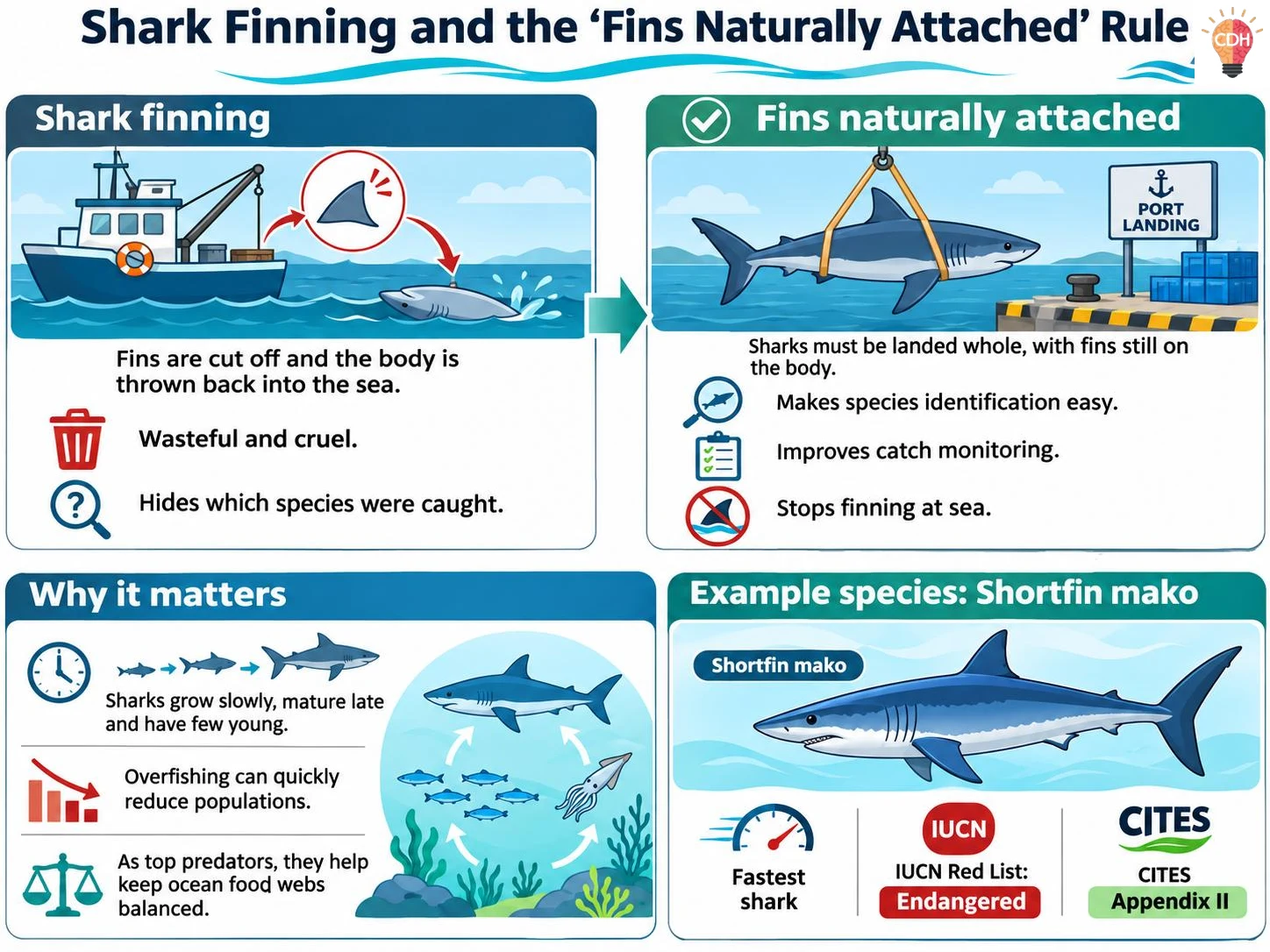
(ENVIRONMENT) (DTE) Members of the International Commission for the Conservation of Atlantic Tunas (ICCAT) agreed on 24 November 2026 to strengthen action against shark finning, moving towards landing sharks with fins naturally attached, and kept the ban on retaining North Atlantic shortfin mako sharks.
What Was Agreed
- Fins attached: the agreement follows an 18-year push to require sharks to be landed whole.
- Compromise: fleets may for now use alternatives such as wires, ropes or tags to match detached fins to carcasses; conservation groups call these largely untested.
- Shortfin mako: the retention ban introduced in 2021 stays; a study to resolve uncertainties is due in 2027.
- Compliance: many parties report no shark discards at all; stronger compliance action may follow in 2027.
Shortfin Mako
| Feature | Details |
|---|---|
| Range | Tropical and temperate waters of the Atlantic, Pacific and Indian Oceans; open-ocean (pelagic) |
| Traits | One of the fastest sharks; feeds on bony fish and squid |
| Status | Endangered (IUCN); CITES Appendix II |
| Threats | Overfishing, finning and by-catch |
About ICCAT
- Type: a Regional Fisheries Management Organisation for tunas and tuna-like species in the Atlantic and adjacent seas.
- Set up: convention signed in 1966, in force from 1969; headquarters in Madrid, Spain (iccat.int).
- India: not an ICCAT member, but a member of the Indian Ocean Tuna Commission (IOTC).
📖 Read More: Introduction to Marine Resources • Atlantic Ocean • Species of Conservation Concern
10. Track Widening Near Sheshnag Lake Sparks Concern
About the Lake
| Feature | Details |
|---|---|
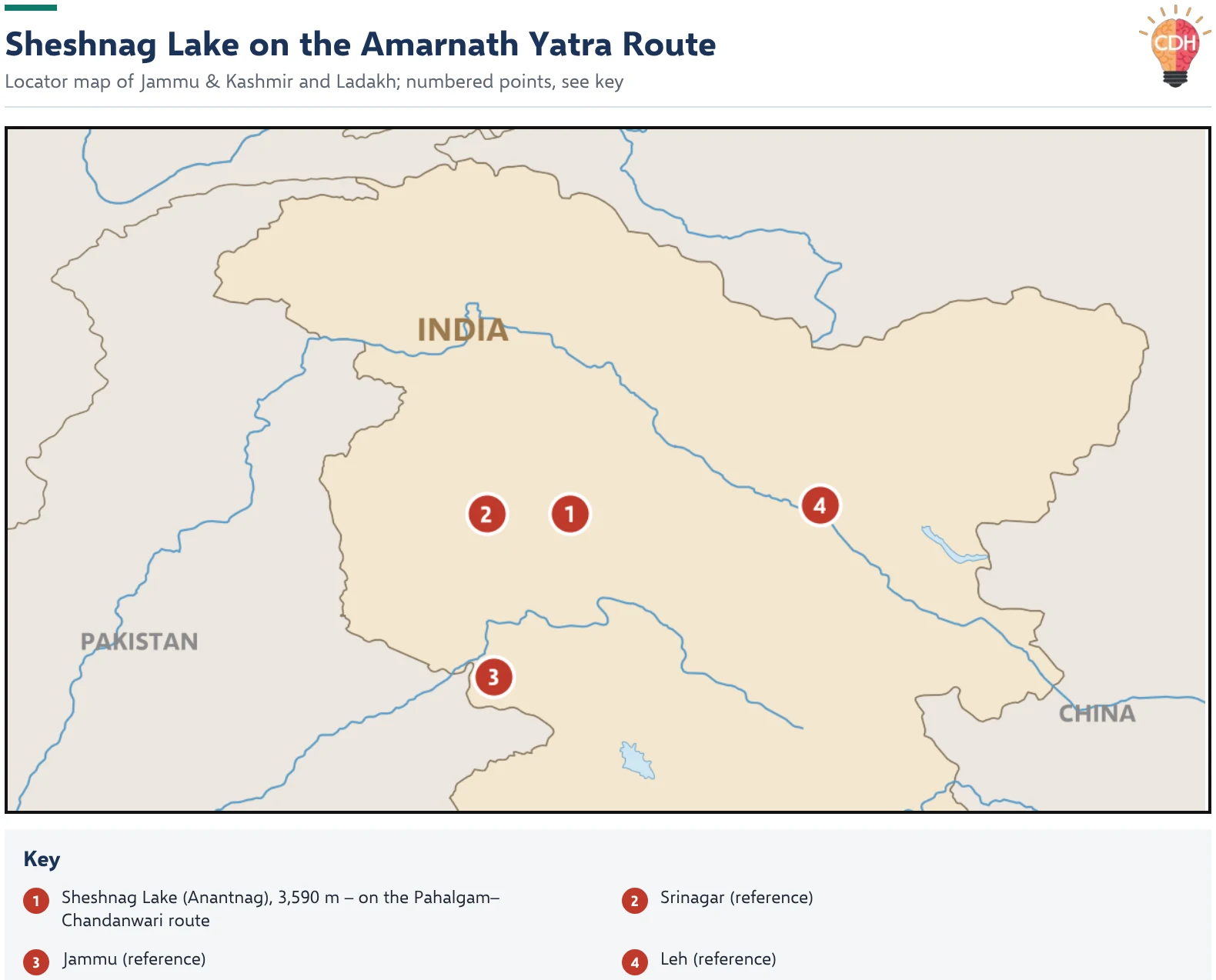
| Location | Anantnag district, Jammu and Kashmir; about 3,590 m high, roughly 23 km by trek from Pahalgam via Chandanwari |
| Type | High-altitude glacial lake; oligotrophic (low nutrients, clear water) |
| Hydrology | Fed by glacier and snow melt; drains into the East Lidder, which joins the West Lidder near Pahalgam to form the Lidder, a tributary of the Jhelum (Indus system) |
| Culture | Linked in tradition to Lord Shiva’s serpent; mentioned in Kalhana’s Rajatarangini (12th century) |
Why the Concern
- GLOF risk: the lake is identified as a high-risk glacial lake for Glacial Lake Outburst Floods.
- Slope damage: digging and dumping can loosen moraine, raise erosion and silt the lake.
- Rules: a court direction in 2012 called for widening the tracks for pedestrian safety, not for building motorable roads.
The Two Yatra Routes
Pahalgam ➜ Chandanwari ➜ Sheshnag ➜ Panchtarni ➜ Amarnath cave ⟵ Baltal (shorter route via Sonamarg)
Balancing pilgrim safety with the health of Himalayan glaciers and lakes needs environmental assessment, debris management and limits on machinery in sensitive zones.
📖 Read More: Major Glaciers of the Himalayas • Periglacial Landforms • Landslides: A Natural Hazard
11. Hapus Mango: Konkan and Valsad Fight Over a Name
(SCIENCE AND TECHNOLOGY) (IE) Mango growers in Maharashtra’s Konkan region are opposing an application to register “Valsad Hapus” from Gujarat as a Geographical Indication (GI). They say the name “Hapus” belongs to the Konkan Alphonso, which got its GI in 2018.
The Dispute
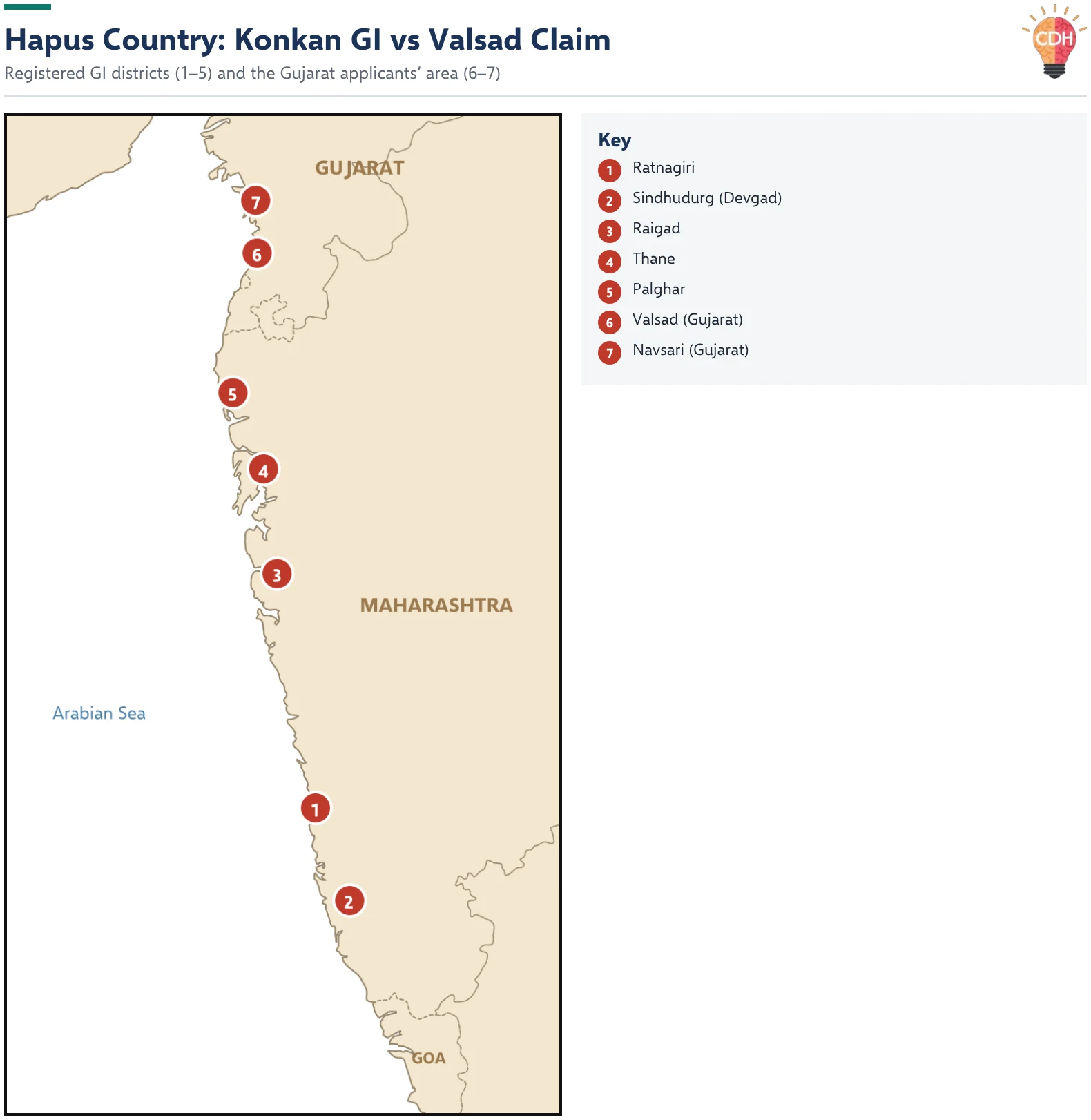
- Konkan GI (2018): covers Ratnagiri, Sindhudurg, Raigad, Thane and Palghar; known for aroma, saffron pulp and low fibre, shaped by lateritic soil and the coastal climate.
- Valsad application: filed by Gujarat applicants including Navsari Agricultural University; the GI Registry lists it as “Opposed”.
- Core issue: Konkan growers do not object to a GI for Valsad mangoes, only to the use of the word “Hapus”.
GI Basics
| Feature | Details |
|---|---|
| Law | Geographical Indications of Goods (Registration and Protection) Act, 1999 |
| Global basis | Articles 22–24 of the WTO TRIPS Agreement |
| Registry | GI Registry, Chennai, under the Controller General of Patents, Designs and Trade Marks (DPIIT) |
| Validity | 10 years, renewable |
| First Indian GI | Darjeeling Tea (2004–05) |
| Transfer | Unlike trademarks, a GI cannot be assigned, licensed or mortgaged |
Name disputes such as Tangail saree (see our 25 November notes) and now Hapus show that a GI protects not just a product but the reputation and income tied to a place. More in Intellectual Property Rights.
📖 Read More: Intellectual Property Rights • Horticulture
12. Kashi Tamil Sangamam 5.0 Puts Thirukkural on Campus
About the Sangamam
- Aim: celebrate ties between Tamil Nadu and Kashi (Varanasi), two ancient seats of learning, in the spirit of Ek Bharat Shreshtha Bharat.
- Organiser: Department of Higher Education, Ministry of Education, with IIT Madras, BHU, the Central Institute of Classical Tamil (CICT) and the UP government.
- Started: 2022, during Azadi Ka Amrit Mahotsav. Each edition runs for about two weeks, with delegates on eight-day tours.
Edition 5.0 Highlights
- Delegates: about 1,400 from Tamil Nadu, in seven groups, visiting Varanasi, Prayagraj and Ayodhya.
- Students’ Engagement Programme: 1,000 higher education institutions; one student each, with a ₹10,000 stipend for a month of study.
- Teaching: 50 teachers from Tamil Nadu will introduce the Thirukkural in UP schools and colleges.
- Outreach: CICT’s Thirukkural app carries all 1,330 couplets in the 22 scheduled languages.
The Thirukkural
| Part | Theme |
|---|---|
| Aram | Virtue — ethics and righteous conduct |
| Porul | Wealth — governance, economy and statecraft |
| Inbam | Love — human relationships |
Written by Thiruvalluvar, the text has 1,330 couplets (kurals) and is counted among the great works of Tamil literature.
📖 Read More: Sangam Literature • Three Early Kingdoms of Tamilakam