
Spread of Indian Architectural Influence Beyond India
Architecture does not stop at borders.
When ideas are powerful enough — spiritual, philosophical, cosmological — they travel. And few civilizations have exported their architectural imagination as widely and as deeply as India.
Through trade routes, maritime commerce, and the migration of religious ideas — particularly Hinduism and Buddhism — Indian architectural concepts spread across Southeast Asia. From Cambodia to Indonesia to Vietnam, we see temples not built in India, but whose every element — the garbhagriha, the shikhara, the mandala layout, the Mount Meru symbolism — speaks the language of Indian sacred architecture.
This phenomenon is called Indianization — the process by which Indian cultural, religious, and artistic traditions were absorbed and adapted by Southeast Asian civilizations without direct political conquest. It happened through contact, commerce, and conviction.
Let us now examine few of the most important examples of this Indian architectural legacy beyond India’s borders.
🏛 Angkor Wat (Cambodia)
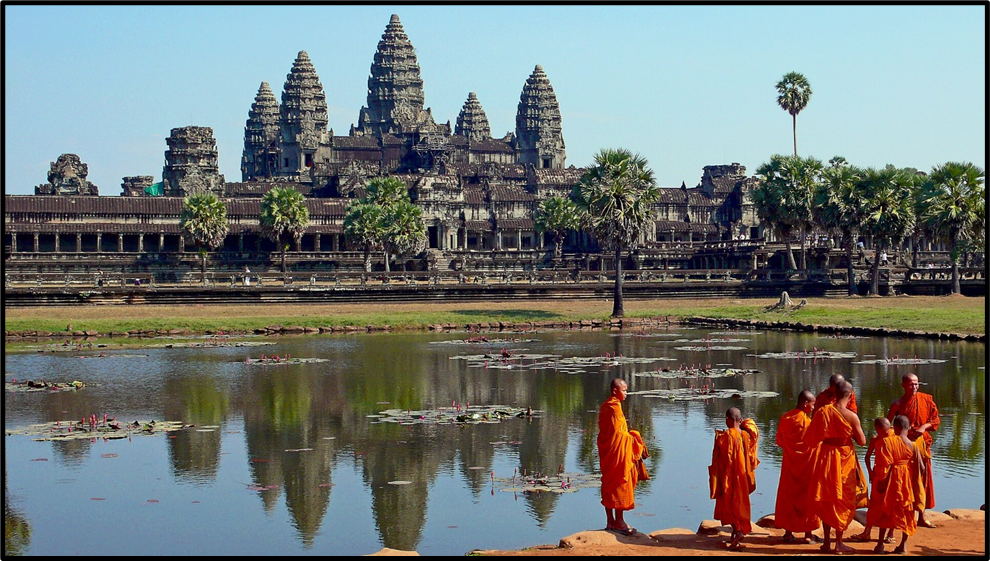
The name itself says everything. Angkor comes from the Sanskrit word nagara (city or capital). Wat means temple in Khmer. Together: “City of Temples.” A monument conceived in Sanskrit, built in stone, and dedicated to the Indian god Vishnu — in the heart of Cambodia.
Basic Facts
- Location: Siem Reap province, Cambodia (within the ancient capital of Angkor)
- Built by: Khmer King Suryavarman II (reigned 1113–1150 CE)1
- Period of construction: c. 1116–1150 CE
- Original dedication: Hindu temple dedicated to Vishnu
- Later transformation: Gradually converted into a Theravada Buddhist temple from the late 13th century; remains an active Buddhist centre to the present day
- Scale: World’s largest religious monument (covering approx. 162.6 hectares)
- UNESCO Status: World Heritage Site (1992); removed from the danger list in 2004
- National symbol: Appears on the Cambodian national flag — the only temple featured on any country’s flag
- Indian restoration contribution: The Archaeological Survey of India (ASI) has participated in restoration work at Angkor
Architectural Features
Angkor Wat combines two fundamental concepts drawn directly from Indian sacred architecture:
- Temple-Mountain (Prasad): The entire complex represents Mount Meru — the cosmic mountain and abode of the gods in both Hindu and Buddhist traditions. The five central towers symbolise the five peaks of Meru. The surrounding moat represents the cosmic ocean at the edge of the universe.
- Mandala Layout: The plan of the complex is a cosmic mandala — a sacred diagram of the universe. It is designed so that the movements of the sun and moon align with the temple’s architecture, incorporating a kind of astronomical calendar in stone.
- Three Galleries: The pilgrim enters through a western gopura (gateway) and moves inward through three concentric galleried enclosures, each progressively elevated — just as the devotee in an Indian temple moves from outer space to inner sanctum, from the worldly to the divine.
- Orientation: Unusually oriented toward the west (unlike most Indian and Cambodian temples which face east). This westward orientation is associated with Vishnu and also with death — consistent with the theory that it was intended as King Suryavarman II’s mausoleum.
- Jagati: The temple is built on a raised platform (jagati) — a feature directly borrowed from Indian temple architecture.
- Bas-reliefs: The gallery walls carry approximately 800 metres of detailed bas-reliefs depicting scenes from the Mahabharata, the Ramayana, the Churning of the Ocean of Milk (Samudra Manthan), and Hindu cosmological scenes. These are considered among the finest stone reliefs in the world.
- Devatas and Apsaras: The walls are adorned with thousands of female celestial figures — a sculptural tradition rooted in Indian iconography.
- Material: Sandstone blocks fitted together without mortar — a remarkable engineering achievement. A 188-metre bridge over the moat provides access to the complex.
The Deeper Significance
King Suryavarman II — whose name means “protector of the sun” — designed Angkor Wat to declare that Angkor was the centre of the universe, and that the king stood at its cosmic axis. This is architecture as political theology — the same impulse we saw in the Brihadeeswarar Temple of the Cholas, expressed here in Khmer stone.
🏛 Borobudur (Indonesia)
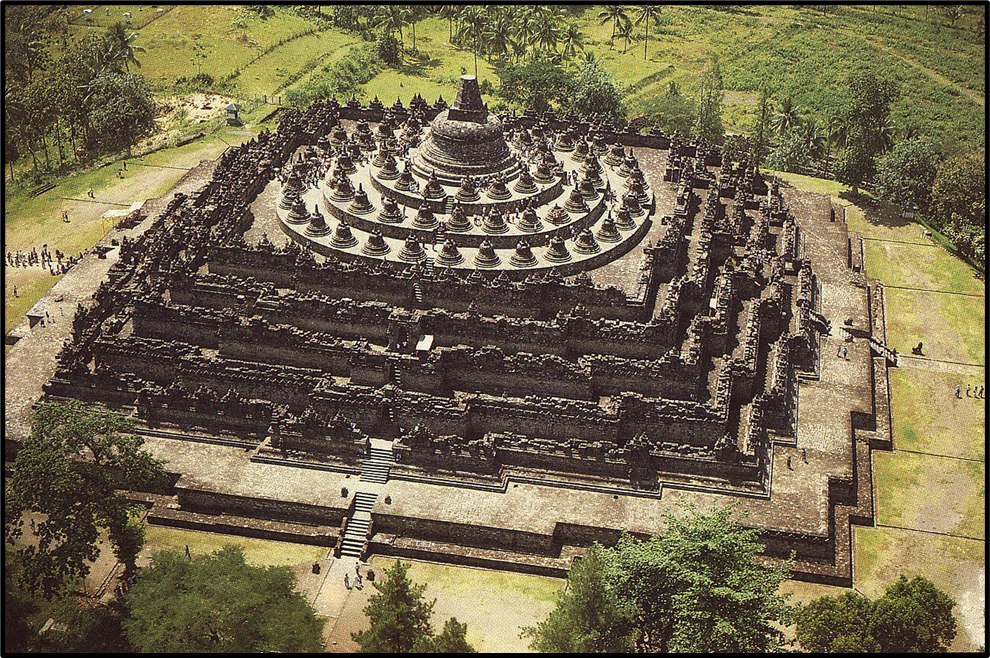
If Angkor Wat is India’s temple-mountain tradition transplanted to Cambodia, Borobudur is India’s stupa tradition elevated to a colossal philosophical monument in Java.
Basic Facts
- Location: Kedu Valley, Central Java, Indonesia (near Yogyakarta)
- Built by: The Sailendra Dynasty of Java
- Period: c. 778–850 CE; completed approximately 825 CE
- Religion: Mahayana Buddhism
- Scale: World’s largest Buddhist monument
- Artistic richness: 2,672 bas-relief panels; 504 Buddha statues; 72 perforated bell-shaped stupas on circular terraces; considered to have the world’s most extensive collection of Buddhist reliefs
- Rediscovered: 1814 CE by British Lt. Governor Thomas Stamford Raffles, after centuries buried under volcanic ash and jungle
- UNESCO Status: World Heritage Site (1991); major restoration carried out with UNESCO assistance in the 1970s–80s
- Indian architectural influence: Style influenced by Indian Gupta and post-Gupta art; structural concept derived from the Indian stupa tradition
Architectural Features
Borobudur is a synthesis of three Indian concepts made tangible in stone:
- Stupa: The entire monument is conceptually one colossal stupa. Seen from above it takes the form of a great mandala.
- Temple-Mountain: Like Angkor Wat, Borobudur is modelled on Mount Meru — the axis of the universe. Its stepped pyramid form rises to a summit stupa that represents the highest point of enlightenment.
- Mandala: A cosmic diagram of the Buddhist universe. Every level represents a stage of spiritual progress toward Nirvana.
- Three Realms of Buddhist Cosmology (all rooted in Indian Buddhist philosophy):
- Kamadhatu (World of Desire) — the base; reliefs depicting earthly life and the law of karma
- Rupadhatu (World of Form) — five square terraces; reliefs of the Buddha’s life and Jataka tales
- Arupadhatu (Formless Realm) — three circular terraces and the summit stupa; plain terraces with 72 perforated stupas each containing a Buddha statue, representing states of incomplete enlightenment on the threshold of Nirvana
The pilgrim’s journey upward through Borobudur is a physical enactment of the Buddhist path from ignorance to liberation. Architecture here becomes a textbook of Buddhist philosophy carved in volcanic stone.
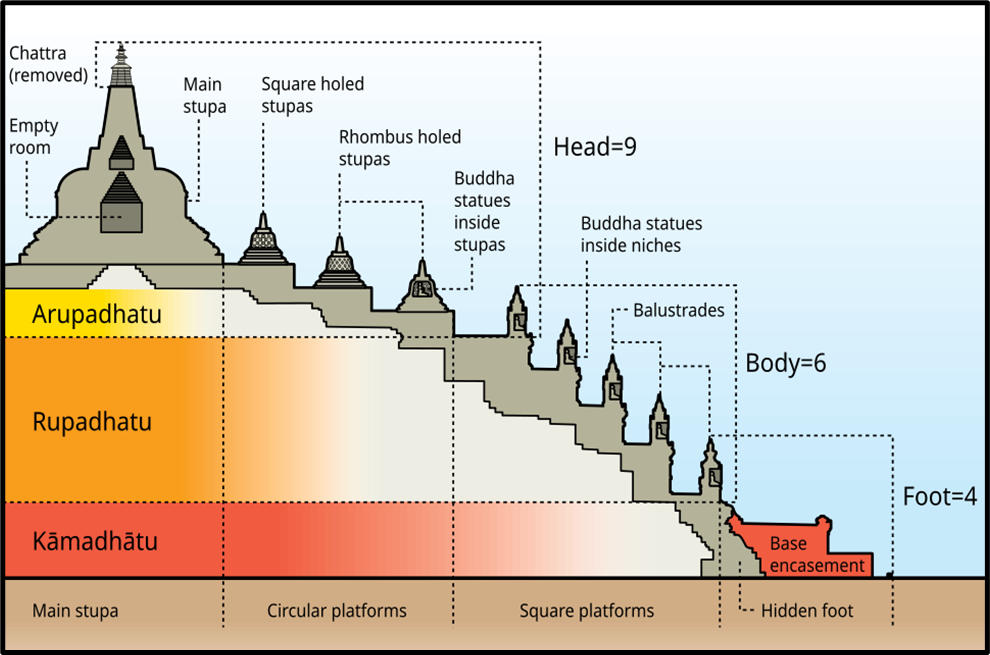
By Gunawan Kartapranata – Own work, CC BY-SA 3.0, via Wikimedia Commons
🏛 Prambanan (Indonesia)
Just 40 kilometres from Borobudur — a Buddhist monument — stands Prambanan, a magnificent Hindu temple complex. This proximity reflects the remarkable religious coexistence of 9th-century Java, where both traditions thrived side by side, often under the same royal patronage.
Basic Facts
- Location: Border of Yogyakarta and Central Java provinces, Indonesia
- Built by: Primarily attributed to King Rakai Pikatan of the Sanjaya Dynasty
- Period: 9th century CE (c. 850 CE)
- Dedication: The Hindu Trimurti — Brahma (creator), Vishnu (preserver), Shiva (destroyer). Originally named Shivagrha (abode of Shiva) and primarily Shaivite
- Scale: Largest Hindu temple site in Indonesia; second-largest in Southeast Asia (after Angkor Wat); compound originally consisted of 240 structures
- UNESCO Status: World Heritage Site (1991)
Architectural Features
- Vastu Shastra and Mandala Plan: The temple design follows Hindu architectural principles based on Vastu Shastra. The compound is arranged as a sacred mandala — a cosmic diagram — with concentric enclosures moving from the outer (less sacred) to the inner (most sacred) zone.
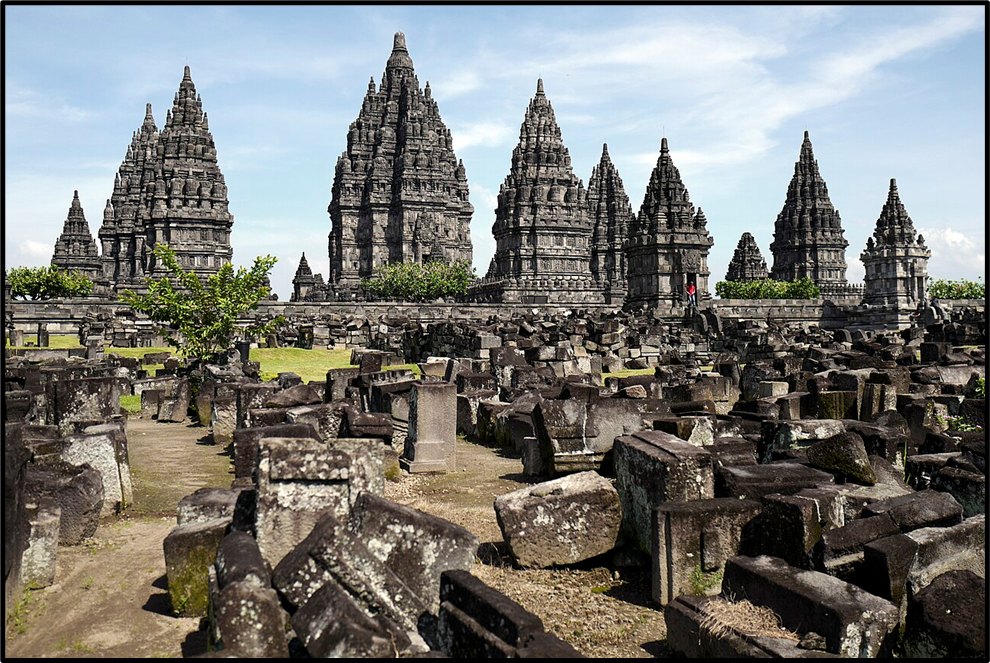
- Mount Meru Symbolism: Like Indian Nagara temples, Prambanan was designed to represent Mount Meru — the abode of Shiva. The towering central spire mimics the Shikhara form of North Indian temples.
- Three Trimurti Temples + Vahana Temples: The inner zone has three main temples — the Shiva temple (47 metres high, the tallest), the Brahma temple (south), and the Vishnu temple (north). Opposite each stands the temple of its vahana (divine vehicle): Nandi (bull of Shiva), Hamsa (swan of Brahma), and Garuda (eagle of Vishnu) — all concepts directly from Indian iconography.
- Ramayana Reliefs: The inner walls of the Shiva and Brahma temples carry bas-reliefs narrating the Ramayana in a distinctly Javanese visual idiom — faithfully conveying the Indian epic while adapting it to local artistic sensibilities. These are considered masterpieces of stone carving.
- Nagara-style Spires: The tall, pointed towers characteristic of the Nagara style of Hindu architecture make Prambanan visually similar to the temples of North India, adapted to the Javanese volcanic-stone landscape.
- Religious Harmony: The Prambanan Archaeological Park also contains several major Buddhist temples (including Candi Sewu — Indonesia’s largest Buddhist complex after Borobudur), built around the same time — reflecting coexistence of Hindu and Buddhist traditions under the Mataram kingdom. This is Ellora in stone, replicated in Java.
The Prambanan Ramayana Ballet — performed under the full moon in the temple’s open-air stage since the 1960s — keeps this living connection between Indian epic tradition and Javanese artistic culture alive.
🏛 My Son Sanctuary (Vietnam)
While Angkor Wat and Borobudur receive more attention, My Son Sanctuary represents something equally profound: the longest continuous development of Indian-influenced Hindu temple architecture in Southeast Asia — spanning nearly ten centuries, from the 4th to the 13th century CE.
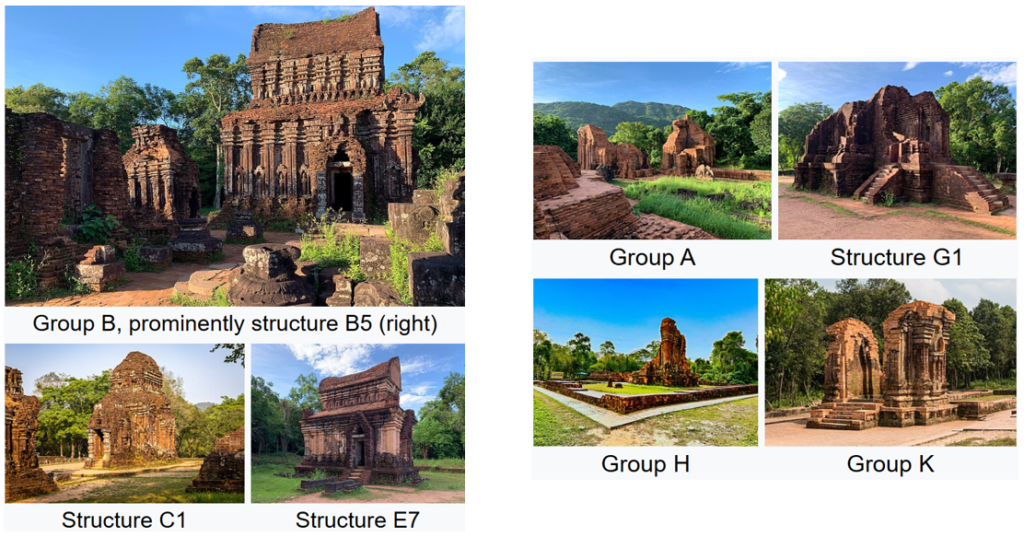
Basic Facts
- Location: Duy Xuyen district, Quang Nam Province, Central Vietnam; approx. 40 km from Hoi An and 70 km from Da Nang
- Built by: Kings of the Champa Kingdom (an Indianized kingdom of the Cham people), beginning with King Bhadravarman I
- Period: 4th to 13th century CE (longest continuously developed Hindu temple site in Southeast Asia)
- Religion: Primarily Shaivite Hinduism; Shiva was the tutelary deity of the Champa kings
- Scale: Over 70 structures (towers, sanctuaries, ancillary buildings), most partially ruined
- UNESCO Status: World Heritage Site (1999)
- Indian Connection (Recent): The Archaeological Survey of India (ASI) has actively conserved My Son, restoring three temple groups (A, H, and K) between 2017 and 2022 at a cost of USD 2.25 million — a significant act of India’s cultural diplomacy.
Background: Who Were the Cham?
The Cham people established the kingdom of Champapura — a Sanskrit name meaning “City of the Cham people” — in 192 CE along the coast of present-day Central Vietnam. They were skilled seafarers deeply connected to the Indian Ocean trade network. Through trade and contact, Indian culture pervaded Cham civilization. They adopted:
- Sanskrit as their royal language (early inscriptions are in Sanskrit written in Pallava script — the script of the South Indian Pallava dynasty)
- Royal titles ending in ‘Varman’ (common in Indian dynasties, especially the Pallavas)
- Shaivite Hinduism as the state religion; Shiva as guardian deity of the Champa kings
- Indian architectural traditions, cosmological ideas, and iconographic vocabulary
Architectural Features
- Kalan (Tower Sanctuary): The primary building type is the kalan — a brick tower sanctuary housing the deity, analogous to the garbhagriha of Indian Hindu temples. Each kalan is entered from the east and houses a Shiva linga.
- Mandapa: An entry hallway (mandapa) contiguous with the sanctuary is also present — directly using the Indian architectural term and concept.
- Pyramidal Towers (Mount Meru Symbolism): The tower-temples rise in a tiered, pyramidal form symbolising Mount Meru. Gates face east to receive sunlight — a solar orientation common in Indian temples.
- Brick Construction: The temples are built of fired brick with stone pillars and sandstone bas-reliefs. The precise binding method remains a subject of scholarly debate — no conventional mortar was used; the bricks were fitted with extraordinary precision, a technique still not fully understood.
- Iconography: Outer walls carry sandstone bas-reliefs drawn directly from Indian iconography — Makara, Garuda, Apsara dancers, Ganesha, Skanda, Gajalakshmi — adapted to Cham artistic sensibilities.
- Shiva Bhadreshvara Cult: The principal deity is Bhadreshvara — a fusion of Shiva and the deified Cham king Bhadravarman. This merging of the divine and the royal mirrors the Indian concept of the king as a divine representative (seen similarly in Pallava and Chola traditions).
- Sacred Valley Setting: The site sits in a valley surrounded by mountains. The Cham believed the southern mountain — called Mahaparvata (Great Mountain) — was itself divine. This integration of natural landscape and sacred architecture reflects the Indian concept of the temple embedded in a sacred geography.
A Note on Historical Loss
My Son suffered devastating damage during the Vietnam War (1960s–70s), when sustained aerial bombing destroyed many of its structures. Much of what had survived centuries of jungle encroachment was lost within days. Today, conservation efforts — including India’s ASI contribution — are slowly restoring what remains.
📌 What Does This Teach Us? — A Civilizational Perspective
These four monuments were not built by Indians. They were built by Khmers, Javanese, and Chams — each with their own language, traditions, and identity.
Yet all of them reach toward the same mountain.
Across all four sites we see the same Indian architectural vocabulary at work:
- Mount Meru symbolism — all four sites; cosmic axis; temple as sacred mountain
- Mandala layout — Angkor Wat, Borobudur, Prambanan; sacred geometry; cosmic map in stone
- Garbhagriha / innermost sanctum — all four sites; journey from outer to inner; from worldly to divine
- Epic narratives (Ramayana, Mahabharata) — Angkor Wat, Prambanan, My Son; Indian literary tradition expressed in local stone
- Stupa tradition — Borobudur; architecture of spiritual memory; path to Nirvana
Final Reflection
All four monuments speak in the language of sacred geometry, cosmic symbolism, and the devotee’s journey through sacred space that India first articulated — in the dark chambers of the Gupta period, on the granite cliffs of Mahabalipuram, in the sandstone plains of Khajuraho.
This is what civilizational influence means. Not conquest. Not colonisation. But the quiet power of ideas that travel because they are true.
Remember: These monuments are not just “temples abroad.” They are evidence that Indian civilization was a living, radiating force — not confined within borders, but carried across oceans through faith, trade, and the power of architectural imagination.
This article forms part of the broader Art and Culture syllabus for UPSC preparation.
- UPSC Prelims 2006 ↩︎