
Spykman’s Rimland Theory – 1944
“All geography should be read historically and all history should be read geographically.”
This quote by Herodotus (3rd century BC) sets the philosophical foundation for understanding the Rimland Theory, proposed by Nicholas Spykman in 1944 in his book ‘The Geography of Peace’ — right in the midst of World War II.
Where Mackinder spoke of the Heartland, Spykman redirected the spotlight to a different region — the Rimland — redefining the power equation in geopolitical thought.
🔁 Background: A Response to Mackinder
Let’s recall:
- Mackinder’s Heartland Theory (1904) argued:
“Who controls Eastern Europe, controls the Heartland;
Who controls the Heartland, controls the World Island;
Who controls the World Island, controls the world.”
But Spykman disagreed.
❌ According to Spykman:
- Heartland is not a strength — it’s a weakness.
- Why? Because:
- It is landlocked.
- It lacks access to sea routes, which are crucial for trade, naval power, and geopolitical influence.
- Its “fortress-like” geography may be secure, but also isolated and inflexible.
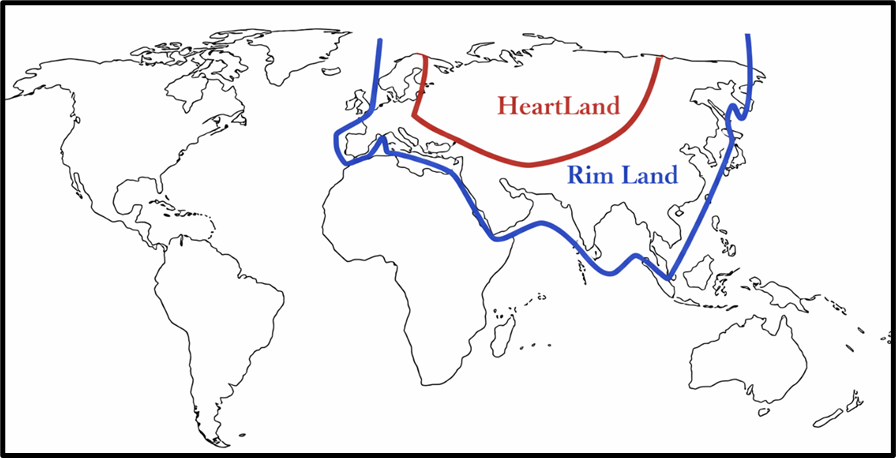
🌊 So what is the Rimland?
✅ Spykman redefined Mackinder’s “Inner Crescent” as Rimland.
- It is the coastal fringe of Eurasia — the land between the Heartland and the seas.
- It includes → Western Europe, The Middle East, South Asia, Southeast Asia, East Asia
This zone is rich in → Resources, Population, Trade routes, Military chokepoints (like the Suez Canal, Strait of Hormuz, Malacca Strait)
🧭 Spykman’s Slogan: The Counter to Mackinder
Spykman challenged Mackinder’s famous slogan and gave us a new geopolitical equation:
🔁 “Who controls the Rimland, rules Eurasia.
Who rules Eurasia, controls the destinies of the world.”
This became the cornerstone of U.S. foreign policy during the Cold War.
🧱 Strategic Implications of Rimland Theory
🔹 The Theory Shaped American Policy:
- Under Harry Truman and John F. Kennedy, the U.S. adopted a policy of containment:
- Goal: Prevent the Soviet Union (Heartland power) from expanding into Rimland.
- Why? Because if any single power controls the Rimland, it can encircle and confine the Heartland—and dominate the world.
🔹 Cold War Conflicts Reflect the Theory:
- Major proxy wars were fought in Rimland countries:
- Vietnam War
- Korean War
- Soviet-Afghan War
- These wars were essentially battles for control over Rimland, without direct confrontation between superpowers.
🔹 Modern-Day Relevance:
- Gulf War, U.S. presence in Indo-Pacific, China’s Belt and Road Initiative, and India’s Act East policy are all strategic plays in the Rimland.
- South Asia and Southeast Asia have emerged as new centres of global power.
❗ Criticisms of Rimland Theory
As with any theory, it must evolve with time. Let’s evaluate Spykman’s proposition in the context of modern geopolitics.
1. Technological Advancements
- In today’s age of nuclear weapons and intercontinental missiles, geographical barriers matter far less.
- Air power, satellite surveillance, and cyber warfare redefine traditional war strategies.
2. Underestimation of Global Institutions
- Spykman did not account for the role of:
- United Nations
- International treaties
- World opinion and diplomatic norms
- These factors now regulate conflicts, prevent territorial expansion, and ensure global stability.
3. Globalization and Interdependence
- Today, the world is often referred to as a “global village.”
- Geopolitics is shaped not just by territory, but also by:
- Multinational Corporations (MNCs)
- Global supply chains
- Economic dependencies
4. Shift from Political to Economic Imperialism
- Spykman’s theory was framed in an era of military and territorial competition.
- But the 21st century is about:
- Economic dominance
- Trade influence
- Soft power
Unlike Ratzel’s view of the State as a living organism needing ‘Lebensraum’ (living space), modern states no longer seek territorial expansion — they seek market access and economic supremacy.
🧠 Conclusion: Why Rimland Theory Still Matters
Spykman’s Rimland Theory, despite its limitations, shifted global attention:
- From the landlocked interior (Heartland) to the dynamic coastal arc (Rimland).
- It accurately predicted the strategic importance of maritime regions, chokepoints, and borderlands.
Today, while traditional warfare has changed, control over the Rimland still decides:
- Trade security
- Regional influence
- Strategic alliances
Thus, even in an era of cyber battles and economic warfare, Rimland remains the pulse of global power politics.