
Unification of Germany and Italy
The Unification of Germany (1815–1871).
To understand this, we must look beyond the dates and battles. We must understand how a fragmented “geographical expression” transformed into a “mighty empire” that shifted the tectonic plates of global power.
The Context: From Fragmentation to Consciousness
Before 1871, “Germany” did not exist as a single political entity. It was a collection of over 300 small states under the titular head of the Holy Roman Empire.
Two major forces acted as the catalysts for change:
- The Napoleonic “Gift”: Paradoxically, it was the French Emperor Napoleon Bonaparte who sowed the seeds of German unity.
- By abolishing the Holy Roman Empire and condensing hundreds of tiny states into the Confederation of the Rhine, he simplified the map.
- More importantly, French occupation ignited a fierce sense of “German-ness”—a collective desire to expel the outsider.
- The Congress of Vienna (1815): After Napoleon’s defeat, the 39 German states were organized into a loose German Confederation. However, this was a “crippled” arrangement because it was dominated by Austria, which had no interest in a strong, unified Germany that might challenge its own multi-ethnic empire.
The Pillars of Unification: Causes and Foundations
Why did unification become inevitable? It wasn’t just about soldiers; it was about identity, ideas, and economics.
A. Intellectual and Cultural Awakening
Thinkers like Johann Gottlieb Fichte and Herder argued that Germans were bound by a Volksgeist (national spirit). They believed that language and culture, not just borders, define a nation.
This “Romantic Nationalism” turned the idea of a unified Germany into a moral and emotional necessity for the youth and the middle class.
B. The Economic Glue: The Zollverein (1834)
This is a crucial point for your answers. Long before political unification, there was economic unification.
- Prussia initiated the Zollverein (a customs union) which abolished internal tariffs.
- The Result: Goods flowed freely, railways were built, and German states became economically interdependent.
- The Strategic Impact: Austria was excluded from this union. Consequently, the smaller German states began looking to Prussia, not Austria, for leadership.
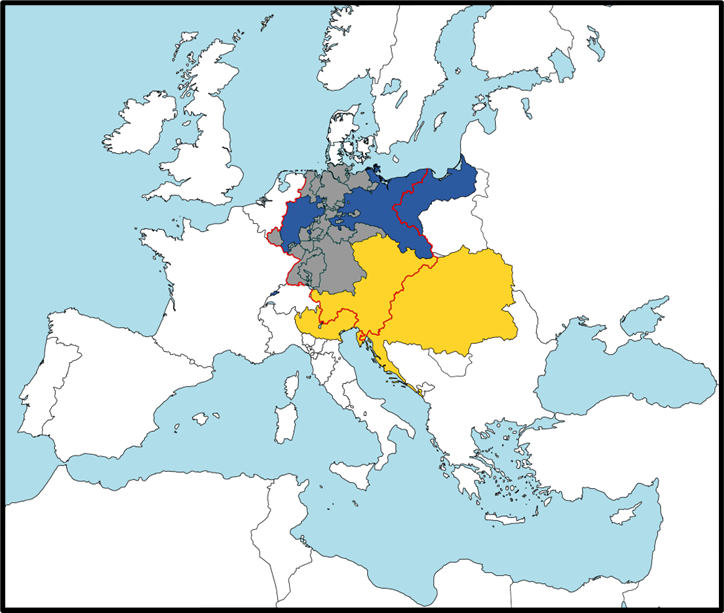
The Architect: Otto von Bismarck and ‘Realpolitik’
If the German people provided the “will,” and the Zollverein provided the “means,” then Otto von Bismarck provided the “method.” Appointed as the Minister-President of Prussia in 1862, Bismarck was a practitioner of Realpolitik—the politics of reality over idealism.
“The great questions of the day will not be settled by means of speeches and majority decisions… but by Blood and Iron.”
The “Blood and Iron” Framework
| Aspect | Core Strategy |
| Blood | The use of decisive military force. Bismarck believed that diplomacy was only effective when backed by a sharp sword. |
| Iron | The development of Prussia’s industrial might—coal, steel, and a modern railway system to move troops faster than the enemy. |
| Realpolitik | A cold, pragmatic approach. He would make an alliance today with an enemy he intended to fight tomorrow, provided it served the Prussian interest. |
The Three Phases of Unification (1864–1871)
Bismarck did not want a “liberal” unification from below (like the failed 1848 revolutions). He wanted a “top-down” unification led by the Prussian Monarchy. This was achieved through three calculated wars.
- The Danish War (1864): Prussia partnered with Austria to “liberate” the duchies of Schleswig and Holstein from Denmark. This was a trap set by Bismarck to create a dispute with Austria later.
- The Austro-Prussian War (1866): Also known as the Seven Weeks’ War. Prussia’s modernized army crushed Austria.
- The Result: Austria was expelled from German affairs.
- Bismarck’s Genius: He offered Austria a lenient peace treaty because he knew he might need them as a neutral party in the future.
- The Franco-Prussian War (1870–71): To bring the southern (Catholic) German states into the fold, Bismarck needed a common enemy: France. He manipulated the “Ems Telegram” to provoke Napoleon III into declaring war.
The Proclamation and Domestic Consolidation
In January 1871, in the Hall of Mirrors at Versailles—the very heart of French pride—the German Empire was proclaimed. King Wilhelm I of Prussia became the German Emperor (Kaiser).
Post-Unification Challenges:
Bismarck now had to manage the “internal” unification of a diverse nation:
- Kulturkampf: A struggle against the Catholic Church’s influence, as Bismarck feared Catholics might be more loyal to the Pope than to the German State.
- Anti-Socialist Measures: He suppressed Socialist movements but, in a stroke of genius, introduced the world’s first welfare state (pensions, accident insurance) to keep the working class loyal to the Monarchy.
Analytical Conclusion: The Impact on History
The unification of Germany was not just the birth of a nation; it was the death of the old European order.
- Shift in the Balance of Power: Germany suddenly became the strongest industrial and military power in Europe. This made Britain nervous and France vengeful.
- The “German Problem”: A nation too big for Europe, but perhaps too small for the world. Germany’s rapid rise led to a scramble for colonies and an arms race.
- Path to World War I: The rigid alliance systems (Triple Alliance vs. Triple Entente) that led to 1914 were direct consequences of the diplomatic “chess game” Bismarck started but his successors could not manage.
In summary: Bismarck’s Germany was a masterpiece of “calculated aggression.” It showed that while ideas (Nationalism) and money (Zollverein) create the potential for a nation, it often takes a “strong hand” and “iron” to forge it into reality. However, the same force that unified Germany also sowed the seeds of the great European tragedies of the 20th century.
Timeline for Unification of Germany
| Year / Period | Event | Key Outcome / Significance |
| 1806 | Fall of the Holy Roman Empire after Napoleon Bonaparte’s victory | Ended the old political order in German lands |
| 1806–1813 | Formation of the Confederation of the Rhine | German states came under French influence |
| 1815 | Congress of Vienna established the German Confederation of 39 states under Austrian presidency | Created a loose political association after Napoleon’s defeat |
| 1834 | Formation of the Zollverein (Customs Union) led by Prussia | Economic integration of German states (excluding Austria) strengthened unity |
| 1848 | Frankfurt Parliament attempted German unification | Failed after the Prussian King rejected the constitution |
| 1862 | Otto von Bismarck became Prime Minister of Prussia | Promoted unification through the “Blood and Iron” policy |
| 1864 | Second Schleswig War (Prussia + Austria vs Denmark) | Denmark defeated; Schleswig and Holstein annexed |
| 1866 | Austro-Prussian War (Seven Weeks’ War) | Prussian victory at Königgrätz; German Confederation dissolved |
| 1867 | Establishment of the North German Confederation | Northern German states united under Prussian leadership |
| 1870–71 | Franco-Prussian War | French defeat led southern German states to join unification |
| 18 January 1871 | Proclamation of the German Empire at the Hall of Mirrors, Versailles | Wilhelm I crowned as German Emperor (Kaiser) |
If the unification of Germany was a story of “Blood and Iron” and calculated Prussian efficiency, the Unification of Italy (The Risorgimento) is a saga of passion, romanticism, and a unique “trinity” of leadership.
Unification of Italy
As Metternich, the Austrian Chancellor, famously said, Italy was merely a “geographical expression.” It was a patchwork of states ruled by the Pope, the Austrians, and the Bourbons. Let’s analyze how this expression became a reality.
The Bedrock of the Risorgimento: Why Unify?
Before the swords were drawn, the idea of Italy had to be born in the minds of the people. This was driven by several multi-dimensional factors:
- The Napoleonic Catalyst: Similar to Germany, Napoleon’s conquest of Italy provided a taste of administrative unity and liberal reforms. When the old monarchs returned after 1815, the people felt the suffocating weight of “foreign” rule and longed for the freedom they had briefly glimpsed.
- Cultural and Linguistic Identity: While the masses spoke local dialects, the elite and the intellectuals were bound by the high culture of Dante, Petrarch, and the Renaissance. This shared heritage provided the “emotional glue” for a national identity.
- Foreign Oppression: Northern Italy was under the direct or indirect grip of Austria. To the south lay the Kingdom of the Two Sicilies under the Bourbons. This foreign exploitation created a common enemy, which is always a powerful unifier.
- Economic Aspirations: The rising middle class realized that internal customs barriers and different currency systems were stifling trade. For Italy to prosper like Britain or France, it needed a single market.
The Trinity of Unification: Heart, Brain, and Sword
The success of Italian unification lies in the fact that three very different men, with often conflicting ideologies, worked (sometimes reluctantly) toward the same goal.
| Leader | Role | The Contribution |
| Giuseppe Mazzini | The Heart | An idealist and revolutionary. His “Young Italy” movement inspired the youth with the dream of a democratic republic. He provided the moral and intellectual soul of the movement. |
| Count Camillo di Cavour | The Brain/Hand | As Prime Minister of Piedmont-Sardinia, he was a master of Realpolitik. He didn’t want a revolution; he wanted a strong state. He modernized the economy and used brilliant diplomacy to win foreign allies. |
| Giuseppe Garibaldi | The Sword | A charismatic guerrilla leader. With his “Red Shirts,” he accomplished the impossible by conquering the South and then, in a legendary act of selflessness, handing it over to the King to ensure unity. |
The Logical Flow of Events: A Strategic Narrative
Unification didn’t happen overnight; it was a drama in three acts.
Act I: The Failures of 1848
The year 1848 saw revolutions across Europe. In Italy, these were mostly crushed by Austria.
- The Lesson: Cavour realized that Italy could not “do it alone” (Italia farà da sé). It needed a strong state (Piedmont-Sardinia) as a nucleus and a powerful foreign ally (France).
Act II: Cavour’s Diplomatic Chess
Cavour involved Piedmont in the Crimean War just to get a seat at the peace table and bring the “Italian Question” to international attention. He then struck a secret deal with Napoleon III of France (the Plombières Agreement) to provoke a war with Austria.
- The Result: Lombardy was liberated and joined Piedmont. Soon, several central Italian states voted to join as well.
Act III: The Romantic Conquest (1860)
While Cavour was playing the diplomat in the North, Garibaldi set sail with 1,000 volunteers (The Expedition of the Thousand) to the South. He toppled the Bourbon monarchy in Sicily and Naples with surprising speed.
- The Dilemma: Cavour feared Garibaldi might set up a republic in the South. To prevent this, Cavour sent the Piedmontese king, Victor Emmanuel II, to meet Garibaldi. In a historic moment at Teano, Garibaldi saluted Victor Emmanuel as “King of Italy,” choosing national unity over his own republican dreams.
Post-Unification: A Nation Made, but Not Yet Unified
In 1861, the Kingdom of Italy was proclaimed. However, the work was far from over.
- The Completion (1870): Venice was added in 1866 (after the Austro-Prussian War), and Rome was finally annexed in 1870 when French troops withdrew during the Franco-Prussian War. Rome became the capital, but it left the Pope as a “prisoner” in the Vatican, creating a rift between the Church and the State that lasted decades.
- The “Southern Question”: Unification brought together a wealthy, industrial North and a poor, agrarian South. This “dual economy” led to social unrest, banditry, and mass migration.
- The Statuto Albertino: Italy adopted the constitution of Piedmont-Sardinia. While it was liberal for its time, it didn’t immediately solve the deep-seated regional differences.
Analytical Perspective: Germany vs. Italy
It is fascinating to compare the two.
- Germany was unified through Prussian dominance and military might; it was a “Top-Down” process.
- Italy was a mix of “Top-Down” (Cavour’s diplomacy) and “Bottom-Up” (Garibaldi’s popular revolution).
The Consequence: While Germany became an immediate industrial and military powerhouse, Italy struggled for decades with internal instability and a lack of resources. Yet, the Italian model remains a powerful example of how a shared cultural spirit can overcome centuries of division.
The famous saying of the period captures this perfectly: “We have made Italy; now we must make Italians.”
This story teaches us that political boundaries are easy to draw on a map, but building a cohesive national heart takes time, sacrifice, and often, the convergence of very different types of leaders.
Timeline for Unification of Italy
Look atthis map in sync for better analysis
| Year | Event | Key Outcome / Significance |
| 1849 | 24 August: Austrian forces crushed the Venetian rebellion and recaptured Venice | Austrian dominance in northern Italy restored temporarily |
| 1858 | Meeting at Plombières between Napoleon III and Camillo Benso di Cavour | France agreed to support Sardinia against Austria in return for Nice and Savoy |
| 1859 | Sardinia and France fought Austria; Treaty of Zurich ended conflict | Lombardy transferred to Sardinia; momentum for Italian unification increased |
| 1860 | Central Italian states joined Sardinia; Giuseppe Garibaldi launched the Expedition of the Thousand and conquered Sicily and Naples | Most of southern Italy united with Sardinia under Victor Emmanuel II |
| 1861 | Official proclamation of the Kingdom of Italy | Italy formally unified under Victor Emmanuel II, except Venetia and Rome |
| 1862 | Garibaldi attempted to capture Rome but was stopped at Aspromonte | Italian government avoided direct conflict with France over the Papal States |
| 1864 | September Convention between Italy and France | France agreed to withdraw troops from Rome gradually |
| 1865 | Capital shifted from Turin to Florence | Florence became the temporary capital of unified Italy |
| 1866 | Italy joined the Austro-Prussian War on Prussia’s side | Italy acquired Venetia after Austria’s defeat |
| 1867 | Garibaldi again attempted to seize Rome but failed | Papal States remained outside Italian control |
| 1870 | Franco-Prussian War forced France to withdraw troops from Rome; Italian army entered Rome | Rome annexed into the Kingdom of Italy |
| 1871 | Capital shifted from Florence to Rome | Rome became the capital of unified Italy, completing Italian unification |
Now, we come to the final and perhaps most intellectually stimulating part of our discussion: The Comparative Analysis.
To understand history deeply, one must not just look at events in isolation but compare them. Germany and Italy were unified during the same era, yet their “genetic makeup”—the way they were born—was vastly different.
Comparative Analysis
The Nucleus: Prussia vs. Sardinia-Piedmont
In both cases, unification didn’t start everywhere at once. It needed a “Nucleus”—a strong state to lead the others.
- Germany (The Prussian Model): Here, the nucleus was Prussia, a military and industrial giant. It didn’t need much help from the outside. Prussia was the “Big Brother” that forced the others into line through sheer strength.
- Italy (The Piedmontese Model): The nucleus was Sardinia-Piedmont. Unlike Prussia, Piedmont was relatively weak. It couldn’t bully its way to victory. Instead, it had to rely on diplomacy, foreign allies (like France), and popular revolutions to achieve its goals.
Comparative Framework: At a Glance
If you are writing an answer in an exam, this structural comparison can help a lot:
| Feature | German Unification | Italian Unification |
| Primary Leadership | Single Mastermind: Otto von Bismarck (The Chancellor). | The Trinity: Mazzini (Soul), Cavour (Brain), Garibaldi (Sword). |
| Nature of Process | “Top-Down”: Led by the Monarchy and the Army. Popular participation was minimal. | “Hybrid”: A mix of state diplomacy (Top-Down) and popular uprisings/volunteers (Bottom-Up). |
| Role of Foreign Powers | Isolation: Bismarck worked to isolate his enemies so he could fight them one-on-one. | Dependency: Cavour had to actively seek foreign help (especially from France) to expel Austria. |
| Economic Basis | Strong: Driven by the Zollverein and rapid industrialization. | Weak: Significant economic gap between the North and the South. |
| Outcome | Created a Mighty Empire and a global military powerhouse. | Created a Constitutional Kingdom that struggled with internal stability. |
The Methods: “Blood & Iron” vs. “Diplomacy & Passion”
The German Method: Calculated War
Bismarck’s strategy was like a surgical strike. He fought three specific wars (Denmark, Austria, France) with a clear beginning and end. He didn’t want “chaos”; he wanted “order.” The German Empire was born out of victory on the battlefield.
The Italian Method: A Messy Revolution
Italy’s path was much more “romantic” and chaotic. It involved secret societies (Carbonari), failed revolutions in 1848, and a rag-tag army of “Red Shirts” led by Garibaldi. While Cavour was playing a high-stakes game of chess in the palaces, Garibaldi was fighting in the trenches. The Kingdom of Italy was born out of a blend of war and popular will.
The Post-Unification Reality: Two Different Destinies
The “birth pains” of a nation often determine its future health.
- Germany’s “Over-Centralization”: Because Germany was unified by Prussia, the new Empire was essentially “Greater Prussia.” It had a highly efficient bureaucracy and a massive army.
- This led to a period of unprecedented industrial growth, but it also created a state that was inherently militaristic—a factor that would eventually lead to the First World War.
- Italy’s “Fragmented Soul”: After unification, the leaders realized that while the map was one color, the people were not yet one nation. The South felt “colonized” by the North.
- There were linguistic barriers and deep religious tensions with the Pope. Italy remained a “Great Power” by title, but a “Struggling Power” in reality for many years.
Analytical Conclusion: The Legacy of 1871
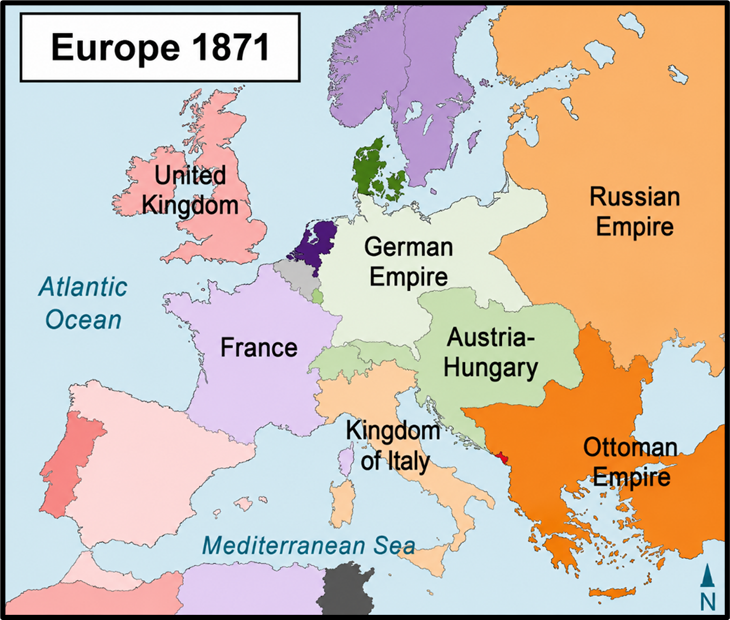
By 1871, the map of Europe had been redrawn. The “Balance of Power” established in 1815 was dead.
- The Rise of Nationalism: These unifications proved that “National Identity” was the most powerful force of the 19th century. It could topple ancient empires and redraw borders.
- The Seed of World Wars: The rise of a powerful, unified Germany in the center of Europe made its neighbors—France and Russia—extremely nervous. This led to the system of “Secret Alliances” which acted like a tripwire, eventually dragging the whole world into war in 1914.
- A Lesson in Statecraft: For students of history and administration, these two processes show that there is no “single way” to build a nation. One used Iron (Power), the other used Sentiment (Passion). Both succeeded in creating a state, but the “character” of those states remained vastly different.
Think of it this way: Germany was a house built by a professional architect with the best materials, while Italy was a house built by a family with great love but limited resources. Both are homes, but they stand differently against the storm.