
Cold War
Please review the following infographics, which provide a clear overview of the discussions covered in this section.
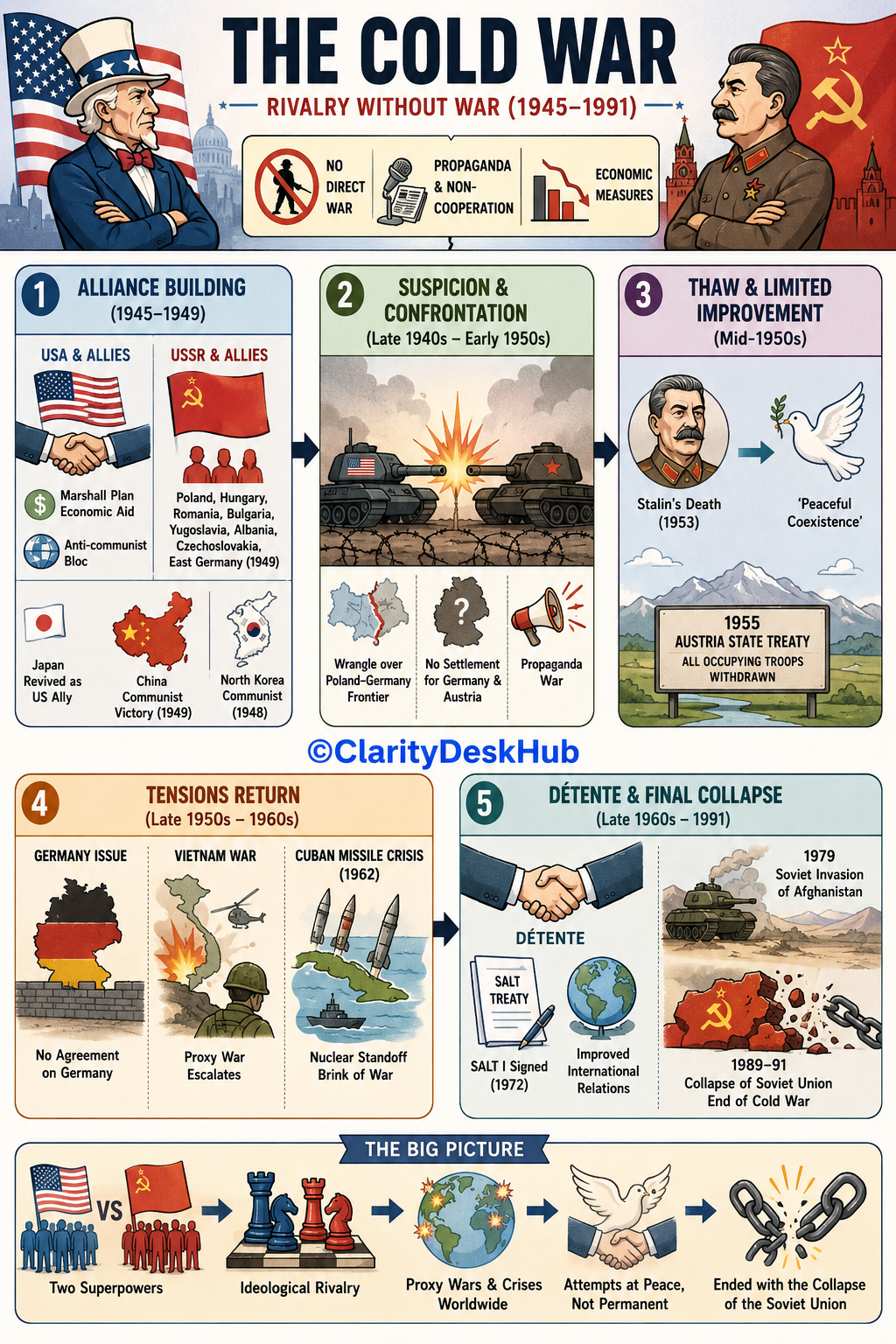
The Origins of the Cold War
The Cold War did not suddenly emerge in 1945—it was the culmination of long-standing ideological, political, and strategic tensions. During the Second World War, the USA, Britain, and the USSR cooperated out of necessity against a common enemy. However, this alliance was inherently fragile. Once the threat of Nazi Germany receded, underlying mistrust resurfaced rapidly.
Thus, the Cold War should be understood not as an accident, but as the re-emergence of unresolved contradictions between two fundamentally different world systems.
Ideological Conflict: Communism vs Capitalism
At the heart of the Cold War lay a profound ideological divide.
- The Soviet system was based on the ideas of Karl Marx, advocating collective ownership, central planning, and prioritization of workers’ welfare.
- In contrast, the Western capitalist model emphasized private property, free markets, and profit-driven enterprise.
This was not merely an economic difference—it represented two competing visions of society and human progress.
From the Western perspective, communism threatened individual freedom and property rights. From the Soviet perspective, capitalism was exploitative and inherently aggressive. This mutual suspicion had existed since the Bolshevik Revolution of 1917 and was reinforced when Western powers intervened in the Russian Civil War.
- The Bolshevik Revolution of 1917 was the uprising in Russia led by Lenin’s Bolshevik Party that overthrew the Provisional Government and established the world’s first communist state.
By the time Joseph Stalin came to power, this mistrust had hardened into a belief that capitalist states would inevitably attempt to destroy communism.
Security Concerns and Soviet Expansionism
The Second World War intensified Soviet insecurity. The USSR suffered immense devastation, and this shaped Stalin’s post-war strategy.
Rather than ideological expansion alone, Stalin’s actions can also be seen through the lens of security and buffer zones. By extending Soviet influence into Eastern Europe, he aimed to prevent future invasions.
However, Western powers interpreted these moves differently. Soviet control over countries like Poland, Romania, and Finland appeared as aggressive expansion rather than defensive consolidation.
This highlights a key Cold War dynamic: the same action—security for one side—was perceived as aggression by the other.
Western Attitudes and Policy Shifts
During the war, cooperation was possible under leaders like Franklin D. Roosevelt, who adopted a relatively trusting approach toward Stalin. The USA even supported the USSR through the Lend-Lease system.
However, after Roosevelt’s death, Harry S. Truman adopted a far more confrontational stance. His policies reflected suspicion rather than cooperation.
Several developments deepened Soviet distrust:
- Delay in opening the Second Front in Europe
- Lack of transparency regarding the atomic bomb
- Exclusion of the USSR from Japan’s occupation
The use of atomic bombs on Japan further intensified tensions. Some historians argue that this was not only about defeating Japan but also a strategic signal to the USSR.
The Nuclear Factor: Power and Fear
The emergence of nuclear weapons fundamentally altered global politics.
The USA’s atomic monopoly created a power imbalance, reinforcing Soviet insecurity. At the same time, it restrained direct conflict—both sides understood the catastrophic consequences of nuclear war.
Thus, paradoxically, nuclear weapons both heightened tensions and prevented open war.
Historiographical Debate: Who Was Responsible?
Understanding the Cold War requires examining how historians have interpreted its origins over time.
(A) The Orthodox View: Blame Stalin
Early Western historians, especially George Kennan, argued that Stalin was primarily responsible.
Kennan believed Stalin aimed to expand communism globally. He advocated the policy of “containment,” which became the cornerstone of US strategy.
This perspective justified actions such as:
- Formation of NATO
- US involvement in the Korean War
In this view, the Cold War was a defensive response to Soviet aggression.
(B) The Revisionist View: Blame the USA
From the 1960s, a contrasting interpretation emerged, influenced by criticism of US foreign policy during the Vietnam War.
Historians like William Appleman Williams argued that the USA was primarily responsible.
According to this view:
- The USSR was acting defensively after suffering massive wartime losses
- The USA pursued global dominance using economic and military power
- Policies like the atomic bomb and economic expansion were tools of hegemony
This interpretation reframes the Cold War as a result of American expansionism rather than Soviet aggression.
(C) The Post-Revisionist View: Shared Responsibility
Later historians adopted a more balanced perspective.
With access to new archival evidence, they concluded that:
- Both sides acted out of fear, insecurity, and misperception
- US policies like Marshall Plan aimed to expand influence
- Stalin, though not necessarily ideologically expansionist, was opportunistic
This interpretation emphasizes mutual suspicion and structural conflict, rather than deliberate aggression by one side.
The Role of Perception and Misinterpretation
A crucial insight from post-revisionist historians is that the Cold War was sustained by interpretive conflict.
Every action had dual meanings:
- Defensive measures appeared aggressive
- Strategic moves were seen as ideological expansion
This created a self-reinforcing cycle of mistrust, where neither side could accurately interpret the other’s intentions.
Later Perspectives After the Cold War
After the collapse of the USSR (1989–91), historians revisited the debate.
John Lewis Gaddis argued that Soviet expansionism was the main cause, and praised leaders like Ronald Reagan and Margaret Thatcher for ensuring Western victory.
In contrast, Odd Arne Westad emphasized broader global factors:
- China’s shift toward capitalism
- Soviet overextension in Afghanistan
According to this view, internal weaknesses—not just Western pressure—led to the collapse of communism.
Concluding Insight: A Conflict Without War
The Cold War was not caused by a single event or leader. It emerged from:
- Deep ideological incompatibility
- Historical mistrust
- Security dilemmas
- Misinterpretations and power struggles
Its most striking feature is that despite intense hostility, direct war was avoided—largely due to nuclear deterrence.
In essence, the Cold War represents a classic case where fear, rather than intention alone, shaped global history.
The Early Cold War (1945–1953)
The period between 1945 and 1953 marks the transformation of wartime cooperation into Cold War hostility. What began as a fragile alliance against Nazi Germany gradually hardened into a deep ideological, political, and military rivalry between the USA and USSR. To understand this transition, we must trace the sequence of events—from diplomatic negotiations to geopolitical confrontations—that steadily widened the divide.
The Yalta Conference (February 1945): Cooperation with Hidden Fault Lines
The Yalta Conference, attended by Joseph Stalin, Franklin D. Roosevelt, and Winston Churchill, represented the last major moment of apparent Allied unity.
Agreements and Optimism
The leaders agreed on key issues:
- Creation of the United Nations to maintain peace.
- Division of Germany and Berlin into zones of occupation.
- Promise of free elections in Eastern Europe.
- Soviet entry into the war against Japan in exchange for territorial concessions.
At this stage, cooperation seemed intact. However, this was more pragmatic coordination than genuine trust.
Underlying Tensions: The Polish Question
Poland became the first serious flashpoint. Stalin supported a communist government in Lublin, while the West backed the government-in-exile in London. Though a compromise was reached, it was vague and open to interpretation—especially regarding free elections.
Analytical Insight: Yalta is often seen as a “compromise built on ambiguity.” Western leaders prioritized ending the war quickly, while Stalin focused on securing a buffer zone in Eastern Europe. This divergence in priorities would soon become explicit.
The Potsdam Conference (July 1945): From Cooperation to Suspicion
By the time of the Potsdam Conference, the geopolitical context had changed significantly.
Changing Leadership and Context
- Harry S. Truman replaced Roosevelt.
- Clement Attlee replaced Churchill midway.
- Germany had already surrendered.
This altered the tone and dynamics of negotiations.
Key Issues and Disagreements
While agreements were reached on disarmament and reparations, major disagreements emerged:
- The future unity of Germany remained unresolved.
- The USSR had already begun consolidating control in Eastern Europe.
- Truman withheld full information about the atomic bomb.
The Atomic Bomb Factor
Shortly after Potsdam, the US used atomic bombs on Japan. This had two implications:
- It ended the war without Soviet help.
- It signaled American military superiority, intensifying Soviet insecurity.
Critical Perspective: Potsdam marks the shift from alliance diplomacy to power politics. Mutual suspicion replaced trust, and both sides began preparing for a post-war rivalry.
Soviet Expansion in Eastern Europe: The “Buffer Zone” vs “Expansionism”
Following the war, the USSR established pro-communist regimes across Eastern Europe—Poland, Hungary, Romania, Bulgaria, and Albania.
Methods of Control
- Manipulated elections
- Suppression of opposition
- Use of secret police and military presence
Even where elections were held (e.g., Hungary), outcomes were engineered in favor of communists.
Ideological Justification
Stalin argued that:
- These states were necessary for Soviet security after repeated invasions.
- Communism would modernize backward economies.
Western Perception
The West saw this as aggressive expansionism and a violation of Yalta promises.
The Iron Curtain Speech
In 1946, Winston Churchill famously declared that an “Iron Curtain” had descended across Europe, symbolizing the division between East and West.
“Iron Curtain” meant the symbolic barrier dividing Soviet‑controlled Eastern Europe from the democratic Western nations, marking the start of the Cold War.
Historiographical Debate:
- Western historians: Soviet actions = expansionism
- Russian historians: defensive strategy misrepresented by the West
The Truman Doctrine (1947): Formalizing Containment
The Truman Doctrine marked a decisive shift in US foreign policy.
Context: Greek Civil War
Britain could no longer support Greece against communist insurgents. The US stepped in.
Core Idea
The US would support “free peoples resisting subjugation.”
Significance
- End of American isolationism
- Beginning of containment policy
- Globalization of the Cold War
Analytical Insight: This was not just about Greece—it was a universal doctrine that framed the Cold War as a moral and ideological struggle.
The Marshall Plan (1947): Economic Strategy with Political Goals
Proposed by George C. Marshall, the Marshall Plan aimed to rebuild Europe.
Economic and Political Dimensions
- $13 billion in aid to Western Europe
- Revival of industry and agriculture
- Prevention of communist appeal through prosperity
Soviet Reaction
The USSR rejected it as “dollar imperialism” and forbade Eastern Europe from participating.
Historiographical Debate
- American view: humanitarian success
- European view: recovery was already underway; aid was supportive but not decisive
The Cominform and Soviet Consolidation
In response, Stalin established the Cominform to coordinate communist parties.
Objectives
- Ensure ideological uniformity
- Strengthen Soviet control
- Promote economic coordination (via Comecon)
Yugoslav Exception
Josip Broz Tito resisted Soviet control and was expelled—showing that communism was not monolithic.
The Czechoslovakia Coup (1948): End of Democratic Eastern Europe
Czechoslovakia, the last democratic state in Eastern Europe, fell to a communist coup.
Key Developments
- Communist leader Klement Gottwald seized power
- Suspicious death of Jan Masaryk
- One-party rule established
Impact
- Shocked the West
- Strengthened perception of Soviet expansion
- Accelerated Western military cooperation
The Berlin Blockade and Airlift (1948–49): First Major Crisis
Berlin became the focal point of Cold War tensions.
Cause → Western zones introduced economic reforms and a new currency.
Soviet Response → Blockade of all land routes to West Berlin.
Western Counter → A massive airlift supplied the city for nearly a year.
Outcome
- Soviet failure
- Western psychological victory
- Permanent division of Germany
Formation of NATO (1949): Militarization of the Cold War
The NATO marked the institutionalization of the Western alliance.
Key Features
- Collective defence principle
- US commitment to European security
Significance → This ended US reluctance toward alliances and formalized the Cold War blocs.
Division of Germany (1949): Symbol of Cold War Division
Germany became the physical and ideological frontier:
- West Germany (Federal Republic) under Konrad Adenauer
- East Germany (GDR) under Soviet influence
This division lasted until 1990, becoming the central symbol of Cold War polarization.
The Nuclear Arms Race and Globalization of Conflict
In 1949, the USSR successfully tested an atomic bomb, ending US monopoly.
Escalation
- US developed hydrogen bomb
- NSC-68 called for massive military expansion
Global Context
- Communist victory in China under Mao Zedong
- Sino-Soviet alliance (1950)
Result → The Cold War became global, extending to Asia (e.g., Korea).
Conclusion: From Fragile Alliance to Structured Rivalry
Between 1945 and 1953, the Cold War evolved through a chain of interconnected developments:
- Diplomatic disagreements (Yalta → Potsdam)
- Ideological polarization (capitalism vs communism)
- Territorial control (Eastern Europe)
- Economic strategies (Marshall Plan)
- Military alliances (NATO)
- Strategic crises (Berlin Blockade)
Final Analytical Insight
The Cold War was not inevitable, but it became highly probable due to:
- Mutual distrust rooted in ideology
- Security dilemmas (each side’s defence seen as threat by the other)
- Power vacuum in post-war Europe
By 1950, the world had effectively split into two hostile blocs, setting the stage for decades of global tension.
To What Extent Was There a Thaw After 1953?
The period after 1953 in the Cold War is often described as a “thaw”—a partial relaxation of tensions between the USA and the USSR. However, this thaw was neither linear nor complete. It was a complex phase marked by coexistence of cooperation and confrontation. To understand its true extent, we must examine its context, causes, manifestations, and limitations in an integrated manner.
Context: From Confrontation to Cautious Engagement
By the early 1950s, the Cold War had already passed through an intense phase—marked by events like the Berlin Blockade and the Korean War. The global situation was precariously balanced, especially after both superpowers acquired nuclear weapons.
The death of Joseph Stalin in 1953 created a turning point,opening the possibility of a shift in Soviet foreign policy. This was not merely a change in leadership—it was a transition from rigid authoritarian diplomacy to a more flexible, strategic approach.
Causes of the Thaw
1. Leadership Change in the Soviet Union
After Stalin’s death, new leaders like Nikita Khrushchev, Malenkov, and Bulganin emerged, advocating a more pragmatic policy.
Khrushchev’s doctrine of “peaceful coexistence” was central. He argued that:
- War between capitalist and communist blocs was not inevitable
- Ideological victory would come through economic superiority, not military conflict
This was a significant ideological shift—it did not abandon communism but redefined the method of achieving it.
2. Nuclear Parity and Fear of Mutual Destruction
By 1953, both the USA and USSR possessed hydrogen bombs, creating a situation of Mutually Assured Destruction (MAD) in practice, even before it was formally conceptualized.
This led to a crucial realization → A direct war would not produce victory—it would mean civilizational collapse. Thus, strategic necessity, not goodwill, became the foundation of détente-like tendencies.
3. Moderation in American Domestic Politics
The decline of extreme anti-communism in the USA also contributed. Joseph McCarthy, whose aggressive campaigns had intensified Cold War hostility, was discredited by 1954.
President Dwight D. Eisenhower signaled a more balanced approach, expressing willingness for improved relations with the Soviet people.
Manifestations of the Thaw
1. Settlement of Ongoing Conflicts
The thaw first became visible in conflict resolution:
- The Korean War ended (1953) with the Panmunjom agreement
- The Indo-China War concluded (1954)
These developments indicated a reduced willingness for proxy wars, at least temporarily.
2. Soviet Concessions in 1955
The USSR took several conciliatory steps:
- Withdrawal of bases from Finland
- Acceptance of new members into the United Nations
- Reconciliation with Josip Broz Tito of Yugoslavia
- Dissolution of the Cominform, suggesting some autonomy for satellite states
These moves projected an image of flexibility and reduced ideological rigidity.
3. The Austrian State Treaty (1955): Peak of the Thaw
The most concrete success was the Austrian State Treaty (1955).
Austria, divided into four zones since 1945, was:
- Reunified and granted full sovereignty
- Declared neutral (not joining NATO or any bloc)
- Freed from foreign troop occupation
This agreement demonstrated that compromise between superpowers was possible, even in strategically sensitive regions.
Limits of the Thaw: Why It Was Only Partial
Despite these positive developments, the thaw had clear structural limitations.
1. Continued Military Rivalry: The Warsaw Pact (1955)
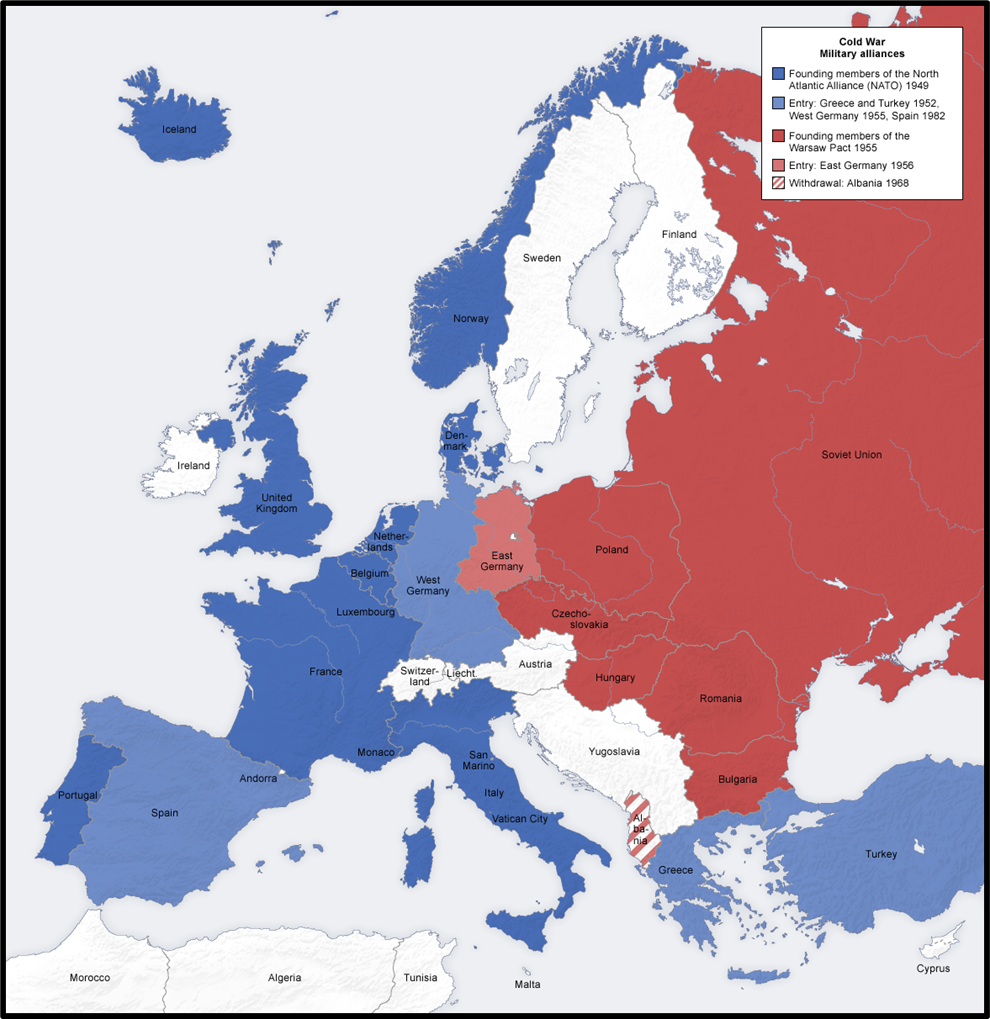
In response to West Germany joining NATO, the USSR formed the Warsaw Pact.
This shows:
- The security dilemma remained intact
- Cooperation coexisted with bloc consolidation
2. Suppression of Dissent: Hungarian Uprising (1956)
When Hungary attempted to break free from Soviet control, the USSR responded with force.
This revealed a crucial contradiction:
- While advocating peaceful coexistence externally, the USSR maintained strict control internally
Thus, the thaw did not extend to Eastern Europe’s political autonomy.
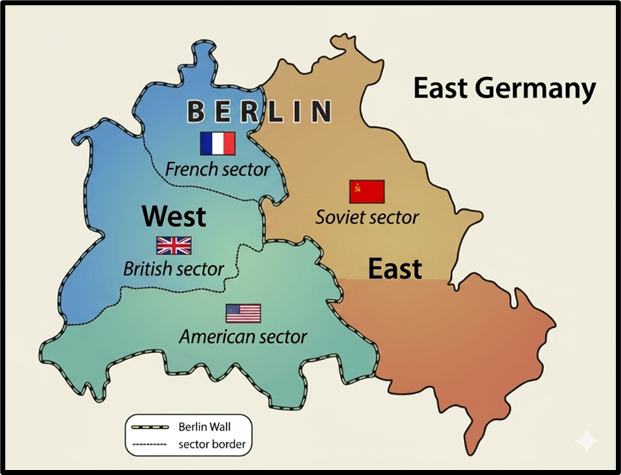
3. Berlin Crisis and Construction of the Wall (1961)
The issue of Germany remained unresolved. Tensions escalated over Berlin:
- Massive migration from East to West embarrassed the USSR
- When negotiations failed, the Berlin Wall was built (1961)
This symbolized → The physical and ideological division of the world
4. Escalation of the Arms Race
Even during the thaw, both sides intensified military capabilities:
- Development of ICBMs (Intercontinental Ballistic Missiles)
- Space race initiated by Sputnik 1
- Expansion of nuclear stockpiles
This suggests that → The thaw was diplomatic, not strategic.
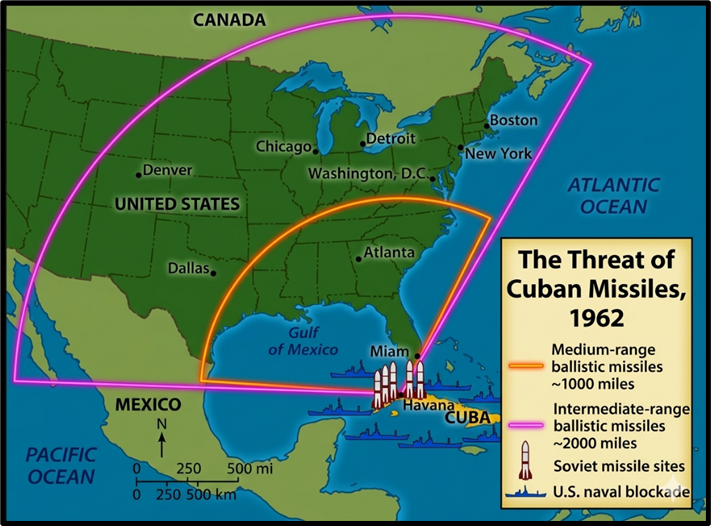
5. The Cuban Missile Crisis (1962): Near Collapse of the Thaw
The most dangerous moment came with the Cuban Missile Crisis.
- Soviet missiles in Cuba triggered a direct confrontation
- The world came close to nuclear war
Although resolved diplomatically, the crisis exposed:
- The fragility of the thaw
- The persistent mistrust and brinkmanship
Consequences of the Thaw
Despite its limitations, the thaw had lasting impacts:
- Institutionalization of Dialogue: Mechanisms like the “hotline” between Washington and Moscow improved crisis communication.
- Arms Control Beginnings: The Nuclear Test Ban Treaty (1963) marked the first step toward limiting nuclear proliferation.
- Foundation for Détente; The experiences of this period laid the groundwork for the later phase of détente in the 1970s.
Critical and Historiographical Perspective
Historians differ in interpreting the thaw:
- Traditional View: Sees it as a genuine relaxation of tensions due to rational leadership
- Revisionist View: Argues it was merely a tactical adjustment, not a real ideological shift
- Post-revisionist View: Suggests a mixed explanation—both superpowers were constrained by nuclear realities but still driven by ideological rivalry
A deeper analysis shows that → The thaw was not a transformation of the Cold War, but a recalibration of its methods.
Conclusion: A Thaw, Not a Transformation
To answer the central question—to what extent was there a thaw after 1953?
There was indeed a meaningful but limited thaw:
- Yes, tensions reduced in diplomacy, conflict resolution, and symbolic cooperation
- No, the core structure of rivalry—military competition, ideological conflict, and geopolitical suspicion—remained unchanged
In essence, the Cold War did not end; it evolved. The period after 1953 represents not peace, but a shift from open hostility to controlled confrontation—a balance between fear and negotiation.
One Comment