An Overview of Conflict in the Middle East
Setting the Stage: How to Read the Region
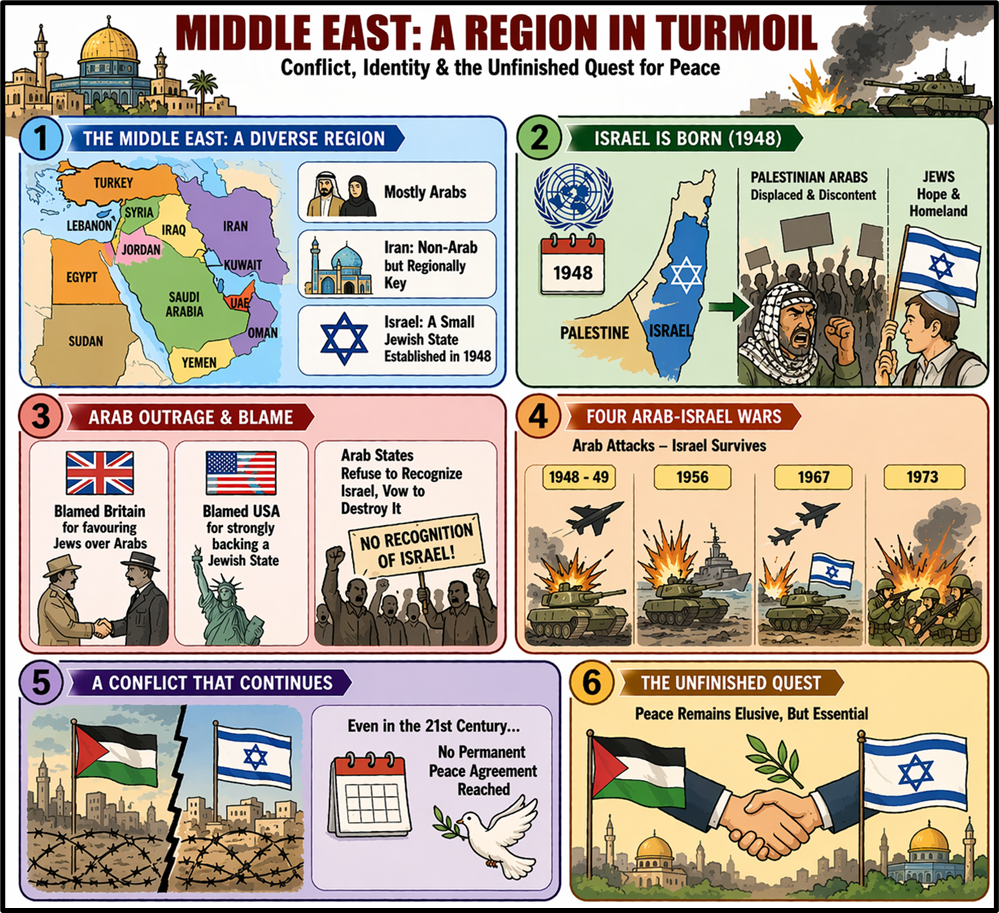
The Middle East — often studied as West Asia — stretches from the eastern Mediterranean to the Arabian Peninsula. Few regions of the world compress so much history, faith and power into so small a space.
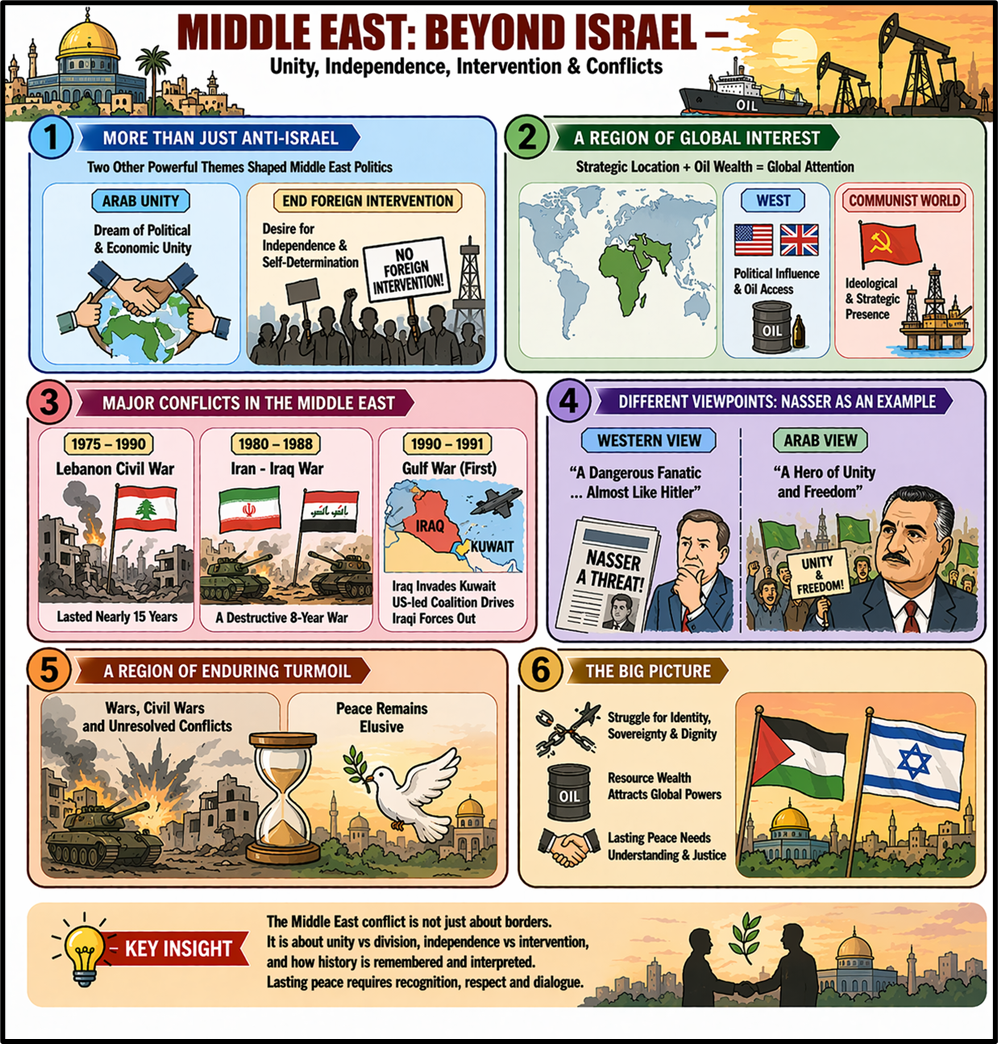
Its importance is easy to state. It sits atop the world’s largest proven reserves of oil and natural gas; it commands three of the planet’s most vital chokepoints — the Strait of Hormuz, the Bab-el-Mandeb and the Suez Canal; and it is the birthplace of three great monotheistic faiths, giving it a civilisational and emotional charge that spills far beyond its own boundaries.
But the conflicts that follow in this chapter — from the Arab–Israeli wars to Suez, Lebanon, the Gulf and the Arab Spring — cannot be read as a series of isolated events. To make sense of them, one must hold several threads together at once: the religious thread of Islam and its internal schisms, the ideological thread of competing answers to Western dominance, the colonial thread of borders drawn by outsiders, and the strategic thread of oil, water and geography. This section supplies those threads.
| Four Lenses to Read Every Middle East Conflict Sectarian: the Shia–Sunni fault line, and the rivalry between Shia Iran and Sunni Saudi Arabia. Ethno-national: stateless peoples such as the Kurds, and contested nationhood as in Palestine. Colonial legacy: artificial borders drawn after World War I that ignored ground realities. Great-power interest: the pursuit of oil, arms markets and strategic depth by outside powers. |
Foundations of Islam: Origin and the Great Schism
Islam is associated with the Prophet Mohammad, who received revelations at the Cave of Hira that became the foundation of the faith. The crisis that shapes the region to this day was not doctrinal at first but political — it began the moment the Prophet died in 632 AD, over a single question: who should lead the community after him?
The first four leaders, the Rightly Guided Caliphs (Abu Bakr, Umar, Uthman and Ali), governed the young and rapidly expanding empire. But tension simmered around Ali — the Prophet’s cousin and son-in-law — whose supporters believed leadership must remain within the Prophet’s bloodline.
After Ali, his opponent Muawiyah of the wealthy Umayyad clan claimed the Caliphate; and when Ali’s son Hussein was defeated and killed at the Battle of Karbala, the split became permanent.
Sunni and Shia — The Fundamental Divide
| Basis | Sunni | Shia |
|---|---|---|
| Core belief on leadership | The leader (Caliph) should be elected or chosen from among the worthy successors of the Prophet | Leadership must descend from the Prophet’s bloodline through Ali and his descendants (the Imams) |
| Title of leader | Caliph | Imam |
| Defining event | Continuity of the Caliphate | Martyrdom of Hussein at Karbala |
| Approx. share today | Large majority of Muslims worldwide | Minority overall; majority in Iran and Iraq |
Broadly, Muslims are divided into four branches — Shias, Sunnis, Kharijites and Quranists — with the Shia–Sunni split the deepest. The Quranists hold the Quran alone as authentic and reject the recorded oral traditions (Hadith).
This ancient theological question has, over centuries, hardened into the geopolitical rivalry that today pits Iran against Saudi Arabia across a dozen battlefields — a rivalry visible in almost every conflict examined in the sections that follow.
The Chain of Caliphates
Power passed through a succession of dynasties, each claiming to lead the Islamic world. Understanding this chain explains why the modern call for a ‘Caliphate’ carries such symbolic weight.
| Rightly Guided Caliphs → Umayyads → Abbasids (750–1258) → Ottomans (to 1924) → ISIS ‘Caliphate’ (2014) |
The Abbasids ruled from 750 AD until the Mongol invasions of 1258. The Ottoman Caliphate, established after Selim I made Egypt Ottoman territory in 1517, lasted until it was abolished in 1924 — giving birth to the modern Republic of Turkey.
When Abu Bakr al-Baghdadi proclaimed a new Caliphate in June 2014, he was deliberately invoking this thousand-year lineage to claim legitimacy.
The Competing Ideologies
Beyond the Shia–Sunni divide, several distinct ideologies drive the region’s politics. Each answers, in its own way, the recurring Islamic question of the modern age: how should Muslims respond to Western dominance and internal decline?
| Ideology | Core Idea | Significance / Where It Operates |
|---|---|---|
| Wahabism | Founded by Ibn Abd al-Wahab; strict monotheism (Tawhid); condemns saint- and tomb-worship as Jahiliya (ignorance) | State ideology of Saudi Arabia via the Al-Wahab–Ibn Saud pact; ideological roots claimed by ISIS, the Taliban and Al-Qaeda |
| Salafism | A revivalist movement to emulate the earliest, ‘purest’ generations who heard the Prophet directly | Peaceful in most forms; a violent ‘Salafi-Jihadi’ strand justifies Jihad to enforce purity |
| Muslim Brotherhood | Founded by Hasan al-Banna in Egypt; grassroots Islam through health, education and welfare; seeks Sharia and Caliphate but is pragmatic and accommodating | Rose after the 2011 Arab Spring; opposed by Saudi Arabia as a threat to monarchies; Qatar’s support for it triggered the 2017 Gulf crisis |
| Baathism | Secular Arab-socialist nationalism; pan-Arab unity placed above religious identity | Ruling ideology of Saddam Hussein’s Iraq and the Assads’ Syria |
| Alawism | A secretive sect close to Shia Islam, based in coastal Syria’s mountains | The House of Assad are Alawis — a minority ruling a Sunni-majority Syria |
| The Sectarian Inversion — A Key to the Region Syria: a Sunni-majority country long ruled by the Alawi (Shia-linked) minority House of Assad. Iraq (under Saddam): a Shia-majority country ruled by a Sunni minority leader. This mismatch between rulers and ruled is a root cause of the civil wars and insurgencies that followed regime change. |
The Colonial Imprint: How the Modern Map Was Drawn
Much of the region’s instability traces back to World War I. As the war raged, Britain and France secretly concluded the Sykes–Picot Agreement (1916) — also called the Asia Minor Agreement — to carve up the Ottoman Middle East between themselves once victory came, primarily to secure oil for their industries.
After the war, the Mandate System under the League of Nations gave effect to these ambitions: Britain received the mandates of Iraq and Palestine, while France took Syria and Lebanon. Borders were drawn to suit imperial convenience, cutting across tribes, sects and peoples.
This single act of external map-making planted the seeds of the Kurdish, Palestinian and many Arab grievances that endure today — the subject of the sections that follow.
The Kurdish Question — The Largest Stateless Nation
No people illustrate the cost of that map-making better than the Kurds — an indigenous people of the Mesopotamian plains with a common race and culture, mostly Sunni Muslim, but without a common dialect and without a state. When the Ottoman Empire collapsed, the Treaty of Sèvres (1920) promised a Kurdish state; but the later Treaty of Lausanne (1923) created modern Turkey without any Kurdistan.
Betrayed, the Kurds have fought ever since — spread across Turkey, Syria, Iraq and Iran.
| Country | Main Kurdish Group | Character of the Struggle |
|---|---|---|
| Turkey | PKK (founded by Abdullah Öcalan, 1978) | Armed struggle, later shifting to demands for cultural and political autonomy; periodic ceasefire talks; branded a terrorist organisation by Turkey |
| Syria | PYD and its militia, the YPG | Fights for autonomy within a federal Syria rather than independence; famously repelled ISIS in Rojava |
| Iraq | KDP / PUK, governing through the KRG | Kurds enjoy the most rights here; the KRG in the north pushes for autonomy and even a referendum, defended by Peshmerga fighters |
Also caught in this landscape are the Yazidis — one of the world’s oldest religious minorities, with roots linked to Zoroastrianism, living near the Sinjar Mountains of Iraq. Branded ‘devil-worshippers’ by ISIS and subjected to genocide, they were driven to the verge of extinction.
Critical Analysis: Why the Foundations Matter
It is tempting to read the Middle East as a region of ancient hatreds erupting endlessly. The foundations above suggest something more precise. The Shia–Sunni schism is 1,400 years old, but its weaponisation as a geopolitical instrument is recent — a product of the 1979 Iranian Revolution and the Saudi response to it. Likewise, the region’s borders are not ancient; they are barely a century old, and were drawn by two European cabinets with a map and a pencil.
The conflicts that follow, therefore, are best understood as modern struggles fought in ancient language: sectarian identity mobilised for political ends, within states whose very shape was imposed from outside, over resources the world cannot do without. Each war in this section is a variation on that theme.