The Korean War (1950-53)
Historical Context: Korea in the Emerging Cold War Order
To understand the Korean War, one must first situate it within the broader transformation of global politics after World War II.
Korea had been under Japanese colonial rule since 1910. With Japan’s defeat in 1945, Korea suddenly became a geopolitical vacuum. Instead of gaining immediate independence, it became entangled in the growing rivalry between two emerging superpowers—the USA and the USSR.
The division of Korea along the 38th parallel was initially conceived as a temporary administrative arrangement. However, like Germany, Korea quickly became a frontline state in the Cold War.
This division was artificial—it ignored cultural, historical, and national unity—and therefore created deep resentment among Koreans. Yet, it suited the strategic interests of both superpowers.
Institutionalization of Division: Two Koreas Emerge (1948)
The failure to organize nationwide elections—mainly due to Cold War distrust—led to the creation of two separate states:
- South Korea (Republic of Korea) under Syngman Rhee (pro-Western, authoritarian)
- North Korea (Democratic People’s Republic of Korea) under Kim Il Sung (communist, Stalinist model)
Both regimes claimed legitimacy over the entire peninsula. This dual claim created a classic Cold War flashpoint—ideological conflict fused with territorial ambition.
The withdrawal of Soviet and American troops in 1949 made the situation even more unstable: two rival regimes, heavily armed, deeply suspicious, and eager for unification.
Causes of the War: Why Did North Korea Invade?
The invasion of South Korea in June 1950 remains a debated issue among historians. Rather than a single cause, it emerged from multiple overlapping factors:
Kim Il Sung’s Initiative
The most widely accepted view is that Kim Il Sung himself pushed for reunification by force, believing conditions were favorable.
Soviet Encouragement
Joseph Stalin provided military support (tanks, weapons), possibly seeing Korea as a way to:
- Test American resolve
- Expand communist influence in Asia
Chinese Factor
The recent communist victory in China (1949) under Mao Zedong created a sense of momentum for communism in Asia.
American Strategic Ambiguity
A key trigger may have been a statement by Dean Acheson, who excluded Korea from America’s defensive perimeter—possibly signaling weak commitment.
Internal Korean Dynamics
Both Koreas:
- Rejected division
- Claimed sovereignty over the whole peninsula
Thus, the war also had a civil war dimension, not just a Cold War conflict.
US Intervention: From Containment to Global Commitment
The invasion shocked the United States, and President Harry S. Truman interpreted it as part of a broader communist expansion strategy.
Key Motivations Behind US Action
- Containment Doctrine: The US believed stopping communism in Korea was essential to prevent a domino effect across Asia.
- Historical Lessons from Appeasement: The failure to stop Adolf Hitler in the 1930s shaped American thinking—aggression had to be resisted early.
- Support for the United Nations: Unlike the failed League of Nations, the US wanted the United Nations to succeed as a peacekeeping body.
- Domestic Political Pressure: Anti-communist sentiment, amplified by Joseph McCarthy, pushed Truman to act decisively.
Course of the War: A Dynamic and Escalating Conflict
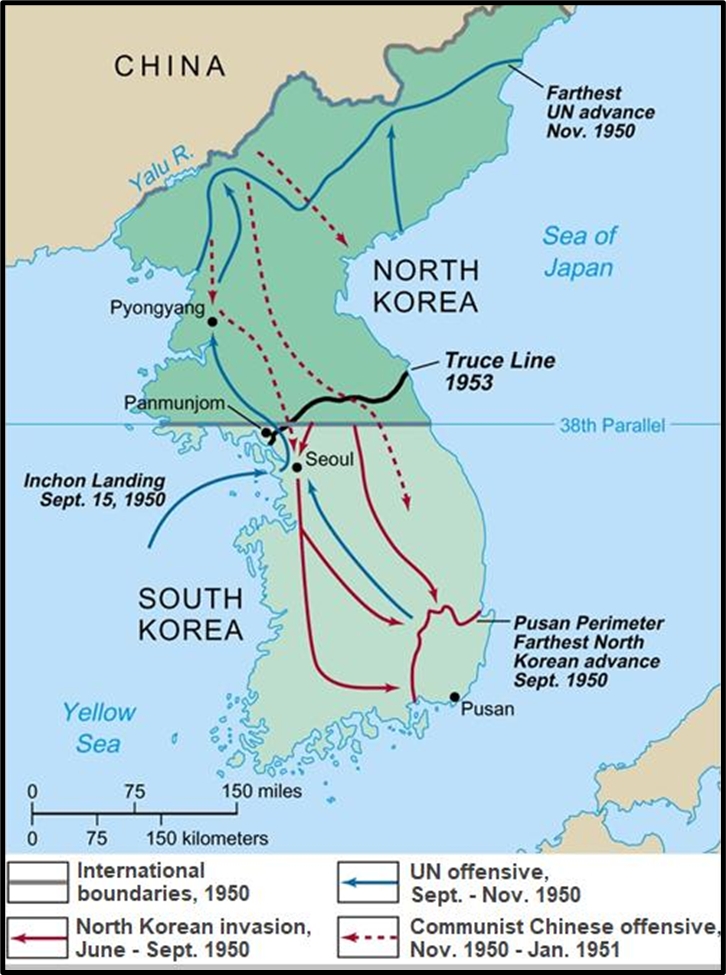
Initial North Korean Success (1950): North Korean forces advanced rapidly, capturing most of South Korea except the Pusan perimeter.
UN Counteroffensive
Under General Douglas MacArthur:
- A daring landing at Inchon reversed the situation
- Seoul was recaptured
- North Korean forces collapsed
Expansion into North Korea
Instead of stopping, UN forces crossed the 38th parallel aiming to unify Korea. This marked a critical turning point—from defensive war to offensive expansion.
Chinese Intervention (1950–51)
China, fearing encirclement, intervened massively under the leadership of Zhou Enlai.
- Over 300,000 troops entered the war
- UN forces were pushed back
- Seoul fell again
Strategic Restraint vs Escalation Debate
MacArthur proposed → Attacking Manchuria using nuclear weapons
Truman rejected this, fearing a wider war with the USSR. MacArthur was dismissed—highlighting civilian control over the military.
Stalemate and Armistice (1951–53)
The war stabilized near the 38th parallel. After prolonged negotiations at Panmunjom, an armistice was signed in 1953.
Consequences: Multi-Dimensional Impact
Impact on Korea: Devastation and Division
Korea suffered immensely →~4 million deaths, Massive destruction, Permanent division
The peninsula became one of the most militarized regions in the world.
Impact on the Cold War: Militarization and Expansion
The war transformed the Cold War from a European-centered conflict into a global one.
- US increased military spending
- NATO strengthened
- Cold War extended to Asia
Rise of China as a Major Power
China emerged as a significant military force → Successfully challenged the US and Asserted its regional influence. Yet, its exclusion from the UN appeared increasingly untenable.
Strained US-China Relations
The war created long-term hostility between the US and China, particularly over Taiwan.
Legitimacy and Limits of the United Nations
The UN:
- Successfully resisted aggression
- But was criticized by communist states as a US tool
This reflects the structural limitation of international organizations in bipolar politics.
Expansion of Alliance Systems in Asia
The Cold War alliance pattern spread to Asia:
- Formation of SEATO
- US alliances with Japan, South Korea, Australia
However, many Asian countries chose non-alignment, foreshadowing the rise of the Non-Aligned Movement.
Critical Analysis and Historiographical Perspective
Was It a Civil War or a Cold War Conflict?
Historians debate whether the Korean War was:
- A civil war (internal Korean struggle), or
- A proxy war between superpowers
The most balanced view sees it as a fusion of both.
Missed Opportunities?
Some argue:
- The US could have avoided Chinese intervention by not crossing the 38th parallel
- Others believe strong action prevented wider communist expansion
Containment vs Rollback
The war marked a clear shift: From passive containment → active military resistance
Yet, Truman stopped short of “rollback” (destroying communism entirely), showing strategic restraint.
Conclusion: Why the Korean War Matters
The Korean War was not just a regional conflict—it was a defining moment in Cold War history. It demonstrated:
- How local conflicts could escalate into global crises
- The dangers of ideological polarization
- The limits of military solutions in achieving political unity
Most importantly, it set a precedent: Cold War conflicts would be fought indirectly, through proxy wars, rather than direct superpower confrontation.