
The Spanish Crucible
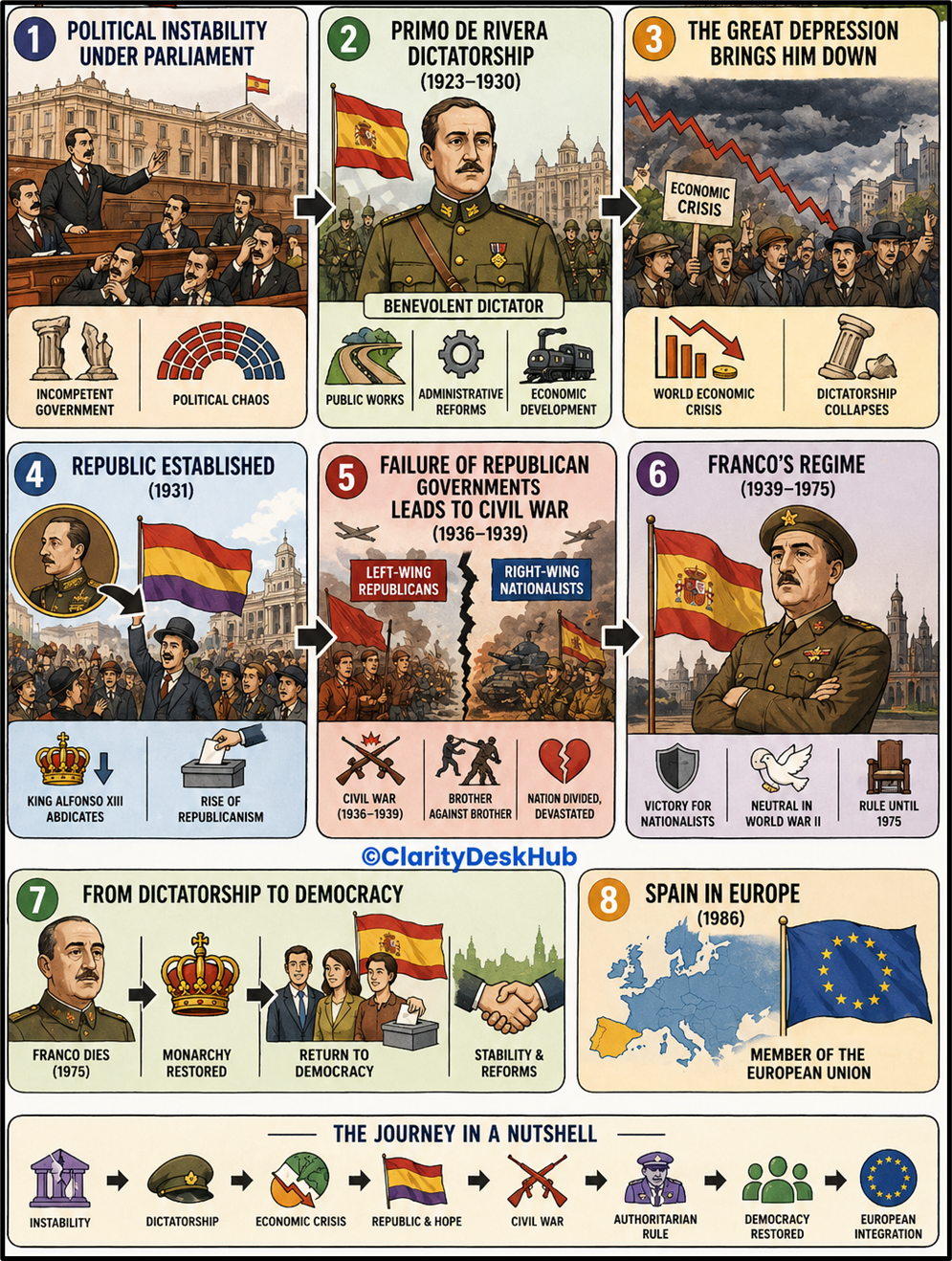
Understanding the history of Spain in the 20th century is to understand the tragedy of a nation torn between its medieval soul and its modern aspirations. If we look at Spain in the 1920s and 30s, it wasn’t just a political struggle; it was a “laboratory of ideologies” where Monarchy, Dictatorship, Republicanism, Fascism, and Communism all collided.
Let’s analyze this journey from the decaying monarchy to the rise of General Franco.
The Twilight of Monarchy and the Rise of Primo de Rivera
At the dawn of the 1920s, Spain was under the constitutional monarchy of King Alfonso XIII. However, this system was hollow.
The real crisis arrived in 1921 with the “Disaster of Annual” in Spanish Morocco, where a tribal revolt led by Abd-el-Krim massacred the Spanish army. This humiliation brought the monarchy to its “rock bottom.”
In this vacuum of authority, General Primo de Rivera seized power in 1923 through a bloodless coup. Interestingly, the King called him “my Mussolini,” yet Primo was more of a traditional military autocrat than a true Fascist.
His era was a paradox: on one hand, he modernized infrastructure—roads, irrigation, and railways—and ended the Moroccan war; on the other, he failed to build a lasting political foundation.
When the Great Depression hit in 1930, the economic stability vanished, the army withdrew its support, and Primo resigned. By 1931, the people’s verdict in municipal elections was so overwhelmingly pro-Republic that Alfonso XIII chose exile to avoid a bloodbath.
The Birth of the Second Republic: A House Divided
The proclamation of the Second Republic in 1931 was met with euphoria, but it inherited a society fractured by centuries of “Two Spains”—the traditional, Catholic Spain and the progressive, secular Spain.
The new government, led by Manuel Azaña, attempted a radical surgery of Spanish society. They granted autonomy to Catalonia, separated Church and State, reduced the bloated officer corps of the army, and initiated land reforms.
However, these reforms were like “poking a hornet’s nest.” The Church felt persecuted, the Army felt insulted, and the Landowners felt robbed. This led to the birth of CEDA (a right-wing Catholic party) and the Falange (Fascist party).
Simultaneously, the government faced fire from the extreme Left—Anarchists and Syndicalists—who felt the Republic was too slow and “bourgeois.” The tragic incident at Casas Viejas in 1933, where government guards killed anarchists, stripped the Republic of its moral high ground, leading to a right-wing victory in the next elections.
The Path to the Abyss: 1934–1936
Between 1933 and 1936, Spain entered a “dark biennium.” The new right-wing government systematically dismantled Azaña’s reforms, infuriating the Left and the Basques. This culminated in the Asturias Miners’ Revolt (1934), which was crushed with brutal efficiency by a rising general named Francisco Franco.
By 1936, the middle ground had disappeared. The Left formed a Popular Front and narrowly won the elections. The atmosphere was electric with violence. The “tipping point” came in July 1936 with the assassination of the right-wing leader Calvo Sotelo.
For the Right, this was the final proof that the Republic could not maintain order. A military conspiracy, led by Generals Mola and Franco, launched a revolt from Morocco. What was intended as a quick coup turned into a three-year-long national agony.
The Spanish Civil War (1936–1939): A Global Prelude
The Civil War was not just a Spanish affair; it was a dress rehearsal for World War II.
- On one side were the Nationalists (Franco’s forces), supported by the iron and airpower of Hitler and Mussolini.
- On the other were the Republicans, supported by the Soviet Union and the International Brigades (volunteers from across the world).
- Britain and France remained neutral, a policy that effectively starved the Republic of resources while the Nationalists were fed by Fascist dictators.
The war was defined by its brutality. We see this in the bombing of Guernica in 1937, where the German Condor Legion tested “carpet bombing” on civilians.
While the Nationalists remained united under Franco’s singular command, the Republicans were plagued by internal “wars within the war”—Stalinists fighting Trotskyites and Anarchists in the streets of Barcelona.
This lack of unity, combined with superior Nationalist military logistics, led to the fall of Barcelona and finally Madrid in March 1939.
The Era of the “Caudillo”: Stability through Silence
General Franco, now the Caudillo, established a regime that lasted nearly 40 years. It is a mistake to call it purely Fascist; it was a “Clerical-Authoritarian” state.
Franco successfully amalgamated the Falangists, the Army, and the Church. He restored the Church’s control over education and social life, reversing all Republican progress for women and regional identities.
Analytically, Franco was a master of survival. He kept Spain out of WWII despite Hitler’s pressure. When the world shunned him after 1945, he waited until the Cold War made him a “useful anti-communist ally” for the USA.
Economically, Spain moved from a stagnant, isolated state to a burgeoning tourist destination and industrializing nation by the 1960s.
The Transition: From Dictatorship to Democracy
The true genius of the Spanish transition was its smoothness. Franco had groomed Juan Carlos, the grandson of Alfonso XIII, to be a conservative successor. However, upon Franco’s death in 1975, the King chose the path of democracy. By 1977, free elections were held, and by 1986, Spain was a member of the European Community.
While Spain faced a severe crisis during the 2008 financial meltdown, the journey from 1921 to the present shows a nation that eventually learned to resolve its “Two Spains” contradiction through democratic consensus rather than the barrel of a gun. The lesson here, is that stability without liberty is a graveyard, but liberty without order often leads to the abyss.