
Stalin and the USSR, 1924-53
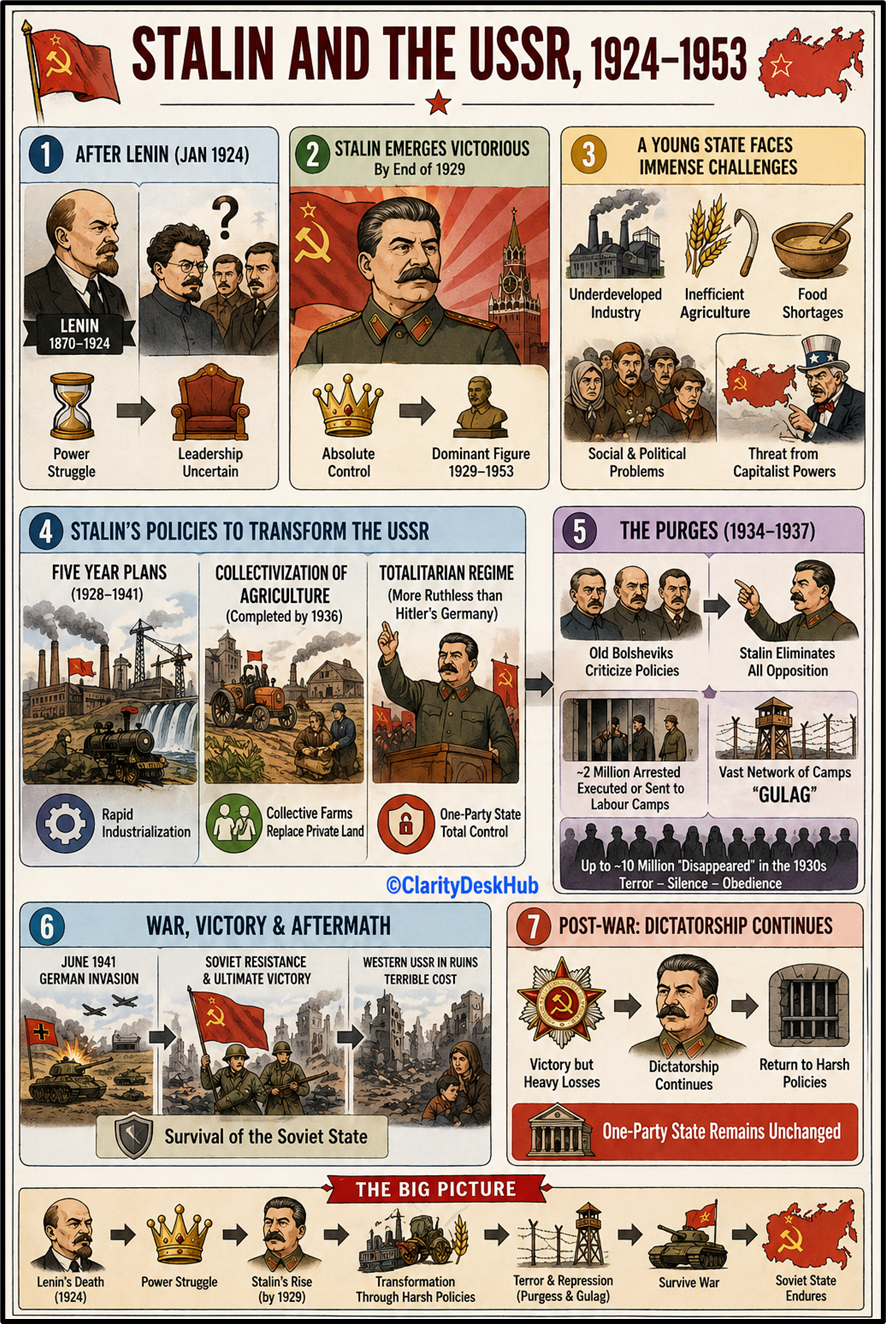
In this section, we shall discuss one of the most fascinating and, perhaps, most chilling chapters of modern history: the rise of Joseph Stalin.
When we look at the history of the Soviet Union, there is a paradox.
- On one side, you have Leon Trotsky—a brilliant orator, a polyglot intellectual, and the architect of the Red Army.
- Leon Trotsky was a leading Bolshevik revolutionary, a close associate of Lenin, and one of the most capable figures of the 1917 Revolution—known for his intellect, oratory, and organizational skill.
- The Red Army was the army created by the Bolsheviks during the Russian Civil War (1918–21).
- On the other side, you have Joseph Stalin—a man described by contemporaries as a “vague, grey blur” and the “party’s most eminent mediocrity.”
The question for us is: How did the “mediocrity” defeat the “brilliance”? How did a man from the fringes of Georgia become the absolute Tsar of the Communist world? Let us analyze this.
Stalin’s Rise to Power
The Genesis: From the Seminary to the Secretariat
To understand Stalin, you must understand his roots. Born Joseph Djugashvili in 1879 in Georgia, he was the son of a poor shoemaker. His mother wanted him to be a priest, but the “Man of Steel” (the meaning of ‘Stalin’) was forged in the fire of revolution, not the incense of the Church.
- The Rebellious Monk: He was expelled from the Tiflis Theological Seminary in 1899 for spreading socialist ideas. This is important—he wasn’t just a thug; he was an ideologue from the start, albeit a quiet one.
- The “Grey” Administrator: After the 1917 Revolution, while others were busy making grand speeches, Stalin was busy with the “boring” work. He became an administrator. By 1922, he was the General Secretary of the Communist Party.
Insight: In politics, never ignore the person who controls the paperwork. While Trotsky was leading armies, Stalin was appointing the people who would later vote for him.
The Crisis of Succession: Lenin’s Warning
When Lenin fell ill and eventually died in 1924, a power vacuum emerged. Lenin, a sharp judge of character, saw the danger. In his “Testament” (Will), he wrote:
“Comrade Stalin has concentrated enormous power in his hands… He is too crude… I suggest that comrades devise a means of removing him.”
The Great Mistake: The Politburo—the seven-man committee deciding policy—ignored this warning. Why? Because they were more afraid of Trotsky’s “Bonapartism” (military dictatorship) than Stalin’s “rudeness.” They underestimated him, and in politics, underestimating your opponent is a terminal error.
Dimensions of Stalin’s Ascent: A Multidimensional Analysis
Stalin did not reach the top by chance; he used a combination of institutional power, psychological warfare, and ideological flexibility.
A. The Institutional Weapon: The General Secretary
As General Secretary, Stalin had the power of patronage.
- He appointed his supporters to key local party positions.
- He sent his rivals’ supporters to remote regions (internal exile).
- Result: By 1928, when the Party Congress met to vote, the room was literally “packed” with Stalinists. The democratic process became a rubber stamp for his will.
B. The Psychological Weapon: Trotsky’s Brilliance as a Flaw
Leon Trotsky was his own worst enemy.
- Arrogance: He was intellectually condescending. He joined the Bolsheviks late (1917), which “old” Bolsheviks like Kamenev and Zinoviev resented.
- The Triumvirate: To stop Trotsky, Kamenev and Zinoviev formed an alliance with Stalin. They thought they were using Stalin to block Trotsky. In reality, Stalin was using them to isolate Trotsky.
C. The Ideological Weapon: “Socialism in One Country”
There was a deep debate on how to build a Marxist state.
- The Left (Trotsky): Advocated for “Permanent Revolution”—the idea that the USSR could only survive if revolutions happened in Western Europe.
- The Right (Bukharin): Supported the New Economic Policy (NEP), allowing some capitalism to help the peasants.
- Stalin’s Masterstroke: He introduced “Socialism in One Country.” He told the party, “We don’t need the West. We can build our paradise right here.” This appealed to the nationalistic pride and war-weariness of the Russian people.
The “Salami Tactics”: Eliminating the Rivals
Stalin’s strategy was to “slice” his opposition one by one.
- Phase 1 (1924–1927): Stalin joins the Right (Bukharin) to crush the Left (Trotsky, Kamenev, Zinoviev). He uses the argument of “Socialism in One Country” to portray Trotsky as a defeatist. Trotsky is expelled from the party and later exiled.
- Phase 2 (1928–1929): Once the Left is gone, Stalin turns on the Right. He suddenly argues that the NEP is failing and that the kulaks (wealthy peasants) are enemies of the state. He adopts the very policies of rapid industrialization he once criticized.
- Result: Bukharin is voted off the Politburo in 1929. Stalin stands alone at the summit.
Historiographical Perspective: Was it just Cynicism?
Many historians argue Stalin’s policy shifts were purely cynical—a way to kill his rivals. However, historians like Robert Service suggest that Stalin’s policies were actually popular within the party.
The rank-and-file members were tired of the “vague” intellectual debates of Trotsky and Bukharin. They wanted action. They wanted to see the USSR become a superpower. Stalin gave them a concrete, albeit brutal, vision.
Conclusion: The “Man of Steel” Legacy
By 1929, the “grey blur” had vanished, and the Dictator had emerged. Stalin’s rise shows us that in the struggle for power:
- Organization triumphs over Oratory.
- Tactical Flexibility triumphs over Ideological Purity.
- Control of the Bureaucracy is the ultimate “High Ground.”
He didn’t just win a political debate; he transformed the party into a personal machine. This set the stage for the Five-Year Plans and the Great Purges that would follow.
Do you think Stalin’s rise was inevitable, or could a more united opposition have stopped him?
Now let’s move on! Having seen how Stalin secured the “commanding heights” of the Communist Party, we must now ask: What did he do with that power?
Stalin inherited a Russia that was essentially a 19th-century agrarian society trying to survive in a 20th-century industrial world. His response was a “Revolution from Above”—a brutal, high-speed transformation of the entire Soviet economy. Let us analyze whether this experiment was a success or a catastrophic failure.
Stalin and Russia’s Economic Problems
The “10-Year Deadline”: Why the Hurry?
In 1931, Stalin gave a speech that defines his entire economic philosophy. He said:
“We are 50 or 100 years behind the advanced countries. We must make good this distance in 10 years. Either we do it, or we shall be crushed.”
The Context of Fear:
- Military Survival: Stalin was convinced that the capitalist West would eventually invade. Without heavy industry (steel, coal, oil), the USSR would have no tanks, no planes, and no hope.
- The Capital Crisis: No Western country would lend money to a Communist state. To build factories, Stalin needed machines. To buy machines, he needed foreign currency. The only thing Russia had to sell was grain.
- Ideological Security: To Stalin, peasants were “enemies of socialism” because they were small-scale capitalists. He wanted a nation of industrial workers—the true backbone of the Communist Party.
The Five-Year Plans: Forging the “Iron Wall”
Stalin abandoned the New Economic Policy (NEP) and replaced it with Central Planning. The state (Gosplan) decided everything: how many nails to produce, where to build dams, and what every worker should earn.
Key Developments:
- The Heroic Narrative: The government promoted the Stakhanovite Movement. Alexei Stakhanov, a miner, allegedly cut 102 tons of coal in one shift. He became a national celebrity to inspire other workers to push beyond human limits.
- The Geographical Shift: Fearing an invasion from the West, Stalin built huge industrial complexes east of the Ural Mountains (e.g., Magnitogorsk). This was an inspired strategic move that saved Russia during WWII.
- The Education Explosion: To run these factories, the state invested heavily in technical education, creating a new generation of skilled Soviet engineers.
The Dark Reality:
- Human Exploitation: Historian Richard Freeborn calls this a “declaration of war” against the workers. Discipline was ruthless. A mistake in a factory wasn’t just an error; it was “sabotage” or “wrecking,” punishable by the Gulag (forced labor camps).
- Quality vs. Quantity: Because managers were obsessed with meeting impossible targets, they produced shoddy, unusable goods just to “check the box.”
Collectivization: The War in the Countryside
If the factories were the “heart” of the plan, the farms were the “fuel.” Stalin introduced Collectivization—merging small peasant plots into massive state-owned farms called Kolkhoz.
The Logic and the Conflict:
Stalin wanted to “liquidate the Kulaks (prosperous peasants) as a class.” He saw them as the bottleneck holding back grain exports.
The Resistance:
The peasants did not go quietly. In a tragic display of defiance, they slaughtered their own livestock and burnt their crops rather than hand them over to the state.
- Consequence: Livestock levels didn’t recover to 1928 levels until 1953!
The Great Famine (1932–33):
The disruption led to a horrific famine, especially in Ukraine (the Holodomor). While 5 million people were starving to death, Stalin continued to export 1.75 million tons of grain to buy industrial machinery.
Critical Analysis: For Stalin, the famine was not a failure; it was a tool. It broke the will of the peasantry and ensured the state had total control over the food supply.
The Final Audit: Was it a Success?
To evaluate Stalin’s economy, we must look at two different balance sheets.
The “Success” Side (The Macro View):
- Industrial Superpower: By 1940, the USSR had overtaken Britain in iron and steel production. It became the second-largest industrial power in the world.
- Military Preparedness: As historian Alec Nove points out, without the Urals-Siberian industrial base, the Soviet Union would have likely lost to Nazi Germany in 1941.
- Modernization: It dragged a medieval society into the machine age in just over a decade.
The “Failure” Side (The Human View):
- Agricultural Ruin: Collectivization was an economic disaster. Grain production barely grew, and the loss of livestock was a permanent scar.
- Standard of Living: While the state grew rich, the people stayed poor. Housing was primitive, and consumer goods (clothes, shoes) were a luxury.
- The Moral Cost: The cost of this “success” was millions of lives lost to famine, execution, and the Gulag.
Summary and Conclusion
Stalin’s economic policy was a brutal success. He achieved his goal of making Russia a military-industrial titan capable of surviving a world war, but he did so by treating his own citizens as “fuel” for the state machine.
In the language of UPSC or academic analysis, we call this Extensive Growth—growth achieved through the massive mobilization of resources and labor, rather than through efficiency or innovation. It built a superpower, but it sowed the seeds of the Soviet Union’s eventual economic stagnation decades later.
A question for you to ponder: If you were a Soviet citizen in 1930, would you have supported the “heroic” struggle of the Five-Year Plans, or would you have seen it as a “war” against the people?
Next! We have already seen how Stalin transformed the Soviet economy into an industrial giant. But now, we must look at the darker side of the moon.
Success in the 1930s came with a strange byproduct: Extreme Paranoia. You might think that a man who had industrialised a nation and defeated his rivals would feel secure. But history shows us that the more power a dictator concentrates, the more he fears losing it. Let’s analyse the era of the Great Terror and the political machinery of Stalinist Russia.
Politics and the Purges
The Paradox of Insecurity: The Ryutin Platform
By 1930, Stalin was the “Supreme Leader,” yet the air in the Kremlin was thick with tension.
- The Discontent: Collectivization had caused a famine, and the First Five-Year Plan had pushed workers to the breaking point. Even within the Party, people were whispering.
- The Ryutin Platform (1932): A man named Ryutin circulated a document calling Stalin the “evil genius of the Revolution” and advocating for his removal.
- Stalin’s Reaction: While the Politburo initially refused to execute Ryutin, Stalin never forgot this. This “insult” convinced him that the Party was infested with “traitors.”
The Catalyst: The Murder of Sergei Kirov (1934)
If you want to understand the “Great Terror,” you must understand the Kirov Murder. Sergei Kirov was the popular leader of the Leningrad Party. He was a Stalin ally, but some saw him as a more “human” alternative to Stalin.
- The Event: In December 1934, Kirov was shot dead.
- The Pretext: Historians like Robert Conquest suggest Stalin himself might have arranged the murder. Why? Because it served as the perfect excuse to launch a massive “witch hunt.”
- The Result: Stalin claimed there was a vast, underground conspiracy involving the exiled Trotsky to kill all Soviet leaders. The gates of hell were opened.
The Great Terror (1934–1938): Slicing the Soul of the Party
This was not just a police action; it was a Show Trial era.
- The Victims: It started with the “Old Bolsheviks”—men like Zinoviev, Kamenev, and Bukharin, who had stood next to Lenin during the Revolution. They were tortured until they “confessed” to absurd crimes (like being British spies) and then shot.
- The Military Purge: Stalin didn’t even spare the defenders of the nation. He executed Marshal Tukhachevsky and two-thirds of the army’s high-ranking officers.
- Critical Linkage: This purge of the “best brains” in the military is why the Soviet Union nearly collapsed when Hitler invaded in 1941.
- The Numbers: While estimates vary, it is widely accepted that during 1937–38 alone, over 700,000 people were executed, and millions more were sent to the Gulag (labour camps).
The 1936 Constitution: The Democratic Mask
While the Purges were at their peak, Stalin introduced a new Constitution. On paper, it was the most democratic in the world!
- It promised universal human rights, secret ballots, and freedom of speech.
- The Reality: It was a complete illusion. There was only one candidate to vote for—the Communist Party candidate.
- Why do it? To show the outside world (and his own people) that the regime was legitimate and popular. It was “Democracy by Decree,” but “Terror by Practice.”
Holding the Union: The Nationalities Question
Stalin was a Georgian, but he ruled like a Red Tsar.
- The USSR was a collection of republics (Ukraine, Georgia, Uzbekistan, etc.).
- The “Two-Handed” Approach: He allowed them their own languages and cultures to avoid the “Russianization” mistakes of the Tsars. However, the moment any republic showed a hint of independence—like the Ukraine “deviationists” in 1932—he crushed them with brutal purges.
- He ensured that while the culture was local, the command was always from Moscow.
Analytical Perspective: Was it Totalitarianism?
There is a fascinating debate among historians here. Let’s look at two dimensions:
| The Traditional View (Totalitarianism) | The Revisionist View (Chaos & Social History) |
| Led by Robert Conquest. | Led by Sheila Fitzpatrick & J. Arch Getty. |
| Stalin was an all-powerful monster who controlled every aspect of life through fear. | The system was actually chaotic and inefficient. Local officials often ignored orders. |
| The people were passive victims. | Many people supported Stalin because they benefited from the new jobs and education. |
| Focus is on the “Top-Down” terror. | Focus is on the “Bottom-Up” social mobility. |
Analysis: The truth lies in the middle. While Stalin’s aim was total control, the execution was often messy. However, the efficiency of the NKVD (Secret Police) meant that even if the government couldn’t deliver bread on time, it could always deliver a bullet on time.
The Consequence: The “Double Life”
The greatest casualty of the Stalin era was the human psyche.
- The Culture of Fear: As Robert Service points out, the USSR became a “listening state.” Your maid, your driver, or even your child could be an informant.
- The Double Existence: Soviet citizens learned to live two lives. In public, they cheered for Stalin and mouthed the correct slogans. In private, behind locked doors, they whispered their true thoughts.
Summary of Stalin’s Rule
By 1938, Stalin had achieved a “peace of the graveyard.” There were no rivals left. The Party was no longer a group of revolutionaries; it was a group of “yes-men.”
The Purges were successful in making Stalin unassailable, but they were catastrophic for the country’s soul and its military readiness. Stalin had built a superpower, but he had broken the people to do it.
A concluding thought for you: In a system where everyone is “mouth-ing” the correct opinion out of fear, can a leader ever truly know what is happening in his country? Or does the dictator eventually become a prisoner of his own lies?
Now, we have analyzed Stalin the Politician and Stalin the Economist. But next, we step out of the Kremlin and into the streets, the communal kitchens, and the classrooms of the Soviet Union.
Stalin’s ambition was not just to change the map of Russia, but to change the DNA of the Russian soul. He wanted to eradicate “backwardness” and create a “New Soviet Man”—someone who was educated, hygienic, disciplined, and fiercely loyal. Let us analyze this “Cultural Revolution”.
Life and Culture under Stalin
The Paradox of “Engineers of the Human Soul”
Stalin famously called artists and writers the “engineers of the human soul.” This is a profound phrase. It implies that the human mind is a machine that can be dismantled and reassembled by the state.
- Socialist Realism: Culture was no longer for “art’s sake.” It had to be a tool for indoctrination. Writers had to glorify the system, factories, and the “Man of Steel” himself.
- The Mission: To replace “bourgeois” (middle-class) values with “Socialist” values. Even leisure was politicized—the NKVD (Secret Police) even ran the Moscow Dinamo football team!
The Ground Reality: Life in the Shadows of Giants
While the posters showed happy workers, the ground reality was far grimmer.
A. The Housing Crisis: The “Kommunalka”
Between 1926 and 1939, the urban population exploded by 31 million. People were rushing to cities that weren’t ready for them.
- Communal Apartments: Large middle-class houses were partitioned. Five families might share one kitchen and one toilet. People lived under staircases and in corridors.
- The Barracks: In new cities like Magnitogorsk, half the population lived in wooden barracks with no running water or sewage.
B. The Food Crisis and the “Nomenklatura”
- By 1933, a Moscow worker was eating half the bread his grandfather ate in 1900. Real wages plummeted.
- The Elite: A new class emerged—the Nomenklatura (party officials). While the masses queued for hours for a loaf of bread, the elite had bread delivered to their homes and spent summers in dachas (country houses). This created a deep “them vs. us” resentment.
The Concept of Kul’turnost’ (Culturedness)
By 1935, Stalin claimed, “Life has become better, life has become more joyous.” To make this a reality, the state promoted State Paternalism—the idea that the State was a “Guardian” and the citizens were children who needed to be “civilized.”
- The Hygiene Drive: The state didn’t just want you to be a communist; it wanted you to be clean. “Culturedness” meant sleeping on sheets, using a knife and fork, and not spitting on the floor.
- Speaking Bolshevik: This wasn’t just about language; it was about conduct. A “cultured” person knew how to propose a motion in a meeting and understood the basics of Marxism.
- Consumer Culture: The state opened 13,000 new bread shops where assistants wore white caps and were taught to be “polite.” This was an attempt to show that the “joyous life” had arrived.
Women and the Family: The “Great Retreat”
In the 1920s, the Bolsheviks were very radical about women’s rights. But in the 1930s, Stalin performed a “Great Retreat” to traditional values.
- The Dilemma: The state needed women in the factories (10 million women entered the workforce), but it also needed them to produce babies for the future army.
- The Law: Abortion was made illegal (1936), and divorce was made difficult.
- The “Double Burden”: Soviet women were expected to work in heavy construction (lumbering, machine building) during the day and handle all the cooking, cleaning, and childcare at night.
- The Wives’ Movement: High-ranking officials’ wives were encouraged to “civilize” the workers by teaching them about home decor and hygiene.
The Educational Miracle: From Literacy to Discipline
If there is one area where Stalinism achieved undeniable success, it was Education.
- The Literacy Drive: In 1917, Russia was a land of the illiterate. By 1939, literacy reached 94% in towns.
- The Conservative Turn: Stalin moved away from the “free-spirited” schools of the 1920s. He brought back strict discipline, examinations, and uniforms. Why? Because a factory-driven state needs workers who can follow instructions, not just “project-based” thinkers.
Religion: The War on the “Opium of the Masses”
The relationship between the Soviet state and the Church was one of brutal conflict followed by a cynical marriage of convenience.
- Phase 1: Terror (The 1930s): The “League of Militant Godless” was used to vandalize churches and mosques. Thousands of priests, mullahs, and rabbis were executed. By 1941, only 1 in 40 churches remained open.
- Phase 2: The U-Turn (1942): When Hitler invaded, Stalin realized that people don’t die for “Marxism-Leninism” as readily as they die for “Mother Russia” and “God.” He allowed churches to reopen to boost patriotism during WWII.
Literature: The Pen as a Tool of the State
Between 1928 and 1931, a “Cultural Revolution” was launched to wipe out “bourgeois” (middle-class) influence.
A. The War of the Unions
Initially, there were two groups: the RAPP (radical communists) and the AUW (non-communist “fellow-travellers”).
- Stalin’s Intervention: Stalin didn’t like the independence of either. He disbanded them both and created a single Union of Soviet Writers, led by his favorite, Maxim Gorky.
- The Rule: If you weren’t in the Union, you couldn’t publish. If you were in the Union, you wrote what you were told.
B. The Doctrine of “Socialist Realism”
This was the official artistic style. It didn’t mean “realism” in the sense of showing the truth; it meant showing “truth in its revolutionary development.”
- “Five-Year Plan” Novels: Literature became repetitive. The hero was always a stoker, a tractor driver, or a soldier who overcame “saboteurs” to meet a target. It was designed to raise morale, not to explore the human condition.
- The Human Cost: The cost of dissent was death. The poet Osip Mandelstam died in a camp for criticizing Stalin. Boris Pasternak and Anna Akhmatova were silenced, their masterpieces (like Dr. Zhivago) hidden away for decades. Khrushchev later admitted that 600 writers perished under Stalin.
Art, Architecture, and the “Music Critic-in-Chief”
Stalin had very specific, traditional tastes. He hated anything “modern” or “abstract.” To him, art should be like a photograph—clear, heroic, and inspiring.
A. The Visual Arts
Paintings had to be “photographic.” No abstract shapes. The subjects were always the same: Stalin looking heroic, steelworkers with bulging muscles, or happy milkmaids. Architecture became “Stalinist Gothic”—grand, neoclassical, and designed to make the individual feel small compared to the State.
B. The Tragedy of Shostakovich
The most famous example of Stalin’s cultural interference involves the composer Dmitri Shostakovich.
- The Incident: In 1936, Stalin attended Shostakovich’s opera, Lady Macbeth of Mtsensk. He hated it—it was too loud, too modern. He walked out.
- The Review: Two days later, Pravda published an article (likely written by Stalin) titled “Muddle Instead of Music.” It called the opera a “cacophony.”
- The Consequence: Shostakovich lived in fear of arrest for years. He eventually “redeemed” himself with his Fifth Symphony, which Stalin found “tuneful” enough to hum.
Insight: In a totalitarian state, even a “wrong note” in a symphony can be seen as a political crime.
Cinema: “The Most Important Form of Communication”
Stalin, like Lenin, understood that films were the most powerful way to reach the illiterate masses. He was a film buff with a private cinema in the Kremlin.
- The Mission: Films had to be “intelligible to the millions.” No complex metaphors—just a simple story of good (Communists) vs. evil (Capitalists/Saboteurs).
- The Shumyatsky Tragedy: Boris Shumyatsky tried to create a “Soviet Hollywood” in Crimea. He failed to meet Stalin’s impossible demands and was arrested and shot in 1938.
- The Patriotic Pivot: As war approached, Stalin shifted from “Class War” to “Patriotism.” Sergei Eisenstein’s film Alexander Nevsky (1938) is a perfect example. It told the story of a medieval Russian hero defeating German knights. The message was clear: “Germany, do not invade us.”
The Irony: The Return to the Classics
After trying to destroy the “bourgeois” past, Stalin performed a strange U-turn. In the late 1930s, the regime brought back 19th-century giants like Pushkin, Tolstoy, and Tchaikovsky.
- Why? Because these classics represented “Russian Greatness.” Stalin realized that to build a superpower, he needed a sense of national pride that “tractor novels” couldn’t provide. He re-branded these aristocrats as “revolutionary democrats.”
Now, we arrive at the final chapter of our study on Joseph Stalin. We have seen his rise, his economic “revolution from above,” and his era of terror. Now, we must analyze the “Last Act” of the Man of Steel—the period from the glorious victory of 1945 to his mysterious death in 1953.
When a nation wins a war as massive as World War II, you expect a “peace dividend”—a period of rest and reward. But in Stalin’s Russia, the end of the war was merely the beginning of a new battle. Let us understand this.
Stalin’s Final Years, 1945-53
The Paradox of Victory: Glory at a Graveyard’s Price
The Soviet Union emerged from WWII as a “Superpower,” but it was a superpower in rags.
- The Human Cost: Nearly 25 million Soviet citizens were dead. To put that in perspective, imagine the entire population of a large country simply vanishing.
- The Physical Ruin: The western parts of the USSR, its industrial heartland, were in literal ruins. 25 million people were homeless.
- Stalin’s Perspective: For Stalin, this victory was the ultimate “Vindication.” He believed it proved that his brutal industrialization and collectivization were right. If Russia had been “soft,” it would have been crushed by Hitler. Therefore, his conclusion was: “More of the same.”
The Fourth Five-Year Plan: Atomic Bombs vs. Bread
Stalin launched the Fourth Five-Year Plan (1946–50) with a single goal: Reconstruction.
- The Industrial Success: Incredibly, by 1950, heavy industry had returned to 1940 levels. The crowning achievement? In 1949, the USSR exploded its first Atomic Bomb.
- The Agricultural Disaster: While the state was building nukes, it couldn’t provide eggs. The 1946 harvest was a catastrophe, leading to a famine that even saw reports of cannibalism.
- The “Double Standards”: Alec Nove, a famous economist, rightly asked: “How could a country capable of making an atomic bomb not supply its citizens with eggs?” This tells you everything about Stalinist priorities—the State’s Power always came before the People’s Stomach.
The Return of Paranoia: “Tainted” Heroes
One of the most tragic aspects of Stalin’s final years was his treatment of his own soldiers.
- The “Traitor” Label: Stalin saw anyone who had been outside the USSR as “tainted” by Western capitalism.
- The Fate of POWs: 2.8 million Red Army soldiers who had survived the horrors of Nazi prison camps returned home, only to be arrested by the NKVD. Stalin thought they had seen too much of the “better life” in the West.
- The Gulag Expansion: The population of the Gulag (forced labor camps) doubled to 2.5 million. These people provided the “cheap labor” needed to rebuild the coal mines and canals.
The Final Purges and the “Doctors’ Plot”
In his final years, Stalin’s suspicion turned into a dark obsession.
- The Zhdanovshchina: Led by Andrei Zhdanov, the state launched a war on the “Intelligentsia.” Writers and composers were told they had become “too independent” during the war.
- The Doctors’ Plot (1952): Stalin arrested 13 top doctors (mostly Jewish), accusing them of a conspiracy to murder him. This was a signal for a new wave of anti-Semitism and a hint that a New Great Terror was coming.
- The End: Before this new purge could begin, Stalin died of a brain hemorrhage on March 5, 1953. Some say his inner circle—Molotov, Beria, Khrushchev—let him die out of fear that they were next on his hit list.
Historiographical Assessment: Hero or Monster?
How do we judge a man who built a superpower but destroyed millions of lives?
A. The “Success” Argument (Geoffrey Roberts, Sheila Fitzpatrick)
- They argue that Stalin’s leadership was irreplaceable. Without his “Steel Will,” Russia might have lost to Hitler.
- He transformed a backward agrarian society into a nuclear superpower in 25 years—a feat unmatched in history.
B. The “Failure” Argument (Robert Conquest, Alexander Yakovlev)
- They argue the cost was too high. 20 million people died due to his policies (excluding war deaths).
- They argue Russia might have modernized better and faster if it had stayed with the New Economic Policy (NEP) and followed a more humane path like the one suggested by Bukharin.
The Ultimate Debate: Was Stalinism the Child of Leninism?
This is a core question for any student of history. Did Stalin simply “finish” what Lenin started, or did he “hijack” the revolution?
| Point of Comparison | Leninism | Stalinism |
| Violence | Used as a tool for survival during the Civil War. | Used as a permanent tool of governance during peacetime. |
| Party Rule | Rule by the “Vanguard Party” (Collective). | Rule by One Man (Personal Dictatorship). |
| Culture | Focused on education to cure backwardness. | Focused on Terror to ensure absolute obedience. |
| Economy | Pragmatic (NEP allowed some capitalism). | Dogmatic (Total state control, zero private property). |
Conclusion: While Lenin provided the “machinery” of the one-party state and the secret police, Stalin was the one who turned that machinery into a totalitarian engine of mass destruction. As historian Martin McCauley said, you can only approve of Stalinism if you “suspend moral judgment.”
Summary of the Era
Stalin left behind a USSR that was feared globally but hollowed out internally. He replaced the “Dictatorship of the Proletariat” with the “Dictatorship over the Proletariat.” He built the walls of the Soviet empire so high and so thick that it took another 40 years for them to finally crumble.
A final thought to guide our discussion: If a leader achieves greatness for the “State” by sacrificing the “People,” is that leader truly great, or is he merely a successful tyrant? Think!