
Communism in Korea and South-East Asia
North Korea
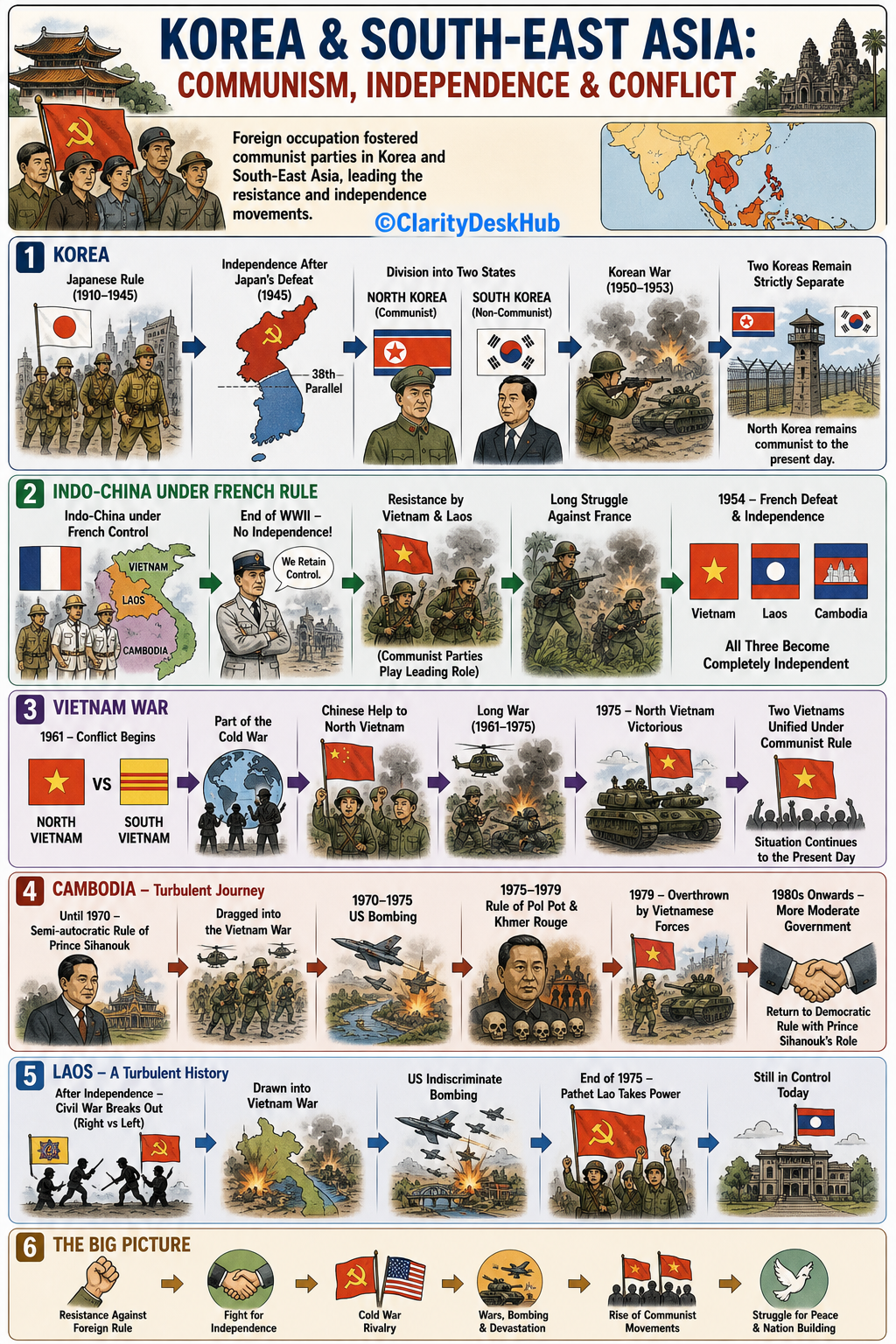
Let’s understand the fascinating, often tragic, and deeply complex evolution of North Korea. In the world of International Relations, North Korea is not just a country; it is a “case study” of how Cold War geopolitics can freeze a nation in time.
To understand North Korea, we must look at it through the lens of history, ideology, and the relentless pursuit of survival.
The Genesis: From Colonial Shackles to Cold War Fault Lines
The story doesn’t begin with communism; it begins with Imperialism.
- The Japanese Shadow: From 1905 to 1945, Korea was under the brutal thumb of Japan. Imagine a nation’s identity being suppressed for 40 years. Naturally, a fierce nationalist movement took root.
- The Broken Promise: In 1943, at the Cairo Conference, the “Big Three” (USA, UK, China) promised a free, united Korea. But history rarely follows the script of promises.
- The 1945 Pivot: As Japan neared defeat, the USSR declared war on Japan (August 8, 1945) and swept into northern Korea. To prevent a total Soviet takeover, the Americans hastily suggested a division at the 38th Parallel.
Analytical Point: This division was intended to be temporary—a mere administrative convenience for disarming Japanese troops. However, in the crucible of the emerging Cold War, this “pencil line” on a map became a permanent scar.
The Rise of Two Titans: Kim Il-sung vs. Syngman Rhee
By 1948, the dream of a united Korea had effectively died. In its place, two mirror-image antagonistic states emerged.
(a) The North: The Birth of a “Red” Dynasty
Under Soviet tutelage, Kim Il-sung emerged. He wasn’t just a leader; he was a Soviet-trained guerrilla fighter. He introduced a rigid version of Marxism-Leninism.
- The Proclamation: In 1948, the Democratic People’s Republic of Korea (DPRK) was born.
- External Support: Stalin poured in aid, transforming the North into a formidable military machine even before Mao’s victory in China.
(b) The South: The Anti-Communist Bastion
In the South, Syngman Rhee took the reins. He was a staunch nationalist and a fierce anti-communist.
- The Irony of Democracy: While the US backed Rhee, his rule was often as authoritarian and corrupt as the North. This is a classic example of Realpolitik: the US chose a “friendly dictator” over a “hostile communist.”
The Great Tragedy: The Korean War (1950–1953)
Why did the war happen? It was a mix of Kim’s ambition to unify the peninsula and a miscalculation of Western resolve.
- The Invasion: On June 25, 1950, North Korean forces crossed the 38th Parallel. The South’s army crumbled.
- The Intervention: The UN (led by the USA) intervened to save the South, while China later jumped in to save the North.
- The Result: A stalemate. After 4 million deaths, the border ended up almost exactly where it started.
- Consequence: The war didn’t solve the “Korea Question”; it only cemented the hatred. The peninsula became a permanent “pressure cooker.”
The Era of ‘Juche’: North Korea’s Path to Isolation
After the war, Kim Il-sung did something unique. While other communist states were satellites of the USSR or China, Kim sought a “Third Way.”
The Philosophy of Juche (Self-Reliance)
Kim defined North Korea through four pillars:
- Autonomy in Ideology: Not just following Marx, but “Kim-ilsung-ism.”
- Independence in Politics: No bowing to Moscow or Beijing.
- Self-sufficiency in Economy: Producing everything internally.
- Self-reliance in Defence: A massive military to ensure no one dared invade again.
The Economic Paradox
Initially, the North’s economy actually outpaced the South! With Soviet and Chinese aid, they industrialized rapidly. However, by the 1960s, the rift between the USSR and China forced Kim into a diplomatic tightrope. When aid dried up, and the regime prioritized “Guns over Butter” (heavy industry and military), the economy began to stagnate.
The Transition: Kim Jong-il and the “Nuclear Gamble”
When Kim Il-sung died in 1994, his son Kim Jong-il (the “Dear Leader”) inherited a nation on the brink of collapse.
- The Great Famine: In the 1990s, North Korea suffered a horrifying famine. Mortality rates for children soared, and the GDP plummeted.
- The Survival Strategy: Kim Jong-il realized that without a conventional economy, he needed a “bargaining chip.” That chip was Nuclear Weapons.
- The Brinkmanship: From the 1994 Agreed Framework (with Clinton) to the “Axis of Evil” era (under Bush), North Korea played a game of “Nuclear Poker”—threatening to build bombs to extract food and fuel aid from the West.
Critical Analysis: For the Kim dynasty, nuclear weapons are not for “starting” a war they know they would lose; they are a regime-survival insurance policy. If you have a nuke, the superpower (USA) cannot treat you like Iraq or Libya.
Historiographical Perspective: Why does the Division Persist?
If we look at this through a broader lens, we see three layers of conflict:
- The Internal Layer: Both North and South leaders used the “threat” of the other to justify their own authoritarianism.
- The Regional Layer: China wants North Korea as a “buffer zone” to keep US troops (stationed in the South) away from its border.
- The Global Layer: It remains a living relic of the Cold War—a place where the ideological battle of the 20th century never actually ended.
Summary: The Road to 2012 and Beyond
By the time Kim Jong-un took over in 2012, North Korea had become the “Hermit Kingdom”—isolated, nuclear-armed, and strictly regimented. It is a state that operates on the logic of a besieged fortress.
The story of North Korea is a reminder that while borders are often drawn by politicians and generals, it is the common people who pay the price in the currency of poverty and separation.
Do you think the “Nuclear Option” was North Korea’s only way to survive in a post-Soviet world, or was there a missed opportunity for a “Chinese-style” economic opening?
Vietnam
The story of Vietnam is one of incredible resilience—a nation that fought the French, the Japanese, the Americans, and even its neighbors to assert its identity. To understand Vietnam, we must look at it not just as a “war,” but as a long, painful journey from colonial exploitation to a modern, “socialist-oriented” market economy.
The Colonial Bedrock and the Rise of Ho Chi Minh
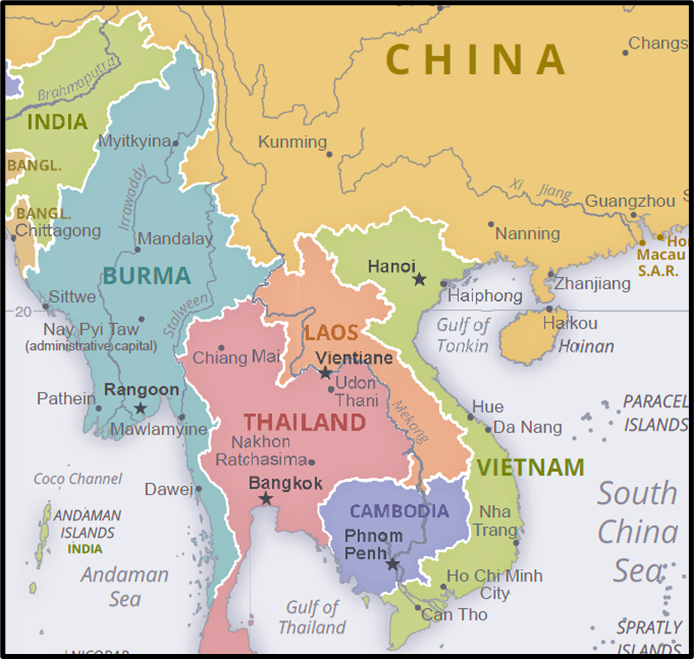
Before it was a Cold War flashpoint, Vietnam was the “jewel” of the French Indochinese Union (est. 1887).
- The French Paradox: The French built schools, hospitals, and railways, but they kept the masses in grinding poverty. They suppressed any talk of freedom.
- The Catalyst: This suppression birthed a new kind of leader—Ho Chi Minh. He was a unique blend: a fierce nationalist who wanted a free Vietnam, and a committed communist who believed Marxism was the tool to achieve it.
- The Birth of Vietminh (1941): During WWII, when France fell to Germany and Japan occupied Vietnam, Ho formed the Vietminh (League for the Independence of Vietnam). They were the only ones fighting for a free Vietnam.
1945: The “Lost Opportunity” for Peace
As Japan surrendered in August 1945, Ho Chi Minh acted fast. He proclaimed the Democratic Republic of Vietnam in September. But then, world politics intervened.
- The British Intervention: In the South, British troops arrived to disarm the Japanese. In a bizarre twist of history, they used undisarmed Japanese troops to suppress the Vietnamese nationalists so that the French could reclaim their colony!
- The Tragedy of Choice: As historians often point out, if the West had recognized Ho Chi Minh’s independence then, the subsequent 30 years of bloodshed might have been avoided. But the British feared that “decolonization” in Vietnam would set a precedent for their own empire.
The Road to Division: From Dien Bien Phu to the 17th Parallel
The French tried to reclaim their glory, leading to eight years of bitter war.
- Dien Bien Phu (1954): This was a turning point in world history. A professional European army was decisively defeated by a peasant-guerrilla force.
- The Geneva Agreements: Vietnam was temporarily divided at the 17th Parallel.
- North: Led by Ho Chi Minh (Communist).
- South: Eventually led by Ngo Dinh Diem (US-backed, Anti-communist).
- The Canceled Election: Elections were promised for 1956 to unite the country. However, the US and Diem blocked them, fearing a landslide victory for Ho Chi Minh. This set the stage for the catastrophic Vietnam War.
Post-1975: The Pain of Victory and Isolation
In 1975, the North finally won, and in 1976, the Socialist Republic of Vietnam was born. But “winning the peace” proved harder than winning the war.
(a) The Failed Socialist Experiment
The government tried to force North-style communism on the South—abolishing capitalism and collectivizing farms.
- The Result: Disaster. Production plummeted, corruption flourished, and the “Boat People” (refugees) began fleeing the country in hundreds of thousands.
(b) The “Proxy War” with China and Cambodia
Vietnam’s foreign policy in the late 70s led to complete isolation:
- Cambodia (1978): Vietnam invaded Cambodia to topple the brutal Pol Pot (Khmer Rouge).
- The China Clash (1979): China, an ally of Pol Pot, invaded North Vietnam to “teach them a lesson.”
- Total Isolation: The US and Europe imposed trade embargoes. By the mid-80s, Vietnam was a pariah state, kept alive only by dwindling Soviet aid.
The Great Pivot: “Doi Moi” (Renovation)
By 1986, the Vietnamese leadership realized they were at a dead end. They introduced Doi Moi—a revolutionary shift toward a “socialist-oriented market economy.”
- The Economic Shift: They embraced the free market, encouraged private business, and invited foreign investment.
- The Diplomatic Thaw: They withdrew from Cambodia (1989) and normalized relations with the USA (marked by President Clinton’s visit in 2000).
- The “Tiger” Emerges: By the early 2000s, Vietnam became one of the fastest-growing economies in Asia. It transformed from a rice importer to a major international donor.
Analytical Conclusion: The “Vietnam Model”
Vietnam today presents a fascinating contradiction—much like China. It has Economic Liberalism but Political Centralism.
- Economic Success: It is a global manufacturing hub with rising living standards.
- Political Rigidity: It remains a one-party state. While the National Assembly allows some debate, all candidates must be “vetted” by the Communist Party.
- The Human Rights Dilemma: Religious and political dissent (like the Montagnards) is often met with harsh suppression.
Critical Insight: Vietnam teaches us that a nation can change its “economic DNA” without changing its “political skeleton.” It has successfully transitioned from a war-torn victim of the Cold War to a major global player, but the journey toward true political pluralism remains a long and uncertain road.
Does this “Market Socialism”—wealth without Western-style democracy—strike you as a sustainable long-term model for developing nations, or is it just a transition phase?
Cambodia
After discussing the struggles of Korea and Vietnam, we now turn our attention to Cambodia (or Kampuchea). If Korea was a story of “Stalemate” and Vietnam a story of “Resilience,” Cambodia is a story of “Extreme Tragedy.”
In the study of history, we often see how external pressures can break a nation’s internal compass. Cambodia is perhaps the most painful example of this.
The Era of Prince Sihanouk: The Tightrope Walk (1941–1970)
To understand Cambodia, you must understand Norodom Sihanouk. He wasn’t just a king or a politician; he was the “architect of independence.”
- The Context: After the Japanese occupation in WWII, Sihanouk skillfully navigated the end of French colonial rule. By 1954, the Geneva Conference recognized Cambodia as an independent, neutral state.
- The Sihanouk Strategy: He was a “shrewd operator.” He abdicated the throne to become “Citizen Sihanouk,” allowing him to lead a political party and sweep elections. His rule was a mix of paternal authoritarianism and peaceful prosperity.
- The Neutrality Trap: As the Vietnam War raged next door, Sihanouk tried to stay neutral. He allowed North Vietnamese troops to use Cambodian soil (the Ho Chi Minh Trail) simply because he wasn’t strong enough to stop them.
Critical Analysis: Sihanouk’s “neutrality” was a pragmatic survival tactic. However, it earned him the enmity of the USA, which saw his “blind eye” toward communist movement as a betrayal. This set the stage for the chaos that followed.
The Catalyst for Chaos: Lon Nol and the U.S. Factor (1970–1975)
History often turns on a single event. In 1970, while Sihanouk was abroad, a pro-US General named Lon Nol staged a coup.
- The Shift: Cambodia was suddenly dragged into the Vietnam War. Lon Nol’s regime was backed by the US, which began a massive, secret bombing campaign in the Cambodian countryside to destroy Vietnamese bases.
- The Consequences:
- Destruction of Infrastructure: The bombing decimated the rural economy.
- Radicalization: The suffering of the peasants drove thousands into the arms of the fringe communist group—the Khmer Rouge, led by Pol Pot.
- The Failure of Intervention: Despite the heavy bombing, the US could not stabilize Lon Nol’s corrupt regime. In April 1975, the Khmer Rouge entered the capital, Phnom Penh.
The “Year Zero”: Pol Pot’s Experiment in Insanity (1975–1979)
What followed was one of the darkest chapters in human history. Pol Pot didn’t just want to change the government; he wanted to restart history.
- The Radical Ideology: He envisioned a “pure” agrarian communist society. He declared “Year Zero”—meaning all history, culture, and modern life before that moment was to be erased.
- The Horrors of the “Killing Fields”:
- De-urbanization: Cities were emptied overnight. Doctors, teachers, and lawyers were forced into the fields to work as peasants.
- The Genocide of Intellect: If you wore glasses or spoke a foreign language, you were viewed as a “class enemy” and executed.
- The Human Cost: Out of a population of 7.5 million, an estimated 2 million people died from execution, starvation, or disease.
Historiographical Perspective: Historians like Philip Short argue that these atrocities were not just about Marxism, but were rooted in a culture of violent extremism that had been simmering in Cambodian society, triggered by the trauma of foreign intervention.
The Vietnamese Intervention and Cold War Hypocrisy
In 1979, the Vietnamese army invaded Cambodia to topple Pol Pot and end the border raids. They installed a more moderate, pro-Vietnamese government.
- The Geopolitical Paradox: Even though Vietnam saved Cambodia from a genocidal maniac (Pol Pot), the UN and the USA refused to recognize the new government.
- Why? Because in the Cold War, the “enemy of my enemy is my friend.” Since Vietnam was backed by the USSR, the West and China continued to recognize Pol Pot’s “government-in-exile” at the UN for years.
The Transition: The Return of Sihanouk and the Rise of Hun Sen
The late 1980s saw a shift as the Cold War ended and Vietnam withdrew its troops.
- The 1993 UN Elections: A massive UN operation (UNTAC) tried to bring democracy. Sihanouk’s son won the most seats, but the strongman Hun Sen (of the CPP) refused to relinquish power.
- The Power Solution: A “bizarre” coalition was formed with two Prime Ministers. Eventually, Sihanouk was restored as a constitutional King.
- The Hun Sen Era: By 1997, Hun Sen consolidated total power through a violent coup and has remained the dominant force in Cambodia.
Analytical Summary: Where does Cambodia stand today?
Cambodia’s journey from 1941 to the early 2000s is a cycle of stability, destruction, and “authoritarian recovery.”
Key Takeaways:
- External vs. Internal: While Pol Pot’s madness was internal, it was the external US bombing and the destabilization of Sihanouk that created the vacuum for him to rise.
- The Economic Struggle: Unlike Vietnam or Thailand, Cambodia has struggled to attract major Western investment due to high crime, corruption, and a history of violence.
- The Human Rights Legacy: The struggle to bring Khmer Rouge leaders to justice continues to be a point of friction between the UN and the Cambodian government.
Final Thought: Cambodia serves as a grim reminder that when the geopolitical interests of superpowers collide in a small nation, the “human cost” can be astronomical. The “Killing Fields” were not just a failure of a nation, but a failure of the international community.
Do you see the parallels between how the US handled Sihanouk in 1970 and how it has approached “neutral” leaders in more recent Middle Eastern conflicts?
Laos
While Vietnam was the main stage, Laos was the “backstage” that determined the outcome of the war. Its story is a poignant lesson in how geography can be both a blessing and a curse.
The Tripartite Struggle: A Kingdom Divided (1950–1964)
Imagine a country pulled in three different directions at once. This was Laos after the French began to lose their grip.
- The Catalyst: In 1950, a nationalist movement called the Pathet Lao (Land of the Lao) emerged. They weren’t just fighting for independence from France; they were deeply ideologically linked to the Vietminh in North Vietnam.
- The Geneva Paradox (1954): The Geneva Accords ended French rule but left a “messy” political structure. It recognized the Royal Government but allowed the Pathet Lao to stay in “regroupment zones” in the North.
The Three Factions
To understand the chaos, you must visualize these three groups:
- The Left (Pathet Lao): Supported by North Vietnam and China.
- The Right (Royalists): Supported by Thailand and the CIA (USA).
- The Neutralists: Led by Prince Souvanna Phouma, who tried to keep Laos out of the Cold War by forming a coalition.
Analytical Point: The “Neutralists” are often the most tragic figures in history. They seek a middle path, but in a bipolar world (USA vs. USSR), the “middle” is often the most dangerous place to stand. In 1964, the CIA backed a right-wing coup to topple this coalition because they feared “neutrality” was just a gateway to communism.
The “Secret War”: The Heavy Price of Geography
Why was a small, landlocked nation like Laos bombed so heavily? The answer lies in the Ho Chi Minh Trail.
- The Strategic Corridor: North Vietnam used Laotian territory to transport troops and supplies to the South. To stop this, the USA launched a “Secret War.”
- The Statistics of Sorrow: Between 1965 and 1973, the US dropped over two million tons of bombs on Laos. To put this in perspective: that is more than the total tonnage dropped on Germany and Japan combined during the entirety of WWII.
- The Human Cost: Village after village was leveled. The use of napalm and anti-personnel bombs turned the countryside into a graveyard. Even today, “unexploded ordnance” (UXO) remains a lethal legacy in Laotian soil.
1975: The Red Horizon and the End of Monarchy
When the “dominoes” began to fall in 1975 (Saigon in April, Phnom Penh in April), Laos followed in December.
- The Takeover: The right-wing forces, seeing their American backers leave, “threw in the towel.” The Pathet Lao took power with minimal resistance.
- The Proclamation: The monarchy was abolished, and the Lao People’s Democratic Republic (LPDR) was born.
- The Aftermath: Like Vietnam, the new regime sent thousands to “re-education camps” and attempted a rigid command economy (collectivization). This led to a massive brain drain, with nearly 10% of the population fleeing to Thailand.
The Great Pivot: From Marxism to “Market-Socialism”
By the mid-1980s, the leadership in Vientiane realized that pure Marxism was leading to starvation. They followed the path of “Doi Moi” (Vietnam) and “Reform and Opening-up” (China).
The Evolution of the System
| Feature | Old System (1975-1985) | New System (1986-Present) |
| Agriculture | State Collectives | Family-run farms |
| Investment | State-controlled | Private and Foreign investment invited |
| Political Structure | One-party (LPRP) | One-party (LPRP) |
| Economic Growth | Stagnant | Improving, but aid-dependent |
Critical Analysis: This raises a fascinating historiographical question: Is Laos still a “Communist” state? Politically, yes—the Party maintains absolute control. Economically, no—it is a capitalist-oriented market. It is more accurate to call it a “one-party development state.”
Current Challenges: The Prosperity Gap
As we look at the situation up to 2026, Laos remains in a precarious position.
- Dependency: The country relies heavily on foreign aid (World Bank, IMF, and increasingly, China) to balance its budget.
- Infrastructure vs. Debt: While there are massive hydroelectric and rail projects (especially the “Belt and Road” links with China), these come with a heavy debt burden.
- Social Unrest: Despite the “100% turnouts” in state-vetted elections, groups like the “Lao Citizens’ Movement for Democracy” have begun to protest the lack of actual prosperity and political freedom.
Final Thought: The story of Laos is a reminder that in the game of “Great Power Politics,” it is the small, buffer states that bleed the most. Laos has survived colonial rule, a secret genocide of bombings, and economic collapse. Today, it seeks to modernize, but the question remains: Can it achieve prosperity without sacrificing its soul to debt or authoritarianism?
Having seen how Vietnam, Cambodia, and Laos all shifted toward “Market Socialism” while keeping a one-party grip, do you think this “East Asian Model” is the only viable path for post-colonial states, or is it just a way for regimes to survive without truly democratizing?