
International Relations from 1933 to 1939 Explained
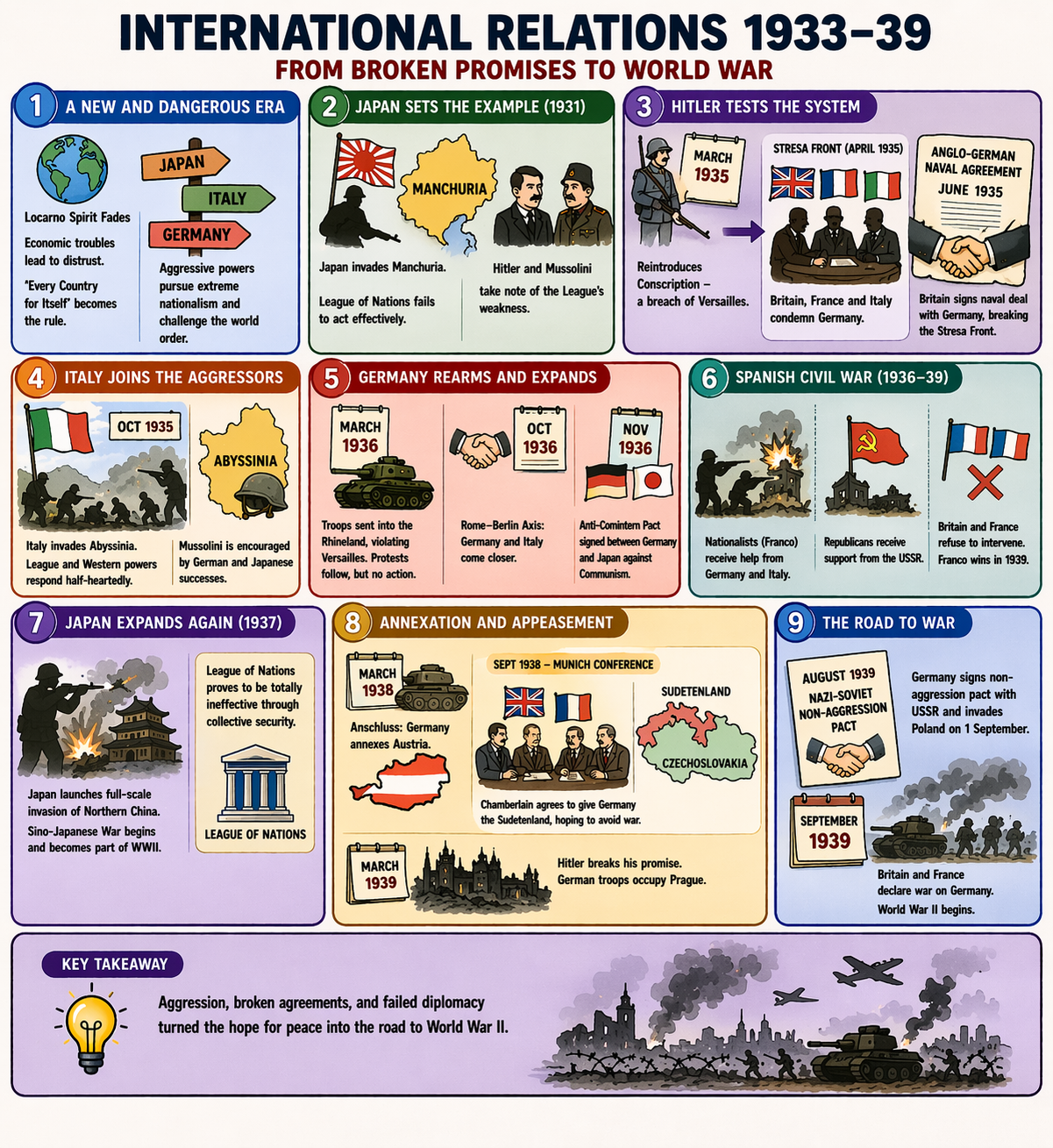
Japan–China Relations
Background Context: Why Manchuria Became Crucial
To understand Japanese aggression, one must situate it within the broader crisis of the interwar world. The Great Depression had destabilized economies globally, and Japan was no exception. Economic hardship intensified its need for markets, raw materials, and strategic security zones.
Manchuria, a resource-rich region in northeastern China, became central to this ambition. Japan had already established deep economic roots there after the Russo-Japanese War, gaining control over the South Manchurian Railway and key economic assets. By 1931, Japan was not merely an external actor—it was deeply embedded economically and strategically.
Thus, Japan’s motives were a mix of → Economic survival, Strategic security, Fear of a resurgent China under Chiang Kai-shek.
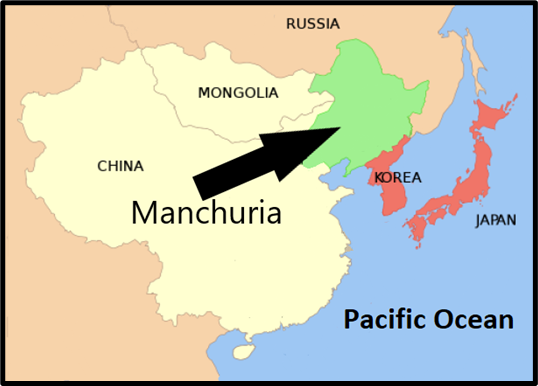
The 1931 Invasion of Manchuria: Beginning of Expansionism
The invasion of Manchuria in 1931 marked a decisive shift from economic influence to outright imperialism. Japan established a puppet state called Manchukuo, installing Pu Yi as its nominal ruler.
However, this was widely recognized as a façade. The real control remained firmly in Japanese hands.
Critical Insight
This episode exposed the weakness of international institutions like the League of Nations. Despite condemning Japan, no concrete action followed. This emboldened not only Japan but also other revisionist powers like Germany and Italy.
Expansion Beyond Manchuria (1933–1935): Gradual Encroachment
Japan did not stop at Manchuria. By 1933, it began advancing into northern China, eventually extending influence up to Beijing.
At the same time, China was internally divided:
- The Kuomintang (KMT) under Chiang Kai-shek,
- The Communists led by Mao Zedong.
This internal conflict weakened China’s ability to resist Japanese aggression effectively.
Interlinkage
This reflects a recurring historical pattern: external aggression thrives when internal divisions exist—a theme also visible in colonial expansions elsewhere.
Full-Scale War: The 1937 Invasion
The turning point came in 1937, following the Marco Polo Bridge Incident, which Japan used as a pretext for a full-scale invasion.
Despite opposition from Prime Minister Prince Konoye, militarists like General Sugiyama pushed for expansion.
Key Developments
- Capture of major cities: Shanghai, Nanjing, Hankow.
- Atrocities such as the Nanjing Massacre.
- Establishment of Chinese resistance from Chongqing.
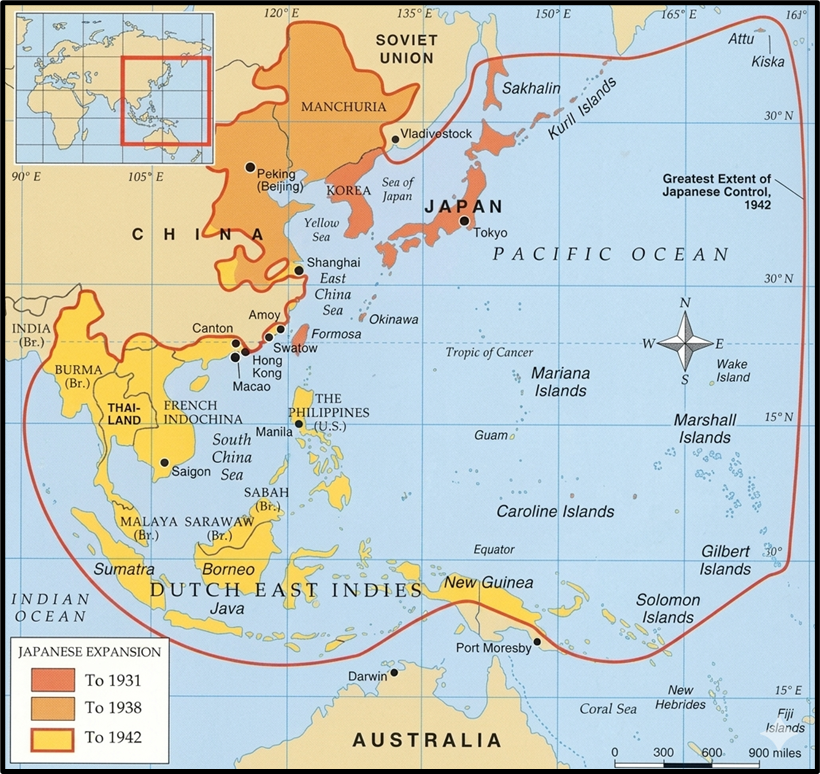
Chinese Resistance and International Response
A significant development was the temporary alliance between Nationalists and Communists—a rare moment of unity against a common enemy.
However, international response remained weak:
- The League of Nations was ineffective.
- Britain and France were preoccupied with Adolf Hitler.
- The USSR avoided full-scale conflict.
- The USA followed isolationism.
Outcome by 1939 → Japan controlled most of eastern China, though its hold remained fragile outside urban centers.
Analytical Perspective
From a historiographical lens:
- Orthodox view: Japanese aggression was driven by militarism and imperial ambition.
- Revisionist view: Economic insecurity and Western imperial precedents shaped Japan’s actions.
In reality, it was a convergence of economic necessity, strategic anxiety, and militarist ideology.
Mussolini’s Foreign Policy
Early Phase (1923–1934): Cautious Expansion and Diplomacy
After coming to power in 1922, Benito Mussolini aimed to make Italy “great, respected, and feared.” However, his approach initially lacked clarity.
Early Aggression → Corfu Incident,Occupation of Fiume.
These actions reflected experimental aggression, testing international reactions.
Diplomatic Maneuvering and Strategic Balancing
During this phase, Mussolini pursued diplomacy to secure influence:
- Participation in the Locarno Conference (1925),
- Control over Albania,
- Friendly relations with Britain and USSR,
- Support for Austrian independence against German influence.
Key Moment
When Austrian Chancellor Dollfuss was murdered (1934), Mussolini mobilized troops to deter Germany—showing his initial opposition to Hitler.
Shift After 1934: From Suspicion to Admiration of Hitler
Mussolini’s perception of Adolf Hitler evolved dramatically:
- From contempt (“mad little clown”),
- To admiration and eventual alliance.
This shift marked a turn from cautious diplomacy to aggressive alignment.
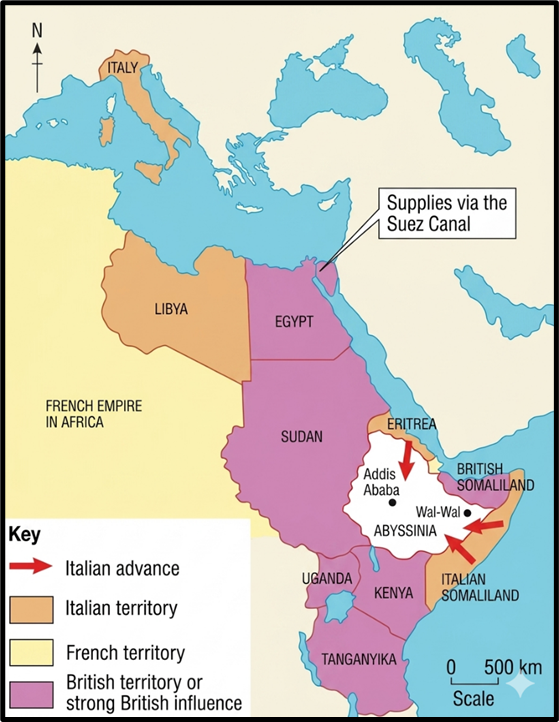
The Abyssinian Crisis (1935): Turning Point
The invasion of Abyssinia (Ethiopia) in 1935 was a watershed moment.
Motives
- Revenge for the 1896 defeat at Adowa,
- Economic diversion during depression,
- National prestige and domestic consolidation.
Despite eventual victory, the broader consequences were far-reaching.
Failure of Collective Security
The League of Nations imposed sanctions but excluded crucial resources like oil.
Why the Failure?
- Britain and France feared war,
- They prioritized containing Germany over punishing Italy.
The secret Hoare-Laval Pact further exposed hypocrisy.
Consequences
- Collapse of faith in collective security,
- Mussolini’s alienation from Western democracies,
- Gradual alignment with Germany.
Formation of the Rome–Berlin Axis
Mussolini moved closer to Hitler:
- Supported Franco in the Spanish Civil War,
- Signed the Rome–Berlin Axis (1936),
- Joined the Anti-Comintern Pact (1937).
This marked Italy’s transformation into a revisionist fascist power aligned with Germany and Japan.
Final Aggression and Strategic Miscalculation
- Participation in the Munich Agreement,
- Occupation of Albania (1939),
- Signing of the Pact of Steel (1939).
Critical Analysis
Mussolini misread domestic sentiment—Italians wanted peace, not war. His overconfidence and imitation of Hitler ultimately led Italy into disaster.
Hitler’s Foreign Policy Aims and Their Success up to 1938
Context: Germany After the First World War
To understand Hitler’s foreign policy, one must begin with the deep sense of humiliation imposed on Germany by the Treaty of Versailles. The treaty not only reduced Germany’s territory and military strength but also imposed heavy reparations and moral blame. This created fertile ground for nationalist resentment.
Hitler’s foreign policy, therefore, was not developed in a vacuum—it was rooted in a desire to overturn this post-war order and restore German prestige.
Core Aims of Hitler’s Foreign Policy
Revision of Versailles and Restoration of Power
At the most fundamental level, Hitler aimed to reverse the Versailles settlement. This involved rebuilding Germany’s military strength and regaining lost territories such as the Saar and the Polish Corridor.
This objective had both emotional and strategic dimensions: emotionally, it appealed to German nationalism; strategically, it was essential for re-establishing Germany as a major European power.
Unification of German-Speaking Peoples
Another key aim was the creation of a Greater Germany (Großdeutschland) by bringing all German-speaking populations under one state. This included:
- Austria (Anschluss)
- German minorities in Czechoslovakia (Sudetenland)
- Territories in Poland
This idea was presented as self-determination, but in reality, it became a tool for territorial expansion.
The Idea of Lebensraum (Living Space)
A more radical and expansionist aim was the acquisition of Lebensraum. Hitler argued that Germany’s population required more land for survival and growth.
This concept had several implications:
- Expansion eastward, especially into the Soviet Union
- Colonization of conquered lands
- Displacement or elimination of local populations
It was not merely geopolitical—it was deeply ideological, tied to racial beliefs and anti-communism.
Anti-Communism and Future War
Hitler’s hatred of “Jewish Bolshevism” suggested an eventual confrontation with the Soviet Union. Thus, foreign policy was not only about territorial revision but also about ideological war.
Debate Among Historians: Intentional vs Opportunistic
Historians disagree on whether Hitler had a clear long-term blueprint:
- A. J. P. Taylor argued that Hitler was an opportunist who reacted to situations rather than following a fixed plan. According to him, Hitler did not initially intend a major war.
- Martin Broszat suggested that ideas like Lebensraum were more propaganda than concrete policy.
- Mark Mazower emphasized that Hitler lacked detailed administrative planning for a future empire.
Critical Insight: This debate is crucial because it shapes how we interpret the origins of World War II—whether as a result of deliberate planning or cumulative miscalculations.
The Phase of Success: 1933–1938
Despite debates about long-term intentions, Hitler’s early foreign policy achievements were remarkably successful, largely because they were achieved without major war and often with the tacit acceptance of Britain and France.
Diplomatic Maneuvering and Deception
Hitler withdrew Germany from the League of Nations and the Disarmament Conference, claiming unfair treatment. Yet, he simultaneously projected himself as a man of peace.
This dual strategy—aggressive action combined with conciliatory rhetoric—became a hallmark of his diplomacy.
Polish Non-Aggression Pact (1934)
The pact with Poland was a masterstroke:
- It reduced immediate tensions
- Weakened France’s alliances in Eastern Europe
- Bought time for German rearmament
However, it also foreshadowed future betrayal, as Hitler later invaded Poland in 1939.
Early Setback: Austria (1934)
The failed Nazi coup in Austria revealed Germany’s temporary weakness. Italian leader Benito Mussolini opposed German interference and mobilized troops.
This episode taught Hitler an important lesson: timing and preparation were crucial.
Saar Plebiscite (1935)
The return of Saar through a democratic vote (90% in favor) was a propaganda victory. It demonstrated that territorial revision could be achieved peacefully—at least initially.
Rearmament and Conscription (1935)
Hitler openly violated Versailles by introducing conscription and expanding the army. Despite condemnation, no real action was taken by Britain or France. This emboldened Hitler and exposed the weakness of collective security.
Anglo-German Naval Agreement (1935)
This agreement allowed Germany to build a navy up to 35% of Britain’s strength.
Critical Analysis: Britain effectively legitimized German rearmament, undermining the Versailles system and weakening alliances like the Stresa Front.
Remilitarization of the Rhineland (1936)
This was a high-risk move. German troops entered the demilitarized zone, violating both Versailles and Locarno.
- France could have stopped it easily
- Hitler had ordered retreat if opposed
But no action was taken.
Significance:
This marked a turning point—Hitler realized that Western powers lacked the will to resist.
Formation of Alliances
Hitler strengthened Germany’s position through:
- Rome–Berlin Axis with Italy
- Anti-Comintern Pact with Japan
These alliances laid the foundation for the future Axis bloc.
Spanish Civil War (1936–39)
Germany supported Franco, gaining:
- Military experience
- Testing ground for new weapons (e.g., bombing of Guernica)
This also deepened ideological polarization in Europe.
Anschluss with Austria (1938)
This was a major success:
- Austria was annexed without significant resistance
- Britain and France again failed to act
- Germany gained strategic advantage over Czechoslovakia
It marked the realization of one of Hitler’s core aims.
Towards Munich: Sudetenland Crisis
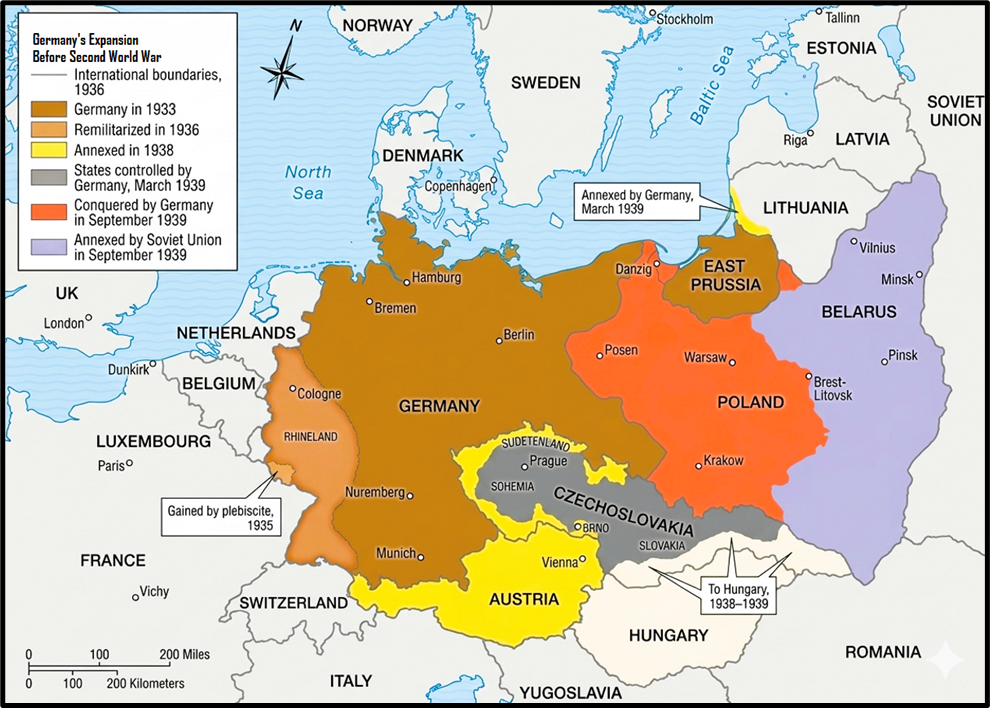
By late 1938, Hitler turned to Czechoslovakia. The demand for Sudetenland culminated in the Munich Agreement, where Britain and France conceded territory in the name of peace.
Why Was Hitler So Successful? The Role of Appeasement
The key to Hitler’s success lies in one word: Appeasement.
Reasons for Appeasement
- War-weariness after World War I
- Economic problems (Great Depression)
- Fear of communism
- Belief that Versailles was too harsh
Consequences
Appeasement:
- Encouraged Hitler’s aggression
- Undermined collective security
- Allowed Germany to grow stronger militarily
Overall Assessment: Success with Hidden Dangers
By the end of 1938, Hitler had:
- Reversed key aspects of Versailles
- Rebuilt German military power
- Expanded territory significantly
- Strengthened Germany’s strategic position
All this was achieved without major war, making him immensely popular in Germany.
However, this success contained the seeds of disaster:
- It emboldened further aggression
- It destabilized Europe
- It made large-scale war increasingly inevitable
Concluding Insight
Hitler’s foreign policy up to 1938 represents a classic case of incremental revisionism—each success made the next step easier. Whether driven by a master plan or opportunism, the outcome was the same: Europe moved steadily toward the catastrophe of World War II.
The real failure was not just Hitler’s aggression, but the inability of other powers to recognize and resist it in time.
Understanding Appeasement: Meaning, Context, and Evolution
Appeasement, in the context of interwar international relations, refers to a deliberate policy adopted primarily by Britain—and to a lesser extent France—of avoiding war by conceding to the demands of aggressive powers like Germany, Italy, and Japan, as long as those demands appeared “reasonable.”
However, appeasement was not a static or uniform policy. It evolved in two distinct phases, reflecting changing leadership, perceptions, and strategic calculations.
Phase I (Mid-1920s to 1937): Passive Accommodation
In its early phase, appeasement was less a conscious doctrine and more a psychological and political drift. The trauma of the First World War created a deep aversion to conflict, leading Britain (and occasionally France) to tolerate violations of the post-war settlement.
Events such as:
- Japan’s invasion of Manchuria (1931),
- Italy’s attack on Abyssinia (1935),
- Germany’s rearmament and remilitarization of the Rhineland (1936),
were met with hesitation and inaction, reflecting a broader reluctance to enforce the Treaty of Versailles.
Phase II (1937–1939): Active and Personalized Appeasement
With the rise of Neville Chamberlain in 1937, appeasement became more intentional and proactive. Chamberlain believed that:
- War could be avoided through direct negotiation,
- Aggressors like Adolf Hitler had limited, rational demands,
- Satisfying these demands would stabilize Europe.
This approach culminated in the Munich Agreement (1938), where Britain and France allowed Germany to annex the Sudetenland from Czechoslovakia—an act often described as the climax of appeasement.
Intellectual and Diplomatic Roots of Appeasement
The origins of appeasement can be traced to earlier diplomatic efforts in the 1920s, which aimed at reintegrating Germany into the international system.
Initiatives like:
- The Dawes Plan (1924) and Young Plan (1929) sought economic stabilization of Germany.
- The Locarno Treaties (1925) attempted to normalize relations but notably did not guarantee Germany’s eastern borders.
This omission was crucial. It signaled that Britain was unwilling to defend Eastern Europe, especially countries like Poland. Even moderate German leaders like Gustav Stresemann saw eastern borders as negotiable.
Thus, appeasement was rooted not merely in weakness, but in a reassessment of the Versailles system itself.
Why Appeasement Seemed Justified: A Multi-Dimensional Analysis
To understand appeasement fairly, we must step into the mindset of the 1930s. Far from being naïve, many contemporaries saw it as a rational and necessary policy.
The Overwhelming Desire to Avoid War
The memory of the First World War—its mass deaths, trench warfare, and economic devastation—remained vivid. The horrors of the Spanish Civil War further reinforced fears of modern warfare, especially aerial bombing of civilians.
Public opinion in Britain was strongly pacifist. Even elite institutions reflected this mood—famously, the Oxford Union in 1933 declared it would not fight for “King and Country.”
Perception of Legitimate Grievances
Many British policymakers believed that:
- Germany had been treated too harshly at Versailles,
- Italy had been denied its rightful gains.
Thus, revising the treaty was seen not as surrender, but as correcting historical injustice—a view aligned with liberal internationalism.
Weakness of the League of Nations
The League of Nations had already failed in crises like Manchuria and Abyssinia. This undermined faith in collective security, pushing leaders like Chamberlain toward bilateral diplomacy and personal engagement.
Economic Considerations
Britain was still recovering from the Great Depression. Rearmament was expensive, and economic cooperation with Germany was seen as a way to:
- Stabilize Europe,
- Reduce internal extremism within Germany.
Fear of Communism
A crucial but often underemphasized factor was the fear of the Communism, particularly Soviet expansion.
Many British conservatives viewed Nazi Germany as a bulwark against Bolshevism, making them more tolerant of Hitler’s actions.
Military Unpreparedness
Perhaps the most practical reason: Britain was not ready for war.
- The air force lacked sufficient bombers and fighters,
- The army was small,
- The empire was overstretched.
Even the navy faced the challenge of defending global trade routes against multiple adversaries (Germany, Italy, Japan). Appeasement, therefore, was also a strategy to buy time for rearmament.
Appeasement in Practice (1933–1939): Key Developments
Appeasement shaped nearly every major diplomatic response of the 1930s.
German Rearmament and Naval Expansion
Britain tolerated German rearmament and even formalized it through the Anglo-German Naval Agreement (1935)—without consulting France. This weakened collective opposition and signaled division among the Allies.
Failure to Resist Aggression
- Italy’s invasion of Abyssinia faced only symbolic resistance.
- Germany’s remilitarization of the Rhineland (1936) went unchallenged, despite being a clear treaty violation.
These instances reinforced Hitler’s belief that Britain and France lacked the will to act.
Non-Intervention in the Spanish Civil War
While Britain and France remained neutral, Germany and Italy actively supported Franco. This created a testing ground for fascist military cooperation, altering the balance of power in Europe.
Anschluss and Munich
The annexation of Austria (Anschluss, 1938) was met with protests but no action. Soon after, the Munich Agreement allowed Germany to annex the Sudetenland—effectively dismantling Czechoslovakia’s defenses.
This was the zenith of appeasement—and its greatest failure.
French Position: Between Resistance and Dependence
Although often grouped with Britain, France had a more complex stance.
Leaders like Raymond Poincaré and Louis Barthou initially favored firmness against Germany, even attempting alliances with the USSR.
However, internal divisions, political instability, and reliance on British support eventually forced France into a subordinate role, aligning with British appeasement policies.
Consequences of Appeasement: Immediate and Long-Term
1. Encouragement of Aggression
Appeasement arguably emboldened Hitler. Each concession reinforced his belief that Britain and France would not resist.
2. Collapse of Collective Security
The failure of both the League of Nations and bilateral diplomacy weakened international norms, making war more likely.
3. Strategic Miscalculation
Historians widely argue that appeasement misread Hitler’s intentions. It assumed he had limited aims, whereas his ambitions were expansionist and ideological.
4. Road to the Second World War
Ultimately, appeasement contributed to the chain of events leading to Germany’s invasion of Poland in 1939—triggering the Second World War.
Historiographical Perspectives: Debate on Appeasement
Historians remain divided on how to judge appeasement:
- Traditional View (Orthodox): Sees appeasement as a grave mistake, driven by weakness and misjudgment.
- Revisionist View: Argues it was a pragmatic policy, buying time for rearmament and reflecting genuine constraints.
- Post-Revisionist View: Takes a balanced stance—acknowledging both the necessity and the miscalculations.
Concluding Insight
Appeasement was not merely a policy of surrender—it was a complex response to fear, economic limitation, strategic uncertainty, and moral ambiguity. Its failure lay not just in its intentions, but in its misreading of Nazi ideology and ambition.
Hitler’s Expansionism and the Road to War (1938–1939)
(From Sudeten Crisis to the Invasion of Poland)
The period between 1938 and September 1939 represents the final collapse of European peace. What we observe here is not a sudden outbreak of war, but a gradual dismantling of the international order established after World War I, driven by Hitler’s aggressive foreign policy and enabled by the policy of appeasement pursued by Britain and France.
Let us understand this phase as a step-by-step escalation, where each success emboldened Hitler further, ultimately culminating in World War II.
The Czechoslovakia Crisis: A Test Case for Aggression
Context: Why Czechoslovakia?
Czechoslovakia was not just another state—it was strategically and ideologically significant for Hitler:
- It was a creation of the Treaty of Versailles, which Hitler despised.
- It was a democratic and industrially advanced state, unlike Nazi Germany.
- It had a significant population of Sudeten Germans.
- Most importantly, it occupied a strategic position in Central Europe, making it crucial for German military expansion.
Thus, the attack on Czechoslovakia was not accidental—it was part of Hitler’s Lebensraum (living space) policy.
The Sudetenland Crisis: Propaganda as a Weapon
Hitler did not invade immediately. Instead, he used a calculated strategy of internal destabilization.
The Role of Sudeten Germans
- Around 3.5 million Germans lived in the Sudetenland.
- Their leader, Konrad Henlein, alleged discrimination by the Czech government.
While some economic grievances existed (due to industrial unemployment), Hitler exaggerated and weaponized these issues through propaganda.
Escalation of Crisis
- Nazi-backed protests and riots were organized.
- The aim was clear: create instability to justify intervention.
Czech President Edvard Beneš understood this tactic and feared a German invasion under the pretext of restoring order.
Appeasement in Action: Chamberlain’s Diplomacy
At this stage, Britain and France—led by Neville Chamberlain and Édouard Daladier—were determined to avoid war at any cost.
Key Developments
- Chamberlain met Hitler at Berchtesgaden (Sept 1938).
- Initially, Hitler appeared satisfied with the Sudetenland.
- But at Godesberg, he escalated demands, asking for immediate occupation.
This reveals a crucial pattern: 👉 Hitler used negotiation not to compromise, but to escalate demands.
The Munich Conference (29 September 1938): The Peak of Appeasement
This is one of the most critical turning points in modern history.
What Happened?
- Britain, France, Germany, and Italy met in Munich.
- The agreement allowed Germany to annex the Sudetenland.
- Czechoslovakia and the USSR were not invited.
Consequences for Czechoslovakia
- Lost 70% of heavy industry
- Lost key fortifications
- Lost one-third of population and territory
Why Did Britain and France Agree?
- Fear of another devastating war
- Overestimation of German strength
- Underestimation of Hitler’s ambitions
Public vs Critical Reaction
- Chamberlain famously declared: “peace for our time.”
- However, critics like Winston Churchill called it a “total and unmitigated defeat.”
Critical Analysis
Munich symbolizes:
- The moral failure of appeasement
- The betrayal of a smaller state
- The collapse of collective security (League of Nations system)
The Final Blow: Destruction of Czechoslovakia (March 1939)
Munich did not satisfy Hitler—it only encouraged further aggression.
Step-by-Step Disintegration
- Slovakia, under Jozef Tiso, declared independence under German pressure.
- Czech President Emil Hácha was coerced in Berlin.
- Under threat (including bombing of Prague), he allowed German occupation.
Outcome
- Bohemia and Moravia → German protectorate
- Slovakia → puppet state
- Ruthenia → occupied by Hungary
Significance
This was a turning point because:
- Hitler violated Munich Agreement promises
- He seized non-German territory
👉 Even appeasers like Chamberlain now realized: Hitler’s ambitions were unlimited.
The Polish Crisis: Immediate Prelude to War
The Danzig Issue: From Diplomacy to Confrontation
After Czechoslovakia, Hitler turned to Poland.
Background
- The Free City of Danzig and the Polish Corridor were created by Versailles.
- Germany demanded:
- Return of Danzig
- Transport corridor linking East Prussia
Though these demands had some ethnic justification, the timing raised suspicion.
Polish Response
- Polish Foreign Minister Józef Beck refused demands.
- Poland feared a repeat of the Munich betrayal.
The Role of Britain: From Appeasement to Guarantee
This marks a shift in British policy.
- Britain guaranteed Poland’s independence.
- This was a clear departure from appeasement.
However, this guarantee had a problem: 👉 It was militarily ineffective without Soviet support.
Nazi-Soviet Pact (23 August 1939): Strategic Masterstroke
In a surprising move, Hitler signed a pact with the USSR:
- Molotov–Ribbentrop Pact
- Public: Non-aggression agreement
- Secret: Division of Poland
Why It Matters
- Hitler avoided a two-front war
- Stalin gained time and territory
This pact shocked the world because it united ideological enemies (Nazism and Communism) for strategic gain.
Invasion of Poland (1 September 1939): War Begins
With diplomatic barriers removed, Hitler launched a full-scale invasion of Poland.
- Blitzkrieg (lightning war) tactics ensured rapid advance.
- Britain issued an ultimatum—ignored by Hitler.
Final Trigger
- On 3 September 1939, Britain and France declared war on Germany.
👉 This marks the beginning of World War II.
Analytical Conclusion: Why War Became Inevitable
1. Failure of Appeasement
Appeasement was not merely a policy—it was a misreading of Hitler’s intentions. It assumed rational diplomacy, whereas Hitler pursued ideological expansion.
2. Collapse of Collective Security
The League of Nations and treaties like Locarno failed because → Major powers lacked unity, Aggression went unpunished
3. Hitler’s Calculated Strategy
Hitler followed a clear pattern:
- Raise minority issue
- Create internal unrest
- Demand concessions
- Escalate demands
- Use force
4. Psychological Dimension
Each success (Rhineland → Austria → Sudetenland → Czechoslovakia) boosted Hitler’s confidence and reduced resistance.
Historiographical Perspective
Different historians interpret this phase differently:
- Traditional View: Blames appeasement as a failure of leadership (Churchill’s perspective).
- Revisionist View: Argues appeasement bought time for Britain to rearm.
- Structural View: Sees war as inevitable due to flaws in Versailles system.
Final Insight
This entire episode teaches a profound lesson in international relations:
👉 Unchecked aggression, when combined with weak opposition, does not stabilize the system—it accelerates collapse.
The tragedy of 1938–39 lies not just in Hitler’s aggression, but in the collective failure to confront it at the right time.
Why Did War Break Out in 1939? A Multi-Dimensional Debate
The outbreak of the Second World War in 1939 remains one of the most debated questions in modern history. Rather than a single cause, historians view it as the result of an interplay of structural tensions, policy failures, and individual agency. The central controversy revolves around three key questions: Was appeasement responsible? Did the USSR make war inevitable? Or was Hitler himself the decisive factor?
To understand this, we must move beyond simplistic blame and examine the context, competing interpretations, and deeper structural forces.
The Broader Context: A Europe Already on Edge
Before assigning responsibility, it is crucial to recognize that Europe in the 1930s was already deeply unstable.
The legacy of the Treaty of Versailles had created resentment in Germany, while institutions like the League of Nations failed to enforce collective security. The Great Depression further destabilized political systems and enabled extremist leaders like Adolf Hitler to rise.
However, by 1938, many of Germany’s grievances had already been addressed—reparations reduced, rearmament achieved, and territorial expansion completed (Rhineland, Austria, Sudetenland). Germany had regained great power status.
So the key question emerges: If grievances were largely resolved, why did war still occur?
This shifts the debate from conditions to decisions.
The Role of Appeasement: Strategic Error or Pragmatic Necessity?
1. The Critique of Appeasement
Appeasement, associated primarily with Neville Chamberlain, is often seen as a major cause of war.
Critics argue that Britain and France failed to confront Hitler early, especially during:
- The remilitarization of the Rhineland (1936)
- The Munich Agreement (1938)
By repeatedly conceding, they:
- Strengthened Hitler domestically
- Encouraged further aggression
- Created a perception that the West lacked resolve
Historian Alan Bullock famously argued that success without resistance emboldened Hitler, pushing him toward riskier actions like invading Poland.
A particularly sharp criticism is that the wrong line was drawn at the wrong place:
- Czechoslovakia was strong and defensible
- Poland was weak and difficult to defend
Thus, making a stand earlier might have prevented escalation.
The Defence of Appeasement
However, this interpretation is not universally accepted.
Defenders argue that appeasement was:
- A strategic delay tactic to allow British rearmament
- A pragmatic response to limited military readiness and public reluctance for war
Historians like John Charmley and Robert Self emphasize that:
- Britain had few viable alternatives
- A grand anti-Hitler alliance (including the USSR) was politically unrealistic
Even Richard Overy highlights an important nuance: Britain and France were not purely moral actors—they acted in national self-interest, balancing power, public opinion, and imperial concerns.
👉 This leads to a critical insight: Appeasement may not have caused the war, but it shaped its timing and context.
The USSR and the Nazi-Soviet Pact: Catalyst or Compulsion?
The Nazi-Soviet Pact (August 1939) is often seen as the immediate trigger for war.
1. The обвинation (Blame Argument)
Critics argue that Joseph Stalin:
- Enabled Hitler by removing the threat of a two-front war
- Allowed the invasion and partition of Poland
Had the USSR allied with Britain and France, Hitler might have been deterred.
2. The Justification (Soviet Perspective)
From the Soviet viewpoint:
- The West had already appeased Hitler (Munich)
- Britain was reluctant to form a genuine alliance
- The pact bought valuable time for military preparation
👉 This reflects a deeper theme: Mutual distrust among potential allies weakened collective resistance to aggression.
Hitler’s Responsibility: Intentional War or Opportunistic Expansion?
This is the most intense historiographical debate.
The Intentionalist View: War Was Planned
Historians like Hugh Trevor-Roper argue that Hitler had a clear long-term vision:
- Expansion for Lebensraum
- Destruction of communism (USSR)
- Racial domination
Evidence includes → Mein Kampf, The Hossbach Memorandum
From this perspective:
- War was inevitable
- Appeasement merely facilitated Hitler’s plans
A.J.P. Taylor’s Revisionist View: War as Accident
A. J. P. Taylor challenged this consensus.
He argued:
- Hitler had no fixed master plan
- He was an opportunist, reacting to circumstances
- War resulted from diplomatic miscalculations on all sides
According to Taylor:
- Hitler expected limited conflict with Poland
- Britain and France unexpectedly escalated the situation
Thus, war in 1939 was a “mistake” born of miscalculation, not design.
Modern Synthesis: Between Plan and Opportunism
Most recent historians reject Taylor’s extreme position but accept elements of it.
They argue:
- Hitler had a broad ideological vision, not a rigid blueprint
- He combined long-term goals with short-term opportunism
Ian Kershaw captures this balance:
- War was inevitable in Hitler’s worldview
- Only its timing and direction were flexible
Similarly, Eberhard Jäckel emphasizes:
- Two core goals: territorial expansion and racial annihilation
Economic Pressures and Strategic Timing
A more recent dimension is added by Adam Tooze.
He argues that:
- Germany’s economy was under strain
- Rearmament was unsustainable due to resource shortages
- Delay would strengthen Britain and France
Thus, Hitler attacked in 1939 because:
- Germany’s military advantage was temporary
- Waiting could mean strategic defeat
👉 This interpretation links economic structure with political decision-making, adding depth to the causation debate.
Final Synthesis: Who Was Responsible?
A balanced conclusion must integrate all perspectives.
1. Structural Causes
- Versailles settlement | Economic crisis | Weak international institutions
These created a fertile ground for conflict.
2. Policy Failures
- Appeasement emboldened aggression | Failure of collective security
- Lack of unity among powers (especially with USSR)
These made war more likely and harder to prevent.
3. Decisive Agency: Hitler
Ultimately, most historians agree:
- Hitler was the central driving force
- His ideology made war not just possible, but necessary
The invasion of Poland was not just revisionism—it was expansionist aggression with broader ambitions.