
The Holocaust
When the Allied forces advanced into Nazi-occupied Europe during the final phase of the Second World War, they encountered something far beyond the horrors of conventional warfare. What they uncovered was a systematic, industrial-scale programme of mass murder—the Holocaust.
This was not merely an episode within the war; it was a civilizational rupture that forces us to confront fundamental questions about human nature, state power, and ideology.
Context: Discovery and Scale of the Atrocity
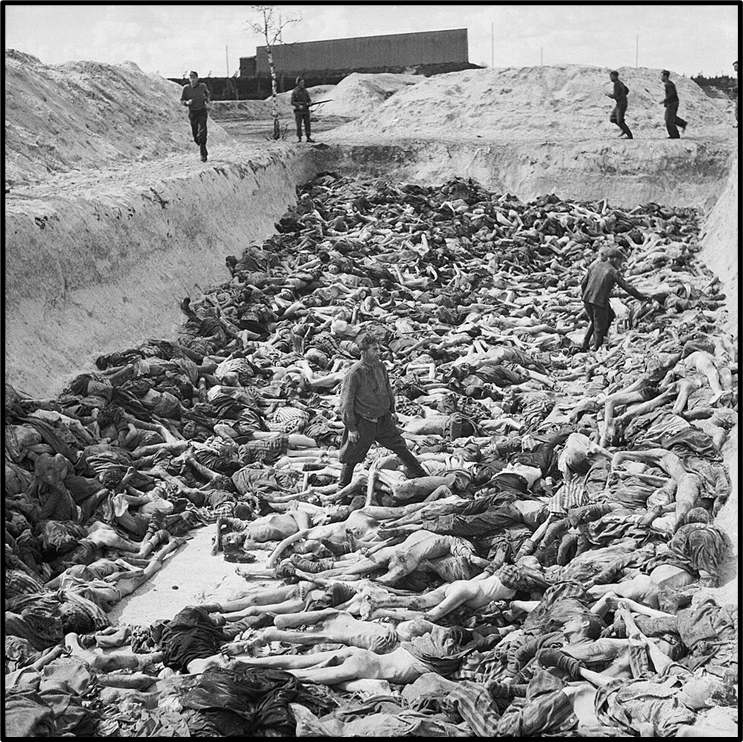
As Soviet troops approached Poland in 1944, they discovered extermination camps such as Majdanek. What they found—gas chambers, mass graves, and unburied corpses—was the first concrete evidence of a vast killing machinery.
Soon it became clear that this was part of a broader Nazi policy known as the ‘Final Solution’ (Endlösung)—the deliberate attempt to exterminate Europe’s Jewish population.
Between 1941 and 1945:
- Around 5.7 million Jews were murdered.
- Hundreds of thousands of others—Roma (gypsies), political opponents, homosexuals, and the mentally disabled—were also killed.
This scale and intent distinguish the Holocaust as a genocide, not just wartime brutality.
The Central Historical Debate: Why Did the Holocaust Happen?
Historians have long debated how such an atrocity became possible. Two major schools of thought emerged:
(a) Intentionalist Perspective: Hitler’s Central Role
The intentionalists argue that the Holocaust was the direct result of Adolf Hitler’s long-standing ideology.
From his early writings in Mein Kampf, Hitler:
- Expressed extreme anti-Semitism.
- Blamed Jews for Germany’s defeat in World War I.
- Viewed Jews as a racial and existential threat.
By 1939, he openly declared that another world war would lead to the “annihilation of the Jewish race in Europe.”
Historians like Karl Dietrich Bracher argue that:
- The Holocaust was not accidental.
- It was a delayed realization of Hitler’s ideological vision.
Criticism of this view: If Hitler intended genocide from the beginning, why did mass extermination begin only in 1941? Earlier policies focused on discrimination, segregation, and forced emigration.
(b) Functionalist Perspective: War and Circumstances
Functionalists shift focus from ideology to circumstances and administrative dynamics.
Historians like Hans Mommsen argue:
- The Holocaust emerged gradually due to the pressures of war.
- The conquest of Poland and the USSR brought millions of Jews under Nazi control.
- Local officials and SS leaders pushed for radical solutions.
Ian Kershaw introduced the idea of “working towards the Führer”:
- Nazi officials anticipated Hitler’s wishes.
- Policies became increasingly radical without explicit orders.
Key implication: The Holocaust was not a single decision but an evolving process driven by bureaucratic competition and wartime pressures.
(c) Synthesis: Beyond the Debate
Modern historians like Allan Bullock and Richard Overy suggest that both perspectives are incomplete in isolation.
Their combined view:
- Hitler’s ideology created the framework and direction.
- Wartime conditions provided the opportunity and mechanism.
In essence, the Holocaust resulted from a convergence of intent and circumstance.
Hitler’s Ideology: The Core Driving Force
To understand the Holocaust, one must grasp Hitler’s worldview.
He believed:
- Jews were behind communism and global conspiracy.
- Germany was engaged in a racial struggle for survival.
- Eliminating Jews was necessary to save the German “Volk.”
As Overy puts it, Nazi policy created a mindset where → Germany’s survival seemed dependent on the exclusion or annihilation of Jews.
This ideological framing transformed genocide into a perceived act of national defense.
From Discrimination to Extermination: Evolution of Policy
Early Phase (1933–1939): Exclusion and Emigration
Initially, Nazi policy focused on:
- Legal discrimination (e.g., Nuremberg Laws, 1935).
- Economic exclusion.
- Encouraging Jewish emigration.
Events like Kristallnacht (1938) marked a shift toward violence, but not yet systematic extermination.
📌Kristallnacht (1938) was a state‑sponsored pogrom in Nazi Germany during which Jewish homes, businesses, and synagogues were violently attacked, burned, and destroyed in a coordinated assault.
War as a Turning Point (1939–1941)
The outbreak of World War II radically altered the situation:
- Poland’s occupation brought millions of Jews under Nazi control.
- Ghettos were established in cities like Warsaw and Łódź.
- Conditions were deliberately made inhumane—starvation, disease, overcrowding.
The invasion of the USSR (1941) escalated violence further:
- Mass shootings by SS units (e.g., Babi Yar massacre).
- SS units were Nazi paramilitary formations (Schutzstaffel) that carried out mass killings and enforced Nazi policies, especially through mobile death squads called Einsatzgruppen.
- Jews and communists were targeted as ideological enemies.
The “Final Solution” Takes Shape
By late 1941, a decisive shift occurred:
- Mass killing became systematic and organized.
- The Wannsee Conference (1942) coordinated the logistics of genocide.
Although no signed order from Hitler exists:
- His role was decisive and indispensable (as per Kershaw).
Extermination camps like → Auschwitz-Birkenau, Treblinka, Sobibor became centers of industrialized killing.
The Machinery of Genocide
The process was chillingly methodical:
- Victims transported in trains.
- Selection upon arrival:
- Fit for labour → temporary survival.
- Others → immediate execution in gas chambers.
- Bodies disposed of in crematoria.
By 1942 alone, over 4 million Jews had been killed.
Even as Germany began losing the war, the extermination continued—revealing that genocide had become an end in itself.
Participation and Responsibility: A Complex Question
(a) German Society
Historian Daniel Goldhagen argued → Ordinary Germans were “willing executioners.”
Others, like Michael Burleigh, suggest → Anti-Semitism was deeply embedded in German society.
However, this view is debated. Not all Germans supported or participated.
(b) Wider Collaboration
The Holocaust was not carried out by Germans alone:
- Local collaborators in Eastern Europe participated.
- Leaders like Ion Antonescu independently pursued anti-Jewish policies.
(c) Resistance and Humanity
Despite the risks:
- Many individuals sheltered Jews.
- Networks in places like Warsaw helped thousands survive.
This reminds us that even in extreme darkness, moral choice persisted.
Consequences and Historical Significance
The Holocaust had profound consequences:
Moral and Ethical
- It exposed the depths of human cruelty under ideological regimes.
- Raised enduring questions about obedience, conformity, and responsibility.
Political
- Led to the creation of international human rights frameworks.
- Influenced the establishment of Israel (1948).
Historiographical
- Sparked ongoing debates about:
- State power and bureaucracy.
- Role of ideology vs circumstance.
- Nature of collective guilt.
Concluding Insight
The Holocaust was not an isolated aberration—it was the result of:
- Radical ideology (anti-Semitism)
- Modern state machinery
- War-time conditions
- Human choices—both evil and courageous
Understanding it is not just about the past. It is about recognizing how ideas, when combined with power and opportunity, can reshape reality in catastrophic ways.
And perhaps the most unsettling lesson is this → Such events were not inevitable—but they were made possible.
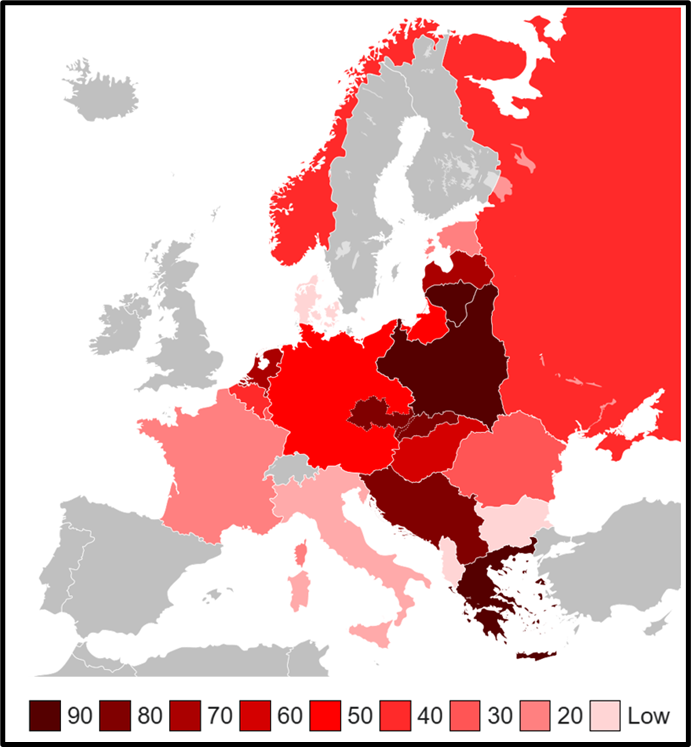
By Buidhe – Own work, CC BY-SA 4.0, via Wikimedia Commons
2 Comments