
Effects of the Second World War
The end of the Second World War was not merely the conclusion of a military conflict; it marked a profound restructuring of global politics, society, economy, and ideology. Unlike earlier wars, especially the First World War, its consequences were deeper, more widespread, and long-lasting. To understand the post-1945 world, one must carefully examine these multidimensional effects.
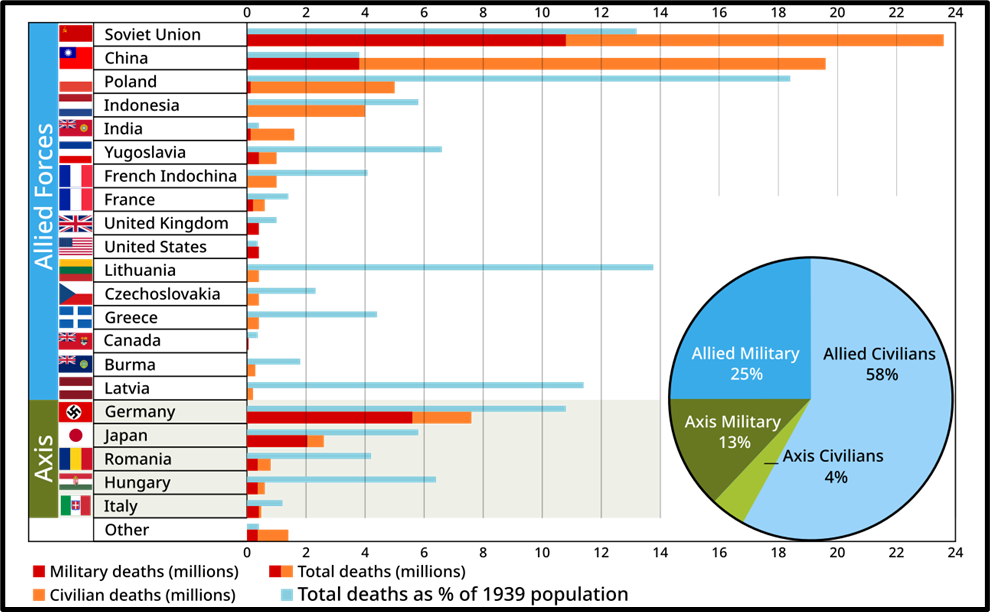
1. Enormous Human and Material Destruction
Scale of Devastation
The war resulted in unprecedented destruction across Europe and Asia. Nearly 40 million people lost their lives, with the Soviet Union suffering the highest casualties. Countries like Poland, Germany, China, and Japan also faced catastrophic losses.
This was not just a military tragedy but a civilizational collapse in many regions—cities destroyed, industries crippled, and communication networks shattered.
Displacement and Human Crisis
Around 21 million people were displaced, creating one of the largest refugee crises in history. Many had been forced into:
- Slave labour in Germany
- Concentration camps
- Migration due to advancing armies
The challenge of repatriation (returning people to their homeland) became a major humanitarian issue.
The Holocaust: Moral Catastrophe
At the heart of Nazi brutality was the Holocaust—the systematic extermination of over 5 million Jews and hundreds of thousands of others. This event fundamentally reshaped global consciousness regarding human rights, genocide, and state power.
Critical Insight
While the destruction was immense, historians often note a paradox: the war eliminated Nazism, one of the most destructive ideologies in human history. Thus, the war simultaneously represented destruction and moral reckoning.
2. Absence of a Comprehensive Peace Settlement
Contrast with Versailles
Unlike the Treaty of Versailles, there was no single, all-inclusive peace settlement after WWII. This reflected emerging tensions between former allies—especially between the USSR and Western powers.
Fragmented Agreements
Instead, multiple treaties addressed different regions:
- Italy lost its colonies and imperial claims
- The USSR expanded territorially in Eastern Europe
- Japan renounced its imperial gains in the 1951 San Francisco Treaty
However, Germany and Austria remained unresolved, except for their occupation and division.
Analytical Perspective
This fragmented settlement laid the groundwork for the Cold War, as unresolved questions became sources of ideological and geopolitical conflict.
3. Social Transformations and Population Shifts
Mass Migration and Ethnic Restructuring
Post-war Europe witnessed forced migrations on an unprecedented scale:
- Around 10 million Germans were expelled from Eastern Europe
- Ethnic homogenization became a political strategy to avoid future conflicts
Urban Reconstruction and Welfare State
War destruction led to massive rebuilding efforts, especially in the USSR and Germany. In Britain, the Beveridge Report laid the foundation of the modern Welfare State, focusing on social security, healthcare, and employment.
Interlinkage
This marks a key shift: from laissez-faire capitalism to welfare-oriented governance, influenced by war experiences and economic hardships of the interwar period.
4. Emergence of Nuclear Weapons
Beginning of the Nuclear Age
The Atomic bombings of Hiroshima and Nagasaki revealed a new level of destructive capability.
Deterrence and Fear
The development of nuclear weapons introduced the concept of “Mutually Assured Destruction (MAD)”, where:
- War between major powers became less likely
- Fear replaced direct confrontation
Historiographical Debate
Some historians argue nuclear weapons prevented another world war by acting as a deterrent, while others see them as a permanent existential threat to humanity.
5. Decline of European Dominance
Economic and Political Weakening
Traditional European powers—Britain, France, Germany, Italy—were left:
- Economically exhausted
- Politically weakened
- Dependent on external aid
Britain, despite being victorious, became financially dependent on the USA, marking a shift from imperial dominance to economic vulnerability.
Global Power Shift
This marked the end of Eurocentrism in global politics and the beginning of a bipolar world order.
6. Emergence of Superpowers and the Cold War
Rise of Two Giants
The war elevated:
- The United States as an economic and military powerhouse
- The Soviet Union as a military giant
Ideological Rivalry
Their conflicting ideologies—capitalism vs communism—led to the Cold War.
Long-term Impact
This rivalry shaped:
- International relations for nearly half a century
- Military alliances (NATO vs Warsaw Pact)
- Proxy wars across Asia, Africa, and Latin America
7. Decolonization: The End of Empires
Collapse of European Imperialism
The war weakened colonial powers and shattered the myth of European superiority. Japanese victories in Asia exposed European vulnerability.
Rise of Nationalism
Colonized peoples, having fought in the war, demanded independence:
- India (1947)
- Indonesia, Vietnam, African nations (1950s–60s)
Emergence of the Third World
Newly independent nations identified themselves as the “Third World”, choosing non-alignment in the Cold War.
Critical Insight
Decolonization was not peaceful everywhere; it often involved violent struggles, showing that political freedom did not always bring immediate stability.
8. Establishment of the United Nations Organization
A New Global Institution
The United Nations replaced the failed League of Nations.
Objectives and Role
Its primary aim was to → Maintain international peace, Promote cooperation, Prevent future wars
Comparative Perspective
Unlike the League, the UN had → Greater participation, Stronger institutional structure, Backing of major powers
Though not flawless, it has been relatively more effective in conflict management.
Conclusion: A War that Reshaped the Modern World
The Second World War was not just a destructive event—it was a foundational moment for the contemporary global order. It ended old empires, created new powers, reshaped societies, and introduced both hope (United Nations, welfare states) and fear (nuclear weapons, Cold War).
From a historiographical standpoint, the war represents a transition from imperialism to bipolarity, from total war to ideological conflict, and from colonial domination to global self-determination.
In essence, the post-1945 world—politically, socially, and economically—was born out of the ashes of this conflict.
2 Comments