
Johnson’s Classification of Shorelines
D.W. Johnson presented a genetic classification of shorelines based on the nature of the coastland before any sea-level change and emergence or submergence of the coastline due to changes in sea level.
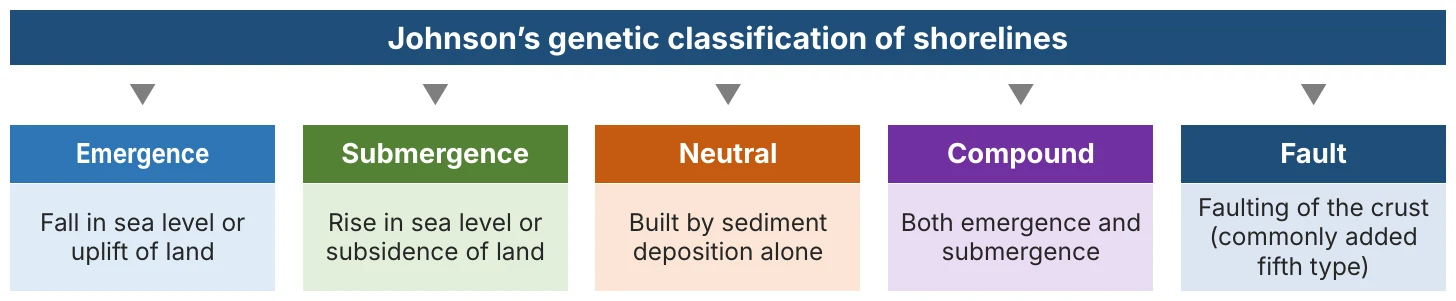
He classified shorelines into four main types (submergence, emergence, neutral, compound); fault shorelines are commonly added as a fifth:
1. Shoreline of Emergence: Coastlines Rising from the Sea
- Cause:
- Formed due to either fall in sea level, or upliftment of landmass (tectonic movement).
- This may occur due to climatic factors (growth of ice sheets lowering sea level, or rebound of land after ice melts) or tectonic forces (earthquakes, faulting).
- Features:
- Bars, spits, lagoons, salt marshes, beaches, sea cliffs, and raised beaches / marine terraces.
- Generally, the coast appears to advance into the sea due to land upliftment.
- Examples:
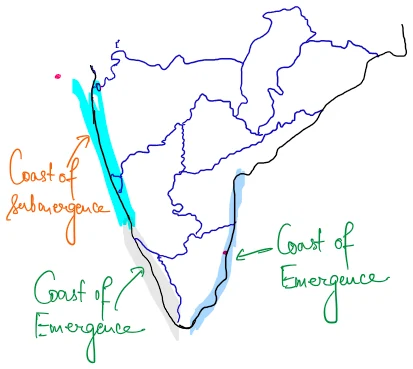
- East coast of India (especially the southeast coast) shows evidence of emergence.
- The stretch near Varkala on the west coast of India is also an emergent coast.
- Interesting Fact: West coast of India is partially emergent (Kerala) and partially submerged (Mumbai) due to faulting.
✅ Why Important? Emergent coasts provide new land for human settlements, agriculture, and infrastructure.
2. Shoreline of Submergence: Sinking of Coastal Land
- Cause:
- Formed due to either rise in sea level, or subsidence of landmass (tectonic movement).
- May happen due to climatic changes (melting of polar ice caps) or tectonic activity (earthquakes, faulting).
- Features:
- Ria Coasts: Submerged river valleys, giving a highly irregular coastline. Example: Southwest Ireland.
- Fjords: Glacially eroded U-shaped valleys submerged under seawater after ice melts. Example: Norway coast.
- Drowned lowlands: Coastal plains submerged by seawater.
- Example:
- Mumbai coastline (India) — submergence due to faulting.
- Norwegian Fjords — deep, narrow, steep-sided sea inlets formed by glacial erosion.
✅ Why Important? Submerged coasts offer natural harbors, deep-sea ports, and scenic beauty, boosting tourism and trade.
3. Neutral Shoreline: Coastlines Built by Sediment Deposition
- Cause:
- Formed neither by emergence nor submergence.
- Created solely by the deposition of sediments brought by rivers, waves, and coastal currents.
- Features:
- Example:
- Sundarbans Delta (West Bengal) — formed by river sediment deposition.
- Chilika Lake (Odisha) — formed by marine deposition.
✅ Why Important? Highly fertile areas suitable for agriculture, fisheries, and tourism.
4. Compound Shoreline: Mixed Impact of Emergence and Submergence
- Cause:
- Formed due to both emergence and submergence over different geological timescales.
- These coasts show mixed features of both types.
- Features: Presence of sea cliffs (emergence), fjords (submergence), beaches, and coastal lagoons.
- Example:
- Norway and Sweden coastlines show evidence of both glacial submergence and land upliftment.
- West coast of India— partially submerged and partially emergent.
✅ Why Important? These coasts offer diverse landscapes, making them ideal for harbors, tourism, and biodiversity.
5. Fault Shoreline: Result of Tectonic Movements
- Cause: Formed due to faulting (cracking) of the Earth’s crust, where one block is uplifted (emergent coast) and another block is downthrown (submerged coast).
- Features:
- Steep cliffs, deep coastal waters, and narrow beaches.
- Unlike deeply indented submerged coasts, fault coastlines are remarkably straight and linear initially.
- Example:
- West coast of India — the western flank of the Peninsula subsided below the Arabian Sea, while the plateau slopes gently eastward.
- California coast (USA) — major fault shoreline due to tectonic movements.
✅ Why Important?
- Fault shorelines create deep sea harbors, steep cliffs, and geological diversity.
- However, they are highly prone to earthquakes and tsunamis.