
The Six Day War of 1967
We have now reached a defining moment in the modern history of the Middle East—The Six-Day War of 1967. If the 1948 war was about the birth of Israel, and 1956 was about imperialism, then 1967 was about the geopolitics of survival and the total redrawing of the map.
In the classroom of history, we often say that some wars are won before the first bullet is fired. Let us analyze how this happened.
The Ideological Cauldron: The Rise of the Ba’ath Party
By the mid-1960s, the political climate in the Arab world had shifted toward a more radical, left-wing nationalism. The key word here is Ba’ath (meaning ‘Resurrection’).
In Iraq and Syria, Ba’athist governments came to power. They weren’t just nationalists; they were socialists who believed in the absolute unity of the Arab people.
- Syria, in particular, became the “radical heartbeat” of the region. They began supporting El Fatah (the core of the PLO), led by a young Yasser Arafat, to conduct guerrilla raids into Israel.
- From the Golan Heights, Syrian artillery began a persistent bombardment of Jewish settlements below. The message was clear: the status quo was no longer acceptable.
Nasser’s Domestic Success and Geopolitical Gamble
In Egypt, Nasser was at the peak of his domestic glory. He had successfully redistributed land to the peasants and was nearing the completion of the massive Aswan Dam with Soviet help.
Flushed with these successes and pressured by the radical rhetoric coming from Syria and Iraq, Nasser made a fateful series of moves in 1967.
- He moved his army into the Sinai Peninsula, demanded the withdrawal of UN peacekeepers, and closed the Gulf of Aqaba (Israel’s southern naval lifeline). By doing so, he effectively placed a “noose” around Israel.
- At this point, the Soviet Union encouraged the Arabs with propaganda, hoping to displace American influence, while the entire Arab world—from Saudi Arabia to Algeria—began massing troops.
The “Pre-emptive” Strike: Six Days that Changed Everything
Israel found itself in an existential crisis. To use a Hindi metaphor, they felt like a chakravyuh was being built around them. On June 5, 1967, Israel decided not to wait for the blow to fall.
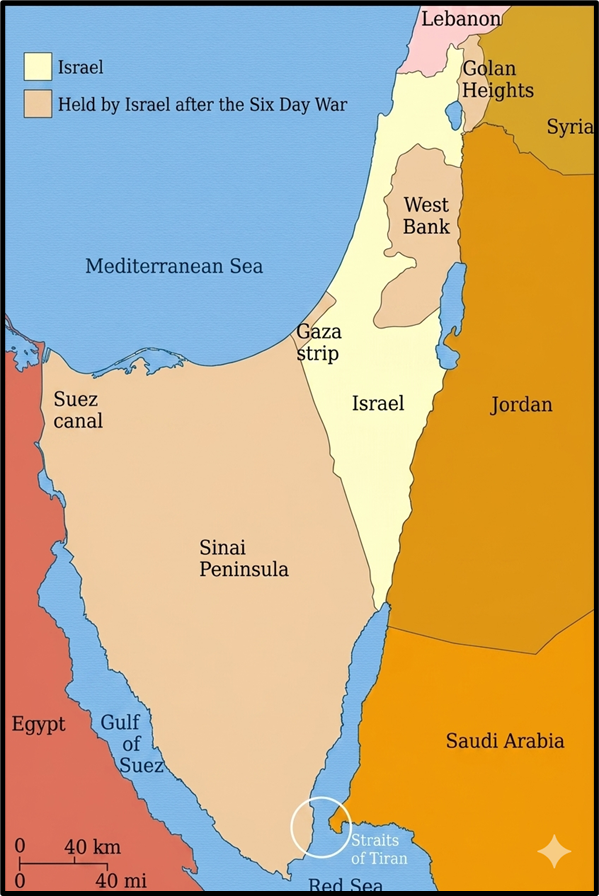
In a daring and meticulously planned operation, the Israeli Air Force destroyed almost the entire Egyptian Air Force on the ground within hours. Without air cover, the Arab armies were “blind.” What followed was a military whirlwind:
- From Egypt: Israel captured the Gaza Strip and the entire Sinai Peninsula.
- From Jordan: They took the West Bank and, most significantly, the Old City of Jerusalem.
- From Syria: They scaled the “impregnable” Golan Heights.
In just 132 hours of fighting, the map of the Middle East had been transformed.
Why did the Arabs lose so decisively?
If we analyze this from a military perspective, the failure was multidimensional:
- The Ponderous Build-up: The Arab mobilization was slow and loud, giving Israel ample time to plan its strike.
- Technological and Strategic Gap: Israel’s mastery of the air and rapid movement (blitzkrieg style) overwhelmed the traditional, static Arab defenses.
- Communication Failures: There was a tragic lack of coordination between Egypt, Syria, and Jordan. They were united in rhetoric but divided in command.
The Aftermath: A Legacy of “Occupied Territories”
The consequences of this war are still the headlines of today’s newspapers.
The Israeli Dilemma
For Israel, the victory was a miracle, but it brought a “demographic time bomb.” By capturing the West Bank and Gaza, Israel suddenly found itself governing over a million Palestinians. These were people living in refugee camps since 1948, now under the rule of the very state they wished to see dismantled. The captured lands became “buffer zones,” making Israel easier to defend, but harder to govern ethically and peacefully.
The Arab Humiliation
For the Arab states, 1967 was a “psychological collapse.” Nasser’s prestige was shattered. The Soviet Union, despite their tall claims, had not intervened to save them. This realization led to a new era of dependency; the Russians began pouring in even more advanced weaponry to “save face,” setting the stage for the next round of conflict—the Yom Kippur War.
Critical Analysis: The Pivot Point of History
The Six-Day War ended the “Nasser Era” and began the “Occupied Territories Era.” It shifted the focus from a conflict between nations (Egypt vs. Israel) to a conflict over land and identity (Israel vs. Palestinians).
Historiographically, some see Israel’s strike as a necessary act of self-defence against imminent annihilation, while others see it as an opportunistic expansion. Regardless of the perspective, one thing is certain: the “buffer zones” created in 1967 remain the most contested pieces of real estate on the planet today.