
Conflict in the Lebanon
We now turn our attention to a chapter that is perhaps the most tragic and complicated in the entire Middle Eastern narrative: the Lebanese Civil War and its long aftermath.
If the Arab-Israeli conflict is a battle between two nations, the Lebanese conflict is a “kaleidoscope of chaos”—a war where the lines of religion, politics, and foreign interference blurred so much that, at times, it was impossible to tell who was fighting whom. Let us analyze this “Switzerland of the Middle East” turned into a battlefield.
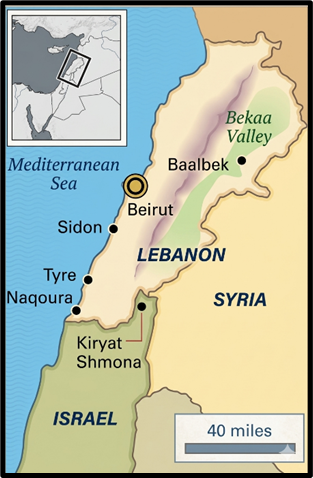
The Fragile Mosaic: A Powder Keg of Identities
To understand Lebanon, you must understand its unique social fabric. It was never a monolithic state. Instead, it was a “consociational democracy”—a system where power was meticulously divided among various religious groups based on a 1932 census.
- The Maronite Christians (wealthy and conservative) held the Presidency;
- Sunni Muslims held the Premiership; and
- Shia Muslims (the largest but poorest group) provided the Speaker of Parliament.
While this “National Pact” kept the peace for decades, it was a frozen snapshot of the past. By 1975, the demographic reality had shifted. The Muslims felt underrepresented, and the Christians felt their traditional dominance was under threat.
The Palestinian Factor: The Match that Lit the Fuse
The delicate balance of Lebanon was finally shattered by an external force: the Palestinian refugees. By 1975, over half a million Palestinians lived in Lebanon. Following their expulsion from Jordan in 1970 (“Black September”), the PLO moved its headquarters to Beirut.
This changed everything. The PLO began using southern Lebanon as a base to attack Israel. Israel, in turn, retaliated against Lebanese soil. The Christian Maronites viewed the PLO as a “state within a state” and a dangerous, left-wing Muslim force that would tip the scales of power.
In 1975, a minor dispute over fishing rights escalated into a massacre of Palestinians by the Phalange (a right-wing Christian militia). Within weeks, the country was engulfed in a full-scale civil war.
The Era of “Centrifugal Chaos” (1975–1990)
For fifteen years, Lebanon became a theater for everyone else’s wars. Let us look at the three main layers of this conflict:
- The Internal Layer: It wasn’t just Christians vs. Muslims. Soon, Christians fought Christians (Gemayel vs. Chamoun), and Muslims fought Muslims (the Shia Amal vs. the more radical, Iranian-backed Hezbollah).
- The Israeli Layer: In 1982, Israel invaded Lebanon to drive out the PLO. They reached Beirut and oversaw the expulsion of Arafat’s forces. However, this invasion birthed a new and more formidable enemy: Hezbollah, which rose to resist the Israeli occupation of the south.
- The Syrian Layer: Syria entered Lebanon in 1976, ostensibly to keep the peace, but ended up staying for nearly 30 years. Damascus became the “kingmaker” in Beirut, often playing different factions against each other to ensure Syrian dominance.
The Taif Agreement: A “Pax Syriana”
By 1990, the country was exhausted. The Taif Agreement finally brought a formal end to the civil war. It adjusted the power-sharing formula to give Muslims an equal number of seats in Parliament as Christians.
However, this peace came at a price: Syrian tutelage. Lebanon became a virtual protectorate of Syria. While this brought stability and the release of Western hostages, it also meant that Lebanon’s sovereignty was deeply compromised. Israel remained in a “Security Zone” in the south until 2000, ensuring that the embers of conflict remained warm.
The 2006 July War: The New Proxy Battle
July 2006: By this time, the PLO was gone, but Hezbollah had become a state-level military force.
When Hezbollah kidnapped two Israeli soldiers to gain leverage for the Palestinians, Israel responded with a massive, 34-day air and ground campaign. The war was a humanitarian disaster for Lebanon, with over a thousand civilians killed.
But analytically, it was a strategic failure for Israel. Hezbollah’s ability to survive and continue firing rockets into Israel “dented the myth of Israeli invincibility.” It proved that a disciplined guerrilla force, backed by Iran and Syria, could stand its ground against a conventional superpower.
Critical Analysis: Lebanon as a Microcosm
In retrospect, the tragedy of Lebanon is that it is a “small country in a big neighbourhood.” Every regional tension—the Sunni-Shia divide, the Arab-Israeli conflict, the Iran-US rivalry—manifests itself on Lebanese soil.
The Lebanese Civil War taught us that a “political vacuum” in the Middle East is always filled by militias and foreign powers. Today, while the guns of the civil war are mostly silent, the structural issues—sectarianism, corruption, and foreign interference—remain. Lebanon remains a fragile mirror, reflecting the broader instabilities of the entire region.
One Comment