
The Japanese Phoenix
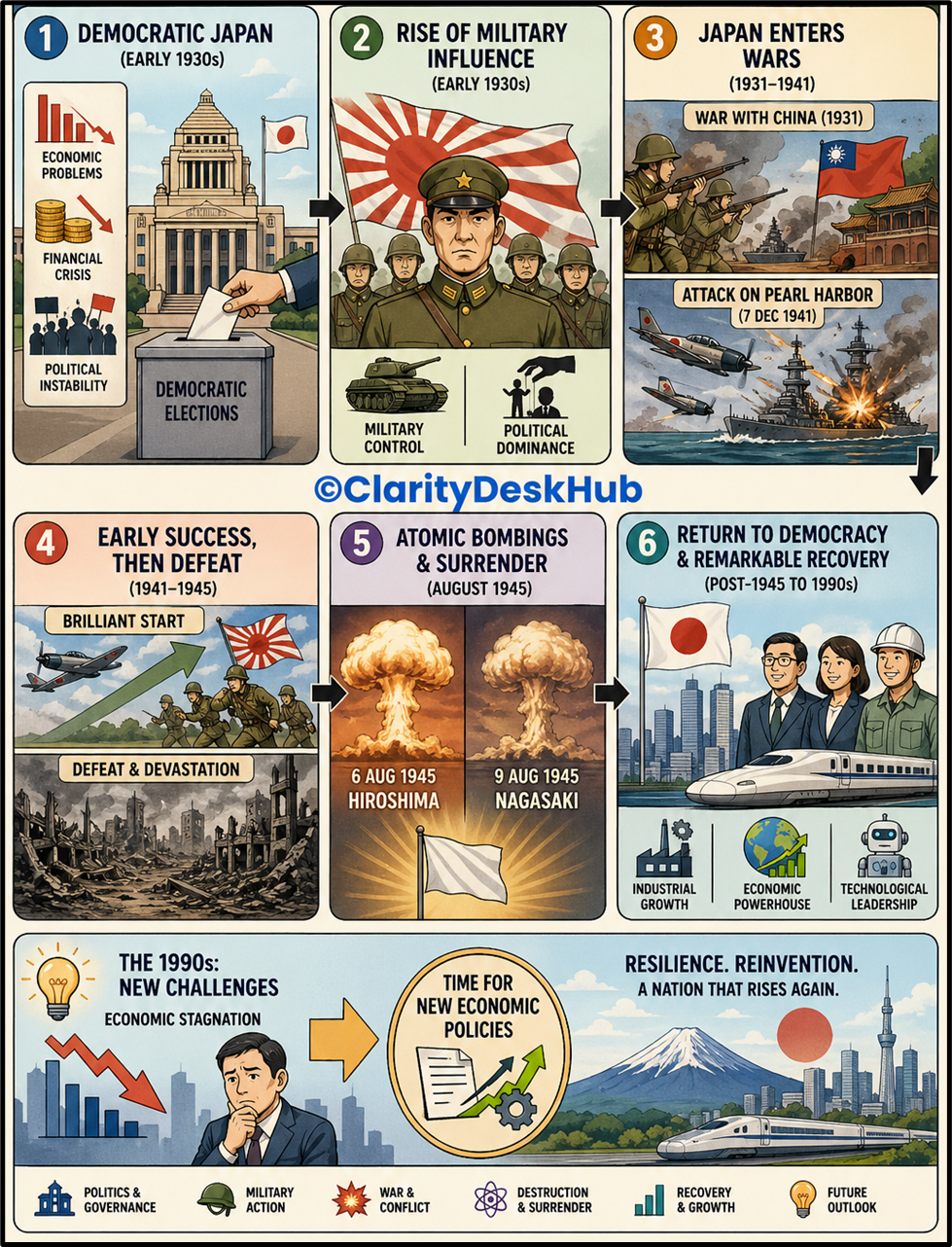
If you look at the map of the early 20th century, you will see a small island nation that, within just a few decades, transformed itself from a secluded feudal society into a global titan that challenged the might of the Western world.
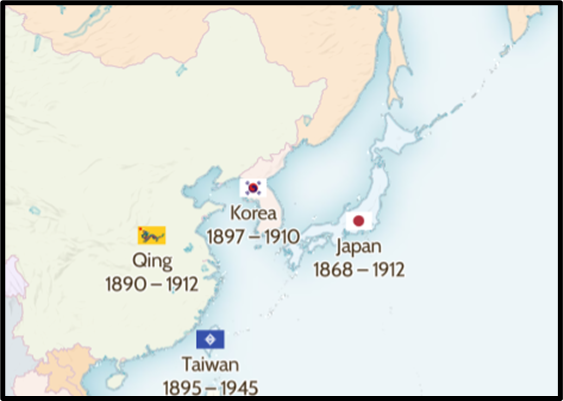
To understand why Japan took the path it did, we must look at the deep-seated psychological and systemic shifts that occurred between the late 19th century and the mid-20th century.
The Trauma of Opening: From Isolation to Modernization
The story of modern Japan does not begin in 1918, but in 1853.
- Imagine a country that had been closed to the world for 250 years. Suddenly, American Commodore Matthew Perry arrives with “Black Ships”—modern battleships—and demands that Japan open its doors.
- For the Japanese, this was not just a trade proposal; it was a profound national humiliation. They realized that if they did not modernize, they would end up like China—colonized and fragmented by Western powers.
This fear gave birth to the Meiji Restoration (1868).
- The Japanese leadership did something extraordinary: they decided to “Westernize to defeat the West.” They built railways, modernized industries like silk and cotton, and created a centralized empire under the Emperor.
- They even adopted a German-style parliamentary system. However, there was a catch—while the system looked democratic, the Emperor remained “sacred and inviolable,” and the military held a special, independent status. This “structural flaw” would later prove fatal for Japanese democracy.
1918: Japan as a Global Superpower
By the end of the First World War, Japan was sitting at the high table of global geopolitics. While the European powers were busy destroying each other, Japan was expanding. It had already defeated China (1894–95) and stunned the world by defeating Russia in 1904–05—the first time an Asian power had defeated a European “Great Power” in the modern era.
In 1918, Japan was an economic winner. Its exports of cotton had trebled, and its merchant fleet had doubled. When the Treaty of Versailles was signed in 1919, Japan was recognized as one of the “Big Five” world powers and became a founding member of the League of Nations.
To a casual observer in 1925, when Japan granted universal suffrage to all adult males, it seemed that Japan was destined to be a stable, prosperous democracy. But beneath this surface of success, the clouds of a military dictatorship were already gathering.
The Fragility of Democracy and the Rise of the Military
You might wonder: why would a successful nation choose a military dictatorship? The answer lies in the failure of the civilian government to solve the “triple crisis” of the 1920s: political, economic, and institutional.
The Institutional Vacuum
- The Japanese constitution was a strange hybrid. The Parliament (the Diet) had the power to make laws, but the Cabinet was often paralyzed because the Army and Navy ministers could resign and bring down the entire government.
- The military didn’t report to the Prime Minister; they reported directly to the Emperor. This meant that the civilian government had the responsibility of governing, but the military had the “veto power” over existence.
Economic Despair and the Great Depression
- The post-war economic boom ended in 1921. But the real “death blow” was the 1929 Great Depression.
- Japan’s economy relied heavily on the export of raw silk to the USA. When the American market crashed, silk prices plummeted to one-fifth of their previous value.
- Farmers in the north faced desperate poverty. Since many army recruits came from these peasant families, the soldiers began to hate the “corrupt” urban politicians and big businesses (the Zaibatsu) who they believed were selling out the country.
The Manchurian Crisis: The Point of No Return
In 1931, the situation reached a breaking point. Manchuria, a province in China, was rich in resources that Japan desperately needed for its industries. Without the permission of the civilian government in Tokyo, the Japanese army staged an explosion near a railway line—the Mukden Incident—and used it as an excuse to invade and occupy Manchuria.
When the Japanese Prime Minister, Inukai, tried to criticize this military extremism, he was assassinated in 1932. This was a symbolic moment: the “rule of law” was replaced by the “rule of the sword.”
From 1932 to 1945, the military effectively ran Japan. They suppressed communists, took control of education, and steered the nation toward a path of aggressive expansionism, mirroring the fascist regimes of Italy and Germany.
The Road to Pearl Harbor and Total Defeat
The military’s logic was simple: Japan needed a “Greater East Asia Co-Prosperity Sphere” to be self-sufficient. This led to a full-scale invasion of China in 1937. As Japan pushed further, it came into conflict with American interests in the Pacific.
There is a historical debate regarding Emperor Hirohito’s role.
- Some argue he was a helpless puppet; others, like historian Richard Storry, suggest that his prestige was so high that if he had taken a firm stand against the military early on, the tragedy might have been averted.
- However, after the initial success of the German Blitzkrieg in Europe, Japan felt emboldened to sign the Tripartite Pact with Germany and Italy and launched the attack on Pearl Harbor in December 1941.
The Turning Point and the End
Initially, Japan was unstoppable, capturing Hong Kong, Singapore, and the Philippines. But the tide turned at the Battle of Midway (1942), where the US destroyed Japan’s vital aircraft carriers. What followed was a brutal, three-year retreat. The dream of a Great Japanese Empire ended in August 1945 with the horrific atomic bombings of Hiroshima and Nagasaki.
Ultimately, Japan’s journey before the Second World War teaches us a vital lesson: when a nation’s military becomes more powerful than its civilian institutions, and when economic despair is met with hyper-nationalism, the path leads inevitably to a catastrophe that can ruin even the most “modernized” of empires.
After understanding the aggressive rise and tragic fall of Imperial Japan, we now move to one of the most remarkable chapters in modern history: the Japanese Economic Miracle. How does a nation, whose cities were literally in ashes and whose spirit was crushed by two atomic bombs, become the world’s third-largest economy in just a few decades?
This is not just a story of economics; it is a story of strategic adaptation, external luck, and a peculiar political stability.
Recovery of Japan
The Alchemy of Defeat: Occupation and Rebirth (1945–1952)
In 1945, Japan was a “ruined landscape.” Imagine a country where a quarter of the housing is gone and factories are silent.
For the first few years, the Allied occupation under General Douglas MacArthur had a single-minded goal: Demilitarization and Democratization. They wanted to ensure Japan could never pose a threat again.
The Emperor, once a “living god,” was stripped of his divinity and turned into a constitutional symbol. A new constitution was drafted, making ministers responsible to the Diet (Parliament).
The Americans dismantled the armaments industry and purged the old nationalist leaders. At this stage, the US wasn’t interested in making Japan rich; they just wanted it to be peaceful.
The Cold War Pivot: From “Prisoner” to “Partner”
History changed in 1948. Why? Because the geopolitics of the world shifted. The “Iron Curtain” fell in Europe, and the Communists took power in China. Suddenly, the USA realized that a weak, starving Japan was a liability—a breeding ground for Communism.
To turn Japan into a “bulwark against Communism,” the Americans initiated a 180-degree turn in policy.
- They began pumping in aid and equipment. Most importantly, they pushed for Land Reform.
- By taking land from wealthy landlords and selling it to the peasants, they created a new class of “owner-farmers” who became a conservative, anti-communist base of support for the government.
- This was a masterstroke of social engineering that stabilized the countryside.
The Engines of the “Miracle”: Luck and Strategy
Three major factors accelerated Japan’s journey from recovery to global dominance.
- First was the Korean War (1950–1953). For Japan, this war was a “gift from the gods.” Japan became the primary supply base for UN forces. This provided the massive infusion of cash and demand that Japanese factories needed to restart their engines.
- Second was the Security Umbrella. Because the US handled Japan’s defense, the Japanese government didn’t have to spend a single yen on a massive army. Every penny of national savings could be poured into industrial technology and infrastructure.
- Third was the High-Tech Shift. Since their old factories were destroyed, Japan didn’t “repair” the old; they built the “new” with the latest global technology. By the 1960s, the government launched the “Income Doubling Plan.” They moved away from cheap textiles to high-value goods: electronics, cameras, and cars. By 1972, Japan had overtaken West Germany to become the world’s third-largest economy.
The LDP and the Price of Stability
Politically, Japan achieved something rare: absolute stability. From 1952 to 1993, the Liberal-Democratic Party (LDP) held power almost continuously. This “pro-business, pro-farmer” party created a predictable environment for long-term economic planning.
However, this success had a “dark side.” The rapid urbanization meant that by 1970, 80% of Japanese lived in crowded cities. The “Office Culture” demanded total dedication, leading to tiny apartments, long commutes, and the erosion of leisure time.
There was also a growing “Anti-American” sentiment; many Japanese felt like a “vassal state,” resenting the presence of US troops and the “moral decay” of Western-influenced youth culture.
The Great Stagnation: The “Lost Decade” (1990–2004)
By the early 1990s, the “bubble” burst. Japan’s economy, which had been built on “exporting like mad,” hit a wall. Domestic prices were too high, and wages weren’t keeping up with inflation. The 1980s fever of speculation led to a massive recession in 1992.
Historian R.T. Murphy offers a sharp critique here. He argues that Japan’s bureaucracy and banks became “insulated” from reality. They kept following the old post-war script—exporting and hoarding cash—even when the world had changed.
This “disastrous irresponsibility” led to a demoralized citizenry and an unheard-of unemployment rate of 5.4%. The LDP, once invincible, was rocked by corruption scandals, leading to a period of political instability with a revolving door of Prime Ministers.
Critical Analysis: The Lessons of Japan
When we look at Japan’s trajectory, we see a fascinating paradox. The very things that made Japan successful—a rigid bureaucracy, a single-minded focus on exports, and a dominant political party—eventually became the “chains” that prevented it from adapting to the 21st century.
Japan’s story reminds us that while a “strong state” can engineer a miracle, a “flexible state” is what survives the aftermath of that miracle. Japan remains a titan, but its journey from the ruins of 1945 to the stagnation of the 1990s serves as a profound lesson in the limits of managed growth.
How do you think Japan’s experience with rapid “Westernization” after the war compares to its first attempt during the Meiji Restoration we discussed earlier?