
End of the European Empires
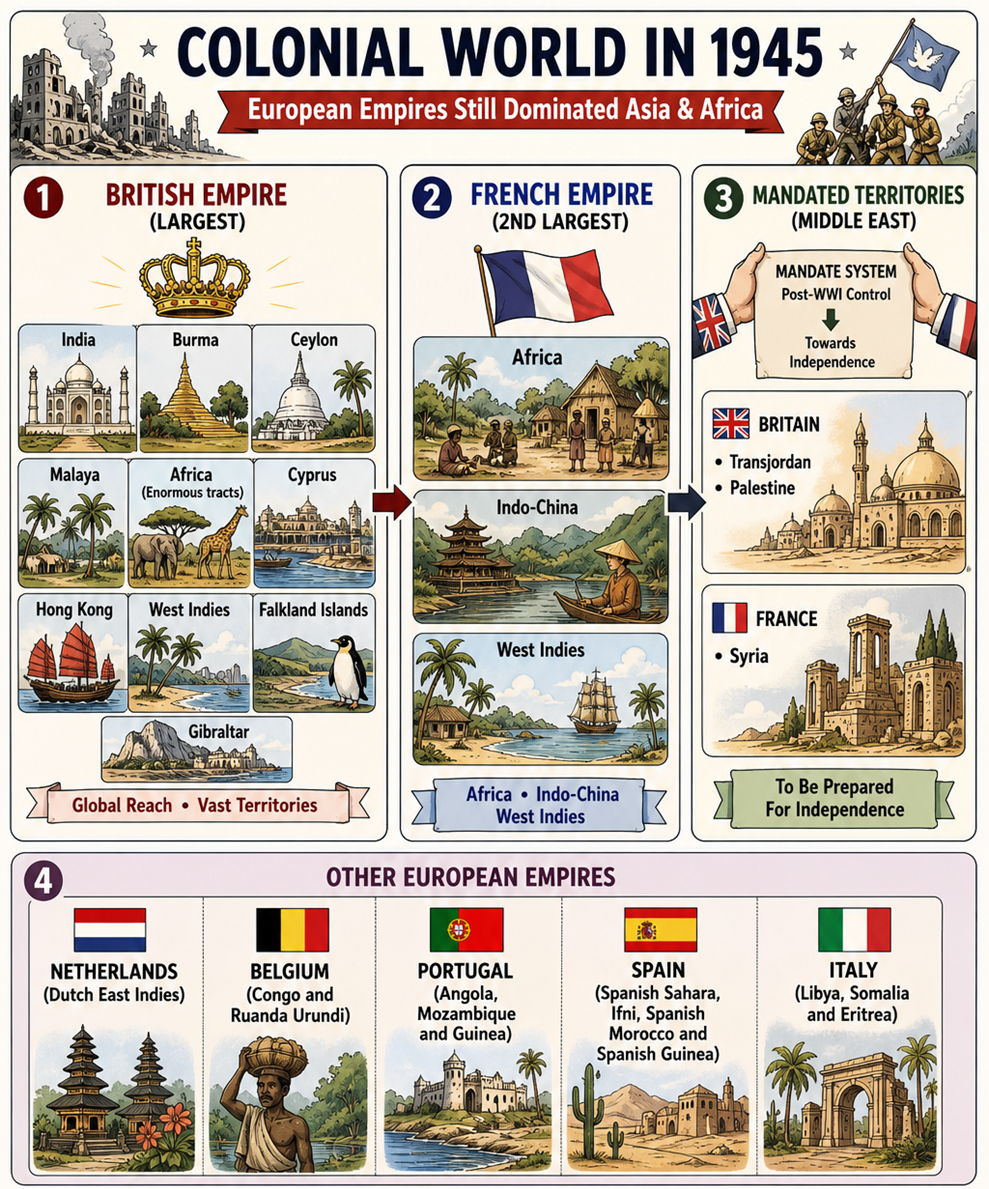
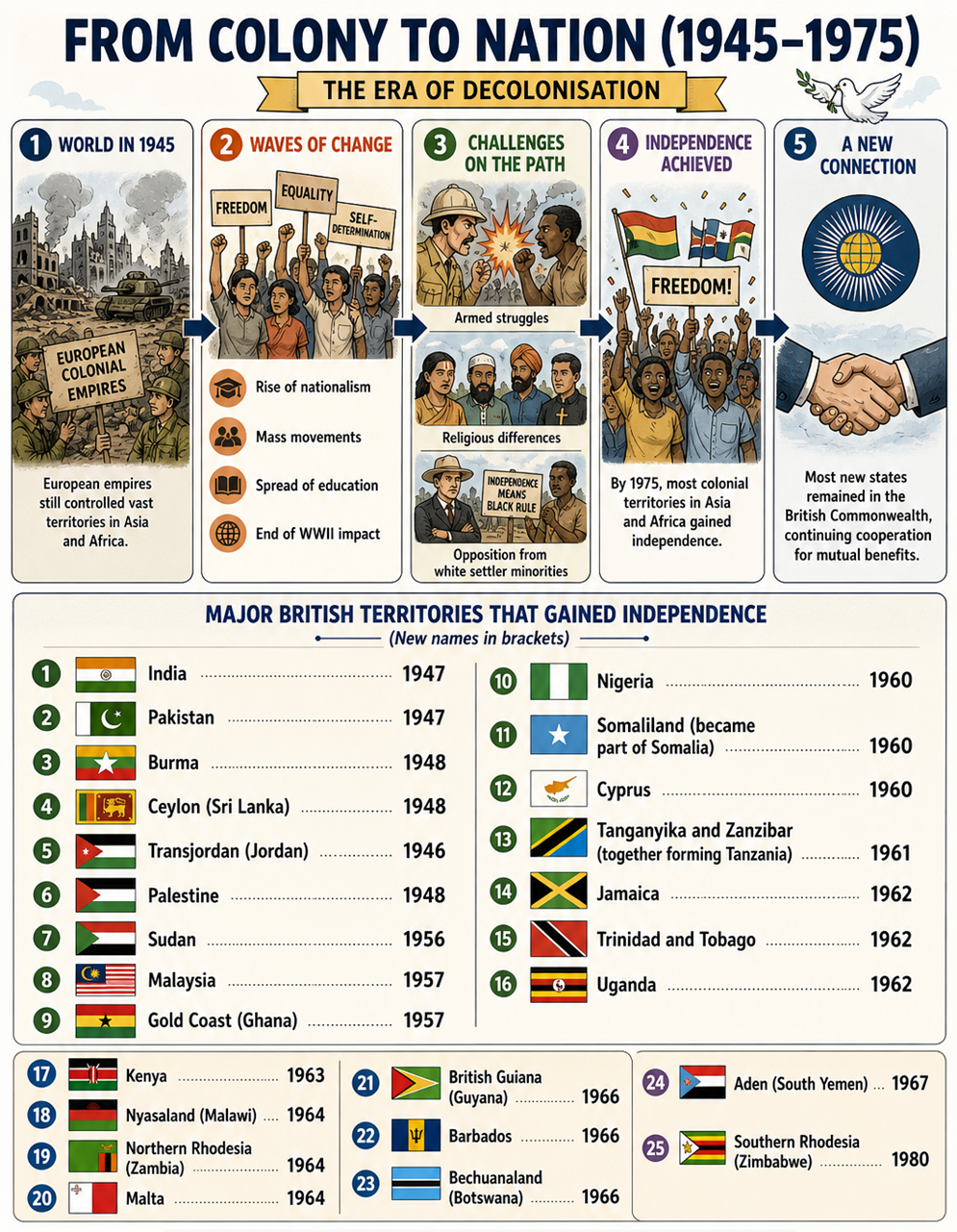
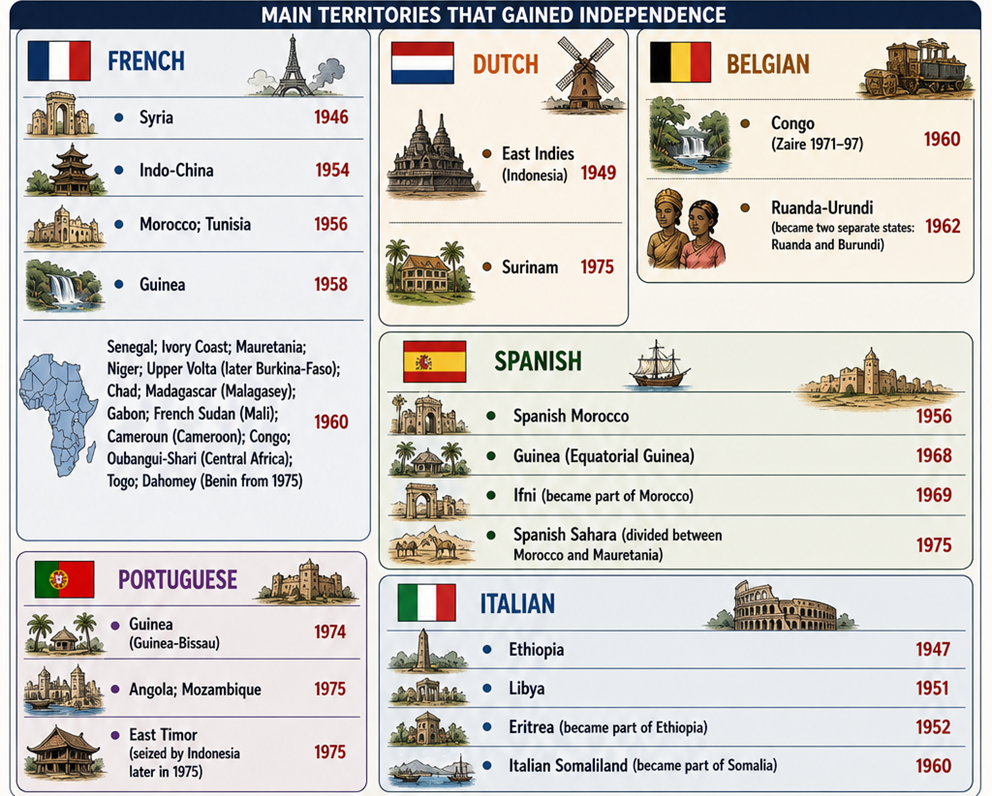
If you look at the map of the world in 1939, it was painted in the colors of a few European capitals—London, Paris, Lisbon. But by the 1960s, those colors had faded, replaced by the vibrant flags of new nations.
The question we must ask, from an analytical perspective, is: Why? Did the colonial masters suddenly develop a “moral conscience,” or were they forced out? Or, perhaps, did the colonies simply become “bad business”?
Let us analyze this.
Why did Europeans Leave?
The Historiographical Debate: Why did they leave?
Before we look at the facts, we must understand the perspective. In history, there is rarely a single “truth.” There are two main schools of thought here:
- The Metropolitan Thesis: Scholars like Robert Holland argue that decolonization wasn’t just about local pressure. Instead, the European powers (the “Metropole”) realized that keeping colonies was no longer “modern.” It didn’t fit their new foreign policy and economic goals. In simpler terms: the cost of maintaining the empire became higher than the profit it generated.
- The Nationalist Perspective: Other historians argue that this “Metropolitan” view ignores the blood and sacrifice of the local people. Could the British have left East Africa if there were no Mau Mau uprisings or organized political resistance? Likely not.
The reality, as we often see in complex historical processes, lies in the interplay of both.
The Internal Pressure: The Rise of Nationalist Movements
Nationalism is a powerful psychological force. It is the realization by a people that “We are a nation, and we should rule ourselves.”
The Long Gestation
In Asia, these movements weren’t new. The Indian National Congress had been challenging the British since 1885. In Vietnam, nationalists were fighting French rule as early as the 1920s.
The Narrative of Exploitation
The core “fuel” for these movements was the sense of economic drain. While Europeans claimed they were bringing “civilization,” the local people saw their wealth being shipped to Europe while they remained in poverty. This created a “General Will” (as Rousseau might say) to expel the foreigner.
Critical Note: However, in many parts of Africa, nationalism was less organized before 1939. In these regions, decolonization happened so rapidly after the war that the new states weren’t “prepared” for self-rule, leading to the tragedies we saw in the Congo, Rwanda, and Angola.
The Great Catalyst: The Second World War (1939–1945)
If nationalism was the fuel, the Second World War was the spark. It changed the “Psychology of Power” in three distinct ways:
A. The Shattering of European Invincibility
Before 1939, there was a myth that the “White Man” was militarily superior. But when Japan—an Asian power—swiftly defeated the British in Singapore and the French in Indo-China, that myth was broken. Even though Japan was eventually defeated, the prestige of the European masters was gone. They had failed in their primary duty: protecting their subjects.
B. The “Returning Soldier” Syndrome
Imagine an African soldier recruited into the British army. He travels to Europe, sees the world, and realizes that the Europeans are not “gods”—they are humans who bleed and suffer. When 374,000 African soldiers returned home, they brought back a new consciousness. They had fought for “Freedom” in Europe; naturally, they wanted it for their own homes.
C. The Moral Contradiction: The Atlantic Charter (1941)
During the war, Churchill and Roosevelt signed the Atlantic Charter, which stated that “all peoples have the right to choose their own form of government.”
- The Irony: Churchill meant this for countries under Hitler’s thumb.
- The Interpretation: But leaders in Asia and Africa said, “Wait, does this not apply to us too?” You cannot fight a war against “Tyranny” while being a “Tyrant” in your colonies. The moral ground had shifted.
The Economic Reality: The “Cheapskate” Empire
We must look at the “Pocketbook.” Historian Bernard Porter gives us a brilliant insight: the British Empire was always a “cheapskate affair.” The British didn’t want to spend their own tax money on colonies; they wanted the colonies to pay for themselves.
After WWII, Europe was exhausted.
- Britain: Recognized the reality early. They tried to “manage” the exit (like in India, 1947) to make it look like a graceful gift rather than a retreat.
- They realized they couldn’t hold Africa by force—as Iain Macleod said, the “march of men towards freedom” could only be guided, not stopped.
- The Others: France, Portugal, and the Netherlands tried to hold on. The result? Costly, bloody wars in Algeria, Vietnam, and Mozambique which they eventually lost anyway.
The Ideological Wave: Pan-Africanism
In Africa, decolonization was also driven by an intellectual movement called Pan-Africanism. Leaders like Marcus Garvey and W.E.B. Du Bois argued that all people of African descent share a common destiny.
Kwame Nkrumah (Ghana) was the champion of this. He didn’t just want independence for Ghana; he dreamed of a “United States of Africa.”
- The Outcome: While the dream of a single federal Africa failed (due to the “artificial frontiers” drawn by Europeans and local power struggles), it resulted in the Organization of African Unity (OAU) in 1963. Even if they weren’t one nation, they stood together against imperialism.
Outside Pressures: The New Superpowers
By 1945, the era of European dominance was over. The world now had two new bosses: the USA and the USSR.
- The USA: Despite being an ally of Britain and France, the US was historically anti-imperialist (remember 1776!). More importantly, the US wanted access to markets. Colonial “protected markets” were bad for American business.
- The USSR: From the Marxist-Leninist perspective, imperialism was the “highest stage of capitalism.” The Soviets constantly hammered the Europeans in the UN, encouraging nationalist rebels to weaken the West.
- The United Nations (UN): Under pressure from the US, USSR, and newly independent nations, the UN became a global forum that demanded a timetable for decolonization.
Conclusion: A Multi-Causal Event
So, why did they give up their empires? It wasn’t just one thing. It was a “Perfect Storm”:
- The Nationalists made it difficult to rule.
- The Second World War made it impossible to rule.
- The Economic Crisis made it unprofitable to rule.
- The New Superpowers made it diplomatically “uncool” to rule.
In the end, the European powers didn’t just “leave”; they were pushed by history, pulled by economics, and shamed by a new global morality. This is the beauty of history—nothing happens in a vacuum. Everything is interlinked.
Next, we shall discuss an episode that is not just a part of history but a deep wound in the psyche of the Indian subcontinent: Indian Independence and the Partition of 1947.
To understand why the British left and why they left the house divided, we must look beyond simple dates. We must look at the clash of ideologies, the economic compulsions of a fading empire, and the tragic failure of communal harmony.
Indian Independence and Partition
The Great Debate: Was Independence a “Gift” or a “Victory”?
In history, the “Why” is often more important than the “What.” There are three major historiographical perspectives on why Britain decided to leave India in 1947:
- The “Evolutionary” View (Official British Version): This view suggests that the British were “preparing” India for democracy through a series of reforms—the Morley-Minto (1909), Montagu-Chelmsford (1919), and the Government of India Act (1935). To them, 1947 was the natural culmination of a long-term plan.
- The “Nationalist” View (Sumit Sarkar, Anita Inder Singh): Indian historians argue that this is a myth. They believe the reforms were actually British tactics to postpone independence, not prepare for it. Independence, they argue, was “the hard-won fruit of struggle and sacrifice” by the masses, making India ungovernable for the British.
- The “Economic & Realist” View: This perspective argues that after WWII, India was no longer a “source of profit” but a “drain on resources.” Britain was broke. The Labour Government (Clement Attlee and Ernest Bevin) realized they couldn’t afford the military cost of holding India. Their goal shifted from “ruling” to “getting out gracefully” while keeping India within the British financial network and the Commonwealth.
The Path to Partition: Why was it necessary?
It is a tragedy of history that the birth of freedom was accompanied by the birth of a border. Why did a united struggle against the British end in a divided nation?
A. The Widening Rift (The 1937 Catalyst)
The turning point was the 1937 Provincial Elections.
Although Congress did not formally exclude the Muslim League from provincial governments after 1937, it refused to recognize it as the representative of Muslim political interests and insisted that its members join as individuals.
This was perceived by Jinnah as political marginalization. This alarmed M.A. Jinnah. He feared that in a democratic, united India, the Muslim minority would be permanently dominated by the Hindu majority. His slogan became “Pakistan or Perish.”
B. The Failure of Compromise
The British tried a “Middle Path”—a Federal Scheme.
- The Idea: A weak central government with very strong provinces. This would allow Muslim-majority provinces (like Punjab and Bengal) to have near-total autonomy.
- The Result: While both sides liked it in theory, they couldn’t agree on the “fine print.” Trust had evaporated.
C. The “Direct Action” and the Descent into Chaos
In August 1946, when Nehru was invited to form an interim government, Jinnah felt the League was being bypassed. He called for “Direct Action Day.”
- What followed was the “Great Calcutta Killings”—5,000 dead in days.
- Violence spread like a forest fire to Bengal and Bihar. India was on the brink of a full-scale civil war.
The “Mountbatten Plan”: Haste and its Harvest
By early 1947, the British government was desperate. They announced they would leave by June 1948 to “shock” Indian leaders into a settlement. They sent Lord Louis Mountbatten as the last Viceroy.
The Decision for Partition
Mountbatten concluded that a united India was an impossibility without a bloodbath. He decided that Partition was the “lesser evil.”
- In a move of “superficial haste,” he brought the independence date forward by 10 months—from June 1948 to August 15, 1947.
- The Indian Independence Act was rushed through. Two provinces—Punjab and Bengal—were to be sliced in half based on religious majorities.
The Consequences: A Human Tragedy
The actual execution of Partition was, by many accounts, a disaster of planning.
- The Great Migration: Millions of people suddenly found themselves on the “wrong side” of a new border. 14 million people began a desperate trek.
- The Bloodbath: In the Punjab especially, “near-hysterical mob violence” took over. About 250,000 to 500,000 people were murdered in communal riots.
- The Martyrdom of Gandhi: On January 30, 1948, Mahatma Gandhi—the man who had preached non-violence his whole life—was shot by Godse who hated his Muslim Appeasement. Ironically, this shock finally brought the rioting to a halt.
Critical Analysis: Could it have been avoided?
There is a sharp debate on Mountbatten’s role.
- The Defense: Attlee argued that the violence was the “failure of Indians to agree among themselves.” Some, like V.P. Menon, believe the British exit earned them “universal respect” because they didn’t cling to power.
- The Critique: Historians like A.N. Wilson compare Mountbatten’s negligence to war crimes. By rushing the process, failing to provide peacekeeping forces for the migrants, and being “arrogant” about the details, he turned a political transition into a humanitarian catastrophe.
Long-term Echoes
The partition was not just a one-time event. The “Two-Nation Theory” eventually failed even within Pakistan. In 1971, East Pakistan (separated by 1,000 miles and a different culture) broke away to become Bangladesh, proving that religion alone could not hold a state together against the forces of language and geography.
In summary: Indian independence was a triumph of the human spirit, but the Partition remains a reminder that when politics fails to bridge the gap between communities, the cost is paid in human lives.
After discussing the giants like India, we must now look at a fascinating “experiment” the British tried in their smaller colonies.
When the British realized they had to leave, they faced a practical problem: many of these colonies were too small to survive alone. So, they came up with a “Formula”—The Federation. Think of a federation like a group of roommates sharing a flat. They have their own rooms (internal affairs), but they share the kitchen and the rent (central government).
Let’s analyze three such experiments: The West Indies, Malaya, and Cyprus. One failed, one succeeded, and one ended in a tragic partition. Let’s understand the “Tark” (logic) behind each.
The West Indies, Malaya and Cyprus
The West Indies: A Failed Marriage of Cricket and Geography
Imagine a string of beautiful islands scattered across the Caribbean Sea. This was the British West Indies.
The Problem of Scale
The British were ready to give independence, but they were worried. How can an island with only 60,000 people (like St. Kitts) survive as a modern nation? They wouldn’t have the money for an army, a central bank, or a foreign ministry.
The Federation (1958–1962)
To solve this, the British created the West Indies Federation.
- The Intent: Combine the “big players” (Jamaica and Trinidad) with the smaller islands.
- The Reality of Conflict: It was a disaster. Why?
- Economic Fear: Jamaica and Trinidad felt they were “subsidizing” the smaller, poorer islands.
- Power Struggle: There were constant squabbles over who gets how many seats in parliament.
- Lack of Unity: They had a passionate love for Cricket, but you cannot run a country solely on a sport!
The Consequence
In 1961, Jamaica and Trinidad walked out. The Federation collapsed. By 1983, almost every island became a separate independent state.
The Irony: After rejecting political unity, they realized they needed each other for survival. This led to CARICOM (1973)—a common market. They didn’t want to live in the same “house,” but they agreed to trade at the same “shop.”
Malaya and Malaysia: A Masterclass in Pragmatism
Malaya was far more complex. It wasn’t just geography; it was a “Melting Pot” of Malays, Chinese, and Indians.
The Two Great Hurdles
- Administrative Complexity: There were nine Sultans and two British settlements. How do you unite kings and colonists?
- The Red Threat: A Chinese communist leader, Chin Peng, started a guerrilla war. This is known as the “Malayan Emergency” (1948–1960).
How did the British succeed here?
The British used a “Carrot and Stick” policy.
- The Stick: They resettled Chinese villagers to cut off the guerrillas’ support.
- The Carrot: They promised independence as soon as the ethnic groups showed they could work together.
- The Result: An “Alliance Party” was formed by Tunku Abdul Rahman, uniting Malays, Chinese, and Indians. Seeing this stability, Britain granted independence in 1957.
The Expansion into Malaysia (1963)
Tunku then proposed a “Greater Malaysia” including Singapore and Borneo territories.
- The Logic: Combining resources and securing the region against communism.
- The Split: Singapore, under Lee Kuan Yew, eventually left in 1965 due to ethnic and political differences to become the powerhouse it is today. But the rest of Malaysia remained a success story of prosperity based on Rubber and Tin.
Cyprus: The Strategic Victim
If Malaya is a success story, Cyprus is a tragedy of “Strategic Interest.”
The Ethnic Divide
The population was 80% Greek (who wanted Enosis—union with Greece) and 20% Turkish (who were terrified of being a minority).
British “Geo-Politics”
The British didn’t want to leave. Why? Not for money, but for Military Bases. After losing the Suez Canal, Cyprus was Britain’s “Aircraft Carrier” in the Middle East. Anthony Eden famously said Cyprus must “permanently” remain British.
The Conflict
This led to a bloody guerrilla war by Eoka (Greek nationalists) led by General Grivas. The British responded with force and by deporting the Greek leader, Archbishop Makarios.
The Failed Compromise (1960)
Finally, a deal was struck:
- No Enosis: Cyprus would be independent, not part of Greece.
- Power Sharing: A Greek President (Makarios) and a Turkish Vice-President.
- British Bases: Britain kept its military bases.
The Consequence: A Divided Island
The compromise was a paper-thin mask over deep hatred. In 1963, civil war broke out. In 1974, Turkey invaded to protect the Turkish minority.
The Reality Today: The island remains divided by a “Green Line” guarded by the UN. The North is Turkish; the South is Greek. Even when the Greek side joined the EU in 2004, the island remained a house divided.
Analytical Summary: The “Federation” Verdict
Why did some work and others fail? Let’s look at the interlinkages:
| Territory | Result | Why? |
| West Indies | Failed | Geography was too wide; economic “ego” of big islands; no common threat. |
| Malaya | Successful | Strong leadership (Tunku); common economic interest; a shared “enemy” (Communism). |
| Cyprus | Tragic | Deep ethnic rift; used as a “pawn” in British military strategy. |
Final Thought: Decolonization wasn’t just about giving back land. It was about trying to “engineer” nations. Where the engineering respected local ethnic and economic realities (Malaya), it worked. Where it was forced for the convenience of the colonizer (Cyprus), it left a legacy of permanent conflict.
Do you see a pattern here with how the British handled the Partition of India? Think about it—is it a coincidence that “Divide and Rule” often ended in “Divide and Quit”?
Next, we move to one of the most dramatic theatre of decolonization: Africa.
If the independence of India was a “controlled explosion,” the British exit from Africa was a complex series of events that ranged from graceful handovers to brutal, “grotesque” wars. To understand this, we must look at Africa not as one single unit, but through the lens of what I call the “Settler Factor.”
The British Leave Africa
The Context: The Awakening and “Neo-Colonialism”
After 1945, a new generation of African leaders—educated in London and the USA—returned home. Leaders like Kwame Nkrumah and Jomo Kenyatta saw the hypocrisy of the West: the Europeans fought a war for “Freedom” against Hitler while denying that very freedom to Africans.
The British Strategy: Neo-Colonialism
The British Labour government was not entirely “anti-empire” out of pure kindness. They were pragmatists. They realized that holding colonies by force was expensive. Their new goal was Neo-Colonialism:
- Give them political independence (their own flag and anthem).
- Maintain economic influence (trade links and the Commonwealth).
- Basically, the “Owner” becomes the “Senior Partner.”
The Analytical Framework: The Three Africas
To write a good answer on this, you must categorize the colonies based on the “Settler Factor”—the presence of permanent European residents who owned land and didn’t want to leave.
| Region | Key Colonies | The “Settler Factor” | Difficulty Level |
| West Africa | Ghana, Nigeria | Low: Mostly administrators, few permanent white estates. | Relatively Easy |
| East Africa | Kenya, Tanganyika | Medium: Significant white and Asian settlers (especially in Kenya). | Violent & Complex |
| Central Africa | Rhodesia (Zimbabwe) | High: Large, entrenched white minority with massive estates. | Very Difficult/Long War |
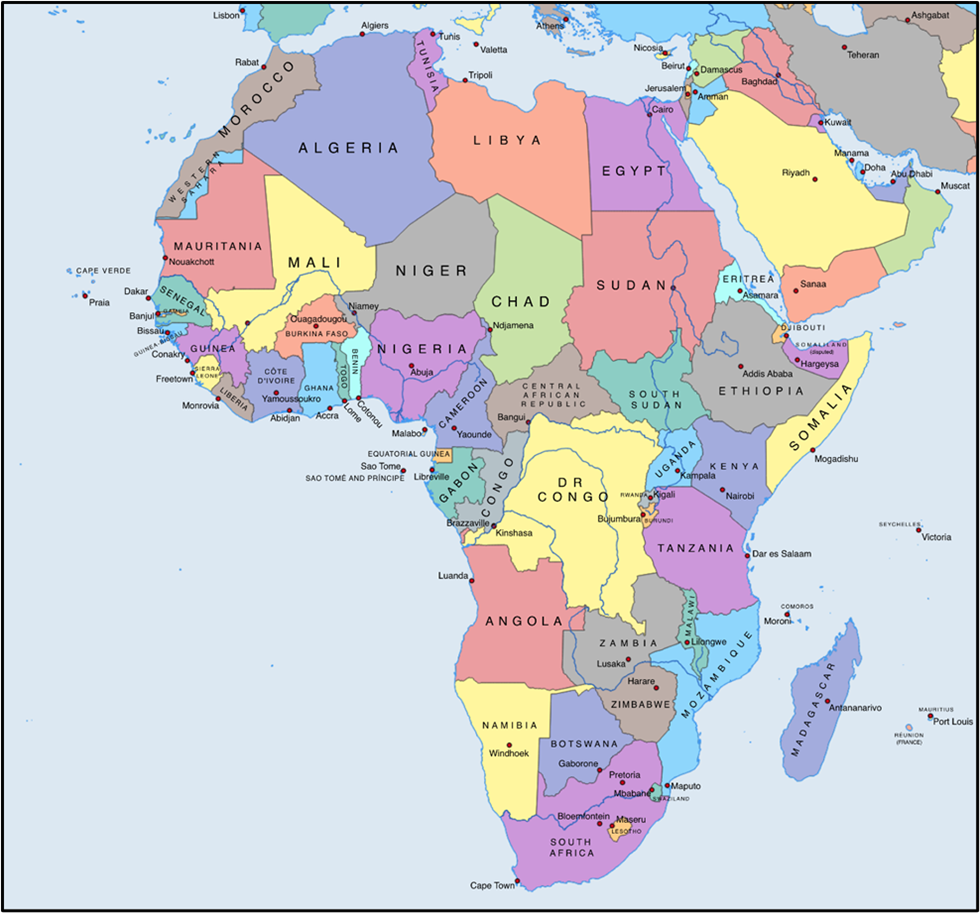
Following is the current political map of Africa, which will help you to better grasp the analysis:
West Africa: The Laboratory of Independence
A. Ghana (The Gold Coast) – The Pioneer
Kwame Nkrumah led the Convention People’s Party (CPP). He used “Positive Action”—strikes and boycotts.
- The British Response: They imprisoned him, but seeing his mass support, they did something clever: they released him and made him Leader of Government Business.
- The Outcome: Ghana became the first black African colony to win independence (1957). It was a “model” exit.
B. Nigeria – The Giant with Tribal Fault Lines
Nigeria was massive (60 million people). The challenge wasn’t the British; it was the Tribes.
- The Three Pillars: The North (Hausa-Fulani), the West (Yoruba), and the East (Ibo).
- The Solution: A Federal System (1954).
- The Tragedy: While they got independence in 1960, the tribal tensions were so deep that they later exploded into the Biafra Civil War (1967).
East Africa: The “Wind of Change” and the Kenya Bloodshed
By 1960, British Prime Minister Harold Macmillan realized the game was up. He gave his famous “Wind of Change” speech, admitting that national consciousness was a “political fact.”
A. Tanganyika (Tanzania): The Peaceful Path
Julius Nyerere was a visionary. He convinced the British that a black-majority government would be fair to whites. Because there were fewer settlers, the transition was smooth (1961).
B. Kenya: The Mau Mau Uprising
This was the dark chapter. The Kikuyu tribe, led by Jomo Kenyatta, wanted their land back from the “White Highlands.”
- The Conflict: A secret society called the Mau Mau began a guerrilla war.
- The Brutality: The British response was “grotesque.” They used Operation Anvil, putting 100,000 people in detention camps.
- Historiographical Correction: For years, Britain hid the scale of the torture. We now know thousands were killed and tortured in camps like Hola.
- The Result: Despite defeating the Mau Mau militarily, Britain realized the political cost was too high. Kenyatta was released from prison and became the first President in 1963.
Central Africa: The Last Bastion of White Rule
In Central Africa, the white settlers tried to create their own “Mini-Empire” called the Central African Federation (1953) to stop black majority rule. It failed because Malawi (Nyasaland) and Zambia (Northern Rhodesia) demanded to leave.
The Rhodesia (Zimbabwe) Saga
This is where the story gets most intense. Southern Rhodesia had 200,000 whites who refused to give up power.
- UDI (1965): The white leader Ian Smith did something illegal—he declared independence from Britain himself to avoid giving votes to blacks. This is called the Unilateral Declaration of Independence.
- The International Reaction: The UN imposed sanctions, but they were weak because South Africa and Portugal helped Smith. Even some US and British companies kept buying Rhodesian goods (like chrome and oil).
- The Bush War: Nationalist leaders Robert Mugabe (ZANU) and Joshua Nkomo (ZAPU) launched a long guerrilla war.
- The Turning Point: When Mozambique became independent (1975), Smith lost his “buffer.” By 1979, the whites were exhausted.
- The Lancaster House Agreement (1979): A compromise was reached. Zimbabwe became independent in 1980 with Robert Mugabe as leader.
Analytical Conclusion: The Legacy of the British Exit
Was the British exit a success?
- The Positive: They avoided a “Vietnam-style” total collapse by using the Commonwealth and “Neo-colonialism” to maintain some order.
- The Negative: In places like Kenya and Zimbabwe, the delay in granting rights led to deep-seated trauma and radicalization.
- The “Tribal” Oversight: In their haste to leave, the British often ignored ethnic complexities (like in Nigeria and Uganda), leading to decades of internal conflict after the flags were lowered.
The “Wind of Change” did indeed blow, but it left behind a landscape that was as full of hope as it was of scars.
Do you see the pattern?
- Where there were Settlers, there was Blood.
- Where there were only Administrators, there was a Handshake.
This is the fundamental logic of African Decolonization.
So, we have seen above how the British “managed” their exit—sometimes gracefully, sometimes with a messy haste. Now, next, we look at a very different psychology: The French.
If the British were like a landlord who realized the tenants were too much trouble and decided to sell the building, the French were like a landlord who insisted the tenants were actually part of the family—whether they liked it or not. To the French, their colonies weren’t just possessions; they were “France d’outre-mer” (Overseas France).
Let us analyze this intense, often bloody transition from Empire to the Fifth Republic.
End of the French Empire
The Core Philosophy: “France is Indivisible”
To understand the French exit, you must understand the Brazzaville Declaration of 1944. While the British were already talking about “Dominion Status” for India, the French were saying:
“The colonizing work of France makes it impossible to accept any idea of autonomy… even at a distant date, there will be no self-government.”
The French goal was Assimilation, not Independence. They wanted to turn Africans and Asians into French citizens. But after 1945, the world had changed, and the French were about to receive a series of “shocks” that would shatter this illusion.
The First Shock: Indo-China and the Humiliation of 1954
In Southeast Asia (Vietnam, Laos, Cambodia), the French faced a determined communist leader: Ho Chi Minh.
- The Conflict: After the Japanese left in 1945, Ho Chi Minh declared independence. The French refused to recognize it, leading to an eight-year war.
- The Turning Point: In May 1954, at a place called Dien Bien Phu, the French army was surrounded and decisively defeated by Vietnamese guerrilla forces.
- The Consequence: This was a massive blow to French military prestige. It forced the liberal premier Pierre Mendès-France to realize that public opinion was done with the war. At the Geneva Conference, France withdrew, and Indo-China was split.
PS: Here, Indo-China = French colonial region comprising Vietnam, Laos, and Cambodia, where France suffered a major defeat in 1954.
The Pragmatic Retreat: Tunisia and Morocco (1956)
Seeing the disaster in Indo-China, the French tried to be more “British” in North Africa.
- Tunisia: The leader Habib Bourghiba led a nationalist movement called New Destour. The French initially jailed him, but they realized that if they didn’t deal with a moderate like him, they would end up fighting extremists. He was released, and Tunisia got independence in 1956.
- Morocco: Similar story. The French tried to depose King Mohammed V, but this only sparked more violence. They brought him back and granted independence in 1956.
Why was it so easy here? Because the number of European settlers was relatively small (around 250,000–300,000). But just across the border lay Algeria, where the logic of history would take a much darker turn.
The Algerian Tragedy: The War that Broke France
Algeria was not a colony; it was a Province (Département) of France. Imagine if a part of your own heart decided it wanted to leave your body—that was the French perspective.
A. The “Pieds Noirs” Factor
There were 1 million French settlers (called Pieds Noirs or “Black Feet”) living among 9 million Muslims. These settlers owned the best land and had all the political power. To them, “Algeria is France.”
B. The War of Extremes (1954–1962)
The FLN (National Liberation Front), led by Ben Bella, launched a brutal guerrilla war. The French responded with 700,000 troops.
- The Stalemate: Militarily, the French could hold the cities, but they could never “win” the hearts of the Algerian people.
- The Crisis of the Fourth Republic: The war was so expensive and divisive that France itself was on the verge of civil war. The French army, tired of losing, threatened a military coup (Operation Resurrection) against their own government in Paris.
C. The Return of De Gaulle
In this moment of “Peril,” General Charles de Gaulle was called back to power in 1958.
- The Pragmatist: The settlers thought De Gaulle would save them. But De Gaulle was a realist. He saw that 700,000 troops were not enough and that France was being condemned by the world.
- The Betrayal: When De Gaulle began peace talks, the settlers and rogue army generals formed the OAS (a terrorist group) and tried to assassinate him multiple times.
D. The Result: The Evian Accords (1962)
Algeria finally won independence in 1962. The cost?
- 800,000 settlers fled to France overnight.
- Up to 150,000 “Harkis” (Muslims who served the French) were executed as traitors.
- It saved France from civil war but left a scar on the French soul that remains to this day.
Sub-Saharan Africa: The “French Community” Experiment
In West and Equatorial Africa, De Gaulle tried to avoid the “Algerian mess” by offering a deal in 1958: The French Community.
- The Offer: You get internal self-government, but France keeps control of your currency, foreign policy, and minerals. If you say “No,” you get independence but zero French aid.
- The “Non” of Guinea: One leader, Sékou Touré, had the courage to say “No.” He famously said, “We prefer poverty in liberty to riches in slavery.” The French left Guinea in a day, even taking the lightbulbs and telephones with them!
- The Domino Effect: Guinea’s bravery inspired the rest. By 1960, all 12 colonies demanded and received full independence.
Critical Analysis (Neo-Colonialism): Even after independence, France maintained a massive grip on these countries’ economies (the CFA Franc). This is often cited as a classic example of Neo-Colonialism—independence in name, but economic dependence in reality.
Conclusion: A Comparative Perspective
If we compare the British and French exits:
- Identity: The British saw their empire as an “outer garment” they could take off. The French saw it as their “skin.” Taking it off was painful and bloody.
- Violence: Because the French were more “stubborn” about their identity, their decolonization (Vietnam and Algeria) was significantly more violent than the British (except for India’s partition).
- The Remnants: Interestingly, France still keeps several “Overseas Departments” (Guadeloupe, Martinique, French Guiana) as full parts of France. They didn’t just leave; they redefined what “France” means.
A final thought: The end of the French Empire wasn’t just the birth of new nations; it was the birth of the Fifth Republic. The crisis in the colonies literally forced France to change its own constitution and leadership. That is the true “interlinkage” of history.
Next, we move into the more turbulent, phase of decolonization. We have already seen how the “Great Powers,” Britain and France, navigated their exits. But what about the others? The Netherlands, Belgium, Portugal, Spain, and Italy?
If Britain and France were the “Corporate Giants” of imperialism who could afford to pivot to Neo-colonialism, these smaller powers were like “Old Landlords” clinging to their properties because they lacked the capital to influence the world in any other way. For them, losing a colony wasn’t just a loss of pride; it was an economic death sentence.
Let us analyze this.
The Netherlands, Belgium, Spain, Portugal and Italy
The Core Logic: Why were they so stubborn?
Before we look at specific countries, let us understand the Metropolitan Psychology.
- Lack of Resources: Unlike Britain, these powers couldn’t sustain influence through trade and finance (Neo-colonialism) after leaving. They knew that if they left, larger powers like the USA or the USSR would take over their markets.
- The “Dictatorship” Factor: In countries like Portugal and Spain, right-wing dictatorships (Salazar and Franco) saw the empire as a pillar of their national identity.
The Netherlands: The Tragedy of Indonesia
The Dutch East Indies (Indonesia) was a “Jewel” that the Netherlands was desperate to keep.
A. The Catalyst: 1942–1945
The Japanese occupation did two things: it shattered the myth of Dutch superiority and it gave leaders like Ahmed Sukarno a taste of administration.
In 1945, Sukarno declared the Republic. The Dutch, just liberated from Nazi rule themselves, ironically sent troops to “re-liberate” Indonesia.
B. The “Police Actions”
The Dutch called their military campaigns “Police Actions” to make them sound like minor internal matters. But it was a full-scale war.
- Why did they give up in 1949? It wasn’t a change of heart. They were under crippling economic pressure and, more importantly, the USA and Australia pressurized them. The US wanted the Dutch out so American capital could enter the region.
C. The Cold War Twist: Suharto and the “New Order”
In 1965, a right-wing coup led by General Suharto (with CIA backing) overthrew Sukarno.
- The Consequence: A brutal purge followed. At least 500,000 people were murdered. Why did the West stay silent? Because Suharto was “Anti-Communist.” This shows us a recurring theme: In the Cold War, human rights were often sacrificed at the altar of ideology.
Belgium: The Disaster of the “Panic Exit”
If the Dutch were too slow to leave, the Belgians were dangerously fast.
A. The “Paternalist” Trap
The Belgians thought they could rule the Congo forever by keeping the population uneducated. They denied Africans any higher education.
The Data of Neglect: At independence in 1960, there were only 17 university graduates in the entire Congo. No doctors, no engineers, no army officers.
B. The Sudden Retreat (1960)
When riots broke out in 1959, the Belgians panicked. They granted independence in just six months!
- The Logic: They hoped that by leaving a weak, uneducated state, the Congo would remain totally dependent on Belgium.
- The Result: Immediate civil war, the assassination of Patrice Lumumba, and decades of chaos. This teaches us that Decolonization without preparation is as destructive as Colonization itself.
Portugal: The “Oldest Empire” and the Carnation Revolution
Portugal, under the dictator Salazar, ignored the “Wind of Change.” They spent 40% of their national budget fighting three wars at once: in Angola, Mozambique, and Guinea-Bissau.
A. The Turning Point
The Portuguese army became “demoralized.” They realized they were fighting a losing battle against Marxist guerrillas supported by the USSR and Cuba.
- The Carnation Revolution (1974): The army itself got tired of the wars and overthrew the dictatorship in Lisbon. The new government granted independence almost immediately.
B. The Cold War Playground
In Angola, decolonization turned into a proxy war between the MPLA (backed by Russia/Cuba) and UNITA/FNLA (backed by USA/South Africa). The result was a civil war that lasted into the 1990s.
The Tragedy of East Timor: A Small Nation’s Struggle
East Timor is a heart-wrenching example of how small nations are treated as “pawns.”
- When Portugal left in 1975, Indonesia (under Suharto) invaded.
- The Silence of the West: The USA supplied arms to Indonesia because they feared the Timorese nationalists were “Leftists.” One-sixth of the population was killed.
- The Conclusion: It took until 2002 for East Timor to finally become independent, only after the Cold War ended and global attention turned toward human rights.
Italy and Spain: The Minimalist Exits
- Italy: Being on the losing side of WWII, they lost their empire by decree in 1947. The UN tried to create states like Libya and Somalia, but the lack of modernization led to the rise of strongmen like Gaddafi.
- Spain: General Franco was indifferent to colonies. However, the exit from Spanish Sahara in 1975 was “bungled.” Instead of independence, the land was split between Morocco and Mauritania, leading to a decades-long struggle by the Polisario Front that continues even today.
Comparative Analysis & Conclusion
Let us summarize the “Style” of withdrawal in this table:
| Power | Style of Withdrawal | Primary Reason for Exit | Final Outcome |
| Netherlands | Reluctant/Forced | US & UN Pressure | Military Dictatorship (Suharto) |
| Belgium | Hasty/Panic | Fear of Guerilla War | Civil War & Institutional Collapse |
| Portugal | Forced by Revolution | Military Coup at Home | Proxy Wars (Cold War Battleground) |
| Spain | Indifferent/Bungled | Death of Dictator (Franco) | Permanent Territorial Dispute |
The Analytical Takeaway:
Decolonization was not a uniform process.
- Where the power was wealthy (Britain), they used Neo-colonialism.
- Where the power was weak (Belgium/Portugal), they left behind Chaos.
- Where the Cold War intervened (Indonesia/Angola), decolonization became a Bloodbath.
History shows us that the “Exit Strategy” of a colonizer often determines the “Future Strategy” of the nation. When the masters leave in a hurry, or through blood, the scars remain in the geography and the politics of the new world.
Do you see how the American interest in Indonesia and Angola changed the course of their history?
After tracing the maps and the wars, we must now step back and ask the most important question: Was it worth it?
The “Verdict on Decolonization” is not a simple “Success” or “Failure.” It is a debate between two very different visions of history. On one side, we have the view of Empire as a civilizing mission; on the other, the view of Empire as organized theft.
Let us break down the “Debit” and “Credit” sides of this historical ledger.
Verdict on Decolonisation
The Prosecution: Empire as “Despotism with Theft”
Many modern historians (and thinkers like George Orwell and Bertrand Russell) argue that the primary goal of the Empire was never “sweetness and light,” but wealth and power.
A. The Reality of Exploitation
- Artificial Poverty: Famines were not always natural disasters. In India, for example, the Bengal Famine of 1943 (where 3 million died) was exacerbated because Churchill refused to divert ships to carry grain.
- Ruthless Retribution: Whenever colonies resisted, the response was disproportionate. From the Boer War concentration camps to the suppression of the Mau Mau in Kenya, the “civilized” mask often slipped to reveal a “coercive” face.
- The “Scrambled” Exit: In their haste to leave, powers often left behind “artificial frontiers.” They drew lines on maps that cut through tribes and united enemies, leading directly to civil wars in Nigeria and the Congo.
The Defense: The Legacy of Infrastructure
On the other hand, historians like Niall Ferguson argue that the British Empire, in particular, left behind the “Operating System” of the modern world.
- Global Connectivity: The Empire pioneered free trade, global capital movements, and modern communications (railways, telegraphs).
- Institutional Frameworks: The English language, the rule of law (Common Law), and the structure of parliamentary democracy are the foundations upon which many successful modern states (like India or Singapore) were built.
- The “Global Peace”: Ferguson argues that the British maintained a level of global stability that had not been seen before and has rarely been seen since.
The Great Betrayal: Neo-Colonialism
If the “End of Empire” meant a new flag and a new anthem, why did the people often stay poor? This leads us to the concept of Neo-Colonialism, famously described by Kwame Nkrumah.
The Logic of “Power without Responsibility”
- Economic Chains: The new states were independent on paper, but their economies were still tied to Western markets. If a leader tried to nationalize resources (like in Indonesia or East Timor), the West often intervened to “destabilize” them.
- The Cold War Shadow: Decolonization was hijacked by the USA and USSR. New nations became “pawns” in a larger game. If you weren’t “Pro-West,” you were labeled “Communist” and targeted for a coup.
- Passive Democracy: People got the right to vote, but they didn’t get the right to equity. Power shifted from white administrators to local “oligarchies” (wealthy elites) who often continued the same exploitation.
The Final Tally: A Summary Table
| Feature | The Imperialist Claim | The Decolonization Reality |
| Education | We brought modern schools. | Massive illiteracy remained; Malawi had only 3 secondary schools for 3 million people. |
| Democracy | We left behind parliaments. | Many states collapsed into military dictatorships or “elite-rule” oligarchies. |
| Economy | We built infrastructure. | Infrastructure was designed only to export raw materials, leaving nations “one-commodity” dependent. |
| Peace | We maintained law and order. | The withdrawal often left power vacuums and ethnic conflicts (Biafra, Rwanda). |
Conclusion: “Two Sides of the Same Coin”
As the historian Anthony J. Hall suggests, Class exploitation and Colonial exploitation are mirrors of each other. Decolonization increased the number of nation-states from 74 to 192, but it did not necessarily close the gap between the rich and the poor.
The “Wind of Change” blew away the old flags, but it did not blow away the old economic structures. The struggle for true “liberation”—social and economic—continued long after the last colonial governor boarded his ship home.
A Final Thought:
In your exams, don’t just pick a side. Show the examiner that you understand the complexity. Acknowledge the “Civilizing” structures (Law, Language, Infrastructure) but contrast them with the “Coercive” realities (Famine, Repression, Neo-colonialism).