
The Era of US Domination in Latin America
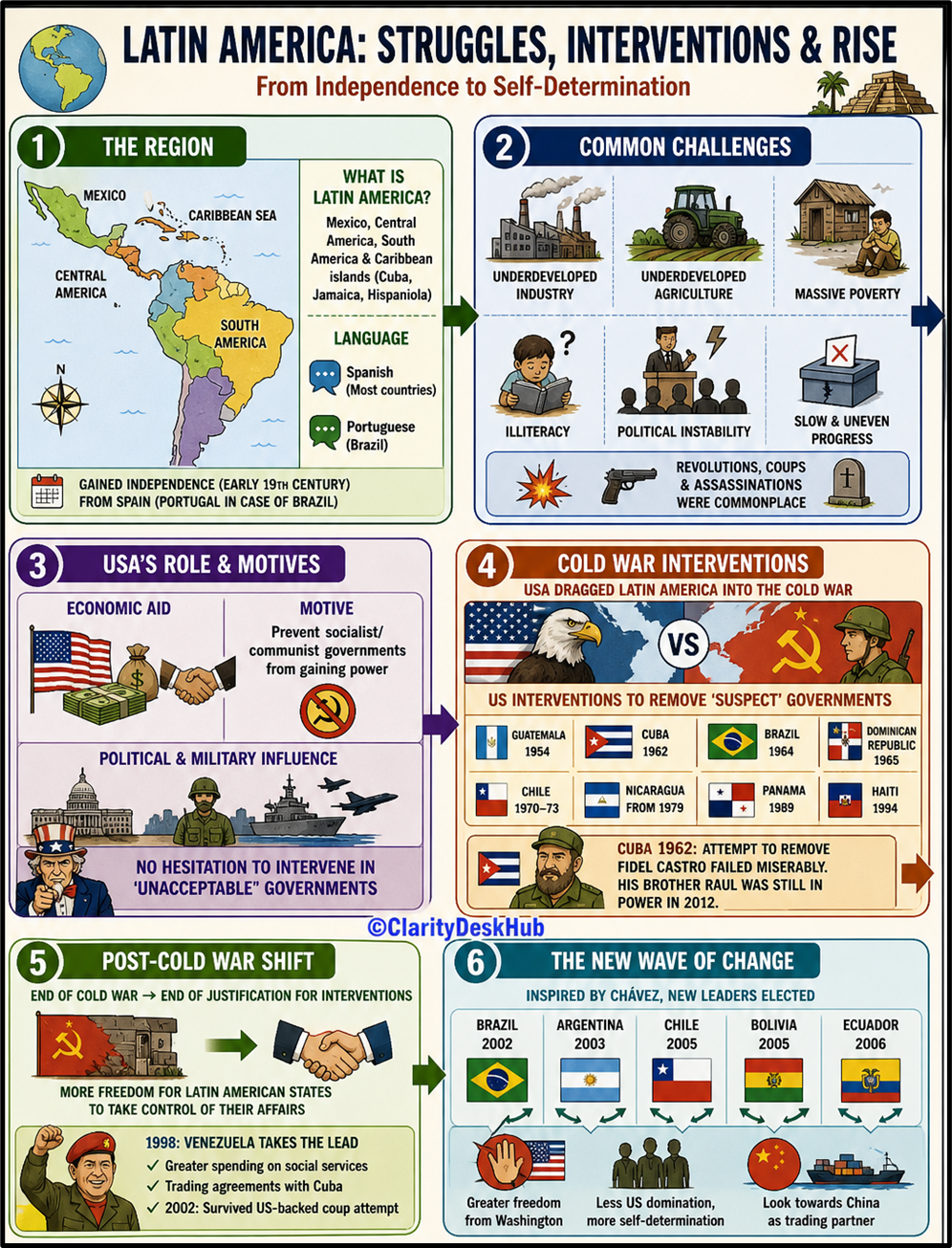
To understand Latin America in the 20th century, you must understand a paradox: these were nations rich in resources but trapped in poverty; nations with a desire for democracy but ruled by the “Caudillo’s” boot.
The Structural Malady: Problems Facing Latin America
When we look at Latin America post-1945, we see a region struggling with deep-seated structural issues. It wasn’t just “bad luck”; it was a combination of historical baggage and economic vulnerability.
A. The Economic “Monoculture” Trap
The primary tragedy of Latin American economies was their dependence.
- The Single-Commodity Weakness: Most nations relied on just one or two products for their survival.
- If the global price of that product fell, the entire nation’s budget collapsed.
- For instance, Chile was tied to copper, Cuba to sugar and tobacco, and Bolivia to tin (which provided 80% of its revenue in the 1950s).
- Underdevelopment: While WWII stimulated some local industry (because imports from Europe stopped), they lacked the capital, technical knowledge, and equipment to compete with giants like Japan or the US.
- Feudal Agriculture: In countries like Peru, huge estates ruled by powerful landowners treated peasants like medieval serfs. There was no incentive to modernize because cheap labor was so abundant.
B. The Social Volcano: Population and Favelas
Imagine a society where the population is exploding, but the economy is stagnant.
- The Demographic Explosion: Thanks to better hygiene and the Roman Catholic Church’s strict opposition to birth control, the population surged.
- The Urban Crisis: Peasants moved to cities looking for bread, but found only “shanty towns”—known as favelas in Brazil. These were (and in many places, are) desperate clusters of improvised housing without water, electricity, or sanitation.
- The Gap: The distance between the elite in their mansions and the masses in the favelas became a recipe for revolution.
C. The Political Deficit: Caudillos vs. Reformers
There was almost no tradition of democracy (Chile being a rare exception). Politics was dominated by Caudillos—military dictators backed by wealthy landowners.
- Whenever a democratic government tried to pass “Land Reforms” (redistributing land to the poor), the elite used the army to crush them. This cycle of “Coup-Reform-Coup” repeated in Guatemala (1950), Brazil (1964), and Chile (1973).
The “Helping Hand” or the “Iron Fist”?
To solve these problems, various “solutions” were offered, but we must ask: Who were these solutions really for?
A. The Institutional Approach
Organizations like the Organization of American States (OAS) were formed in 1948. While they aimed for “cooperation,” the reality was that the US often used the OAS as a tool to ensure Latin American countries remained aligned with Western anti-communist interests during the Cold War.
B. The Kennedy Era: “Alliance for Progress”
President John F. Kennedy launched the Alliance for Progress, pumping billions into the region.
- The Intent: The US wanted to create “moderate” reforming governments. Why? Because they feared that if poverty wasn’t addressed, the people would turn to Communism (the “Cuba effect”).
- The Reality: Much of this aid came with strings attached. Loans often had to be spent on buying US products, which stifled local industries. If a government—like Salvador Allende’s in Chile—became “too socialist,” the aid was instantly cut off.
C. Economic Imperialism
The US didn’t just influence politics; it owned the resources.
- United Fruit Company: This American company was the largest landowner in Guatemala.
- Resource Extraction: US firms controlled Bolivian oil, Chilean copper, and Cuban sugar. The profits didn’t stay in Latin America to build schools; they flowed back to New York and Chicago.
The 1980s: The “Lost Decade” and the Debt Trap
By the 1980s, the situation shifted from “stagnation” to “catastrophe.” This was the era of Neo-liberalism.
A. The Mechanics of the Debt Crisis
Under US influence, Latin American nations were pushed toward Neo-liberal policies: privatization, deregulation, and austerity (cuts in social spending).
- To industrialize, these nations borrowed heavily from US banks.
- In the late 70s, interest rates in the US doubled. Suddenly, countries like Brazil and Mexico couldn’t even pay the interest on their loans, let alone the principal amount.
- By 1982, the seven largest US banks were making 60% of their profits just from interest on Third World loans! It was a massive transfer of wealth from the poor south to the rich north.
B. The Rise of Liberation Theology
In this atmosphere of suffering, a fascinating shift occurred within the Church. Instead of siding with the elite, many priests embraced Liberation Theology.
- The Concept: They argued that Jesus was a liberator of the poor and that the Church must fight social injustice. They even used some Marxist social analyses (without the atheism).
- The Cost: This put them in the crosshairs of US-backed dictators.
- In 1980, Bishop Oscar Romero was murdered while celebrating Mass in El Salvador by US-backed paramilitaries.
- In Haiti, Jean-Bertrand Aristide was twice removed in coups (1991 and 2004) because his “Liberation” stance threatened the status quo.
Analytical Conclusion: A Legacy of Dependency
If we analyze this era, we see that Latin America was not just “behind” in development; it was “under-developed” by a global system that required its resources but didn’t want its competition.
By 1985, the region owed $368 billion. Brazil eventually stopped paying interest, and Mexico faced total collapse until the IMF and World Bank stepped in with “rescheduling” plans. However, these plans usually demanded even more austerity, further hurting the poor.
Critical Insight: “History teaches us that political independence is hollow without economic sovereignty. As long as a nation’s kitchen is run by someone else’s groceries, the master of the house is not the one who lives there, but the one who provides the supplies.”
This era of US domination turned Latin America into a laboratory for economic theories that benefited global capital, often at the cost of the common man’s dignity and the region’s democratic stability.
Continuing our exploration of Latin America, let us now turn our gaze toward the “Giant of the South”—Brazil. To understand Brazil is to understand a struggle between two forces: the desire for rapid industrial modernization and the iron grip of military and foreign interests.
Let’s analyze the trajectory of Brazil from the mid-20th century to the dawn of the 21st century. And that we will do in the next section