
UPSC CURRENT AFFAIRS — 16 OCTOBER 2026
1. A Card, Not Citizenship: The OCI ‘Leave India’ Notice and the Limits of Foreigners’ Rights
(POLITY AND GOVERNANCE) (IE) The Foreigners Regional Registration Office (FRRO) has directed actor Imran Khan, a US citizen holding an Overseas Citizen of India (OCI) card, to leave India by 28 October. The notice followed his participation in a Mumbai protest against the Chief Election Commissioner, reopening the question of how far OCI cardholders may take part in public dissent.
What happened
Protest at August Kranti Maidan (10 Oct) ➜ Complaint that a foreigner joined the protest ➜ FRRO issues Leave India notice ➜ Challenge before the High Court
The notice invokes Section 7(2)(c), read with Section 29, of the Immigration and Foreigners Act, 2025, which came into force in September 2025 and replaced the Foreigners Act, 1946.
OCI: privileges and limits
| Aspect | Position |
| Legal status | A foreign national of Indian origin; India does not allow dual citizenship |
| Introduced | 2005, under the Citizenship Act, 1955 |
| Privileges | Lifelong multiple-entry visa; no FRRO registration however long the stay; parity with NRIs in several economic and educational matters |
| Political rights | None — under Section 7B OCI holders cannot vote or contest elections |
| Fundamental rights | Article 19 freedoms (speech, assembly) belong to citizens only; Articles 14 and 21 protect everyone |
| Prior permission (2021 notification) | Research, missionary or Tabligh work, mountaineering, journalism, and visits to protected or restricted areas |
Notably, the 2021 notification does not list participation in protests as an activity needing permission (analysis).
Two different powers
| Leave India direction | Cancellation of OCI registration | |
| Law | Immigration and Foreigners Act, 2025 (Sections 7 and 29) | Citizenship Act, 1955 (Section 7D) |
| Grounds | Regulating a foreigner’s presence; contravention of the Act or orders; adverse security report | Fraud, disaffection towards the Constitution, serious crime, or interests of sovereignty, security, foreign relations or the general public |
| Hearing | No express hearing or appeal procedure | Reasonable opportunity of being heard is mandatory |
| Who acts | Powers delegated to FRROs and Foreigners Registration Officers (Sept 2025) | Central Government |
What courts have said
- Calcutta HC (2020): Quashed a Leave India notice to a Polish student who joined an anti-CAA rally; mere participation in a rally was held insufficient under the law then in force.
- Delhi HC on OCI cancellations: Set aside orders where vague allegations of “anti-India activities” denied a fair chance to respond, while leaving the government free to proceed afresh.
- Remedy: Writ jurisdiction under Article 226, testing the action for arbitrariness and procedural fairness — the essence of judicial review.
The larger debate
- Sovereign discretion: States have wide power over the entry and stay of foreigners.
- Diaspora goodwill: Heavy-handed use may alienate the Indian diaspora, a key soft-power asset.
- Clarity needed: Clear, published rules on permitted activities would reduce arbitrariness.
📖 Read More: Citizenship — OCI • The Indian Diaspora • Right to Freedom
2. Chasing a Ninth Term: India’s Contested Bid for a UNSC Seat in 2028–29
(INTERNATIONAL RELATIONS) (TH) After the 81st UN General Assembly session (8–28 September 2026), India has stepped up its campaign for a non-permanent seat on the UN Security Council for 2028–29; the vote is due in June 2027. Unlike past bids, India faces a contest — Tajikistan was already in the fray as the Asia-Pacific group’s expected consensus candidate.
How non-permanent members are elected
| Feature | Details |
| Council size | 15 members — 5 permanent and 10 non-permanent, elected for two-year terms |
| Election | By the General Assembly; a two-thirds majority of members present and voting is needed — about 129 votes if all 193 vote |
| Regional seats | Africa 3, Asia-Pacific 2, Latin America & Caribbean 2, Western Europe & Others 2, Eastern Europe 1 |
| Clean slate | Regional groups usually agree on a single candidate years in advance, avoiding a contest |
India’s record
India has served eight terms: 1950–51, 1967–68, 1972–73, 1977–78, 1984–85, 1991–92, 2011–12 and 2021–22. As consensus candidate it won 187 of 191 votes in 2010 and 184 of 192 in 2020. In the two contested elections it lost — to Pakistan in 1975 and to Japan in 1996.
Why India wants another term
- Unfinished agenda: The 2021–22 term was disrupted by COVID-19; priorities on counter-terrorism and UN reform remain.
- Permanent seat stalled: Frequent non-permanent terms keep India at the table while UN reform remains blocked.
- Global South voice: A platform for debt, climate finance and development concerns.
Why this contest is hard
- Small-state appeal: Tajikistan has never served on the Council and pitches for representation of smaller nations.
- Bloc support: It has Central Asian backing and the endorsement of the 57-member OIC.
- Anti-big-power mood: In 2026, first-timer Kyrgyzstan beat the Philippines, and Germany lost a Western European seat to Portugal and Austria.
- A valued partner: Tajikistan once hosted Indian facilities at Ayni and a medical base at Farkhor (see India and Central Asia).
India’s options
Contest and seek 129 votes ➜ Persuade Tajikistan to withdraw ➜ Step aside now, return later with consensus
India has used the second route before — Kazakhstan withdrew for the 2011–12 term and Afghanistan for 2021–22.
📖 Read More: The United Nations • India and Central Asia • India and Tajikistan • Foreign Policy of India
3. Innovate Today, Nourish Tomorrow: World Food Day 2026 and India’s Food-Security Journey
(SOCIAL JUSTICE) (TH) World Food Day (16 October) was observed on the theme “Innovate today, nourish tomorrow”. The heads of FAO, IFAD and WFP in India highlighted that 645 million people still face hunger and about one-third of humanity cannot afford a healthy diet, while presenting India’s digital food-security system as a model for the Global South.
Why 16 October?
The day marks the founding of the Food and Agriculture Organization (FAO) on 16 October 1945. It links to SDG 2 (Zero Hunger) and to the problems examined in food insecurity and hunger.
From scarcity to safety net
Green Revolution (1960s) ➜ Targeted PDS (1997) ➜ NFSA (2013) ➜ Free grain under PMGKAY (2024–28) ➜ ONORC & digital PDS
| Pillar | Key facts |
| National Food Security Act, 2013 | Legal entitlement for up to 75% rural and 50% urban population — about 81 crore people |
| PMGKAY | Foodgrains free of cost since January 2024; extended until 2028 |
| One Nation One Ration Card | Portability lets migrants draw rations anywhere in India |
| Digitisation | Digitised ration cards, Aadhaar seeding and e-PoS authentication |
How UN agencies complement India
| Agency | Focus in India |
| FAO | Digital agricultural advisories; Clean Milk Scorecard for dairy hygiene; measuring and valorising food loss |
| IFAD | “Financing plus” for the first mile; every dollar invested has leveraged over $3 |
| WFP | Grain ATMs, PDS supply-chain optimisation and millet integration; working in India for over 63 years |
The unfinished agenda
- Hidden hunger: Calories are assured, but anaemia and micronutrient gaps persist (see Health and Nutrition).
- Climate stress: Heatwaves and erratic monsoons threaten yields.
- Post-harvest losses: Weak cold chains cause waste and distress sales.
- Water-intensive cropping: Assured procurement favours paddy and wheat, depleting groundwater.
Way forward
- Diversify the basket: Add pulses, millets and fortified staples to food schemes.
- Climate-smart farming: Direct seeding of rice, micro-irrigation and biofortified varieties.
- Pro-smallholder innovation: Credit and markets for women-led FPOs; share India’s digital public infrastructure with other developing nations.
📖 Read More: Food Insecurity and Hunger • PDS and NFSA • Food Corporation of India (FCI) • Green Revolution in India • Millets
4. Colleges Where the Young Aren’t: Fixing the North–South Mismatch in Higher Education
(SOCIAL JUSTICE) (TP) India’s higher-education capacity is concentrated in southern and western States whose youth populations are shrinking, while northern and eastern States with the largest young cohorts have far fewer colleges. A recent study on the geography of higher education shows Uttar Pradesh, Bihar and Jharkhand lagging well behind the national average in enrolment.
Two demographic Indias
| South & West (e.g., Tamil Nadu, Kerala, Karnataka) | North & East (e.g., UP, Bihar, MP, Rajasthan) | |
| Fertility | Below replacement (TFR under 2.1) — shrinking college-age cohort | Higher fertility — youth bulge lasting into the 2040s |
| College supply | Dense networks; vacant seats in many private colleges | Too few institutions; overcrowding and high cut-offs |
| Result | Under-used capacity | Students forced to migrate or drop out |
This divide reflects States at different stages of the demographic transition.
What the numbers show
| Indicator | Figure |
| National GER (18–23 years) | About 30% (AISHE 2023–24) |
| Bihar GER (2023–24) | 17.66% |
| Jharkhand GER (2023–24) | 19.43% |
| Uttar Pradesh GER (2023–24) | 25.97% |
| NEP 2020 target | 50% GER by 2035 |
State figures are from the study reported by ThePrint.
Why the mismatch hurts
- Equity: Moving to distant hubs (Delhi-NCR, Bengaluru, Pune, Kota) is unaffordable for poor families.
- Gender: Distance, safety concerns and lack of hostels keep young women out.
- Brain drain: Graduates rarely return, deepening regional imbalances.
- Fiscal federalism: Education is in the Concurrent List, but high-burden States have weaker tax bases for new universities.
Way forward
- Targeted grants: Direct central higher-education funding, such as PM-USHA, to low college-density districts.
- Satellite campuses: Premier central institutions could open branches in tier-2 and tier-3 cities of the north and east.
- Use southern capacity: Inter-State partnerships with stipends to fill vacant seats in accredited public colleges.
- Hybrid learning: Combine SWAYAM and the Academic Bank of Credits with district-level labs.
- Hostels for women: Safe, affordable residential facilities to cut dropouts.
Demographic demand mapped ➜ Targeted funding & campuses ➜ Hybrid & credit mobility ➜ Higher, more equal GER
📖 Read More: Education: A Social Perspective • Education: Building Capabilities… • PM-USHA • Regional Imbalances in India • Internal Migration in India
5. The Humans Behind the Machine: Labour Rights of India’s AI Data Annotators
(ECONOMICS) (LL) India’s AI ambitions rest on an invisible workforce: data annotators and content moderators who label images, check text and filter harmful material so that machine-learning models can work. The work brings jobs to smaller towns, but raises serious concerns about pay, job security and mental health.
Who are the “humans in the loop”?
Annotators tag objects in images, transcribe speech, rate chatbot answers and flag violent or abusive content. Estimates put India’s data-annotation workforce at about 70,000 by 2021, earning the sector roughly $250 million a year, mostly from US clients (analysis).
Promise vs reality
| Aspect | The promise | The reality |
| Type of work | Modern digital jobs | Low-paid, task-based gig work |
| Location | Jobs in tier-2 and tier-3 towns; work from home | Strict targets and keystroke-level monitoring |
| Health | Safe desk work | Trauma from viewing violent content; eye strain |
| Career | Gateway to tech careers | Repetitive tasks with little skill growth |
Gaps in the labour codes
- Code on Social Security, 2020: Recognises gig and platform workers, but classification as independent contractors limits benefits.
- Code on Wages, 2019: Minimum wages struggle to cover piece-rate digital tasks.
- Industrial Relations Code, 2020: Contractor status can exclude annotators from the definition of “employee”, weakening collective bargaining.
- OSH Code, 2020: Its list of occupational diseases does not include psychological harm such as PTSD (see New Labour Codes).
Constitutional and ethical anchors
- Article 21: The right to life includes dignity; the Supreme Court has also recognised mental health as part of it.
- Article 39(e) and Article 42: Directive Principles on protecting workers’ health and ensuring just and humane conditions of work.
- Ethics: Technology built on exploited labour fails the test of digital ethics.
Way forward
Recognise as workers ➜ Minimum pay floor for micro-tasks ➜ Human review before account blocks ➜ Mental-health support & upskilling
- Hazard protection: Treat high-volume moderation of graphic content as hazardous work with employer-funded counselling.
- Fair contracts: Limit NDAs that stop workers from seeking help.
- Fair-work ratings: Favour vendors with good labour standards in public and private contracts.
📖 Read More: Artificial Intelligence (AI) • New Labour Codes • Digital Ethics • Emerging Technology and Indian Society
6. A War Room for Trade: Commerce Ministry Launches the National Strategic Trade Command Centre
(ECONOMICS) (NOA) Commerce and Industry Minister Piyush Goyal has launched the National Strategic Trade Command Centre (NSTCC) in New Delhi. It gives senior policymakers a single, data-driven view of India’s trade performance, export schemes and regulatory approvals to support evidence-based decisions.
What the centre tracks
| Dashboard | What it covers |
| Importer Exporter Code (IEC) | The basic registration every trader needs |
| Advance Authorisation | Duty-free import of inputs for export production |
| EPCG | Import of capital goods at concessional duty against export obligations |
| Certificates of Origin | Proof of origin needed to claim FTA tariff benefits |
| SCOMET | Licensing of special chemicals, organisms, materials, equipment and technologies with dual (civil–military) uses |
| Restricted imports/exports | Items needing specific permission |
How it changes trade governance
Scattered DGFT data ➜ Unified dashboards ➜ Real-time monitoring ➜ Faster approvals & sharper policy
Why it matters
- Faster clearances: Tracking pendency helps cut delays in licences, including sensitive SCOMET approvals.
- Better FTA use: Data on certificates of origin show where trade agreements are under-used.
- Compliance: Monitoring export obligations under duty-exemption schemes reduces misuse.
- Policy support: Aligns with the goals of the Foreign Trade Policy 2023 and India’s export targets.
📖 Read More: Foreign Trade Policy 2023 • India’s International Trade • International Trade
7. Seeding Research in Ayurveda: CCRAS Launches SPARK 5.0 and Ayurshodh 2026
(SCIENCE AND TECHNOLOGY) (PIB) The Chairperson of the National Commission for Indian System of Medicine (NCISM) has launched CCRAS SPARK 5.0 and CCRAS Ayurshodh 2026 of the Central Council for Research in Ayurvedic Sciences (CCRAS), aimed at building a research culture among Ayurveda students.
The two initiatives
| Feature | SPARK 5.0 | Ayurshodh 2026 |
| Full form / idea | Studentship Program for Ayurveda Research Ken (5th edition) | National recognition of Ayurveda research |
| Who can apply | BAMS students (3rd/4th professional year) at NCISM- or GoI-recognised institutions | Students and researchers |
| Support | 300 studentships of ₹50,000 each for short projects | Awards with sponsored prize money |
| Key dates | Registration 15 Oct – 15 Nov 2026 | Finals on 11 Dec 2026 |
Ayurshodh categories
- Prabodh 3MT: Three-minute thesis presentations on research.
- Prakash: Recognition of publications based on original research.
- Navonmesha: Innovative prototypes, solutions and new research methods.
Institutional setting
Ministry of Ayush ➜ CCRAS (apex research body) ➜ NCISM (education regulator) ➜ Evidence-based Ayurveda
Building research skills early responds to a long-standing demand for clinical evidence in traditional medicine, complementing initiatives under the National AYUSH Mission.
📖 Read More: National AYUSH Mission • Miscellaneous Ayush Schemes and Initiatives
8. Farthest Wheels Beyond Earth: Perseverance Sets a New Driving Record on Mars
(SCIENCE AND TECHNOLOGY) (TP) NASA’s Perseverance rover has driven about 45.2 km on Mars — the longest distance covered by any vehicle on a world other than Earth — surpassing the record set by Opportunity. The milestone came about five and a half years into the mission.
Mission at a glance
| Feature | Details |
| Landed | 2021, in Jezero Crater — believed to hold an ancient lake and river delta |
| Goals | Seek signs of ancient microbial life, study geology and climate, and cache rock samples for possible return to Earth |
| Power | Plutonium-238 radioisotope thermoelectric generator |
| Navigation | AutoNav — builds 3D maps from stereo images and handles about 90% of drives on its own |
| Previous record | Opportunity (2004–2018), about 45 km |
Why autonomy matters
Stereo images ➜ 3D terrain map ➜ Safest path chosen on board ➜ Longer, faster drives
Radio signals take several minutes each way between Earth and Mars, so a rover that can plan its own route covers far more ground than one driven step by step from Earth.
Context for India
India’s Mars Orbiter Mission (2013) made it the first Asian nation to reach Mars orbit. Learn more about Mars missions and the planets of our solar system.
📖 Read More: Solar, Lunar and Planetary Exploration • Planets of Our Solar System • Global Space Agencies and International Cooperation
9. Ten Years of Cooling the Planet: The Kigali Amendment and India’s Refrigerant Choices
(ENVIRONMENT) (IE) The Kigali Amendment to the Montreal Protocol turned 10 on 15 October 2026. By phasing down hydrofluorocarbons (HFCs), it could avoid up to 0.5°C of warming by 2100 — but India’s cooling demand is projected to more than double by 2035, making efficient cooling just as important.
From ozone to climate
Montreal Protocol (1987): phase out CFCs ➜ Industry shifts to HFCs ➜ HFCs: ozone-safe but powerful greenhouse gases ➜ Kigali (2016): HFC phase-down
The Montreal Protocol has eliminated nearly 99% of controlled ozone-depleting substances, and the ozone layer is recovering. Many HFCs, however, warm the planet hundreds to thousands of times more than CO₂ (see Montreal Protocol and Kigali).
Kigali at a glance
| Feature | Details |
| Proposed | 2009, by Micronesia and Mauritius |
| Adopted / in force | Kigali, Rwanda, 15 Oct 2016 / 1 Jan 2019 (Ozone Secretariat) |
| Approach | Binding phase-down (not complete phase-out), with longer timelines for developing countries |
| Climate benefit | Avoids about 0.3–0.5°C of warming by 2100 |
| Parties | 175 by early October 2026 |
| Finance | Multilateral Fund (set up 1990) meets agreed incremental costs in developing countries |
India’s schedule
| Milestone | Year |
| Ratification | 2021 |
| Freeze at baseline | 2028 |
| First cut (10%) | 2032 |
| Final cut (85%) | 2047 |
Why efficiency matters for India
- Power demand: Cooling already uses slightly over a tenth of India’s electricity; on hot nights, air-conditioners can account for up to a third of demand.
- Double benefit: Combining low-warming refrigerants with efficient appliances could roughly double the climate gain.
- Lock-in risk: Inefficient equipment bought now will run well into the 2030s.
- Leakage: Recovering and safely destroying refrigerants from old equipment is essential.
Beyond HFCs
HFCs are one of four short-lived climate pollutants, along with methane, black carbon and ground-level ozone. The Montreal Protocol’s “start and strengthen” approach is seen as a model for tackling methane from oil and gas (see Greenhouse Gases).
📖 Read More: Regulation of Ozone Depleting Substances • Greenhouse Gases (GHGs) • Climate Mitigation Measures • Global Environmental Governance
10. A Century and Three: Sukhna Wetland and Sauj Jheel Take India’s Ramsar Count to 103
(ENVIRONMENT) (PIB) Union Environment Minister Bhupender Yadav announced that Sukhna Wetland in Chandigarh and Sauj Jheel in Uttar Pradesh have been designated as Wetlands of International Importance, taking India’s tally of Ramsar sites to 103.
The new sites
| Feature | Sukhna Wetland (Chandigarh) | Sauj Jheel (Uttar Pradesh) |
| Type | Man-made reservoir at the foothills of the Shivaliks | Natural, shallow floodplain lake in the Indo-Gangetic plain |
| Origin / setting | Created in 1958 by damming the seasonal Sukhna Choe, as part of Le Corbusier’s plan for Chandigarh | Near Kishni in Mainpuri district, close to the Saman Bird Sanctuary (a Ramsar site since 2019) |
| Importance | Wintering ground for migratory waterfowl on the Central Asian Flyway | Large waterbird congregations, including the vulnerable Sarus crane |
| Key threat | Siltation from the Shivalik catchment and weed growth | Fishing pressure, grazing and agricultural run-off |
With Sauj Jheel, Mainpuri becomes a district hosting two Ramsar sites.
Ramsar basics
- Convention: Signed at Ramsar, Iran, in 1971; India joined in 1982.
- First Indian sites: Chilika Lake (Odisha) and Keoladeo National Park (Rajasthan), designated in 1981.
- Montreux Record: A register of Ramsar sites facing adverse ecological change; Keoladeo and Loktak are on it.
- India’s rules: Wetlands are regulated under the Wetlands (Conservation and Management) Rules, 2017.
How a wetland becomes a Ramsar site
State proposes site ➜ Environment Ministry nominates ➜ Ramsar Secretariat assesses criteria ➜ Site listed as Wetland of International Importance
Why wetlands matter
- Ecosystem services: Flood control, groundwater recharge, water purification and carbon storage (see Wetland Ecosystem).
- Biodiversity: Critical stopovers for migratory birds and nurseries for fish.
- Urban resilience: Peri-urban wetlands like Sukhna buffer cities against floods and heat.
📖 Read More: Ramsar Sites in India • Wetland Ecosystem • Global Protection of Wetlands
11. Back from the Lost, Now at Risk: Bauxite Mining Threatens the Jeypore Ground Gecko
(ENVIRONMENT) (TH) Only four individuals of the endangered Jeypore ground gecko have been recorded in the past year in Odisha’s Balda hills — and they lie within the area of a proposed bauxite mine. Local Adivasi communities have also protested the project for two years, saying the hills are their ancestral land.
Know the species
| Feature | Details |
| Scientific name | Cyrtodactylus (Geckoella) jeyporensis |
| Discovery | Described by the naturalist R.H. Beddome in the 1870s; presumed extinct for about 130 years until rediscovered in 2010 |
| Range | Hills of the Eastern Ghats in southern Odisha and northern Andhra Pradesh |
| Habits | Nocturnal and ground-dwelling; shelters in boulder crevices and leaf litter |
| Look | Strikingly patterned with dark-edged reddish-brown spots |
Why the Balda hills matter
- Tiny population: A species with so few recorded individuals cannot absorb habitat loss.
- Relict habitat: Moist hill forests of the Eastern Ghats are fragmented islands in a drier landscape.
- Indicator value: Its survival reflects the health of montane forest floors.
Minerals vs habitats
Bauxite-capped hills ➜ Proposed mining lease ➜ Loss of forest floor & boulders ➜ Local extinction risk
Odisha holds India’s largest bauxite reserves, often on the same hilltops that sustain endemic species and tribal livelihoods.
Safeguards in law
- Gram Sabha consent: The Forest Rights Act, 2006 and the PESA Act, 1996 give tribal communities a say over land use — as the Niyamgiri case showed.
- Environmental clearance: Impact assessments must consider endemic and threatened species.
- Way forward: Detailed biodiversity surveys before mining approval and protection of key micro-habitats.
📖 Read More: Biodiversity of India • Bauxite • Forest Rights and Conservation Strategies • PESA Act, 1996
12. When the Isthmus Shook: Panama Declares Emergency after a Magnitude-7.7 Earthquake
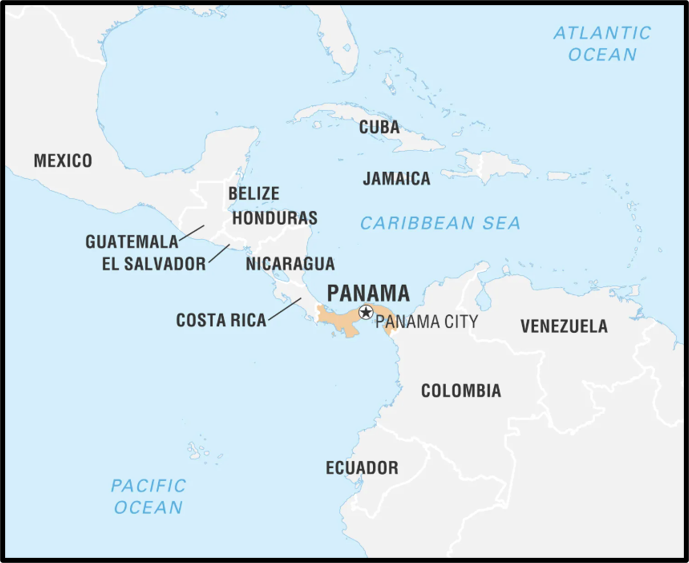
(GEOGRAPHY) (RT) Panama declared a national state of emergency after a magnitude-7.7 earthquake struck near its southern coast, followed by more than 200 aftershocks. Nearly 900 homes and at least 14 bridges were damaged and at least 27 people injured, though no deaths were reported; Panama Canal operations were unaffected.
Panama on the map
| Feature | Details |
| Location | The Isthmus of Panama, linking North and South America and separating the Caribbean Sea from the Pacific Ocean |
| Neighbours | Costa Rica (west) and Colombia (east) |
| Highest point | Volcán Barú (about 3,475 m) |
| Panama Canal | About 82 km long; uses the freshwater Gatún Lake to lift ships through locks |
| Formation | The isthmus rose about 3 million years ago, closing the seaway between the Atlantic and Pacific |
Why Panama shakes
Cocos & Nazca plates ➜ Interact with Caribbean plate ➜ Stress builds along faults ➜ Earthquakes & aftershocks
Panama sits where several plates and microplates meet, so it faces regular seismic activity — a typical setting at a convergent boundary (see Plate Tectonic Theory).
Why it matters to the world
- Shipping: The canal is a vital link between Atlantic and Pacific trade routes; damage could disrupt global supply chains.
- Disaster lessons: Aftershocks often damage weakened buildings, so post-quake inspection is critical (see Earthquake as a Natural Hazard).
- India link: India’s growing trade with Latin America and recent Central American outreach make the region strategically relevant.
📖 Read More: Political Map of North America and Central America • Earthquake: A Natural Hazard • Plate Tectonic Theory • Gateways of International Trade
13. Mapping the Storm: IMD Launches an Interactive Cyclone Warning Platform
(GEOGRAPHY) (DD) The India Meteorological Department (IMD) has launched a WebGIS-based Cyclone Warning and Marine Weather Services Decision Support System. It was unveiled at IMD’s pre-cyclone exercise meeting on 12 October, the anniversary of the landfalls of cyclones Phailin (2013) and Hudhud (2014).
What the platform shows
- Hazard maps: Cyclone tracks, intensity forecasts and wind distribution.
- Rain and surge: Rainfall warnings, storm-surge information and rainfall forecasts for river catchments.
- Access: Through IMD and Regional Specialised Meteorological Centre (RSMC) websites and IMD’s Decision Support System.
From forecast to action
IMD forecasts ➜ Location-specific hazard maps ➜ Disaster authorities plan evacuation ➜ Lives & property saved
The pre-cyclone exercise
Held twice a year since 2008, the meeting reviews preparedness before each cyclone season. This year about 230 participants from over 30 organisations — including NDMA, NDRF, the armed forces, the Coast Guard and coastal States — took part (see NDMA).
Why Phailin and Hudhud matter
Accurate, early forecasts of these very severe cyclonic storms enabled large-scale evacuations in Odisha and Andhra Pradesh and earned international recognition — a turning point in India’s move towards near-zero cyclone deaths. IMD’s New Delhi centre is also the RSMC that issues advisories for the north Indian Ocean (see Distribution of Tropical Cyclones).
📖 Read More: Cyclones: A Natural Hazard • Distribution of Tropical Cyclones • National Disaster Management Authority (NDMA)
14. Eyes Over the Konkan Coast: Coast Guard Inducts the Indigenous ALH Mk-III at Ratnagiri
(INTERNAL SECURITY) (NOA) The Indian Coast Guard has inducted an indigenous Advanced Light Helicopter (ALH) Mk-III, tail number CG 875, at Coast Guard Air Station Ratnagiri under Coast Guard Region (West). It is the first of five ALH Mk-III helicopters allotted to 831 Squadron (CG).
Know the helicopter
| Feature | Details |
| Maker | Hindustan Aeronautics Limited (HAL) — the ALH is known as Dhruv |
| Sensors | Advanced radar, electro-optical pod for long-range imaging, Automatic Identification System |
| Armament | Cabin-mounted 12.7 mm heavy machine gun |
| Roles | Maritime surveillance, search and rescue, interdiction and medical evacuation; operates from ships by day and night |
Why it matters
- Coastal security: Strengthens surveillance of the west coast and the Exclusive Economic Zone (see Coastal and Maritime Security).
- Atmanirbharta: An indigenous platform reduces dependence on imported helicopters.
- Rapid response: Quicker search and rescue for fishermen and ships in distress.
Detect (radar & EO pod) ➜ Identify (AIS) ➜ Respond (interdiction or rescue)
📖 Read More: Coastal and Maritime Security • Naval Defence • Armed Forces and Internal Security
15. Logistics Is Combat Power: Army Launches ‘Bharat Rice’ and Ties Up with FCI
(INTERNAL SECURITY) (TH) The Indian Army has launched ‘Bharat Rice’ for troops and signed a five-year MoU with the Food Corporation of India (FCI) to use its warehouses, manpower and handling equipment during operational contingencies. The initiative was launched by the Defence Minister and the Food and Public Distribution Minister.
Key features
| Feature | Details |
| Supply | Rice meeting defence specifications delivered directly to Army supply depots, including remote areas of Ladakh and the North-East |
| Supplier (2026–27) | NAFED (National Agricultural Cooperative Marketing Federation of India) |
| Packaging | Quality-checked rice in ergonomic 10-kg and 30-kg bags for difficult terrain |
| MoU with FCI | Access to warehouses, modern silos, trained workforce and material-handling equipment; valid five years, extendable by mutual consent |
| Preparation | Nearly 18 months of coordination among the Army, FCI, NAFED and the Food Department |
Why it matters
- Short-warning wars: Lessons from Operation Sindoor show future conflicts may give little warning, so supply chains must be ready in advance.
- Better rations: Standardised quality based on feedback from troops.
- Jai Jawan, Jai Kisan: Links farmers’ produce and cooperatives directly with soldiers’ welfare.
Farmers ➜ NAFED procurement ➜ FCI storage & silos ➜ Army depots in forward areas
📖 Read More: Food Corporation of India (FCI) • Armed Forces and Internal Security • Co-operative Societies