
UPSC CURRENT AFFAIRS — 30 OCTOBER 2026
1. UAE Oil Spill Threatens Gulf Desalination
(ENVIRONMENT) (DD) A large oil spill from the crude tanker Gem No. 2 off the northern Emirates has closed beaches and restricted fishing. Satellite imagery shows the slick spreading towards the coast, and the main worry is the seawater intake of desalination plants that supply most of the UAE’s drinking water.
What Happened
- Shipping sources identified the tanker as Gem No. 2, said to have been struck by an unidentified projectile last month about 13 nautical miles west of Al Jazeera in Ras Al Khaimah (DD News).
- Slicks have spread towards Umm Al Quwain; Sharjah has closed all its beaches as a precaution.
- Footage verified by Reuters showed oil about 2 km from the Naqa’a desalination plant on the Umm Al Quwain–Ras Al Khaimah border, and no plant shutdown had been announced.
Desalinated water accounts for more than 80% of the UAE’s drinking water. The key vulnerability is the intake, which draws raw seawater into the plant; oil near an intake can force a shutdown even if it never enters the plant (Oil Spill).
How Oil Harms Marine Life
| Impact | Mechanism |
| Smothering | A surface film cuts light and gas exchange, harming corals and seagrass |
| Loss of insulation | Oil mats feathers and fur, so birds and mammals lose waterproofing and heat |
| Toxic build-up | Polycyclic aromatic hydrocarbons accumulate along the food chain |
| Mangrove damage | Oil coats aerial roots and chokes the pores through which they breathe |
Response Toolkit
Satellite detection ➜ Booms and skimmers ➜ Dispersants or sorbents ➜ In-situ burning where safe ➜ Bioremediation
Crude oil breaks down faster in warm Gulf waters, within weeks according to one expert quoted by DD News, but a thick slick on beaches or seabed can still do lasting damage.
Why It Matters
- Attacks on shipping in the Persian Gulf region make environmental risk a security issue as well (India and West Asia Policy).
- India depends on Gulf crude and on sea lanes through the area, so a spill and its aftermath touch energy security and the diaspora (India and UAE).
- Rules and rapid-response systems for marine pollution matter for India’s own coasts and ports (Measures to Curb Marine Pollution).
📖 Read More: Oil Spill • Measures to Curb Marine Pollution • India and West Asia Policy
2. India’s Cloud Ecosystem and Data Sovereignty
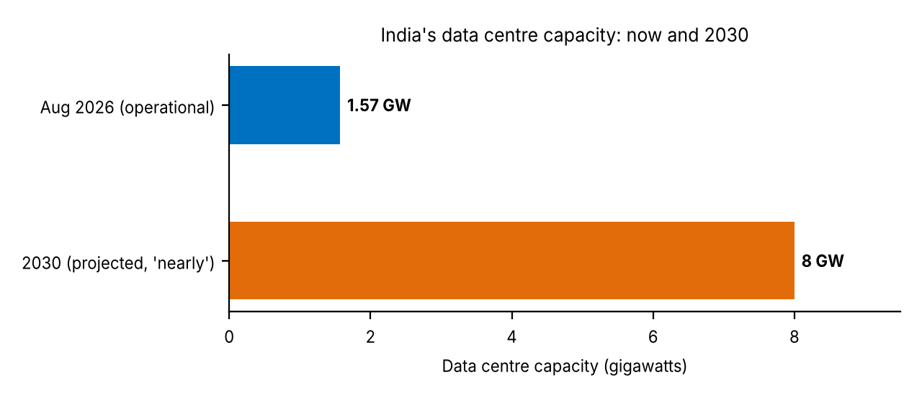
(SCIENCE AND TECHNOLOGY) (PIB) MeitY has highlighted the growth of India’s domestic cloud ecosystem as data use surges and the country seeks control over where sensitive data is stored and processed. India had 1,092.79 million internet subscribers in March 2026, and data centre capacity stood at 1.57 GW in August 2026.
Cloud Basics
| Service model | What the user gets |
| IaaS | Computing, storage and networking on demand |
| PaaS | A ready platform to build and run applications |
| SaaS | Finished software delivered over the web |
Deployment can be public (shared commercial cloud), private (one organisation) or hybrid. A CNCF 2026 report cited by PIB estimates 2.25 million cloud-native developers in India, with 44% using hybrid cloud.
Key Numbers (PIB)
| Indicator | Figure |
| Internet subscribers (March 2026) | 1,092.79 million |
| Average wireless data use | 25.51 GB per subscriber per month; 285,376 petabytes in FY 2025–26 |
| Data centre capacity | 1.57 GW (August 2026), projected near 8 GW by 2030 |
| Investment | About USD 70 billion under way, plus USD 90 billion announced |
| Empanelled cloud service providers | 30 as of September 2026 (including Jio, TCS, BSNL, AWS, Google, Microsoft) |
| IndiaAI Mission | ₹10,371.92 crore outlay; over 45,000 GPUs onboarded |
Why Domestic Cloud Matters
- Data sovereignty: keeps sensitive data under Indian jurisdiction, in line with the DPDP Act, 2023, which sets conditions on cross-border transfers (Data Localisation and Privacy Issues).
- Public service delivery: shared government cloud (MeghRaj) can scale for peak demand and keep backups across sites.
- AI and start-ups: affordable compute under IndiaAI supports local models (Artificial Intelligence).
Challenges and Way Ahead
- Vendor lock-in and weak portability: favour open standards and containerised (Kubernetes) deployments.
- Power and water demand of large data centres: pair them with renewable supply.
- Concentration in a few metros: build edge data centres in smaller cities.
- Third-party and supply-chain security: adopt a zero-trust approach.
The challenge is to grow data centres fast without trading away security, competition or sustainability (Digital Infrastructure in India).
📖 Read More: Digital Infrastructure in India • Data Localisation and Privacy Issues • Emerging Technologies
3. Green Hydrogen: 5.5 Lakh Tonnes of Offtake Deals
(ECONOMICS) (StratNews) India has secured long-term offtake commitments for about 5.55 lakh tonnes a year of green hydrogen equivalent by October 2026, across 23 contracts signed since the National Green Hydrogen Mission began, 18 of them in 2026. Over 70% of the volume is for export.
What Is an Offtake Agreement?
A long-term contract under which a buyer commits to purchase a set quantity of green hydrogen or its derivatives, such as green ammonia and green methanol. It gives producers assured demand and revenue, which lenders need before financing a plant.
Headline Numbers
| Item | Detail |
| Contracts | 23 since 2023; 18 in 2026 |
| Volume | About 5.55 lakh tonnes a year, roughly 11% of the 5 million tonne 2030 target |
| Export share | Over 70%; buyers include Japan, South Korea and Germany |
| Investment | Expected to exceed ₹90,000 crore |
| Domestic demand (SIGHT) | 6.7 lakh tonnes a year of green ammonia for 11 fertiliser plants |
Figures are attributed to the Ministry of New and Renewable Energy and were also shared by the Minister on 29 October.
Why It Matters
- Demand certainty de-risks the mission, which lists fertilisers, refining, steel, shipping and transport as target sectors (National Green Hydrogen Mission).
- Fertiliser plants that now make ammonia from natural gas can switch to green ammonia and cut import dependence.
- Exports position India as a low-cost supplier of clean fuels (Hydrogen Economy).
Cautions
- Contracts are commitments, not production: only a small part of mission capacity has been commissioned so far.
- Export-heavy volumes depend on foreign policy support and carbon rules in buyer markets.
- Prices, shipping and renewable power costs will decide whether projects reach financial close (Measures to Boost Renewable Energy).
📖 Read More: National Green Hydrogen Mission • Hydrogen Economy • Measures to Boost Renewable Energy
4. Mineral Exchanges: A Marketplace for Ores
(ECONOMICS) (TH) The Ministry of Mines has notified the Mineral Exchange Rules, 2026, and the Indian Bureau of Mines (IBM) has invited applications to set up exchanges for physical minerals. PTC India’s board has approved a subsidiary to bid. The aim is price transparency and a national benchmark for ores.
What Is a Mineral Exchange?
An electronic marketplace for delivery-based spot trading of physical minerals. This differs from commodity exchanges, which trade derivative contracts regulated by SEBI. Trade moves from one-to-many sales such as State auctions to a many-to-many platform.
| Feature | Detail |
| Legal basis | Section 18B of the MMDR Act, 1957, which lets the Centre promote mineral markets |
| Regulator | Indian Bureau of Mines; excludes coal and lignite (Part A) and atomic minerals (Part B) |
| Minerals | Iron ore, chromite, bauxite, limestone and manganese (alCircle report); more can be added later |
| Applicants | Companies limited by shares with net worth of at least ₹50 crore (alCircle) |
| Registration | Valid for 25 years; existing commodity platforms must register or stop |
Why India Needs It
- Price discovery: prices differ sharply across Odisha, Karnataka and Chhattisgarh, with no national benchmark.
- Small miners: a level field against large buyers.
- Transparency: assaying and origin tracing help curb illegal mining (Mining).
- Critical minerals: later phases could cover lithium, cobalt and rare earths (Critical Minerals).
- Benchmark role: comparable to the London Metal Exchange for base metals and the Dalian Commodity Exchange for iron ore.
Bottlenecks
- Warehouses, railway sidings and port handling for physical delivery; logistics costs around 13–14% of GDP.
- Building liquidity and preventing market manipulation by a few large players.
- Standardising grades (iron ore ranges from about 50% to 65% Fe) and building independent testing.
- Resistance from firms with long-term captive contracts, and avoiding duplicate compliance.
A phased rollout, strong regulation and logistics upgrades will decide whether exchanges deepen the market (Industrial Sector of Indian Economy).
📖 Read More: Mining • Critical Minerals in the Indian Context • Industrial Sector of Indian Economy
5. AI INSPIRED: Seed Grants for Space Start-ups
(SCIENCE AND TECHNOLOGY) (TOI) IN-SPACe has selected six private space-technology entities for seed grants of up to ₹1 crore each under its AI INSPIRED initiative, which backs artificial-intelligence solutions for space applications.
About IN-SPACe
An autonomous, single-window agency under the Department of Space, headquartered in Ahmedabad. It authorises and promotes private (non-government) space activity, opens ISRO facilities to industry and helps transfer technology (Commercial Space Economy).
The AI INSPIRED Programme
| Feature | Detail |
| Scheme | Run under the IN-SPACe Seed Fund Scheme |
| Grant | Up to ₹1 crore per selected entity; total outlay up to ₹6 crore for up to six projects |
| Eligible | Space start-ups and micro and small enterprises working on AI for space |
| Tracks | Edge Intelligence in Orbit; Space for Earth Intelligence; Smart Access to Space (YourStory) |
| Support | Help with proposals, mentorship and access to resources |
Why It Matters
- AI on board satellites can filter data before downlink and support autonomous operations.
- Small grants help young firms cross the early prototype gap (Evolution of India’s Space Programme).
- Growth of private players supports the national goal of a larger share of the global space economy (Aerospace Industry).
📖 Read More: Commercial Space Economy • Evolution of India’s Space Programme • Artificial Intelligence
6. Cheetah Cub KNG22: First Gunshot Death
(ENVIRONMENT) (NDTV) A 19-month-old India-born cheetah cub, KNG22, died on 27 October after being found shot outside Kuno National Park. It is the first reported death of a cheetah from gunfire since Project Cheetah began in 2022 and took cumulative deaths to 26.
What We Know
- KNG22 was a cub of the female cheetah Nirva and was found injured on 25 October in compartment 748 of the Morena Territorial Forest Division, outside Kuno’s protected core.
- Treated at a veterinary university in Jabalpur, it died on 27 October; five firearm pellets were removed. The assessment was a close-range shot.
- The Centre sent a high-level team and Madhya Pradesh formed a Special Task Force.
Project Cheetah in Numbers
| Item | Detail |
| Launched | 17 September 2022 |
| Imported | 29 cheetahs: 8 from Namibia (2022), 12 from South Africa (2023), 9 from Botswana (February 2026) |
| Deaths | 26 including KNG22; earlier causes were disease, injuries, accidents or unexplained |
| Population | About 58 before KNG22 died: 52 at Kuno, 4 at Gandhi Sagar, 2 at Veerangana Durgavati Tiger Reserve |
The Larger Problem
Cheetahs range widely and often leave the park, entering farms and villages where protection is weaker. Unlicensed guns and crop-protection weapons raise the risk (Big Cat Conservation in India).
Measures and Way Forward
- Radio-collar tracking, drone surveillance and the Cheetah Mitra village network.
- Wider landscape planning, including corridors to Gandhi Sagar and Veerangana Durgavati.
- Strict action against poaching under wildlife law, and incentives for community protection (National Parks in India).
📖 Read More: Big Cat Conservation in India • National Parks in India • Conservation of Major Indian Wildlife Species
7. Punah Bharan: Mapping Groundwater Recharge
(SCIENCE AND TECHNOLOGY) (PIB) The Union Jal Shakti Minister launched the Punah Bharan mobile app and web portal, developed by BISAG-N with the National Water Mission, to guide scientific planning of artificial groundwater recharge at village level.
What the Tool Does
- Identifies potential recharge zones within a 3 km radius of the user and suggests suitable structures for local conditions.
- The web portal offers village-level Artificial Recharge Structure (ARS) zonation maps, GIS tools and thematic layers.
- It combines rainfall, groundwater levels, groundwater yield, slope and drainage data.
Rainfall + water table + aquifer yield + slope + drainage ➜ Recharge zone map ➜ Choice of structure ➜ Village action plan
Typical recharge structures include check dams, percolation ponds, recharge shafts and injection wells; which one fits depends on terrain and aquifer (Water Conservation).
Why It Matters
- Moves recharge planning from ad hoc choices to data-driven siting.
- Helps Gram Panchayats and watershed committees prioritise sites, and can support works under schemes such as MGNREGA and Atal Bhujal Yojana (not detailed in the PIB release).
- Supports drought resilience in over-exploited and semi-arid areas.
The tool is only as good as local data and follow-through: maps need maintenance funding, community ownership and monitoring of results.
📖 Read More: Water Conservation • Indian Climate
8. Ganges Dolphin Recovery Named a UN Flagship
(ENVIRONMENT) (NIE) A UNEP report, Nature’s Comeback, lists India’s Ganges river dolphin recovery programme among 35 UN World Restoration Flagships, as the world reaches the midpoint of the UN Decade on Ecosystem Restoration (2021–2030).
About the Species
| Feature | Detail |
| Identity | Ganges river dolphin (Platanista gangetica), called susu; India’s National Aquatic Animal |
| Protection | Endangered on the IUCN Red List; Schedule I of the Wildlife (Protection) Act, 1972; CITES Appendix I |
| Habitat | Deep pools and confluences of the Ganga–Brahmaputra–Meghna and Karnaphuli–Sangu systems |
| Senses | Nearly blind; navigates by ultrasonic echolocation in turbid water |
| Role | An indicator of river health (Ganga River System) |
What the UNEP Report Found
- About 252 million hectares across 149 countries are being restored, creating over one million green jobs.
- The report was co-published by FAO, UNEP and the Convention on Biological Diversity secretariat.
- Target: under the Kunming-Montreal framework, at least 30% of degraded ecosystems should be under restoration by 2030.
India’s Programme
- A Comprehensive Action Plan for 2022–2047 guides long-term river dolphin conservation, linked to Project Dolphin.
- Riverside communities take part in monitoring, rescue and eco-tourism, creating livelihoods and reducing accidental net entanglement.
- It works alongside river rejuvenation efforts such as the Namami Gange Programme, including protected areas like the Vikramshila sanctuary (Namami Gange Programme).
Recognition is encouraging, but dolphins still face dams, pollution, sand mining and fishing nets (Conservation of Major Indian Wildlife Species).
📖 Read More: Conservation of Major Indian Wildlife Species • Ganga River System • Namami Gange Programme
9. UAE’s Order of Zayed II for an Indian Pilot
(INTERNATIONAL RELATIONS) (NDTV) UAE President Sheikh Mohamed bin Zayed Al Nahyan conferred the First Class Order of Zayed II on Indian pilot Captain Smit Machchhar and other Flydubai crew on 27 October, for protecting 174 passengers during a cockpit assault on a flight on 30 September.
The Incident
On a Flydubai Dubai–Tel Aviv flight on 30 September, an alleged assault took place in the cockpit. The aircraft landed in western Saudi Arabia, and all 174 passengers were reported safe.
About the Honour
| Feature | Detail |
| Order of Zayed II (First Class) | High UAE civilian decoration for foreign diplomats, officials and distinguished individuals |
| Order of Zayed | The UAE’s highest civilian honour, a separate and higher award; PM Narendra Modi received it in August 2019 (Order of Zayed) |
| Named after | Sheikh Zayed bin Sultan Al Nahyan, the UAE’s founding president |
Earlier Indian Recipients
- Navdeep Singh Suri, ambassador to the UAE from December 2016 to September 2019, honoured in September 2019.
- Sunjay Sudhir, ambassador from November 2021 to September 2025, honoured on 17 September 2025 for deepening the comprehensive strategic partnership.
Why It Matters
- India and the UAE are close partners in trade, energy and security; the UAE hosts a very large Indian community (India and UAE).
- Recognition for an Indian professional is a soft-power gain and reflects people-to-people ties (India and West Asia Policy).
📖 Read More: India and United Arab Emirates • India and West Asia Policy
10. The Yamuna: Course, Tributaries and Pollution
(GEOGRAPHY) (IT) Delhi is preparing a tourist cruise on the Yamuna ahead of Chhath Puja even as Delhi Pollution Control Committee data show severe water-quality decline downstream, setting off a political row.
Profile
| Feature | Detail |
| Source | Yamunotri Glacier, near the Banderpooch peaks, Uttarkashi, Uttarakhand, at about 6,387 m |
| Length and basin | About 1,376 km; basin about 3.66 lakh sq km |
| Mouth | Joins the Ganga at Triveni Sangam, Prayagraj |
| States | Uttarakhand, Himachal Pradesh, Haryana, Delhi and Uttar Pradesh; basin extends into Rajasthan and Madhya Pradesh |
Tributaries
Yamunotri ➜ Hathnikund ➜ Wazirabad ➜ Okhla ➜ Mathura ➜ Agra ➜ Prayagraj
| Bank | Main tributaries |
| Right | Tons (a major Himalayan tributary), Giri, Chambal, Sindh, Betwa, Ken |
| Left | Hindon, Hanuman Ganga |
Geographic Notes
- Palaeochannel evidence suggests the Yamuna once fed the Ghaggar–Hakra system before tectonic change diverted it east.
- Barrages at Dakpathar, Hathnikund, Wazirabad and Okhla divert most dry-season flow into canals, leaving little for the river downstream (Major Drainage Systems in India).
Pollution
- The Wazirabad–Okhla stretch in Delhi receives untreated sewage and industrial effluent through drains.
- High biochemical oxygen demand and faecal contamination produce toxic foam during low-flow months.
- Cleaning needs sewage treatment, environmental flows and drain control (Water Pollution Control Measures, Namami Gange Programme).
Delhi-NCR’s drinking water, Haryana and western Uttar Pradesh’s irrigation and many pilgrimage centres depend on the river. Cruises and rituals add to the case for real water-quality improvement first.
📖 Read More: Ganga River System • Major Drainage Systems in India • Water Pollution Control Measures
11. Aditya-L1 and Proba-3 Study Solar Eruptions Together
(SCIENCE AND TECHNOLOGY) (TH) Scientists at the Indian Institute of Astrophysics have, for the first time, combined data from India’s Aditya-L1 and Europe’s Proba-3 to study two coronal mass ejections (CMEs) close to the Sun, giving a cross-checked view of how they form.
The Two Instruments
| Spacecraft | Instrument | Contribution |
| Aditya-L1 (ISRO) | VELC coronagraph | Spectroscopy in the green coronal line; CME gas at about two million degrees, giving density and thermal energy |
| Proba-3 (ESA) | ASPIICS coronagraph | Sharp images in white light and the green line; shape, motion and mass |
Aditya-L1 is India’s first dedicated solar mission, launched on PSLV-C57 in September 2023 and placed near the L1 Lagrange point so it can watch the Sun without eclipses (The Sun: Structure and Atmosphere). Proba-3 is a pair of satellites flying in precise formation to create an artificial solar eclipse.
What They Found
- Between July and December 2025, only two CMEs, on 14 and 16 September, were recorded by both instruments at once.
- The 14 September CME was fast (about 645 km/s); the 16 September CME was slow (about 145 km/s).
- Estimates of mass and thermal energy from both instruments agreed well, despite different methods.
- In the 14 September event, thermal energy was only about 1% of the total; in the 16 September event it grew until it matched kinetic energy.
Why CMEs Matter
A CME is a large eruption of solar plasma and magnetic field. If aimed at Earth it can disturb the magnetosphere, harm satellites and power grids, and cause auroras. Better early-corona data improve space-weather forecasts (Indian Space Exploration Missions).
Note: the underlying report is from 16 October; the Aditya-L1 coronal Doppler work covered on 21 October is a separate study.
📖 Read More: The Sun: Structure and Atmosphere • Indian Space Exploration Missions • Orbits in Space Technology
12. Operation Trident: NCB Targets Narco-Finance
(INTERNAL SECURITY) (PIB) The Narcotics Control Bureau (NCB), with Mizoram Police and the Enforcement Directorate, ran Operation Trident on 23 October: 38 teams hit 38 locations across Assam, Mizoram and Manipur to break a transnational drug network by targeting its money as well as its drugs.
Operation Snapshot (PIB)
| Item | Detail |
| Teams and sites | 38 teams at 38 locations in Assam, Mizoram and Manipur, including Aizawl, Champhai and Zokhawthar |
| Financial trail | ₹100 crore in hawala transactions revealed; 1,424 bank accounts frozen; property worth ₹17.82 crore attached |
| Seized | 500 detonators and ₹12 lakh in cash |
| Arrests | 18 people |
| Route | Across India, Myanmar and Bangladesh via the ‘Death Triangle Corridor’ |
Policy Shift
The operation reflects a move from seizure-centric enforcement to a network-centric, financial-disruption approach under the Vision Document on Narcotics Control 2026–2029, which aims to eliminate drug networks by 31 December 2029 (Organised Crime).
Intelligence fusion ➜ Simultaneous multi-site action ➜ Freeze accounts and attach assets ➜ Dismantle supply chain
Institutions and Law
- NCB: the central coordinating agency for drug law enforcement, constituted in 1986 under the NDPS Act, 1985 and working under the Ministry of Home Affairs.
- ED: investigates money laundering and foreign-exchange violations; it works under the Department of Revenue (Money Laundering as an Internal Security Threat).
- Article 47 directs the State to prohibit intoxicating drugs harmful to health except for medicinal use.
- India is party to the Single Convention on Narcotic Drugs (1961, as amended in 1972) and later UN drug conventions.
Why It Matters
- The border region touches the Golden Triangle and North-East insurgency landscape, where narco-finance can fund armed groups (The North-East Insurgency Landscape, India and Myanmar).
- Following the money is more durable than seizing consignments (Major Illicit Economies).
📖 Read More: Organised Crime • Internal Security • Major Illicit Economies
13. Karela Lake Records 4,600 Years of Monsoon
(GEOGRAPHY) (DD) Scientists at the Birbal Sahni Institute of Palaeosciences used sediments from Karela Lake, an oxbow lake near Hulas Khera in Lucknow district, to rebuild about 4,600 years of monsoon, vegetation and farming history in the Central Ganga Plain.
How the Study Was Done
- Sediment cores from the lake were dated with accelerator mass spectrometry radiocarbon.
- Carbon and nitrogen isotopes, grain size, sediment modelling and pollen analysis recorded changes in climate and plants.
- Results were published in the Journal of Asian Earth Sciences.
Findings
| Climate episode | Meaning |
| 4.2-thousand-year event | A widely reported arid phase in the Late Holocene |
| Roman Warm Period | A warmer, generally more favourable phase |
| Little Ice Age | A cooler phase; the study links moisture changes to westerly winds and flooding |
- Monsoon shifts changed lake levels, sediment flow, vegetation and microbial activity.
- Changes in monsoon strength matched shifts between C3 and C4 plant communities.
- Evidence points to manure-based farming alongside herbivore records.
How an Oxbow Lake Forms
River meander ➜ Neck narrows by erosion and deposition ➜ Flood cuts through neck ➜ Loop sealed off ➜ Oxbow lake ➜ Slowly fills to a marsh
Small oxbow lakes trap sediment in layers and act as natural archives of past climate. Examples include Kanwar and Gogabeel lakes in Bihar (Indian Climate).
📖 Read More: Indian Climate • Impact of Global Warming
14. India–Uzbekistan Counter-Terrorism Dialogue
(INTERNATIONAL RELATIONS) (AIR) India and Uzbekistan held the tenth meeting of their Joint Working Group on Counter Terrorism in New Delhi on 22 October and agreed to deepen cooperation against terrorism and regional security threats.
The Meeting
- Co-chaired by the MEA’s Additional Secretary (Counter Terrorism), Dr Suhel Ajaz Khan, and a senior official of Uzbekistan’s foreign ministry.
- Topics included terrorist threats, extremism and radicalisation, terror financing, misuse of technology and links between organised crime and terrorism.
- They agreed to share information, build capacity, exchange best practices and keep coordinating at the UN, SCO-RATS and the Eurasian Group (EAG).
Wider Relationship
- Relations were raised to a Comprehensive Strategic Partnership in 2026; a long-term arrangement for uranium supply is agreed in principle.
- Trade is about USD 1 billion, with a target of USD 5 billion by 2030.
- A bilateral investment treaty signed in 2024 entered into force in 2025.
- Joint exercise: DUSTLIK.
Why It Matters
- Central Asia is India’s ‘extended neighbourhood’; stability there matters because of Afghanistan (India and Central Asia).
- Uzbekistan is a Shanghai Cooperation Organisation member, and SCO-RATS is its counter-terror body (Shanghai Cooperation Organisation).
- Shared concern: cross-border terrorism, radicalisation and terror finance (Countering Terrorism in India).
📖 Read More: India and Uzbekistan • India and Central Asia • Countering Terrorism in India