
UPSC CURRENT AFFAIRS — 31 OCTOBER 2026
1. Collegium Debate Returns: Transparency Under Scrutiny
(POLITY AND GOVERNANCE) (TH) Former Supreme Court judge Justice Sanjay Kishan Kaul has raised concerns over alleged informal consultations between former CJI D.Y. Chandrachud and the Union Government on judicial appointments. The remarks have revived the debate on the collegium system, its transparency and judicial independence.
The collegium is a judge-led mechanism to appoint and transfer judges of the Supreme Court and High Courts. The Constitution does not mention it; it grew out of judicial interpretation of the word “consultation”. The Supreme Court collegium has the CJI and four senior-most judges.
Constitutional provisions
- Article 124(2): Supreme Court judges are appointed by the President after consulting such SC and High Court judges as deemed necessary; the CJI is always consulted (except for the CJI’s own appointment).
- Article 217(1): High Court judges are appointed by the President after consulting the CJI, the Governor and the High Court’s Chief Justice.
- Framers’ intent: An executive-led process balanced by mandatory judicial consultation (see Supreme Court).
How the collegium evolved: the Judges Cases
| Case | Year | What the Court held |
| First Judges Case (S.P. Gupta v. Union of India) | 1981 | “Consultation” is not “concurrence”, so the executive had the final word. |
| Second Judges Case (Supreme Court Advocates-on-Record Association v. Union of India) | 1993 | “Consultation” means concurrence; collegium created and judicial primacy established. See 1993 case. |
| Third Judges Case (Presidential Reference under Article 143) | 1998 | Collegium expanded to the CJI and four senior-most judges for the Supreme Court; Memorandum of Procedure (MoP) framed. |
| Fourth Judges Case | 2015 | The 99th Constitutional Amendment and the National Judicial Appointments Commission (six members) struck down as violating the Basic Structure. See 2015 case. |
Appointment pipeline
Collegium recommends ➜ Government background checks ➜ May return once with reservations ➜ Unanimous reiteration binds the executive ➜ President appoints
Criticisms
- Opacity: Deliberations are closed-door, with no published minutes or objective criteria.
- Nepotism charges: A self-appointing structure invites allegations of in-group bias.
- Judicial monopoly: The judiciary controls its own appointments, weakening checks and balances.
- MoP deadlock: The revised MoP promised after 2015 is still unfinalised over vetting and screening disagreements.
- Executive delay: Files can sit unnotified because the executive cannot formally reject a reiterated name.
Global comparison
| Country | Appointing authority | Screening or nominating body |
| India | President | Collegium of senior judges, closed and judge-only |
| United States | President | Presidential nomination; public Senate Judiciary Committee hearings and confirmation |
| United Kingdom | Crown on the Prime Minister’s advice | Independent Judicial Appointments Commission with judges, lawyers and lay members |
| South Africa | President | Judicial Service Commission with judges, lawmakers, lawyers and the executive |
Way forward
- Finalise the MoP with public criteria, timelines for the government and a permanent secretariat.
- Publish vetting standards, such as judgments reported, tenure benchmarks and conflict-of-interest declarations.
- Consider a broader commission on UK or South African lines, but keep a decisive judicial voice to protect independence.
📖 Read More: Supreme Court Advocates-on-Record case (1993) • Supreme Court Advocates-on-Record case (2015) • Judicial Review
2. Shintaphu Lake Outburst Alarms Downstream India
(GEOGRAPHY) (IE) A glacial lake outburst flood (GLOF) at Shintaphu Lake in north-western Bhutan sent flash floods down the Mo Chhu and Sankosh river systems. The Central Water Commission and district administrations in border districts of West Bengal and Assam issued flash-flood warnings.
A GLOF is the sudden release of water from a lake held back by a loose natural dam of moraine, ice or bedrock. In Bhutan, Sintaphu Tsho sits in the Mo Chu catchment, north-east of Gasa, and is one of the lakes watched as a hazard.
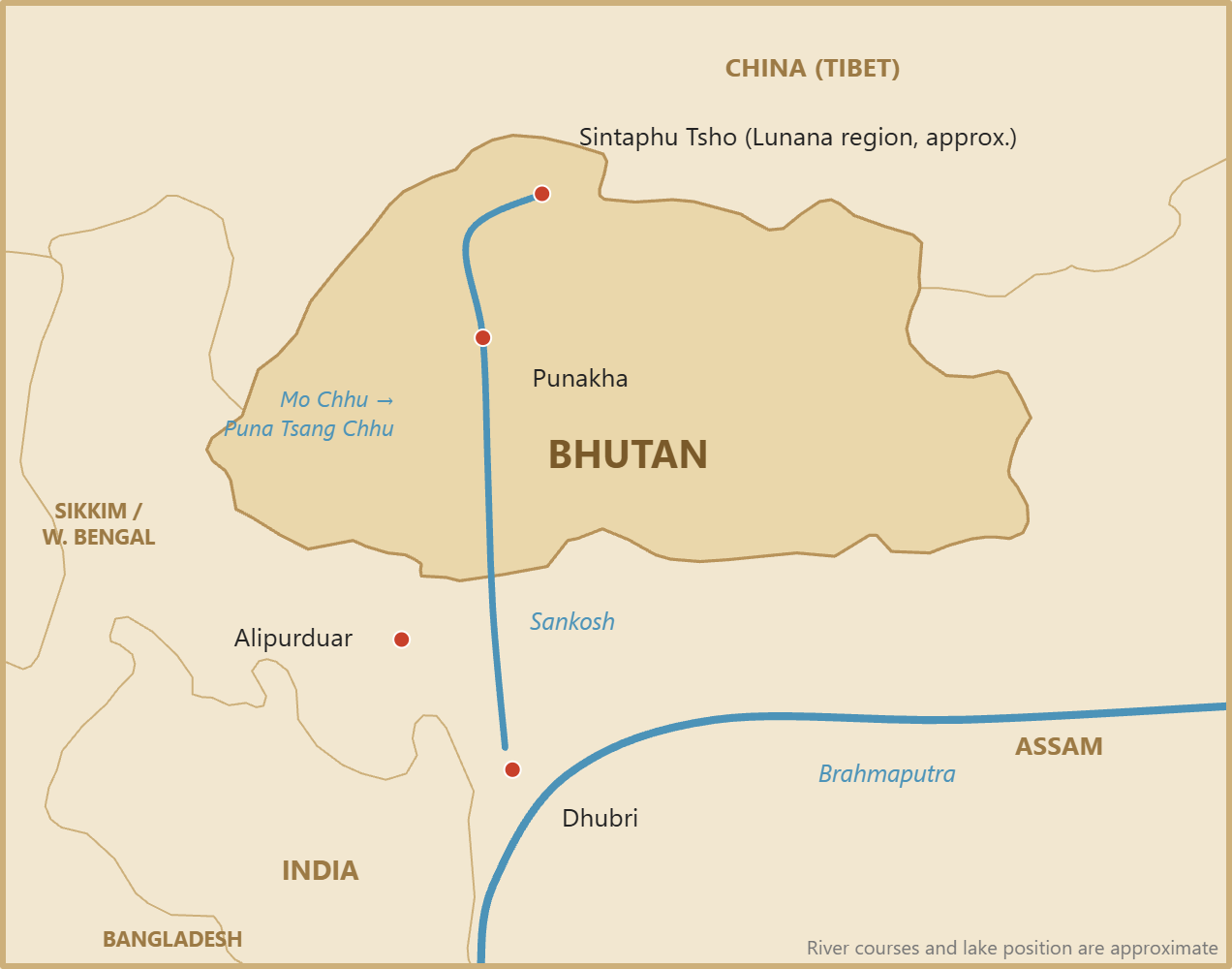
How a GLOF builds up
Warming ➜ Glacier retreat ➜ Lake grows behind moraine ➜ Trigger event ➜ Dam breach ➜ Flash flood downstream
Triggers
- Avalanche or calving: Ice or rock falling into the lake creates displacement waves that overtop the dam.
- Permafrost thaw: Melting ice cores weaken moraine dams from within.
- Cloudbursts: Intense rain raises lake levels and saturates the dam.
- Earthquakes: Shaking destabilises loose moraine.
Scale of the risk
- Bhutan’s national assessment lists 17 potentially dangerous glacial lakes, 11 of them at the head of the Punatsangchhu basin.
- Downstream flood travel times to the Assam and West Bengal plains are only a few hours, leaving little time to warn people.
Impacts and examples
| Impact | Illustration |
| Infrastructure and energy assets destroyed | Bhutan’s Punakha solar irrigation lifting system and the Gasa Tshachu hot springs were reported washed away. |
| Loss of life and displacement | South Lhonak Lake outburst, Sikkim (2023); Chorabari Lake breach during the 2013 Uttarakhand floods. |
| Riverbed aggradation and flooding | Silt and boulders raise riverbeds, worsening floods in Dhubri (Assam) and Alipurduar and Jalpaiguri (West Bengal). |
| Farmland and fisheries damage | Thick sterile sand layers choke fields and river habitats. |
Managing GLOF risk (NDMA approach)
- Map and monitor lakes with satellite SAR imagery and drones.
- Engineer the lake: Controlled draining by siphoning, pumping or channels through the moraine.
- Early warning systems: Water-level sensors, rain gauges and sirens linked by satellite.
- Zoning: Keep settlements and hydropower out of high-risk zones; audit projects.
- Community preparedness: Train village volunteers with NDRF and SDRF support (see NDMA).
Way forward
Glacial lakes ignore borders, so India and Bhutan need real-time transboundary data sharing and automated warnings along the Brahmaputra basin. See India and Bhutan and Brahmaputra River System.
📖 Read More: Floods: A Natural Hazard • Impact of Global Warming • Legal and Institutional Framework of Disaster Management
3. Surangam: Kerala Revives Its Tunnel Wells
(GEOGRAPHY) (TH) Eight grama panchayats in Kerala’s Kasaragod district are preparing to restore traditional Surangam underground water tunnels to strengthen groundwater conservation, rainwater harvesting and drought resilience.
A surangam (also called suranga or thurangam) is a horizontal tunnel dug into a laterite hill until it strikes seeping groundwater. Water flows out by gravity into a small reservoir. It works like the qanats of Iran, with no pump or electricity.
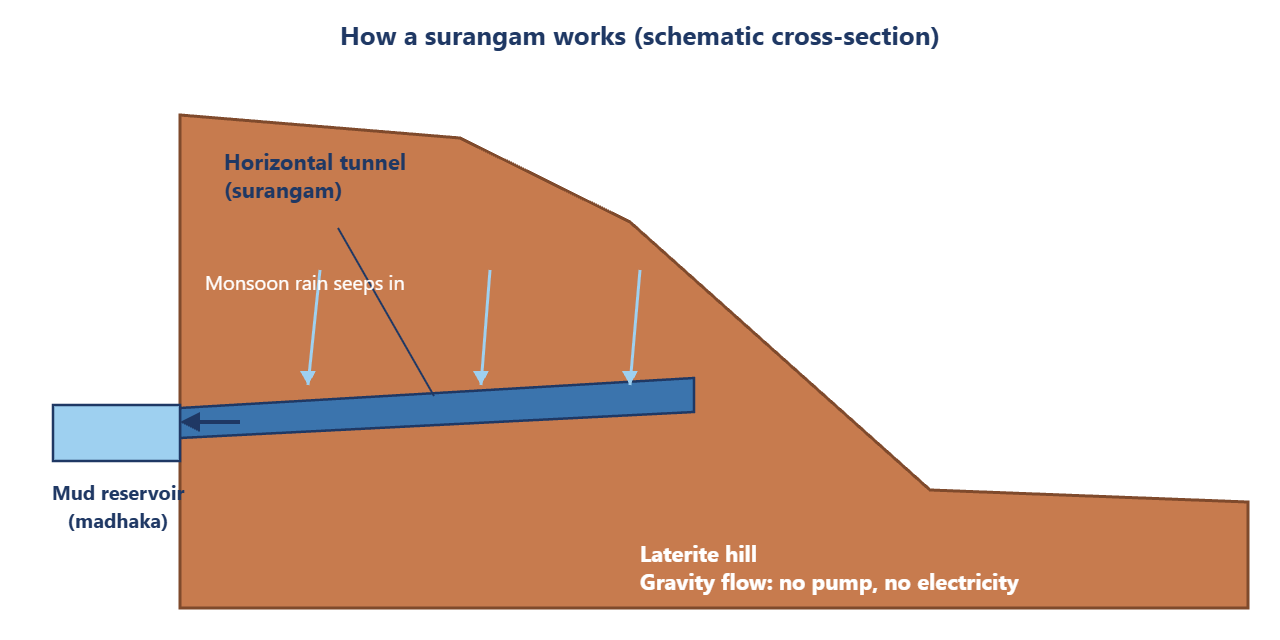
Monsoon rain infiltrates laterite ➜ Water seeps into tunnel ➜ Gravity carries it out ➜ Mud reservoir stores it ➜ Dry-season irrigation and drinking use
Types of tunnel wells
| Type | Design |
| Type 1 | Single tunnel, common on homogeneous laterite slopes |
| Type 2 | Single tunnel with branches and air shafts, suited to heterogeneous laterite |
| Type 3 | Tunnel system ending in a vertical well that stores water |
| Type 4 | Tunnel system ending in a well with a horizontal outlet |
Why revive them
- Low energy and low cost: Gravity flow replaces pumping and costly borewells.
- Climate adaptation: Stores monsoon recharge for dry spells in a district prone to summer shortages.
- Local knowledge: Community management keeps traditional skills alive and creates rural jobs.
Challenges
- Declining yield: A Current Science review found that about half of Kasaragod’s tunnel wells are now dry.
- Monsoon wastage: Open single tunnels can drain the aquifer in the rains; fitting shutter gates at the mouth reduces this.
- Skills shortage: Few young people take up tunnel digging.
This links geography with governance: restoration is led by local bodies, an example of decentralised water management. See Laterite soils.
📖 Read More: Water Conservation • Laterite–Lateritic Soils
4. Sports Values Reach Every Classroom
(SOCIETY) (PIB) The Ministry of Youth Affairs and Sports, Ministry of Education and UNESCO signed an MoU on 28 October 2026 at NADA India’s Clean Sport Conclave to introduce the Sports Values in Every Classroom Toolkit. It promotes integrity, fairness and respect among schoolchildren.
The toolkit began as a 2019 UNESCO guide for 8–12-year-old students. Its video modules will now be available in 13 Indian languages, and the effort supports the goals of Khelo Bharat Niti 2025.
The three core values
| Value | What a child practises | Link to wider life |
| Respect | Accepting rules, referees and opponents | Civility and tolerance of difference |
| Integrity | Playing clean, refusing shortcuts like doping | Honesty in studies and public life |
| Fairness | Equal chances and honest competition | Equity and non-discrimination |
Why it matters
- Early ethics: Values taught young shape adult conduct and a credible sporting culture.
- Bridges education and sport: Treats sport as part of learning, not a distraction from it.
- Federal reach: Two Union ministries and an international body align classroom and field.
- Exam relevance: GS II (education, institutions), GS IV (integrity, fairness) and Essay.
📖 Read More: Governance of Sports in India
5. National Board for Gig and Unorganised Workers
(SOCIAL JUSTICE) (PIB) The Ministry of Labour and Employment notified the constitution of the National Social Security Board for Unorganised Workers and Gig & Platform Workers under the Code on Social Security, 2020.
The Code came into force on 21 November 2025 and, for the first time, defines gig workers and platform workers. The Board is its main advisory and monitoring body for their welfare. See New Labour Codes.
Legal basis and structure
| Aspect | Detail |
| Statutory basis | Section 6 constitutes the National Social Security Board; Section 114(6) makes it the Board for gig and platform workers |
| Chairperson | Union Minister for Labour and Employment |
| Vice-Chairperson | Secretary, Ministry of Labour and Employment |
| Members | Central and State nominees, with representatives of workers, employers and, for gig work, aggregators |
| Term of the Board | Three years |
Functions
- Recommend schemes for life, disability, accident, health, maternity and old-age cover.
- Advise the Centre on implementing the Code.
- Monitor schemes run by the Central Government for informal and platform workers.
- Review registration records, including linkage with the e-Shram portal.
Scale and challenges
- The ministry puts the gig and platform workforce at about one crore, possibly 2.5 crore by the decade’s end.
- No employee status: The Code recognises these workers but does not make them “employees”, so minimum wage and collective bargaining remain open questions.
- Funding and data: Schemes depend on the Social Security Fund and on platforms sharing worker data.
📖 Read More: New Labour Codes • Unemployment • Labour Ministry Schemes
6. Youth Unrest in the Age of Neoliberalism
(ECONOMICS) (TH) Youth-led protests are spreading from G7 countries like France and Spain to India, Sri Lanka and Bangladesh. Analysts read them as a reaction to neoliberal capitalism, which has weakened public welfare, raised living costs and deepened youth unemployment.
Neoliberalism is the post-1970s ideology of free markets, deregulation, privatisation and a smaller welfare state. In India, its local expression began with the 1991 LPG reforms.
What the young are angry about
| Concern | How it shows up |
| Unemployment | Youth make up about 83% of India’s unemployed (India Employment Report 2024), against Directive Principle Article 41 on the right to work |
| Commodified education | High fees, student debt and “credential inflation” |
| Casual work | Contract and gig jobs without security; the Code on Social Security does not make gig workers employees |
| Gendered precarity | Women push into unpaid care work or the weakest gig tiers |
| AI and automation | Entry-level white-collar jobs shrinking |
| Climate injustice | A child born in 2020 faces far more heatwaves and floods than someone born in 1960 |
| Asset inflation | Housing out of reach; wealth concentrates despite Articles 38(2) and 39(b)–(c) |
On livelihood, the Supreme Court read the right to livelihood into Article 21 in Olga Tellis v. Bombay Municipal Corporation (1985).
Then and now
| Feature | 1968-era protests | Today’s protests |
| Demand | Cultural and social freedom | Economic protection and jobs |
| Base | Unionised industrial workers | The precariat: indebted graduates and gig workers |
| Leadership | Charismatic leaders, vanguard unions | Leaderless, social-media networks |
| Mood | Utopian optimism | Eco-anxiety and a “polycrisis” outlook |
Implications
- Economy: IMF research links major unrest to GDP about 1% below baseline after six quarters.
- Politics: Polarisation and openings for populist or extremist mobilisation.
- Trust: Eroding faith in institutions; yet peaceful mobilisation can also renew democracy.
Way forward
- Protect gig and platform workers with clearer employer–worker definitions and minimum protections.
- Universal basic services: Expand Ayushman Bharat and PMAY toward universal entitlements.
- Skills for the future: Vocational training under NEP 2020, FutureSkills Prime and PMKVY 4.0.
- Just transition: Green jobs linked to the green hydrogen mission and the International Solar Alliance.
- Progressive taxation to fund youth welfare and the energy transition.
📖 Read More: LPG Reforms • Unemployment • Inequality • Concept and Nature of DPSPs • Effect of Globalization on Indian Society
7. India Races Past Japan in Automobiles
(ECONOMICS) (AIR) India’s automobile industry, valued at about ₹22 lakh crore, has overtaken Japan to become the world’s third-largest automobile market by new-vehicle sales, behind China and the United States, according to Union Minister Nitin Gadkari.
Note the yardstick: the rank is by sales, and the ₹22 lakh crore figure is the minister’s estimate of industry value. The claim is also not new: Gadkari cited the same rank and value in January 2025.
| Indicator | Figure reported |
| Industry value | About ₹22 lakh crore, up from ₹14 lakh crore |
| New vehicle sales, 2025 | About 55.18 lakh units for India against 45.66 lakh for Japan (OICA data as reported) |
| Revenue to governments | About ₹4.5 lakh crore a year |
| Employment | About 4.5 crore jobs |
| Exports, FY 2025–26 | Up about 24% to over 67 lakh units |
Why it matters
- Manufacturing depth: Supports ancillary industry, jobs and exports.
- Infrastructure link: Better highways cut travel time and logistics costs.
- Energy transition: Cleaner fuels and EVs can reduce oil import dependence.
📖 Read More: Industrial Sector of the Indian Economy • New Industrial Policy 1991
8. Lagarde’s Early Exit Unsettles the ECB
(ECONOMICS) (DD) ECB President Christine Lagarde has reportedly announced an early resignation, citing concerns over keeping the institution neutral on major world issues. Her eight-year term was due to end in October 2027.
Early departure matters because the ECB’s credibility rests on independence from politics. Press reports earlier in 2026 had linked an early exit to the French presidential election due in April 2027, though the ECB then said no decision had been made.
About the ECB
| Feature | Detail |
| Headquarters | Frankfurt am Main, Germany |
| Established | 1 June 1998; the euro launched as an accounting currency on 1 January 1999 |
| Institutional status | One of the EU’s institutions under the Lisbon Treaty (2009) |
| Banking supervision | The Single Supervisory Mechanism from 2014 for significant banks |
| Euro area | 21 EU states use the euro (Bulgaria joined on 1 January 2026) |
| Primary goal | Price stability; symmetric 2% inflation target over the medium term |
Key functions
- Monetary policy: Sets key interest rates and manages liquidity for the euro area.
- Currency issue: Authorises euro banknotes.
- Reserves and FX operations: Manages the euro area’s official reserves (compare India’s forex reserves).
- Supervision and payments: Oversees large banks and payment systems such as TARGET.
For India, ECB policy affects global liquidity, the euro–rupee rate and trade with Europe. See India and Europe.
📖 Read More: Foreign Exchange Reserves • India and Europe
9. NVS-03 Launch Revives NavIC
(SCIENCE AND TECHNOLOGY) (TH) ISRO launched the 2,250 kg navigation satellite NVS-03 on GSLV-F18 from the Satish Dhawan Space Centre, Sriharikota, on the night of 30 October 2026, to restore NavIC coverage and accuracy. (Follow-up to the pre-launch note of 24 October.)
GSLV-F18 is the 20th flight of the GSLV and places the satellite in a Geosynchronous Transfer Orbit; further manoeuvres and commissioning must follow before services improve. See GSLV.
| Feature | Why it matters |
| Indigenous rubidium atomic clock | Precise timing, vital after clock failures in older satellites |
| Civil L1 signal (1575.42 MHz) | Easier use in ordinary GPS-capable phones and chips |
| Standard and Restricted services | Open civilian service plus encrypted service for defence users |
| 12-year design life | Longer than the first-generation satellites |
- Coverage: India and about 1,500 km beyond its borders.
- Strategic value: Reduces dependence on foreign navigation systems (see satellite navigation systems of India).
📖 Read More: Satellite Systems and Applications • ISRO’s Launch Vehicles
10. Rubin Spots Dwarf Planet Candidate 2026 ED138
(SCIENCE AND TECHNOLOGY) (TH BL) Astronomers using the Vera C. Rubin Observatory in Chile have found 2026 ED138, an icy object beyond Pluto that could qualify as a dwarf planet. The observatory is a joint initiative of the US National Science Foundation and Department of Energy.
The object is a candidate, not a confirmed dwarf planet. Its size, estimated at 600–1,500 km, depends on how reflective its surface is; infrared observations are needed to settle it.
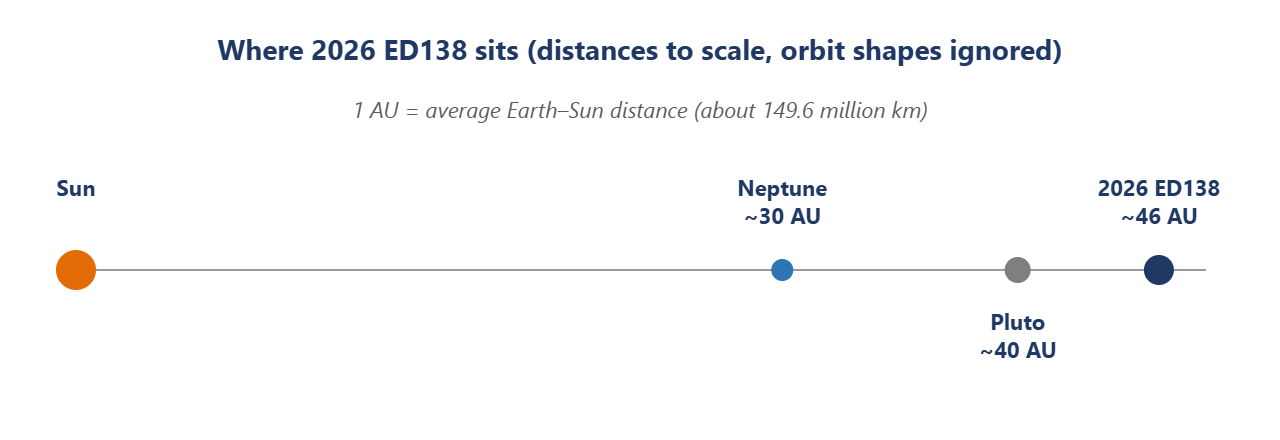
- Orbit: A trans-Neptunian object about 46 AU from the Sun, inclined about 25°, a “hot classical” orbit.
- Survey power: The Legacy Survey of Space and Time repeatedly scans the southern sky for about 10 years.
What makes a dwarf planet (IAU)
- Orbits the Sun and is not a moon.
- Has enough mass to be nearly round.
- Has not cleared its orbital neighbourhood.
- Recognised dwarf planets: Ceres, Pluto, Haumea, Makemake and Eris.
📖 Read More: Current Astronomical Advances • Solar, Lunar and Planetary Exploration
11. Homi Bhabha: Architect of Nuclear India
(SCIENCE AND TECHNOLOGY) (DD) 30 October 2026 marked the 117th birth anniversary of Dr Homi Jehangir Bhabha, revered as the Father of the Indian Nuclear Programme.
Born in Bombay in 1909, Bhabha trained at Cambridge and earned his doctorate in 1935. His physics gave us Bhabha scattering and, with Walter Heitler (1937), the cascade theory of cosmic-ray showers. See Homi J. Bhabha.
Institution-building timeline
1945: TIFR ➜ 1948: Atomic Energy Commission ➜ 1954: DAE and Trombay centre ➜ 1956: Apsara reactor ➜ 1967: renamed BARC
| Institution | Role |
| Tata Institute of Fundamental Research (1945) | Basic research hub founded with Dorabji Tata Trust support |
| Atomic Energy Commission (1948) | Policy body; Bhabha was its first chairman |
| Department of Atomic Energy (1954) | Executive department; Bhabha its first Secretary |
| Bhabha Atomic Research Centre | Began as the Atomic Energy Establishment, Trombay (1954); renamed in 1967 |
| Apsara (1956) | Asia’s first research reactor, at Trombay |
Three-stage nuclear programme
| Stage | Reactors and fuel | Aim |
| Stage 1 | Pressurised Heavy Water Reactors on natural uranium | Generate power and plutonium |
| Stage 2 | Fast Breeder Reactors using plutonium | Breed fuel and build up fissile material |
| Stage 3 | Advanced Heavy Water Reactors using thorium | Use India’s large thorium reserves for long-term self-reliance |
Bhabha also presided over the first UN conference on the peaceful uses of atomic energy at Geneva in 1955. See India’s three-stage nuclear power programme.
📖 Read More: Nuclear Energy in India • India’s Nuclear Foreign Policy
12. ADMM-Plus: India Offers Counter-Terror Expertise
(INTERNATIONAL RELATIONS) (TH BL) Defence Minister Rajnath Singh, addressing the 13th ASEAN Defence Ministers’ Meeting-Plus (ADMM-Plus) in Cebu, Philippines, offered to share India’s counter-terrorism expertise with ASEAN members and dialogue partners. The Philippines chairs ADMM-Plus in 2026.
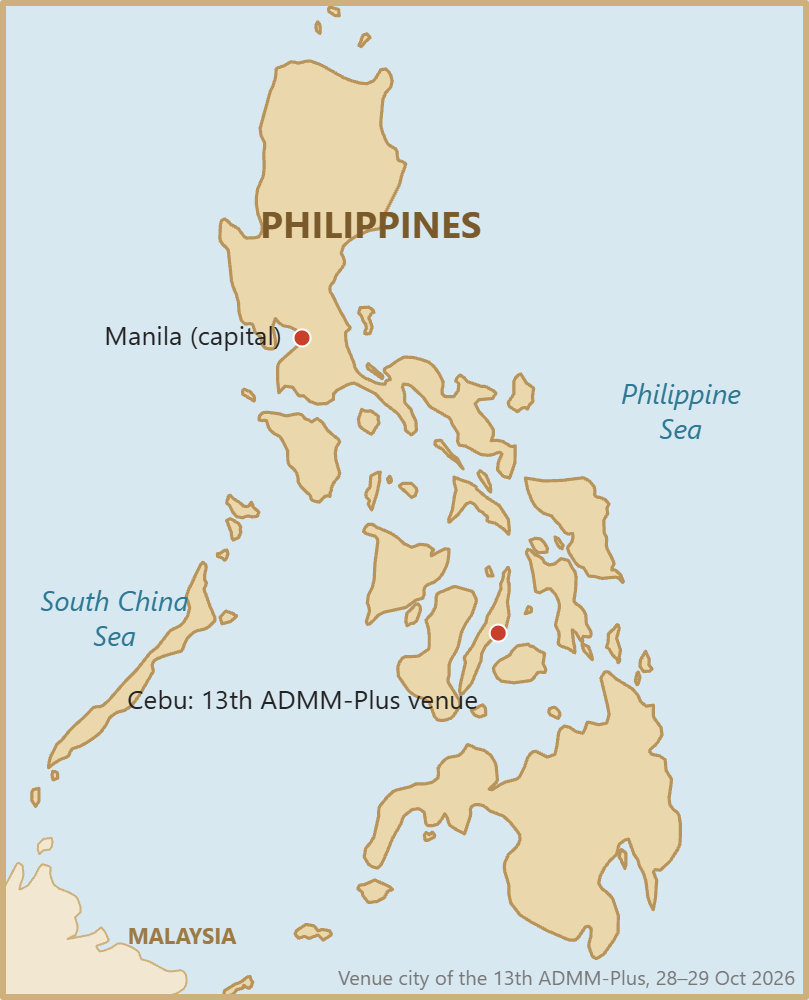
What India proposed
- Counter-terrorism: Joint exercises, capacity building and intelligence sharing; Operation Sindoor cited as an example of India’s approach to cross-border terrorism.
- Maritime security: Freedom of navigation under UNCLOS; 2026 is the ASEAN–India Year of Maritime Cooperation, with the second ASEAN–India Maritime Exercise.
- Defence Youth Bridge: A people-to-people and innovation link for young people.
- Indo-Pacific vision: Secure, stable and rules-based.
About ADMM-Plus
| Feature | Detail |
| Members | ASEAN states plus eight dialogue partners: Australia, China, India, Japan, New Zealand, Republic of Korea, Russia and the US |
| Origin | First held in Hanoi in 2010; annual since 2017 |
| Experts’ Working Groups | Maritime security, counter-terrorism, humanitarian assistance and disaster relief, peacekeeping, military medicine, humanitarian mine action, cyber security |
| India’s role | Co-chairs the counter-terrorism group with Malaysia for 2024–2027 |
📖 Read More: ASEAN • Countering Terrorism in India • India’s Foreign Policy and Terrorism
13. Venezuela on the Map: A 2027 Election Push
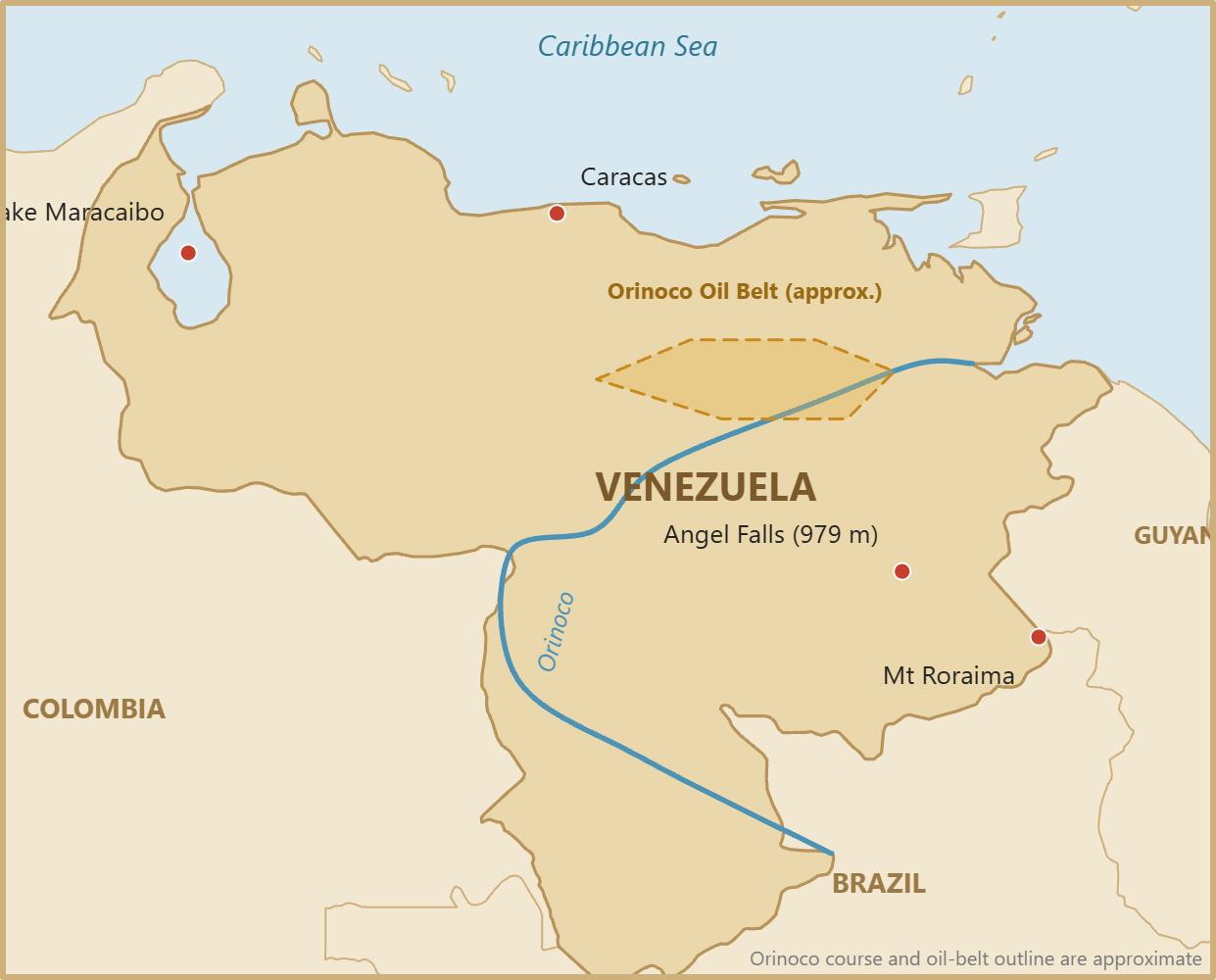
(INTERNATIONAL RELATIONS) (TP) Venezuelan opposition leader María Corina Machado said in Caracas that the United States has proposed holding presidential elections in 2027, following the January 2026 capture of Nicolás Maduro by US forces.
Political background
| When | Development |
| January 2026 | US forces capture President Nicolás Maduro |
| Since then | Interim President Delcy Rodríguez leads the government; no election date announced |
| October 2026 | Machado, 2025 Nobel Peace Prize laureate, calls for polls by July 2027 |
| Now | Reported US proposal of 2027 polls; timing and conditions still contested |
Why Venezuela matters
- Oil: Holds the world’s largest proven crude reserves, mainly in the Orinoco Belt and the Lake Maracaibo basin.
- Geography: On the Caribbean coast; neighbours Colombia, Brazil and Guyana; home to Angel Falls (979 m), the world’s highest uninterrupted waterfall.
- India link: Indian refiners buy Venezuelan heavy crude when sanctions allow.
📖 Read More: India and Venezuela Relations • US Domination in Venezuela • India and Latin America
14. Sardar Patel and National Unity Day
(HISTORY) (ETV) On 31 October 2026, India marked the 151st birth anniversary of Sardar Vallabhbhai Patel as Rashtriya Ekta Diwas (National Unity Day), with national tributes at the Statue of Unity, Ekta Nagar, Gujarat.
Patel, the “Iron Man of India”, was independent India’s first Deputy Prime Minister and Home Minister. He steered the political integration of over 560 princely states. See National Unity Day.
Milestones
| Year | Event |
| 1875 | Born at Nadiad, Gujarat |
| 1918 | Kheda Satyagraha: peasants resist revenue collection after crop failure |
| 1923 | Nagpur Flag Satyagraha |
| 1928 | Bardoli Satyagraha against a land-revenue hike; earns the title “Sardar”. See Bardoli Satyagraha |
| 1931 | Presides over the Karachi session of the Congress (Fundamental Rights resolution) |
| 1942–45 | Quit India Movement; imprisoned at Ahmednagar Fort |
| 1947–50 | Integration of princely states, including Junagadh and Hyderabad (Operation Polo) |
| 1950 | Passes away on 15 December; Bharat Ratna awarded posthumously in 1991 |
Lasting legacy
- Territorial unity: Instruments of Accession and firm diplomacy built a single Union (see National Integration).
- Steel frame: Championed the All India Services, creating the IAS and IPS.
- Constituent Assembly: Chaired the Advisory Committee on Fundamental Rights, Minorities and Tribal Areas.
- Memorial: The Statue of Unity, at 182 m, is among the world’s tallest statues.
📖 Read More: Quit India Movement • Civil Disobedience Movement • National Integration