
UPSC CURRENT AFFAIRS — 13 NOVEMBER 2026
1. Swachh Survekshan 2025-26: Navi Mumbai Tops the League
(POLITY AND GOVERNANCE) (PIB) President Droupadi Murmu conferred 60 national awards under the 10th edition of Swachh Survekshan at Vigyan Bhawan, New Delhi. Navi Mumbai (Maharashtra) topped the Super Swachh League, ahead of Surat (Gujarat) and Vijayawada (Andhra Pradesh).
What Is Swachh Survekshan?
It is the annual urban cleanliness survey of the Ministry of Housing and Urban Affairs (MoHUA), run under the Swachh Bharat Mission – Urban. Billed as the world’s largest urban sanitation survey, it ranks Urban Local Bodies (ULBs) to turn cleanliness into a healthy competition between cities.
| Feature | Swachh Survekshan 2025-26 |
|---|---|
| Coverage | 4,751 cities, up from 73 cities in the first survey (2016) |
| Citizen voice | Feedback from about 2.70 crore citizens |
| Framework | 43 indicators across 10 domains, from segregation and solid waste processing to used-water management and grievance redressal |
| Assessment | Over 3,000 trained assessors, with real-time GPS-enabled monitoring |
| Categories | Cities ranked in five population categories; States/UTs also get a “State First Swachh City” |
Who Won What
| Award category | Top cities |
|---|---|
| Super Swachh League (Clean Cities) | Navi Mumbai, Surat, Vijayawada |
| Swachh Shehar – Million Plus | Greater Visakhapatnam (GVMC), Jabalpur, Lucknow |
| Clean Himalayan City (new) | Rudrapur (Uttarakhand), Jammu, Shopian (J&K) |
| Swachh River Front Town (new) | Rewa (MP), Bilaspur (Chhattisgarh), Varanasi (UP) |
| Swachh Coastal Town (new) | Puri (Odisha), Alappuzha (Keralam), Ratnagiri (Maharashtra) |
| Swachh Shehar Jodi (mentor–mentee) | Ahmedabad–Sanand, Indore–Depalpur, Tirupati–Kuppam |
New Ideas in This Edition
- Swachh Shehar Jodi: 70 mentor cities were paired with 191 mentee cities on an “Each One – Teach One” model. Each pair is ranked on the combined score of the mentor (a 2024-25 awardee) and its mentee, so the award rewards real hand-holding.
- Terrain-specific awards: three first-time categories recognise the special challenges of hill towns, river-front towns and coastal towns.
- PRAGATI-50: 50 cities will be developed as Model Clean Cities through technology-driven interventions and continuous monitoring.
- Broad-based gains: over 350 ULBs climbed more than 500 ranks, and over 1,700 ULBs with populations below 50,000 improved on their 2024-25 rankings.
A Decade of Urban Sanitation Gains
According to MoHUA, since 2014 urban waste processing has risen from 16% to 80%, door-to-door collection from 44% to over 96%, and legacy dumpsite remediation has freed nearly 11,000 acres of urban land.
Waste processing: 16% (2014) ➜ 80% today ➜ Door-to-door collection: 44% ➜ over 96%
📖 Read More: Swachh Bharat Mission – Urban 2.0 (SBM-U 2.0) • Solid Wastes • Evolution of Urban Local Bodies
2. Transgender Act Challenge Revives the Sex–Gender Debate
(SOCIAL JUSTICE) (IE) The India chapter of Women’s Declaration International (WDI) has moved the Supreme Court against Section 7 of the Transgender Persons (Protection of Rights) Act, 2019 and Rule 7 of the Transgender Rules, which allow a person to obtain documents recognising a gender different from the one assigned at birth.
What the Petition Argues
- Women-specific benefits: recognising a changed gender could dilute protections and benefits meant for women.
- Sport: allowing transgender women in women’s categories may affect competitive fairness, especially in contact sports.
- Revisiting NALSA: it asks the Court to reconsider the self-identification principle laid down in 2014.
Critics reply that the plea reopens a settled question, treats transgender persons as a “risk to be managed”, and ignores the discrimination they still face in education, jobs and public services.
Biological Sex vs Gender Identity
| Basis | Biological sex | Gender identity |
|---|---|---|
| Meaning | Physical characteristics — chromosomes, hormones, reproductive anatomy, secondary sex features | A person’s deeply felt sense of their own gender |
| Relation to birth | Recorded at birth; intersex variations show it is not always binary | May match or differ from the sex assigned at birth |
| Where it matters | Medical and physiological contexts | Dignity, autonomy, identity documents, legal recognition |
The NALSA Judgment (2014)
In NALSA v. Union of India (2014), the Supreme Court held that gender cannot be fixed by biology alone; an individual’s own understanding of their gender must get primacy. It also recognised transgender persons as a “third gender” (see NALSA Case (2014)).
- Articles 15 and 16: “sex” includes gender identity, so discrimination on that ground is barred (see Right to Equality).
- Article 21: the right to self-determine gender flows from dignity and personal liberty.
- No medical precondition: surgery, sterilisation or hormone therapy cannot be required for legal recognition.
Where the Law Stands Now
Parliament has since amended the 2019 Act through the Transgender Persons (Protection of Rights) Amendment Act, 2026. The amendment narrows the definition of a transgender person and replaces pure self-declaration with a medical-board-based process.
| Aspect | Original 2019 Act | After the 2026 Amendment |
|---|---|---|
| Definition | Anyone whose gender does not match the gender assigned at birth, incl. trans men, trans women, intersex and genderqueer persons | Lists categories: socio-cultural identities (kinner, hijra, aravani, jogta), intersex variations, and persons forced into a transgender identity; trans men, trans women and genderqueer persons dropped |
| Certificate of identity | Issued by the District Magistrate (DM) on application | DM issues it after considering the recommendation of a medical board headed by a CMO or Deputy CMO |
| Change in gender | Revised certificate may be obtained after surgery | Revised certificate mandatory after surgery; hospitals must report such surgeries to the DM |
| New offences | — | Up to life imprisonment for kidnapping or grievous hurt aimed at forcing a transgender identity |
Application to DM ➜ Medical board recommendation ➜ Certificate of identity
The WDI petition and the 2026 amendment together put self-identification — the heart of NALSA — at the centre of a fresh constitutional test before the Court.
📖 Read More: National Legal Services Authority Case (2014) • Senior Citizens, Persons with Disabilities, LGBTQIA+ Communities and Minorities • Right to Equality
3. NITI Aayog’s Mid-Course Report Card on PLI Schemes
(ECONOMICS) (PIB) NITI Aayog, with IIM Ahmedabad as knowledge partner, has released the “Impact Assessment of PLI Schemes”. It evaluates all 14 Production Linked Incentive (PLI) schemes on investment, production, employment and exports, and finds nearly 70% of targeted segments on track.
PLI in a Nutshell
Launched in 2020 under Atmanirbhar Bharat, PLI pays manufacturers an incentive linked to incremental sales over a base year. It aims to build scale, cut import dependence, plug India into global value chains and draw investment shifting under “China+1”. It complements Make in India.
| Segment | Purpose | Examples |
|---|---|---|
| Labour-intensive | Mass job creation | Textiles, food processing |
| Value-chain integrated | Deep supply chains, high volumes | Electronics, automobiles, pharmaceuticals, white goods |
| Sunrise sectors | Early-mover advantage in new technology | ACC batteries, solar PV modules, drones |
The Mid-Term Numbers (till March 2026)
The report treats 50% of full-tenure targets as the mid-course benchmark, since the schemes have run through 58% of their implementation period.
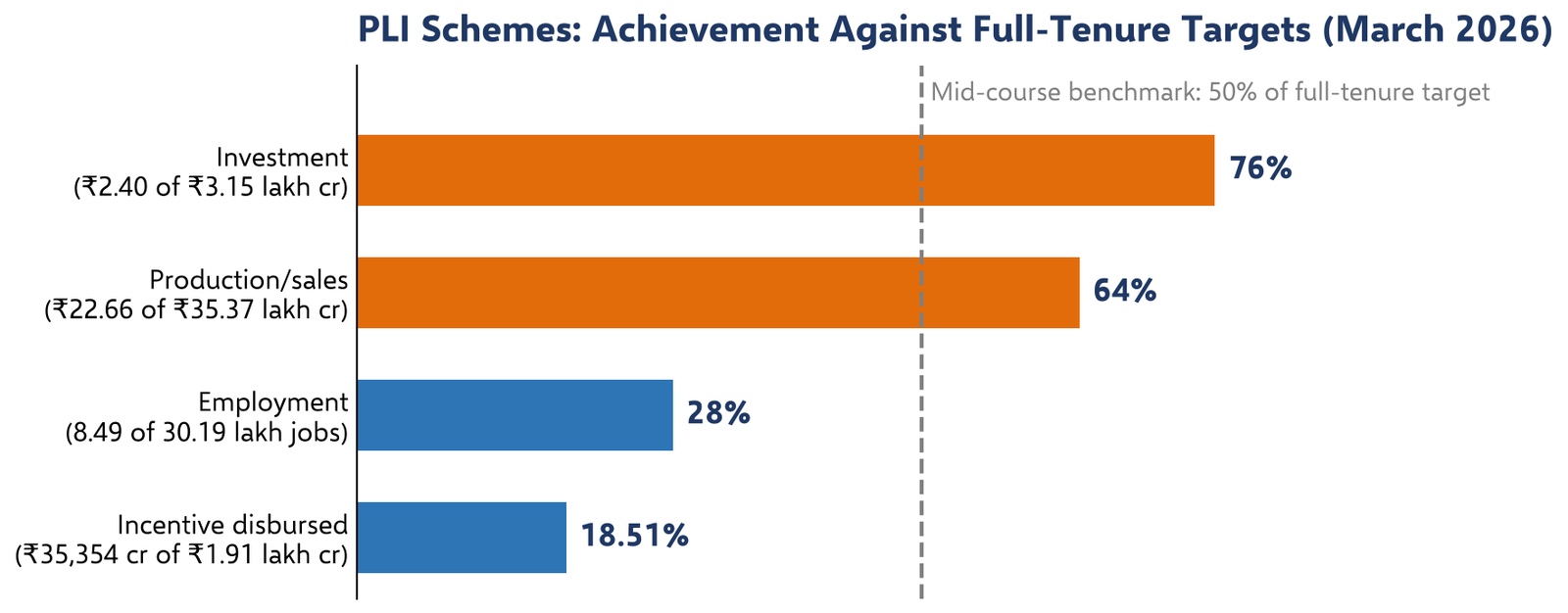
Low disbursement is by design: incentives are released only after firms meet investment and production conditions. Job numbers also lag because factories go through commissioning and ramp-up before hiring at scale.
Sector Snapshot
| Sector | Highlight |
|---|---|
| Mobile phones (LSEM) | Mobile exports rose nearly nine-fold to ₹2 lakh crore in FY2025; imports fell 77% (see PLI for LSEM) |
| Bulk drugs | Trade deficit of ₹1,930 crore (FY22) turned into a ₹2,280 crore surplus (FY25) |
| Pharmaceuticals | 191 products made in India for the first time; exports up 32.7% (2021–25) |
| Drones | Sector turnover up seven-fold; 77.5% of outlay disbursed |
| White goods | Compressor capacity up ten-fold, from 1 million to 10 million units (see PLI for White Goods) |
| Laggards | ACC batteries (localisation norms, mineral dependence), technical textiles (only 3.61% fund use), specialty steel (delays) |
What the Report Recommends
- Sector-specific design instead of one template for all industries.
- Demand-pull support — public procurement and export-market development — alongside production incentives.
- Harmonised data systems and deeper MSME participation.
- Patient policy for technology-heavy sectors with long gestation, and stronger Centre–State coordination.
📖 Read More: Make in India Initiative • PLI Scheme for Large Scale Electronics Manufacturing • Post-1991 Industrial Policy Developments • Drugs and Pharmaceuticals Industry
4. Agrivoltaics: Growing Crops and Power Together
(ECONOMICS) (PIB) The Bharat Renewable Energy Summit & Expo 2026 (2–5 November, Bharat Mandapam, New Delhi) put the spotlight on agrivoltaics — growing crops and generating solar power on the same piece of land.
How Agrivoltaics Works
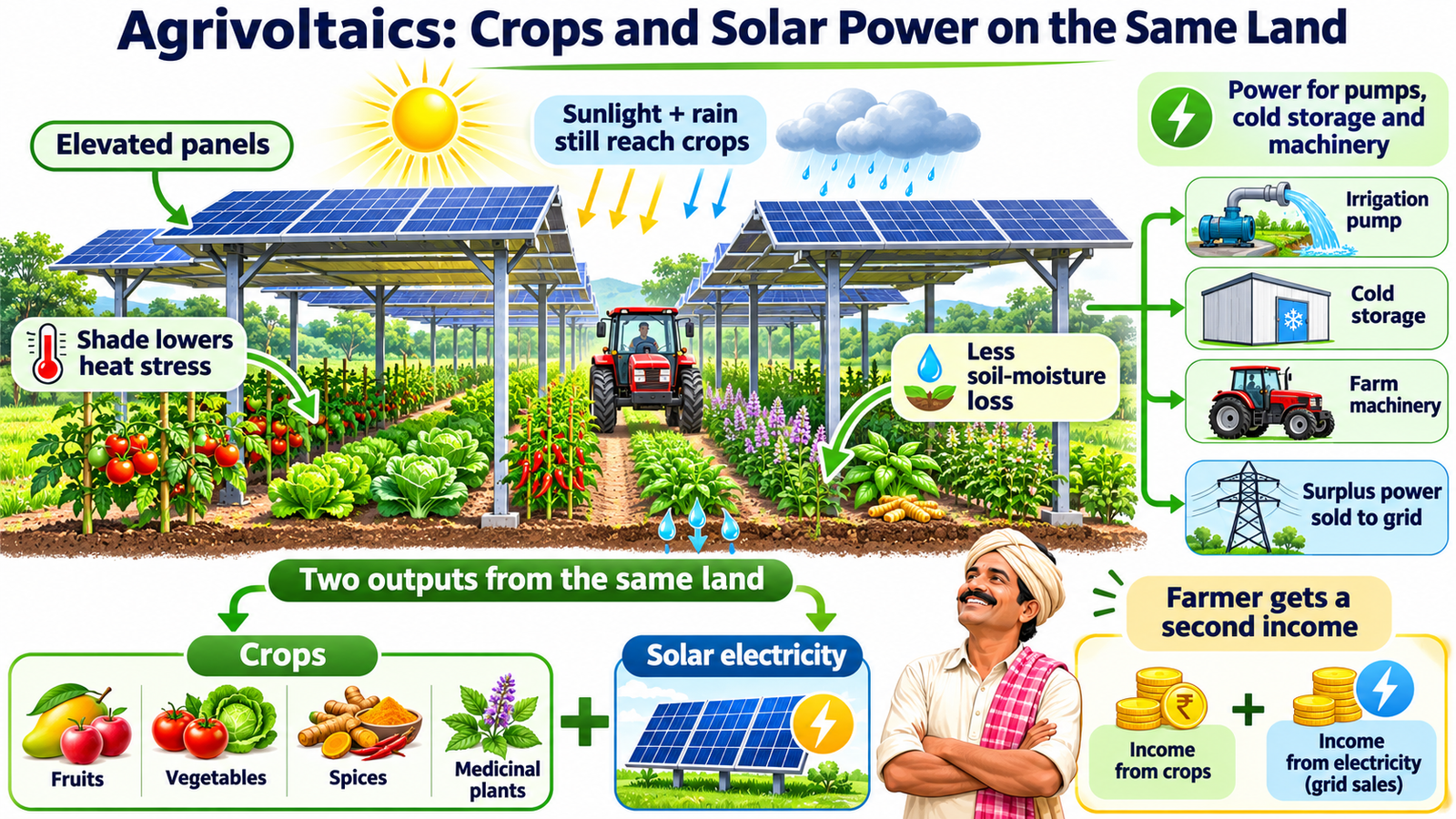
Solar panels are mounted on elevated structures above crops or between rows, leaving room for sunlight, rain, workers and machines. The partial shade can cut crop heat stress and soil-moisture loss. Unlike a conventional solar farm, the land keeps producing food.
Same farmland ➜ Crops + solar electricity ➜ Pumps, cold storage, machinery ➜ Surplus sold to grid ➜ Second income
Fruits, vegetables, spices and medicinal plants suit it best, depending on their light needs. Under good conditions, farm earnings could rise from about ₹60,000 to over ₹1 lakh per acre a year.
India’s Opportunity
| Indicator | Value |
|---|---|
| Agriculture’s role | Livelihood for about 46.1% of the population; GVA estimated at ₹52.08 lakh crore (2025-26) |
| Land base (2023-24) | Reported area 306.96 million ha (about 55% agricultural); net sown 138.99 million ha |
| Current status (Aug 2025) | 36 projects, 37.54 MW installed, plus 10 pilots |
| Potential | 3,000 GW to nearly 14,000 GW |
| Suitable land | 47.35 million ha of “restricted cropland” after GIS screening |
| High-potential States | Maharashtra, Rajasthan, Andhra Pradesh, Madhya Pradesh, Karnataka, Uttar Pradesh (≈50% of potential) |
Policy Push
- PM-KUSUM (February 2019): Central financial assistance of about ₹34,422 crore for decentralised solar plants (Component A), standalone solar pumps (B) and solarising grid-connected pumps (C) (see PM-KUSUM).
- Centre of Excellence on Agrivoltaics: set up by the National Institute of Solar Energy with ICAR-IARI, with a 100-kW demonstration plant at IARI.
- India Agrivoltaics Alliance (2023): a multi-stakeholder platform anchored by the National Solar Energy Federation of India.
- State schemes: Maharashtra’s Mukhyamantri Saur Krushi Vahini Yojana 2.0, Gujarat’s Kisan Suryoday Yojana and Karnataka’s Surya Raitha Scheme.
Scaling up needs crop-compatible designs, affordable finance, clear rules on land use and tariffs, and active farmer participation (see Measures to Boost Renewable Energy).
📖 Read More: PM-KUSUM • Solar Energy • Measures to Boost Renewable Energy • Agriculture and Allied Sectors of Indian Economy
5. COP31: Do Climate Summits Still Matter?
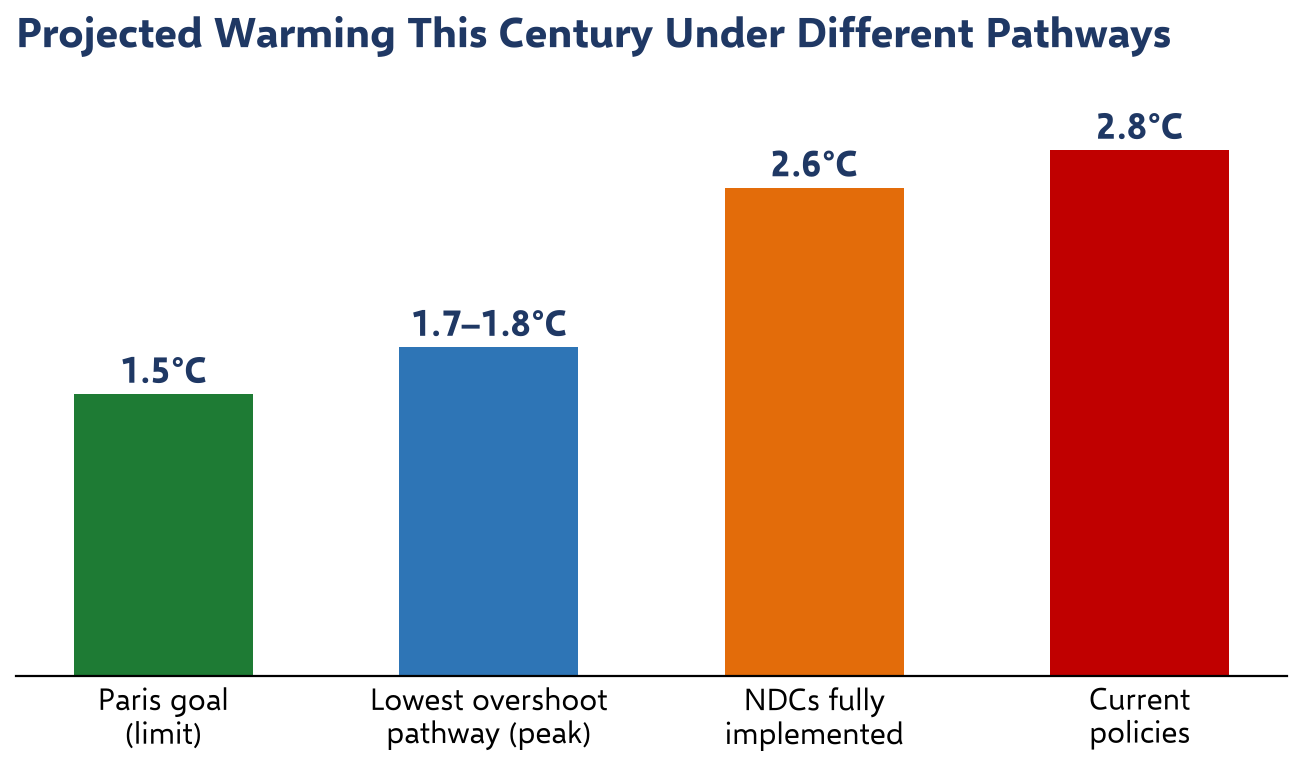
(ENVIRONMENT) (IE) COP31 to the UNFCCC is under way in Antalya, Türkiye (9–20 November 2026), with Australia leading the negotiations. It opens amid a sobering verdict: the window to keep warming within 1.5°C has closed, raising questions about the value of annual COPs.
The Implementation Gap
The Emissions Gap Report 2026 of UNEP finds that even full delivery of current NDCs would cut emissions only 11–15% by 2035 (from 2025 levels), against about 45% needed for the lowest-overshoot pathway.
- Finance shortfall: the $100-billion-a-year goal, due by 2020, was met only in 2022, and largely through loans.
- Adaptation gap: public adaptation finance remains short of the Glasgow Climate Pact pledge to double it to about $40 billion by 2025.
Why Targets Keep Slipping
- Consensus rule: the UNFCCC never adopted a voting rule (draft rule 42), so any single Party can block or dilute a text.
- No enforcement: the Paris Agreement obliges Parties to submit NDCs, not achieve them; its compliance committee (Article 15) imposes no penalties.
- Diluted responsibility: the Kyoto Protocol (1997) bound only Annex I countries; Paris relies on voluntary pledges from all.
- Geopolitics: wars, energy-security worries and the US exit from the Paris Agreement have sapped ambition.
Why COPs Still Matter
- Accountability forum: the only place where developing countries can press rich nations on unmet finance and technology promises.
- Finance architecture: COPs run the NCQG of at least $300 billion a year by 2035 and the $1.3 trillion roadmap agreed at COP29.
- Quick relief: the Fund for responding to Loss and Damage promised US$20 million to Nepal after its August 2026 floods.
- Common rules: carbon markets (Article 6) and the Enhanced Transparency Framework make national pledges comparable and verifiable.
COP31 Action Agenda: Targets for 2035
The COP31 Presidency’s non-negotiated Action Agenda sets six global goals under 10 priority themes, without new obligations for Parties. The headline targets are:
| Theme | 2035 target |
|---|---|
| Clean energy and electrification | Raise electricity’s share of final energy use from just over 20% to 35% |
| Zero waste and methane | Halve the projected growth in municipal solid waste |
| Climate-resilient cities | Cut energy-use intensity of buildings by at least 25% |
| Green industrialisation | Raise the global circular material use rate to at least 15% |
Way Forward
- Use the second Global Stocktake (2028) to set sector benchmarks for 2035 and 2040.
- Raise the grant share of NCQG finance and replenish the loss and damage fund predictably.
- Turn the COP28 call to transition away from fossil fuels into a time-bound roadmap.
- Pair negotiations with minilateral coalitions such as the ISA and CDRI.
📖 Read More: UNFCCC • Paris Climate Change Conference, 2015 • COP 29 (Baku, 2024) • COP30 (Belem, 2025) • Climate and Environment Diplomacy
6. Five New Nematode Species Found in Keralam’s Mangroves
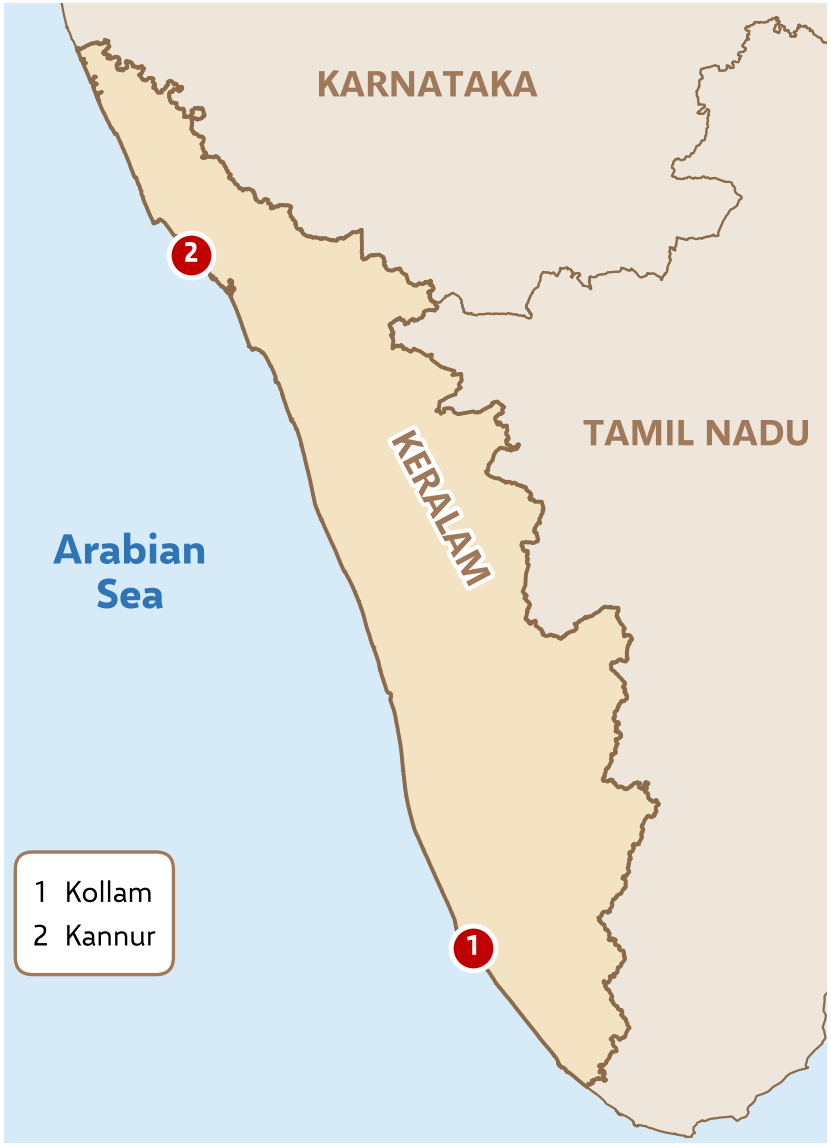
(ENVIRONMENT) (TH) Researchers of the Department of Aquatic Biology and Fisheries, University of Kerala, have described five new species of free-living marine nematodes from mangrove sediments along the Keralam coast, in a paper in the journal Marine Biodiversity.
Note: the State’s official name changed from Kerala to Keralam under the Kerala (Alteration of Name) Act, 2026, in force from 25 August 2026.
Why the Find Matters
- First regional record: it is the first confirmed record of the genus Pseudochromadora from the Arabian Sea.
- Collection sites: the specimens came from mangrove patches in Kollam and Kannur.
- Hidden biodiversity: it fills gaps in our knowledge of meiofauna — tiny animals living between sediment grains — which remain poorly documented in the Indian Ocean.
- Conservation lesson: saving mangroves must mean protecting the whole community, including microscopic species that drive decomposition and nutrient cycling.
Nematodes at a Glance
Nematodes (phylum Nematoda), or roundworms, are unsegmented, cylindrical worms with a fluid-filled body cavity (pseudocoelom). They are among the most abundant multicellular animals on Earth, found from soils and deserts to the deep ocean floor (see Kingdom Animalia).
| Type | Feeding / role | Example |
|---|---|---|
| Free-living | Feed on bacteria, fungi, algae; recycle nutrients | The five new Pseudochromadora species |
| Parasitic | Infect plants, animals and humans | Root-knot nematodes (crops), Ascaris (humans) |
| Entomopathogenic | Kill insects with the help of symbiotic bacteria | Used in biological pest control |
📖 Read More: Kingdom Animalia • Biodiversity Conservation • Wetland Ecosystem • Components of an Ecosystem
7. CRPF Moves to Acquire Kamikaze Drones
(INTERNAL SECURITY) (HT) The Central Reserve Police Force (CRPF) has begun the process of buying kamikaze drones for counter-insurgency operations, circulating Quality Requirements and Trial Directives to suppliers.
What the CRPF Wants
| Parameter | Requirement |
|---|---|
| Warheads | Two high-explosive warheads of at least 1.5 kg |
| Range | At least 15 km |
| Endurance | At least 30 minutes of flight with payload |
| Role | One-way missions against designated targets; kill/impact radius of 10 metres |
| Timeline | Suppliers to respond by 25 November |
What Is a Kamikaze Drone?
Also called a loitering munition, it is an unmanned aerial vehicle that carries an explosive payload and destroys itself by striking its target. Unlike surveillance drones, it is built for a one-way mission.
Launch ➜ Loiter over area ➜ Identify target ➜ Operator confirms ➜ Strike
- Precision: onboard cameras and sensors relay live video, so the operator can choose and confirm the target.
- Lower risk: useful in difficult terrain where sending personnel is dangerous.
- Swarms: some systems can be launched in large numbers to overwhelm air defences.
| Drone type | Main use | Returns after mission? |
|---|---|---|
| Surveillance | Reconnaissance and intelligence | Yes |
| Combat (UCAV) | Carries weapons for repeated strikes | Yes |
| FPV (first-person view) | Live-feed flying for surveillance, racing or attack | Depends on role |
| Kamikaze / loitering munition | Search, then crash into target | No |
Why It Matters
Use of lethal drones by a Central Armed Police Force marks a shift in internal security, from area domination to precise stand-off strikes. It also raises questions about rules of engagement, collateral damage and accountability in operations on Indian soil.
📖 Read More: Central Armed Police Forces • Countering Left Wing Extremism • Armed Forces and Internal Security
8. Sea Vigil-26: Stress-Testing India’s Coastal Defence
(INTERNAL SECURITY) (PIB) The fifth edition of the pan-India coastal defence exercise Sea Vigil-26 is being held from 11 to 19 November 2026, with the Indian Navy as the lead agency.
Origin and Purpose
Sea Vigil was conceived in 2018 to test the measures put in place to strengthen maritime security after the 26/11 Mumbai terror attacks. It gives the nation an apex-level check of its preparedness for coastal and maritime security.
Two Phases
CDSRE phase (11–17 Nov) ➜ Sea Phase (18–19 Nov) ➜ Build-up to TROPEX
CDSRE stands for Coastal Defence and Security Readiness Evaluation. Sea Vigil feeds into the Navy’s biennial Theatre Level Readiness Operational Exercise (TROPEX); together they cover the full spectrum, from coastal defence to high-seas operations.
Scale and Participants
- Area: the entire coastline and Exclusive Economic Zone, involving all coastal States and UTs.
- Forces: Indian Navy, Indian Coast Guard, Coastal Security Police, Customs and other maritime agencies.
- Ministries: Defence; Home Affairs; Ports, Shipping and Waterways; Petroleum and Natural Gas; and Fisheries, Animal Husbandry and Dairying.
- Communities: fishing and coastal communities, the “eyes and ears” of coastal security.
📖 Read More: Coastal and Maritime Security
9. SS United States Becomes World’s Largest Artificial Reef
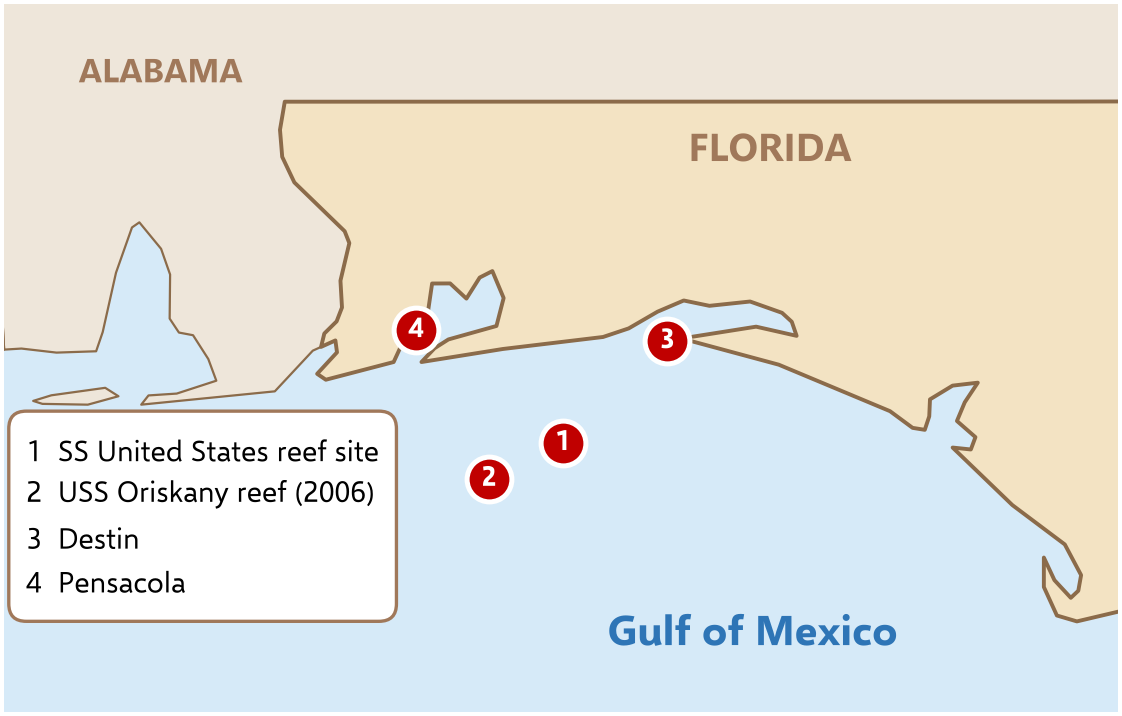
(GEOGRAPHY) (TOI) The historic ocean liner SS United States, once the fastest passenger ship across the Atlantic, has been deliberately sunk in the Gulf of Mexico off Destin, Florida, to become the world’s largest ship-based artificial reef.
The Ship and the Site
- The liner: a 990-foot (≈302 m) ship designed by naval architect William Francis Gibbs; it set a transatlantic speed record on its 1952 maiden voyage.
- The site: about 22 nautical miles south-west of Destin–Fort Walton Beach in Okaloosa County, after hazardous materials were stripped out.
- Record broken: the previous holder was the USS Oriskany, an 888-foot aircraft carrier sunk off Pensacola in 2006.
- Naming note: the US government has officially used the name “Gulf of America” for this water body since 2025; international usage remains Gulf of Mexico.
Artificial Reefs Explained
Artificial reefs are human-made structures placed on the seabed to create habitat for marine life. They may be concrete modules, purpose-built units or cleaned decommissioned ships.
| Benefit | How |
|---|---|
| Ecological | Hard surfaces are colonised by corals, algae and sponges, adding habitat complexity and sheltering fish |
| Economic | Boost diving tourism, recreational fishing and coastal livelihoods (see Fishing Industry) |
| Caveats | Benefits depend on clean materials, suitable sites and monitoring; poorly prepared wrecks can pollute |
📖 Read More: Fishing Industry • Measures to Curb Marine Pollution • Tourism
10. Maulana Abul Kalam Azad: Scholar, Patriot, Educator
(HISTORY) (DD) The Lok Sabha Speaker paid tributes to Maulana Abul Kalam Azad (1888–1958) on his birth anniversary, 11 November, which India observes as National Education Day.
In the Freedom Struggle
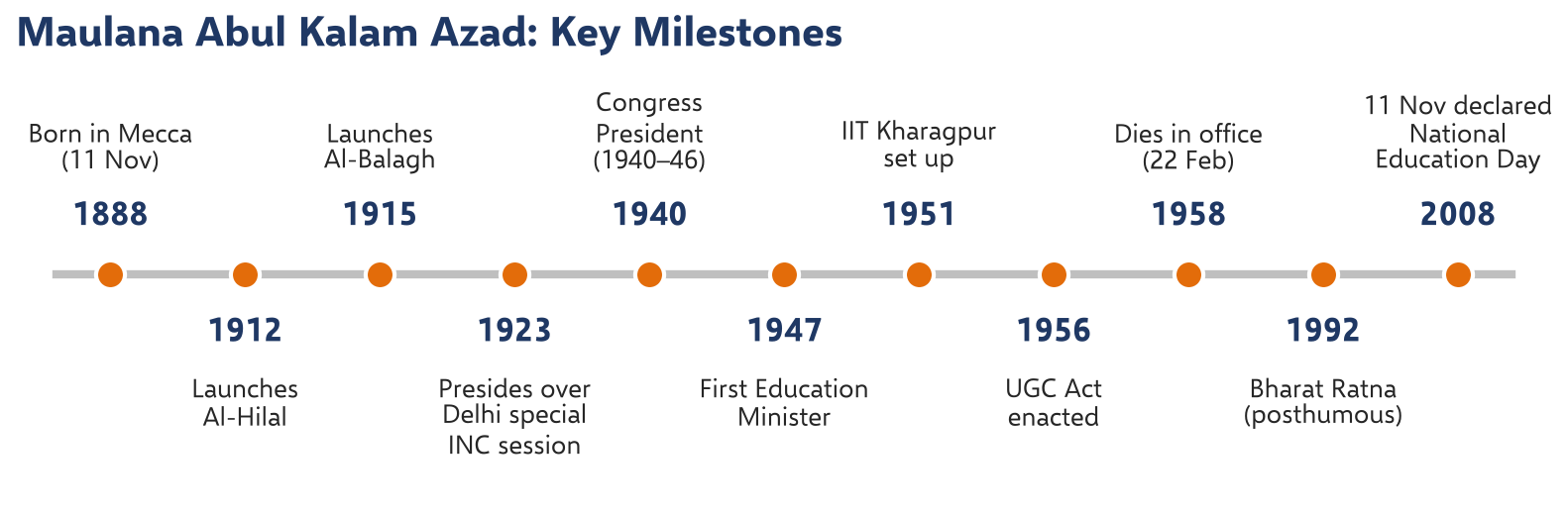
- Journalism as protest: started the Urdu weekly Al-Hilal (1912) and, after it was banned, Al-Balagh (1915) to spread anti-colonial nationalism.
- Mass movements: a leading voice of the Khilafat and Non-Cooperation Movements.
- Congress President: presided over the special Delhi session of 1923, one of the youngest to hold the post, and again led the party from 1940 to 1946, through the Quit India Movement.
- Unity over division: a firm champion of Hindu–Muslim unity who opposed Partition and backed a united India under the Cabinet Mission Plan (1946).
Building Independent India’s Education System
As India’s first Education Minister (1947–1958), Azad laid the foundations of higher, technical and cultural education.
| Area | Contribution |
|---|---|
| Higher education | Helped set up the University Grants Commission, made statutory by the UGC Act, 1956 |
| Technical education | Backed new technical institutions, including the first IIT at Kharagpur (1951) |
| Culture | Supported the Sahitya Akademi, Sangeet Natak Akademi and Lalit Kala Akademi (see Cultural Institutions in India) |
| Recognition | Bharat Ratna (posthumous, 1992); 11 November declared National Education Day in 2008 |
📖 Read More: Khilafat and Non-Cooperation Movements (1919–22) • Quit India Movement • Cabinet Mission (March–May 1946) • Independence with Partition • Cultural Institutions in India