
China Since 1949
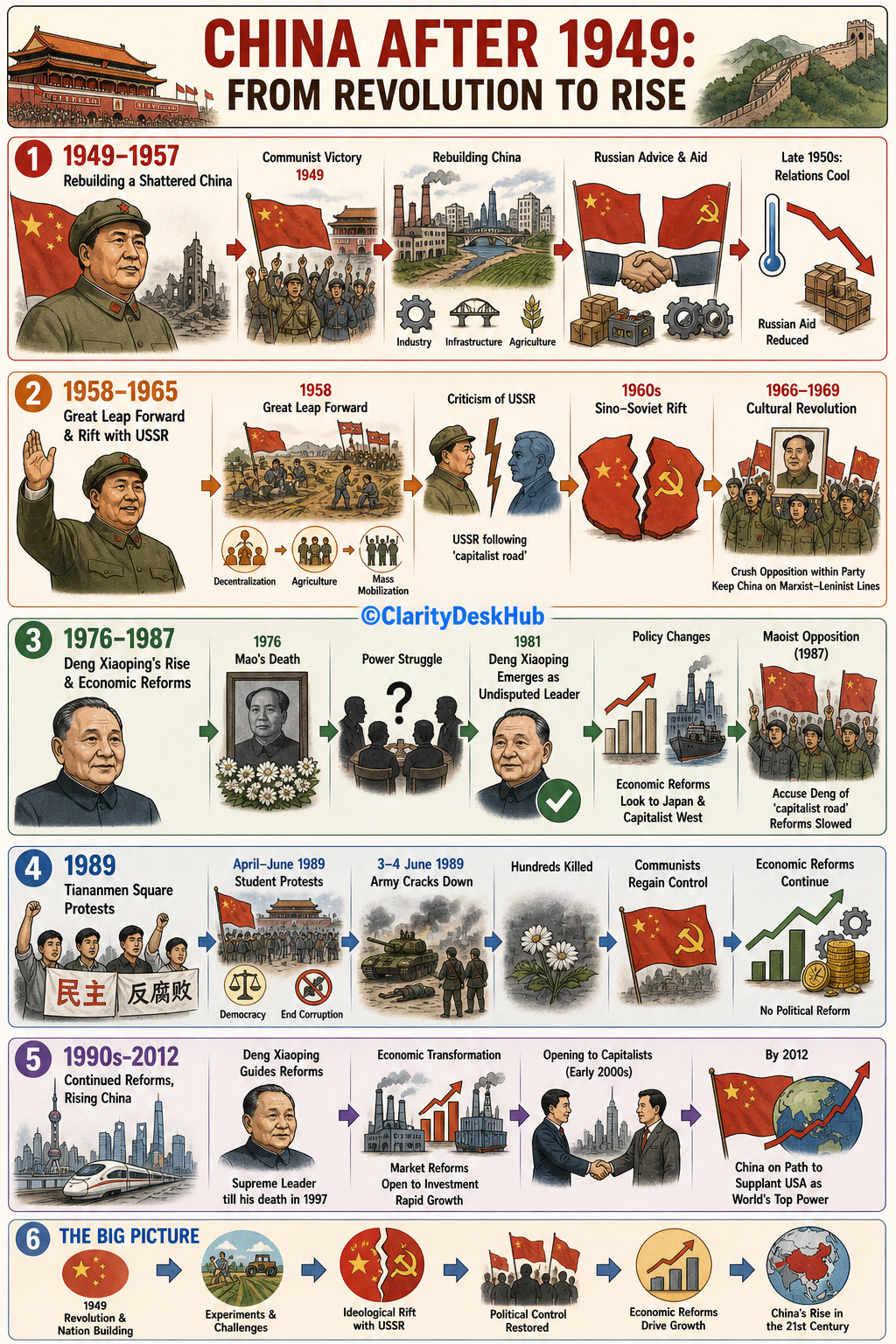
At the outset of this section, we shall analyze one of the most complex figures of the 20th century—Mao Zedong—and his attempt to transform China. When we look at Mao, we aren’t just looking at a political leader; we are looking at a man who tried to rewrite the destiny of one-fourth of humanity.
The question before us is: How successful was Mao in dealing with China’s problems? To understand this, we must look beyond the black-and-white lens of “hero” or “villain” and examine the socio-political and economic dimensions of his reign.
Mao and China’s Problems
The Starting Point: China in 1949
To judge a doctor, you must first see the condition of the patient when he arrived. In 1949, when the People’s Republic was born, the “patient”—China—was in the ICU.
- The Scars of War: Decades of civil war and the brutal Japanese occupation had left the infrastructure (railways, roads, dams) in ruins.
- Economic Collapse: Inflation was spiraling out of control, and industry was almost non-existent.
- The Hungry Masses: Agriculture was primitive and couldn’t feed a population of 600 million.
- The Mandate of Heaven: While the peasants supported Mao out of hatred for the inefficient Kuomintang (KMT), this support was conditional. Mao knew that if he couldn’t put food on the table, the revolution would fail.
Institutionalizing the Revolution: The Constitution
Mao’s first task was to provide a “spine” to a fragmented nation. This came in the form of the 1950 Constitution (formally adopted in 1954).
The Power Structure
- The National People’s Congress (NPC): The highest legislative body, elected by the people.
- The State Council: The executive arm responsible for administration.
- The Politburo: The “brain” of the system, where all real decisions were made.
- Analysis: On paper, it looked like a democracy; in reality, it was a monolith. Only Communist Party members could participate. However, it gave China a strong central government for the first time in centuries, which was essential for stability.
The Great Transformation: Agriculture and Industry
Mao initially looked toward the Soviet Union for a roadmap, but he soon realized that China’s soul lay in its villages, not just its factories.
A. Agricultural Reform (1950–1956)
Mao began by redistributing land from “landlords” to the “peasants.”
- The Historiographical Debate: Earlier historians (like Jack Gray) suggested this was a legal, relatively peaceful process. However, modern declassified archives (as highlighted by Prof. Frank Dikötter) reveal a much darker reality.
- The Violence: In many regions, there weren’t even “wealthy” landlords. Party activists often manufactured “class enemies,” leading to torture, public executions, and burials alive to seize land. By 1956, 95% of peasants were moved into collective farms.
B. Industrialization: The First Five-Year Plan (1953)
Mao focused on heavy industry (steel, coal, chemicals) with Soviet aid. While it brought some stability and growth, Mao grew restless. He felt the Soviet model was too “top-down” and bureaucratic for China.
The Turning Point: The “Hundred Flowers” and the “Great Leap”
In 1957, Mao conducted a social experiment called the Hundred Flowers Campaign. He invited intellectuals to criticize the government: “Let a hundred flowers bloom; let a hundred schools of thought contend.”
The Outcome: The criticism was so fierce—attacking the Party as undemocratic and incompetent—that Mao panicked. He crushed the critics and concluded that China needed a “shaking up” to move toward true socialism.
The Great Leap Forward (1958)
This was Mao’s attempt to “walk on two legs”—developing industry and agriculture simultaneously.
- The Communes: Huge units of up to 75,000 people that managed everything from farming to schools.
- Backyard Furnaces: Mao famously asked peasants to melt their pots and pans in “backyard furnaces” to produce steel. It was a disaster; the steel was useless.
The Human Cost: The Great Famine
The “Great Leap” turned into a “Great Fall.” Poor planning, bad weather, and the withdrawal of Soviet aid led to the worst famine in human history.
- The Toll: While official figures were suppressed, researchers like Dikötter estimate 45 million deaths between 1958 and 1962.
- The Cruelty: Archives reveal reports of parents being forced to bury children alive for stealing grain. Mao’s chilling logic at the time: “It is better to let half the people die so that the other half can eat their fill.”
The Final Storm: The Cultural Revolution (1966–1969)
After the failure of the Great Leap, Mao was sidelined. Leaders like Liu Shaoqi and Deng Xiaoping tried to introduce market-friendly reforms. Mao saw this as “capitalist revisionism” and launched the Cultural Revolution to reclaim power.
- The Red Guards: Mao mobilized the youth (students) to attack “The Four Olds” (Old Customs, Old Culture, Old Habits, and Old Ideas).
- Chaos: Schools closed, teachers were beaten, and intellectuals were sent to the countryside to “learn from peasants.”
- The Result: It nearly caused a civil war. Mao eventually had to use the army (under Lin Biao) to stop the very students he had unleashed.
Analytical Conclusion: A Balanced Audit
So, was Mao successful? Let us look at the balance sheet.
The Successes (The “Silver Lining”)
- Unification: He ended a century of humiliation and unified a fragmented China.
- Social Metrics: Infant mortality dropped significantly (from 203 to 84 per 1,000).
- Women’s Rights: He famously said, “Women hold up half the sky,” and passed laws to improve their status.
- The Model: The commune system, despite its flaws, provided a blueprint for rural governance that kept the massive population fed in later years.
The Failures (The “Dark Shadow”)
- Economic Ruin: By 1976, expert Jonathan Fenby argues China was virtually bankrupt. Urban wages had stagnated for decades.
- Equality of Poverty: While he removed the gap between rich and poor, he did so by making almost everyone equally poor.
- Human Trauma: The sheer scale of state-sponsored violence and the loss of life (up to 45 million in the famine alone) remains a permanent stain on his legacy.
The Bottom Line: Mao was a master at destroying the old world, but he struggled significantly with building the new one. China survived Mao, but it was his successor, Deng Xiaoping, who eventually had to “repair” the engine Mao had built.
What do you think was the single biggest mistake Mao made—was it an error of ideology or an error of administration?
Let us move forward now. In above discussion, we saw how Mao Zedong’s era ended in a whirlwind of revolution and chaos. Now, imagine a massive ship—the “People’s Republic”—where the captain has just passed away, and the crew is fighting for the steering wheel. This is the story of China after 1976.
To understand this transition, we will look at how China moved from the ideological obsession of Mao to the steely pragmatism of Deng Xiaoping.
Life after Mao
The Power Vacuum: A Tripartite Struggle (1976–1981)
When Mao died in 1976, China didn’t just lose a leader; it lost its “North Star.” Immediately, a fierce struggle for the soul of the nation began among three distinct factions:
- The Loyalist (Hua Guofeng): Mao’s hand-picked successor. His philosophy was simple: continue Mao’s policies. However, he lacked the “gravitas” and political skill to manage the complex bureaucracy.
- The Radicals (The Gang of Four): Led by Mao’s widow, Jiang Qing. They were the “High Priests” of the Cultural Revolution. They wanted more revolution, more class struggle, and zero compromise with “capitalist” ideas.
- The Pragmatist (Deng Xiaoping): A man who had been purged twice, Deng was like “teak”—hard, resilient, and unbreakable. He believed that ideology is useless if the people are hungry.
The Resolution of the Conflict
The Gang of Four attempted a coup but was outmaneuvered and arrested by Hua Guofeng. While Hua initially seemed like the “Supreme Leader,” he failed to fix the economy. His “Ten-Year Plan” led to trade deficits and inflation. By 1981, the Party elders realized Hua lacked the “organizational muscle” to lead.
Deng Xiaoping, working quietly from the background, eventually sidelined Hua and emerged as the undisputed leader.
Re-evaluating the “Great Helmsman”: The 70/30 Formula
One of the most brilliant political moves in history was how Deng handled Mao’s legacy. He couldn’t reject Mao entirely (that would destroy the Party’s legitimacy), but he couldn’t follow Mao’s path (that would destroy China).
- The Scapegoat Strategy: The Party issued a resolution blaming the “Great Leftist Error” of the Cultural Revolution on Mao, but primarily on the Gang of Four.
- Historiographical Perspective: As historian Steve Smith notes, by pinning the blame on individuals, the Party saved itself. It shifted from “one-man rule” to collective leadership.
- The Verdict: Mao was declared “70% good, 30% bad.” This allowed China to keep Mao’s portrait on the wall while throwing his “Little Red Book” into the drawer.
The Great Shift: “Socialism with Chinese Characteristics”
Deng Xiaoping initiated a period of “dramatic policy changes” that turned the world’s most populous nation into an economic laboratory.
A. The Reversal of the Cultural Revolution
Deng didn’t just change the future; he “cleaned up” the past.
- Revolutionary committees were replaced by elected groups.
- Confiscated property was returned to the “capitalists.”
- Intellectuals and artists were given a “breathing room” they hadn’t felt in decades.
B. The Economic Modernization (The “Open Door”)
Deng’s philosophy was famously summarized by his “Black Cat, White Cat” theory: It doesn’t matter if a cat is black or white, as long as it catches mice.
- Global Integration: China joined the IMF and World Bank in 1980, signaling it was ready to play by global rules.
- Agriculture (The Household Responsibility System): The massive, inefficient communes were broken up. Land was still state-owned, but individual families were given plots. They could sell their surplus and keep the profits. The result? Record grain production and a sudden rise in peasant prosperity.
The Paradox of Reform: The Democracy Wall (1978–1979)
Whenever you open a window for fresh air, flies are bound to come in. This is exactly what happened with the Democracy Wall.
Deng initially encouraged public posters (Dazibao) to help him criticize the Gang of Four. But the people went further. They began demanding the “Fifth Modernization”—Democracy. They attacked Mao and demanded human rights and freedom of travel.
Deng’s Response: Once the criticism turned toward the Party itself, Deng’s “teak” hardness returned. He realized that political chaos would destroy economic progress. He abolished the Democracy Wall in 1979 and arrested the dissidents. His logic was clear: Stability is the prerequisite for development.
Modernization and its “Growing Pains”
By the mid-1980s, China was experiencing a “Gold Rush” feeling, but with serious side effects:
- The Trade Gap: China was importing expensive technology faster than it could export goods.
- Inflation: As prices were allowed to fluctuate on the open market, inflation hit 22% by 1986, causing anxiety among the urban poor.
- The Wealth Gap: For the first time in a generation, some people were getting very rich while others stayed behind. Deng’s response was bold: “To get rich is not a crime; it is glorious.”
Analytical Conclusion: The Legacy of Deng Xiaoping
Deng Xiaoping’s “Market Socialism” was a radical departure from everything the Communist world believed in. He replaced “Equality in Poverty” with “Opportunity for Prosperity.”
While he maintained a strict “Iron Fist” on political control (as seen in his handling of the Democracy Wall), he gave the Chinese people the “Invisible Hand” of the market to improve their lives. By the time of his 82nd birthday in 1986, he had set China on a course to become a global superpower, proving that he wasn’t just a survivor of Mao’s purges—he was the architect of the modern world.
Let’s reflect on this: Deng famously said, “Without the Party, China will retrogress into divisions and confusions.” Do you think China could have achieved its economic miracle if it had allowed political democracy in 1979, or was “authoritarian capitalism” a necessary evil for a country of that size?
We now arrive at the most dramatic and tragic chapter of the post-Mao era. Imagine, if you will, a tightrope walker. Below him is a canyon of chaos, and he is balancing a long pole. On one end of the pole is Economic Liberalization (Capitalism); on the other is Political Control (Communism).
This tightrope walker was Deng Xiaoping. In 1989, the pole snapped.
Tiananmen Square, 1989 And the Crisis of Communism
The Context: A House Divided (1987)
To understand Tiananmen, we must understand the “Cold War” happening inside the Chinese Communist Party. Deng was playing a sophisticated game of balance between two factions:
- The Reformers (The “Left”): Led by Hu Yaobang and Zhao Ziyang. They believed that to modernize the economy, you eventually had to modernize the politics.
- The Hardliners (The “Right”): Led by Li Peng. They were terrified that any “Western” influence or student protest would lead to the total collapse of the state.
The 1987 Crisis
When student protests broke out in 1986 demanding more democracy, the hardliners panicked. They forced the resignation of the liberal Hu Yaobang, accusing him of being “too soft.” While Deng allowed this to appease the conservatives, he replaced Hu with another reformer, Zhao Ziyang. This set the stage for a massive collision.
The Catalyst: The Death of a Reformer
In April 1989, Hu Yaobang died. For the students, he was a symbol of hope. His funeral became the spark for a massive movement.
What began as a mourning ceremony in Tiananmen Square quickly morphed into a protest against:
- Inflation: Which had hit a staggering 30%, eroding the savings of the working class.
- Corruption: The “Princelings” (children of high officials) were getting rich through party connections.
- Lack of Freedom: Students wanted a “Fifth Modernization”—Democracy.
The 1989 Protests: A Sense of Liberation
By May 1989, the square was occupied by nearly a million people. The atmosphere was electric—reminiscent of the 1960s counter-culture in the West.
- The Gorbachev Factor: Soviet leader Mikhail Gorbachev visited Beijing in mid-May. Because the world’s media was there to cover the summit, the students had a global stage.
- The “Goddess of Democracy”: Students erected a foam-and-papier-mâché statue facing the portrait of Mao, a direct symbolic challenge to the old guard.
- Internal Paralysis: The government was paralyzed. Zhao Ziyang wanted to negotiate with the students, even visiting them in the square with a megaphone, tearfully saying, “We have come too late.” But Li Peng and Deng Xiaoping saw this as a betrayal of the revolution.
The Crackdown: June 4, 1989
Deng Xiaoping eventually sided with the hardliners. He believed that if the Party lost control of the square, China would descend into the same “warlordism” and chaos it suffered in the 1920s.
- Martial Law: On May 20, martial law was declared.
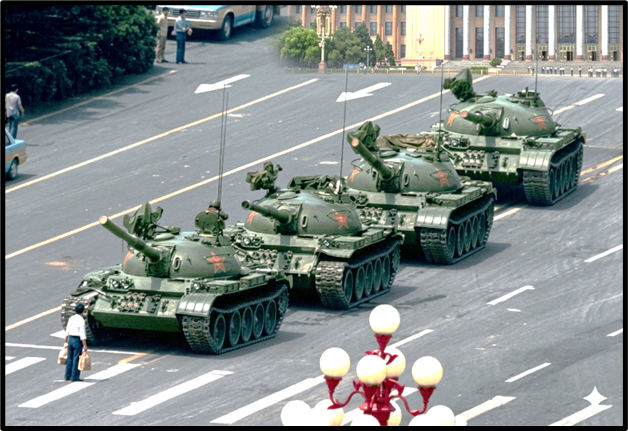
- The Massacre: On the night of June 3–4, the People’s Liberation Army (PLA) was ordered to clear the square by any means necessary. Tanks and infantry moved in from all directions.
- The Toll: While official figures were low, independent sources estimate between 1,500 and 3,000 deaths. The “Tank Man”—a lone individual stopping a column of tanks—became the global icon of this resistance.
Consequences and Critical Analysis
The aftermath of Tiananmen Square redefined China’s path for the next 40 years.
A. The Victory of the Hardliners
Zhao Ziyang was purged and placed under house arrest for the rest of his life. He was replaced by Jiang Zemin, a man who would faithfully implement Deng’s vision of “Economic Reform + Political Authoritarianism.”
B. The “China Model” vs. The “Soviet Model”
This is the most crucial analytical point. At the same time, Mikhail Gorbachev was trying to reform the USSR using Glasnost (Political Openness) and Perestroika (Economic Restructuring) simultaneously.
- The Result in USSR: The state collapsed, and the country broke into 15 pieces.
- The Result in China: The CCP crushed the political reform but doubled down on economic growth.
Deng and the hardliners felt vindicated. They argued that by sacrificing the protesters in the square, they saved the nation from the disintegration that befell the Soviet Union.
C. The Grand Bargain
Following 1989, the Party offered the Chinese people a “New Deal”: We will give you the opportunity to get rich, to travel, and to consume, but you must never challenge our right to rule.
Summary Verdict
Deng Xiaoping’s legacy is written in the blood of Tiananmen and the gold of Shanghai. He proved that it is possible to have a “Market Economy” without a “Liberal Democracy.”
Let us ponder this: If Deng had listened to Zhao Ziyang and negotiated with the students, would China be a thriving democracy today, or would it have collapsed into a “failed state” like the Soviet Union did in the 1990s? This remains the greatest “What If” of modern Asian history.
We now arrive at the final act of this epic transformation—the era of Jiang Zemin, Hu Jintao, and the rise of Xi Jinping. Imagine a high-performance sports car: it is incredibly fast, breaking all speed records, but its engine is overheating and the steering wheel is locked. This is the “China Paradox.”
Let us analyze how China managed to become the world’s factory while remaining a political fortress.
The changing Face of Communism in China
The Strategy of “Economic Pacification”
Following the collapse of the Soviet Union, the Chinese leadership—Deng, and later Jiang Zemin—reached a critical conclusion: People only demand democracy when they are poor and the system is failing.
- The Boom: In the 1990s, China’s GDP grew at an average of 11.4%. It was the fastest sustained growth in human history.
- The Bet: The CCP hoped that rising living standards would act as a “political sedative,” making people forget about the blood spilled at Tiananmen.
- Corruption as a Pressure Point: To keep the public happy and silence hardliners, Jiang launched massive anti-corruption campaigns. In 2000, high-ranking officials were executed for bribery—not just to clean the system, but to maintain its credibility.
The “Three Represents” and the Capitalist Communist
In 2000, Jiang Zemin introduced a daring ideological shift called the “Three Represents.” This was a masterstroke of political adaptation.
- What it meant: The Party no longer just represented “workers and peasants”; it now represented the “most advanced productive forces.”
- The Irony: This effectively opened the doors of the Communist Party to Billionaires and Capitalists.
- The Logic: If you can’t beat the capitalists, make them join your Party. This co-opted the new elite, ensuring they wouldn’t fund a revolution against the state.
The Hu Jintao and Wen Jiabao Era (2002–2012)
When Hu Jintao (President) and Wen Jiabao (Premier) took over, China’s “Open Door” became a floodgate.
A. The Global Titan
By 2010, China had overtaken the world to become the largest manufacturer and exporter. It held $2.3 trillion in foreign reserves. During the 2008 global financial crisis, while the West was crumbling, China’s “voracious appetite” for raw materials and its massive stimulus packages actually helped stabilize the world economy.
B. The Internal Fault Lines
However, as the artist Ai Weiwei noted, the country was like a sprinter with a heart condition. Beneath the glittering skylines of Shanghai, serious issues were festering:
- The Wealth Gap: A massive disparity between the “Gold Coast” (the East) and the impoverished “Hinterland” (the West).
- Social Unrest: By 2011, there were 180,000 “mass incidents” (protests) annually—mostly over land seizures, pollution, and local corruption.
- The “Great Firewall”: To prevent these local protests from becoming a national movement, the government pioneered “internet sovereignty,” forcing companies like Google to censor politically sensitive content.
The Fall of Bo Xilai and the Rise of Xi Jinping
As the leadership transition of 2012 approached, a dramatic power struggle broke out—the most significant since the Gang of Four.
- The Chongqing Model: Bo Xilai, a charismatic leader, promoted a more “egalitarian” and “Maoist-style” revival, combined with a crackdown on organized crime. He was becoming a populist threat to the central leadership.
- The Purge: Using a corruption scandal, the central leadership (Hu and Wen) removed Bo Xilai. This was a signal: the Party would not tolerate “local models” or populist rivals.
- The Succession: In November 2012, Xi Jinping emerged as the General Secretary. He inherited a China that was the world’s second-largest economy but one that was “urbanizing” at a rate that created immense social friction.
Final Analytical Audit: Success or Survival?
| Dimension | Achievement | Critical Challenge |
| Economy | World’s factory; 600m lifted out of poverty. | Overproduction; massive debt; “overheating.” |
| Politics | CCP survived when other regimes fell. | “Credibility deficit” due to rampant corruption. |
| Social | Massive urbanization; modern infrastructure. | Widening gap between rich and poor; 5-6m in labor camps. |
| Global | “Will China save the world?” (2011 sentiment). | Tensions with the US over trade and currency (Yuan). |
Historiographical Verdict
Was the “China Model” a success?
Francis Fukuyama and George Soros once noted that the one-party system was remarkably “decisive.” It could build a high-speed rail network or a dam (like the Three Gorges) in the time it takes a democracy to pass a budget.
However, as Roderick MacFarquhar warned, China might be sitting on a “geological fault.” The decision to choose Economic Growth over Political Reform has created a society that is rich in hardware but fragile in its “social software.”
Closing Thought
As Xi Jinping took the helm in 2012, the world watched with a mixture of awe and anxiety. China had avoided the “Gorbachev mistake” of collapsing, but in doing so, it created a unique, high-pressure system where the only way to stay stable is to keep growing.
The big question for the future remains: Can a country be a “Superpower” in the 21st century if it continues to treat political dissent as an “economic crime”? What happens when the growth finally slows down?