
Problems in Africa
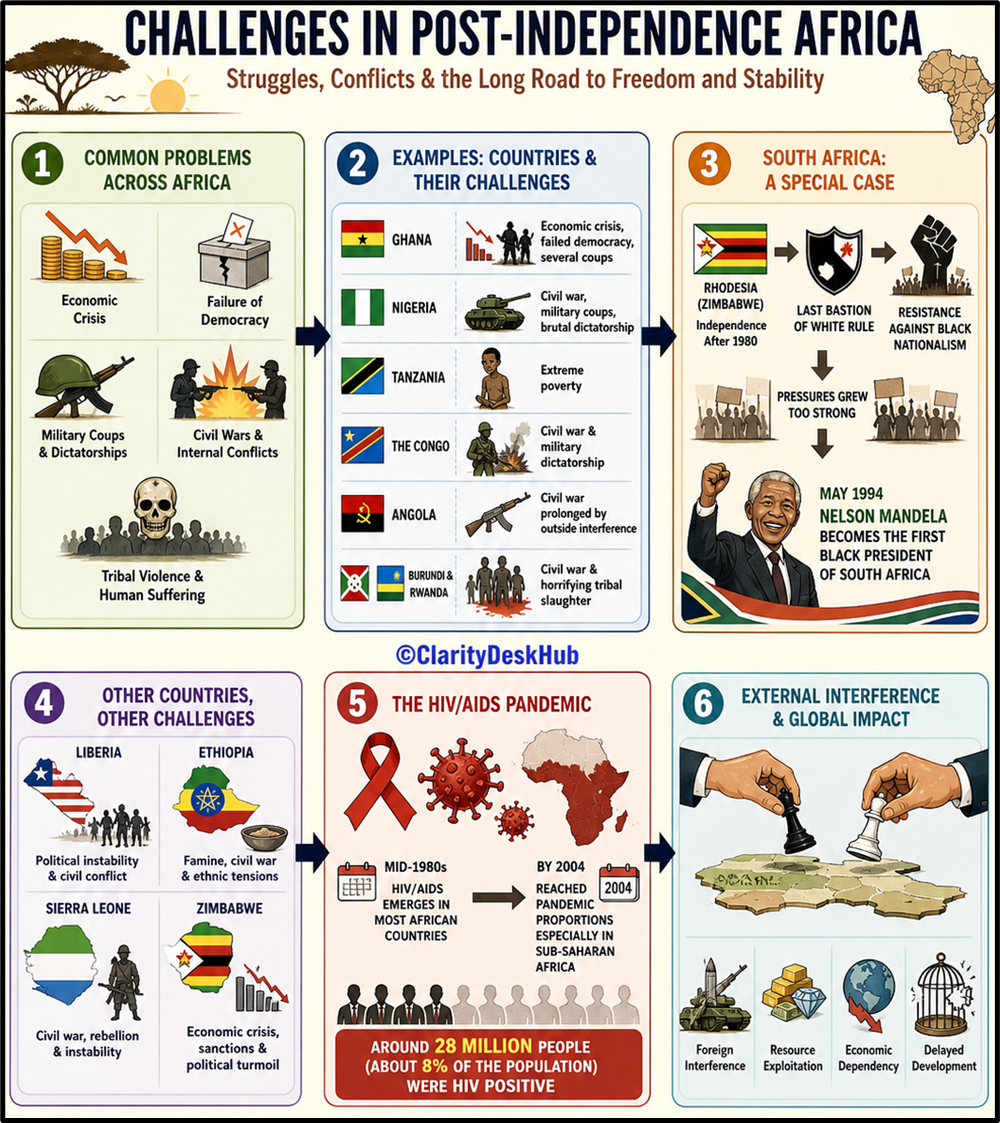
When we look at Africa, we see a continent of immense beauty and resources. However, if you look through the lens of a political scientist or a historian, you will find a “crisis of transition.” The transition from being a colony to a sovereign nation is never easy, but for Africa, it was exceptionally arduous.
Problems common to African States
The Crisis of Identity: Tribalism vs. Nationalism
The first and perhaps most foundational problem was the artificiality of the state.
- The Colonial Legacy: You must understand that the borders of modern African states were not drawn by Africans; they were drawn by Europeans in the late 19th century (most notably during the Berlin Conference of 1884-85). They used rulers and maps, completely ignoring the ethnic, linguistic, and cultural realities on the ground.
- The “Glues” that Failed: During the struggle for independence, diverse tribes united under one banner for a common enemy—the foreign ruler. But once the Europeans left, the “glue” dissolved.
- Tribe over Nation: In many cases, people felt a deeper loyalty to their tribe than to the newly formed nation-state. This was not a “backward” mindset, but a survival instinct in a vacuum of power.
- The Result: This friction led to catastrophic civil wars. In Nigeria (the Biafran War), the Congo, Burundi, and the horrific genocide in Rwanda, we see what happens when tribal identity is weaponized in the struggle for political control.
The Economic Paradox: Wealthy Land, Poor People
Africa is rich in minerals, oil, and land. Why then did it remain “under-developed”? This is what we call a structural economic trap.
A. The “Extraction” Model
The colonial powers never intended to build African economies. They treated colonies as resource farms. They built railways to transport raw materials to the coast, not to connect African cities. Consequently, most states inherited an “Export-Oriented” economy with almost no industrial base.
B. The Trap of Mono-Commodity
After independence, many nations relied on just one or two products for their entire survival.
- Example: Nigeria depended on oil for nearly 80% of its income.
- The Problem: If the global price of oil or copper falls, the entire national budget collapses. It is like a house built on a single pillar; if that pillar shakes, the house falls.
C. Neo-Colonialism and the Debt Trap
Even after political independence, economic independence remained a dream. This is what we call Neo-colonialism.
- African nations needed capital to build schools and hospitals, so they took massive loans from the West.
- To pay back these loans, they had to grow more “cash crops” (like cocoa or coffee) for export, which meant they grew less “food crops” for their own people.
- The Result: A cycle of debt and hunger. Furthermore, during the Cold War, if a country like Angola tried to adopt a Marxist model to break this cycle, it faced military intervention or destabilization from powers who feared Soviet influence.
The Political Vacuum: Democracy vs. Authority
Transitioning from a colonial dictatorship to a parliamentary democracy is like trying to run a marathon before you’ve learned to walk.
- Inexperience: African leaders often had zero experience in running complex democratic institutions. The British or French style of parliament was “imported,” but the “social soil” was not prepared for it.
- The Rise of One-Party States: Many leaders, often influenced by Marxist ideologies or a desire for stability, argued that multi-party democracy was “divisive” (citing tribalism). Countries like Kenya and Tanzania opted for one-party systems. While this sometimes brought stability, it often stifled dissent.
- The “Barrel of the Gun”: When there is no legal way to change a government, the military steps in. Military coups became the standard method of regime change.
- A classic example is Kwame Nkrumah of Ghana—once a hero of Pan-Africanism, he was ousted by his own army in 1966.
The “Lost Decade” (1980s): Disasters and the IMF
By the 1980s, the situation shifted from “difficult” to “disastrous” due to a combination of nature and global economics.
A. Natural Calamity
A severe drought between 1982 and 1985 led to widespread famine and the death of livestock. In a continent where most people depend on agriculture, this was a death blow to the social fabric.
B. The IMF and the “Bitter Medicine” (ESAP)
When these states could no longer pay their debts, the International Monetary Fund (IMF) stepped in. But this help came with strict conditions known as Economic Structural Adjustment Programmes (ESAP).
- The Logic: “Austerity.” Governments were told to stop subsidizing food, devalue their currency, and cut spending on health and education.
- The Human Cost: While these measures were meant to “fix” the economy on paper, in reality, they led to skyrocketing food prices, unemployment, and a decline in the quality of life for the common man.
Critical Analysis: A Multidimensional Perspective
In conclusion, we must not view Africa’s problems as a “failure of the African people.” Rather, it is a failure of the global structure.
- Historiographical View: One school of thought blames internal corruption and tribalism (Internalist view), while another emphasizes the lingering shadows of colonial exploitation and the unfair global trade system (Externalist view). The truth, as is often the case, lies in the interplay of both.
- The Cold War Factor: Africa was often treated as a “chessboard” where the US and USSR played their games, often at the cost of African lives and stability.
The Lesson: For a nation to be truly free, it needs more than just a flag and an anthem; it needs an integrated economy, a unified national identity, and institutions that can withstand the hunger for power. Africa’s journey is a reminder that the path from “Subject” to “Citizen” is long and fraught with challenges.
Why do you think the “one-party state” model was so attractive to early African leaders despite its risks to freedom?