
Confusion and Civil War in Somalia
We now arrive at a case study that is often used—rightly or wrongly—as the ultimate example of a “Failed State.”
Somalia is a fascinating and tragic anomaly in African history. While most African nations struggle because they are composed of many different ethnic groups forced into one border, Somalis are remarkably homogeneous: they share the same language, the same religion (Islam), and the same culture. Yet, they have been torn apart by a factor that predates colonialism: Clanism.
The Dream of “Greater Somalia”
When British and Italian Somaliland united in 1960, the new nation had a specific mission: to bring all Somalis under one flag.
- The Five-Pointed Star: The Somali flag features a star with five points, representing the five regions where Somalis live (including parts of Ethiopia, Kenya, and Djibouti).
- The Border Wars: This desire for unity led to immediate conflict. Somalia fought border skirmishes with Kenya and a full-scale war with Ethiopia (the Ogaden War) in 1977.
- The Cold War Pivot: This is a classic Cold War story.
- Originally, the USSR backed Somalia. But when Somalia invaded Ethiopia (which had also become Marxist), the USSR switched sides to back Ethiopia.
- Somalia turned to the USA, but the Americans, wary of Barre’s aggression, provided little help. The invasion failed, and Barre’s prestige never recovered.
Siad Barre and the Clan Collapse (1969–1991)
Major-General Siad Barre tried to replace “Clanism” with “Scientific Socialism.” He even made it a crime to ask someone what clan they belonged to.
- The Irony of Dictatorship: Despite his rhetoric, Barre eventually fell back on his own clan (the Marehan) to maintain power.
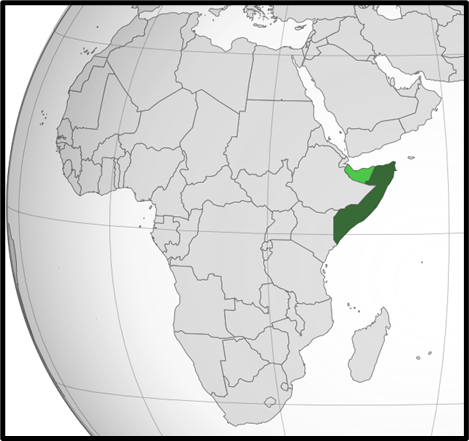
- The Explosion: In 1991, a coalition of clans finally ousted him. But once the “common enemy” was gone, the clans turned on each other. The country shattered into fiefdoms ruled by warlords. The north (Somaliland) declared independence, creating a stable but unrecognized state that persists to this day.
“Black Hawk Down” and the UN Failure
In the early 1990s, the world watched as hundreds of thousands of Somalis starved while warlords hijacked food aid.
- UNOSOM: The UN sent troops to protect food shipments.
- The Battle of Mogadishu (1993): The USA tried to capture a specific warlord, General Aided. The mission went disastrously wrong, resulting in the death of 18 US Rangers and the infamous dragging of American bodies through the streets.
- The Withdrawal: President Clinton pulled out, followed by the UN. This left a “scar” on Western foreign policy; for the next decade, the West was terrified of intervening in African conflicts (a hesitation that contributed to the tragedy of the Rwandan Genocide just a year later).
The Rise of the Islamists and Al-Shabaab
With no central government, a new force emerged to provide “order”: the Islamic Courts Union (ICU). They used Sharia law to bring a semblance of peace to Mogadishu in 2006.
- The Ethiopian Invasion (2006): Fearing a radical Islamic state on its border, Ethiopia (with US backing) invaded and ousted the ICU.
- Radicalization: This intervention backfired. The moderate wing of the ICU fled, but the radical youth wing—Al-Shabaab—remained to fight a guerrilla war. They pledged allegiance to al-Qaeda and began a campaign of terror that reached as far as Uganda.
Modern Somalia: Piracy and Fragile Hope
By the 2010s, Somalia was struggling with two “stateless” industries: Terrorism and Piracy.
- The Pirates: Because there was no coast guard, foreign ships overfished Somali waters and dumped toxic waste. Somalis responded by hijacking commercial vessels for ransom, turning the Gulf of Aden into the most dangerous waters on Earth.
- The Academic Presidents: Since 2012, there have been efforts to move toward a “more moderate” leadership, with academics like Hassan Sheikh Mohamud taking the helm. These leaders face a country where the “government” often only controls a few blocks of the capital, while Al-Shabaab and regional warlords control the rest.
Critical Analysis: Is the Nation-State the Problem?
Somalia forces us to ask a difficult question: Does every “people” need a single central government?
- The Clan Reality: In Somalia, the clan is the social safety net. When the state (Barre) tried to destroy the clan, the people felt threatened.
- The Proxy War Trap: Somalia has been a playground for foreign interests—the USSR, USA, Ethiopia, and Al-Qaeda. Each intervention has often made the internal situation worse.
- The Somaliland Example: Interestingly, the northern region (Somaliland) has been peaceful and democratic for decades without international recognition. This suggests that “bottom-up” peace built by local elders is more effective than “top-down” peace imposed by the UN or foreign armies.
As we look at the total collapse of the Somali state in 1991, do you think the “warlords” were the cause of the problem, or were they just the natural result of a people who had been oppressed by a central dictator for too long?