
UPSC CURRENT AFFAIRS — 26 OCTOBER 2026
1. Defining Journalists: The National Media Council Debate
(POLITY AND GOVERNANCE) (TH) The Supreme Court, hearing a PIL on protecting freelance journalists after the October 2026 protests in New Delhi, questioned how a “journalist” should be defined in the digital age and flagged the need for a national protocol and a unified regulatory framework. This has revived the demand for a National Media Council (NMC).
How Media Is Regulated Today
| Medium | Regulator / Law | Key limitation |
| Press Council of India (Press Council Act, 1978) | Moral watchdog; no punitive powers; excludes TV and digital | |
| TV | NBDSA (self-regulation by the NBDA); Cable Television Networks (Regulation) Act, 1995 | Self-regulation criticised for TRP-driven sensationalism |
| Digital / OTT | IT Act, 2000 (Sections 69A, 79(3)(b)); IT (Intermediary Guidelines and Digital Media Ethics Code) Rules, 2021 | Alleged executive overreach in blocking and takedowns |
| Films | CBFC under the Cinematograph Act, 1952 | Pre-certification model; separate from news regulation |
A working journalist under the Occupational Safety, Health and Working Conditions (OSHWC) Code, 2020 is a person whose principal avocation is journalism; managerial staff are excluded. Accreditation by the PIB or state DIPs is quota-based, so many genuine freelancers stay outside the system.
Why an NMC Is Being Demanded
- Convergence: one corporate group runs print, TV and digital arms; separate regulators leave gaps.
- Definition problem: smartphone “reel makers” and professional reporters are hard to tell apart.
- Weak watchdog: the PCI is called a “toothless tiger”.
- Misinformation and deepfakes demand a statutory mechanism across all mediums (see Deepfake Regulation).
- Ownership concentration: cross-media monopolies threaten editorial diversity.
Challenges
- Independence: executive control over appointments could turn the NMC into a censorship tool.
- Financial leverage: government advertising (DAVP) can quietly buy compliance. In Bennett Coleman & Co. v. Union of India (1972), the Supreme Court held that financial strangulation of the press violates Article 19(1)(a).
- Licensing risk: punitive powers or mandatory licences may conflict with Article 19(1)(a) and its limits under Article 19(2).
- Industry resistance and the borderless nature of digital platforms.
Way Forward
Co-regulation model ➜ Insulated selection committee ➜ National police protocol ➜ Anti-SLAPP law ➜ Independent ombudsmen
- A co-regulatory NMC blending statutory backing with self-regulation; selection panel insulated from the executive.
- A national protocol so police do not obstruct journalists carrying valid employer ID, whatever their PIB/DIP status.
- Cross-media ownership rules, as TRAI recommended in 2014.
- Anti-SLAPP legislation against Strategic Lawsuits Against Public Participation, which drain journalists financially.
- Global cues: Australia’s News Media Bargaining Code and the EU Digital Services Act.
📖 Read More: Press and Media Freedom in India • Media and Broadcasting Governance • Deepfake Regulation in India
2. Cabinet Secretary: India’s Top Civil Servant
(POLITY AND GOVERNANCE) (IE) Reports say the Cabinet Secretariat declined to take disciplinary action against senior officer Maneesh Garg after Election Commissioners Sukhbir Singh Sandhu and Vivek Joshi complained about internal administrative orders. The episode has focused attention on the office and powers of the Cabinet Secretary.
The Office at a Glance
| Feature | Detail |
| Body | Cabinet Secretariat — apex executive office under the Prime Minister serving the Union Cabinet |
| Head | Cabinet Secretary — senior-most civil servant; ex-officio Chairman of the Civil Services Board; Rank 11 in the Order of Precedence |
| Incumbent | T. V. Somanathan |
| Legal basis | Article 77(3): President makes rules for convenient transaction of Government business |
| Rules administered | Government of India (Allocation of Business) Rules, 1961 and (Transaction of Business) Rules, 1961 |
| Tenure | Extendable up to five years in total under Rule 56(d) of the All India Services (DCRB) Rules, 1958 |
Functions
- Prepares agendas, memoranda and records for the Cabinet and its committees.
- Heads the Committee of Secretaries, resolving inter-ministerial disputes.
- Chairs the Civil Services Board, shaping senior appointments that go to the Appointments Committee of the Cabinet.
- Coordinates crisis response across civil, defence, intelligence and disaster-management agencies.
- Liaises with State Chief Secretaries on Centre–State coordination.
Why It Matters Here
The Election Commission is a constitutional body whose independence rests on its separation from the executive. Disputes over administrative orders touching its functioning raise a basic question — who disciplines whom, and through what channel? The episode tests institutional comity between the executive and a constitutional body; see Election Commission of India.
📖 Read More: Election Commission of India • Civil Services Board • Cabinet Committees • Central Council of Ministers
3. Frontier Nagaland Authority: State-Level Autonomy
(POLITY AND GOVERNANCE) (NOA) The President has granted assent to the Frontier Nagaland Territorial Authority (FNTA) Bill, 2026, passed unanimously by the Nagaland Legislative Assembly. It creates a statutory autonomous body for six eastern districts.
Key Features
- Area: Tuensang, Mon, Longleng, Kiphire, Noklak and Shamator — home to the Konyak, Chang, Phom and Sangtam tribes (Tuensang is the regional hub).
- Nature: a statutory, autonomous executive body; the Nagaland Legislative Assembly retains legislative authority over the region.
- Planning and finance: prepares Annual Development Plans, with its own planning and finance mechanism.
- Funding: State budget allocations by population and area, plus Special Development Grants from the Union Home Ministry.
- Origin: gives effect to a tripartite Memorandum of Agreement of 5 February 2026 between the Centre, the State and the Eastern Nagaland Peoples’ Organisation (ENPO).
Constitutional Context
Nagaland is outside the Sixth Schedule; it enjoys special protection under Article 371A, which safeguards Naga customary law and land. FNTA therefore uses a State law, not a Schedule-based council, to deliver autonomy — a creative use of cooperative federalism.
Significance
- Answers the long-standing ENPO demand for a separate arrangement without dividing the State.
- Targets the eastern districts’ development deficit with ring-fenced funds.
- Offers a template for tribal self-governance outside Schedules V and VI (Scheduled Tribes).
📖 Read More: Schedules of the Constitution • Scheduled Tribes in India • North-East Insurgency Landscape • Federal vs Unitary Government
4. Children in Campaigns: Not a Corrupt Practice
(POLITY AND GOVERNANCE) (TH) The Madras High Court condemned the use of children in political campaigns but held that a child’s appeal to parents is not “undue influence” under the Representation of the People Act, 1951. It urged Parliament to consider making such use a ground for voiding an election.
What the Court Said
- Persuasion by children does not overpower an adult voter’s free will; so it is not undue influence or a corrupt practice under Section 123(2).
- The practice was called “in bad taste” and a “cheap and politically motivated act”.
- Parliament should examine whether it should become a ground for setting aside an election.
Existing Safeguards
- ECI follows a zero-tolerance policy: no children in rallies, holding party flags or shouting slogans. Merely accompanying a parent near a leader is not a violation.
- Parties must comply with the Child and Adolescent Labour (Prohibition and Regulation) Act, 1986; Returning Officers ensure compliance.
The Legal Gap
ECI’s rules are administrative advisories. Section 100 of the RPA, which lists grounds for declaring an election void, has no clause tying such violations to the result. Internationally, the UN Convention on the Rights of the Child separates meaningful civic participation from manipulation and tokenism.
📖 Read More: Election Laws in India • Electoral Reforms • Election Commission of India • NCPCR
5. Agri Welfare Portal: One Window for Farmers
(POLITY AND GOVERNANCE) (PIB) The Union Agriculture Ministry launched an upgraded Agri Welfare Portal, a mobile-friendly single window for schemes, financial assistance and agricultural information.
Highlights
- Single window: schemes, subsidies, rules and digital services on one platform, cutting visits to multiple offices.
- Scheme access: PM-KISAN, AgriStack and PMFBY through a common interface.
- DBT and transparency: online eligibility checks and direct applications reduce intermediaries.
- Light design: works on basic smartphones and weak connectivity; offers weather, seeds, fertiliser and market-price information.
- Ecosystem link: connects FPOs, Primary Agricultural Credit Societies, scientists and start-ups.
- Capacity building: Krishi Vigyan Kendras will train small and marginal farmers.
- Built to the Digital Brand Identity Manual 3.0 and Guidelines for Indian Government Websites.
Why It Matters
Information asymmetry, not just money, keeps small farmers from benefits. A single interface lowers transaction costs and is a practical example of e-governance under Digital India. Digital literacy and connectivity remain the binding constraints.
📖 Read More: PM-KISAN • PMFBY • Farmer Producer Organisations • E-Governance
6. Equity LTCG Tax Review
(ECONOMICS) (IE) The Finance Minister said the government is open to stakeholder debate and review of the Long-Term Capital Gains (LTCG) tax on equities, ahead of the next Union Budget.
What Is LTCG?
A direct tax on profit from selling a capital asset held beyond a prescribed period. For listed equity shares, equity-oriented mutual funds and equity ETFs, the period is 12 months.
How the Tax Evolved
2004: exempt, STT introduced ➜ 2018: 10% above ₹1 lakh ➜ 2024: 12.5% above ₹1.25 lakh
| Parameter | Current position |
| LTCG rate | 12.5% on gains above ₹1.25 lakh a year, plus surcharge and 4% cess |
| STCG rate | 20% (holding up to 12 months) |
| Indexation | Not available |
| Loss set-off | Long-term losses set off only against LTCG; carry forward 8 assessment years |
| STT | Additional cost; not deductible |
| Grandfathering (2018) | Gains up to 31 January 2018 protected |
The Debate
- For review: market participants argue that LTCG on top of STT burdens investors and may weigh on foreign portfolio inflows.
- For retention: the 12.5% vs 20% gap rewards long holding and curbs speculation; the tax broadens the base.
📖 Read More: Union Budget 2026-27 • Capital Market • India’s Securities Market Infrastructure
7. Siang Upper Project: Dam and Geopolitics
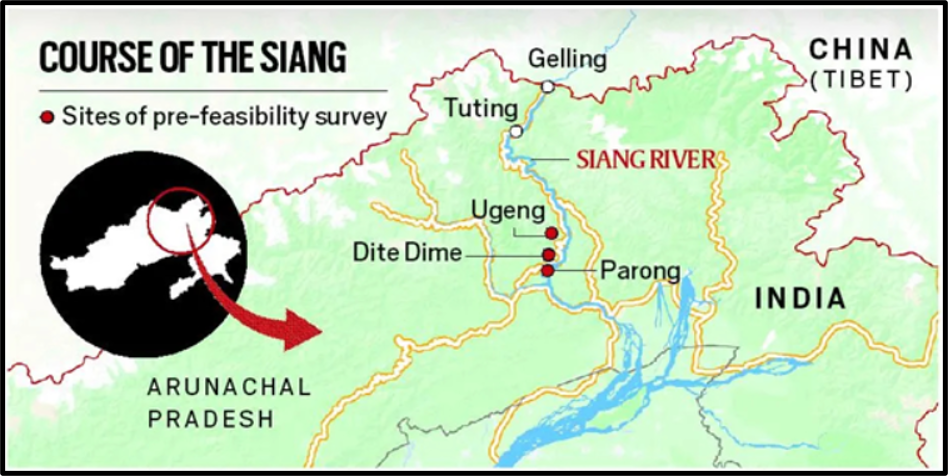
(GEOGRAPHY) (HT) Protests against the proposed Siang Upper Multipurpose Project (SUMP) turned violent in Pasighat, Arunachal Pradesh, with arson at an NHPC office and a police station. The project is pitched as India’s answer to China’s upstream dam on the Yarlung Tsangpo.
The Project
- A proposed hydropower and storage project of roughly 11,000 MW+ (reports cite 11,200 MW) on the Siang, in Siang and Upper Siang districts; sites discussed include Parong, Dite Dime and Uggeng. See SUMP.
- Proposed by NHPC; conceived around 2008 as two stages (6,000 MW and 3,750 MW), later merged.
- Live storage of about 9.2 billion cubic metres (BCM) to buffer sudden upstream releases and moderate downstream floods.
The River System
Yarlung Tsangpo (Tibet) ➜ Siang (Arunachal) ➜ Brahmaputra (Assam) ➜ Jamuna (Bangladesh)
China’s Medog hydropower project on the Yarlung Tsangpo gives it control over flows, silt and flood warnings. Without a binding water treaty, India seeks a storage buffer — a typical river water dispute among upper and lower riparians. See Brahmaputra River System.
Concerns
- Indigenous rights: the Adi community and groups such as SIFF demand consultation through traditional kebang councils and protection of ancestral land.
- Seismic and geological risk: the area lies in Seismic Zone V; fears include reservoir-induced seismicity, landslides and glacial lake outburst floods (earthquake risk).
- Ecology and livelihoods in the upper Siang valley.
Way Forward
Free, prior and informed consent, transparent impact assessments, and a diplomatic push for data-sharing with China (India–China Relations) must run in parallel.
📖 Read More: Brahmaputra River System • River Water Disputes • Earthquakes in India • India–China Relations
8. Keen Sword 27: Japan–US Drills Near Taiwan
(INTERNATIONAL RELATIONS) (DD) Japan and the United States began Keen Sword 27, the largest joint field-training exercise in their history, across waters and islands of south-western Japan. China is watching closely because the drills take place near Taiwan.
What Is Keen Sword?
A biennial, multi-domain joint field training exercise between the Japan Self-Defense Forces and the US Armed Forces, meant to sharpen combat readiness and interoperability. Host: Japan.
Key Features
- About 56,000 Japanese and US personnel, with warships, submarines and combat aircraft.
- Mobile anti-ship missiles and coastal defence systems on Yonaguni and Ishigaki, close to Taiwan.
- Rehearsal of island defence, amphibious recapture, integrated air and missile defence, and civilian evacuation.
- Land, sea, air, cyber, space and electronic-warfare integration.
- Japanese fighters intercepted Chinese reconnaissance aircraft and drones; Chinese ships monitored allied movements near the Miyako Strait.
Why It Matters
- Strengthens deterrence along the First Island Chain and Japan’s forward-defence posture.
- Signals allied readiness amid Taiwan Strait tensions.
- For India: Indo-Pacific stability matters to its sea lanes and to partners such as Japan (India–Japan Relations) while managing India–China Relations.
📖 Read More: India–Japan Relations • India–China Relations
9. SAMHiTA: Digitising Buddhist Manuscripts
(INTERNATIONAL RELATIONS) (DD) India and Sri Lanka launched the SAMHiTA Project at the Gangaramaya Temple, Colombo, to digitise 100 ancient manuscripts, deepening cultural ties around shared Buddhist heritage.
About SAMHiTA
- Full form: South Asian Manuscript Histories and Textual Archive.
- An India-supported heritage initiative implemented by the India International Centre, New Delhi, with Government of India grant support.
- Gangaramaya Temple is Sri Lanka’s first partner, under an MoU signed in July 2026.
- Target: digitise 100 manuscripts on Buddhist traditions, philosophy, languages and culture by November 2026.
Significance
- Preserves fragile texts and widens digital access.
- A tool of cultural diplomacy reinforcing civilisational and people-to-people links (India and Sri Lanka).
- Builds on Buddhism as a shared soft-power asset.
📖 Read More: India and Sri Lanka • Buddhism
10. SARAS Mela Moves to Vijayawada
(SOCIAL JUSTICE) (PIB) The National SARAS Mela 2026 was held in Vijayawada, Andhra Pradesh — the first national edition outside Delhi-NCR — with women entrepreneurs from 34 States and UTs showcasing Self-Help Group (SHG) products under DAY-NRLM.
About SARAS Mela
- A marketing platform under DAY-NRLM linking rural women’s SHGs with consumers and institutional buyers.
- First held in Delhi in 1999; now at national, regional, State and district levels. A total of 117 national melas have been held, with annual sales above ₹200 crore.
- Products: handlooms, handicrafts, natural products, processed foods and regional cuisine; supported by NABARD and NIRDPR.
Digital Reach
Physical Mela ➜ eSARAS marketplace ➜ SARAS Mela Digital App ➜ UPI payments
Lakhpati Didi
An outcome target under DAY-NRLM: SHG women earning at least ₹1 lakh a year, sustained over four agricultural seasons or business cycles. The target rose from 2 crore (2023) to 3 crore (2024), achieved by December 2025; in February 2026 it was raised to 6 crore.
SARAS Melas help SHGs graduate from subsistence to micro-enterprise through branding, buyer links and market access.
📖 Read More: DAY-NRLM • Self-Help Groups
11. AATAL: Reading Polluted Air
(ENVIRONMENT) (ANI) Union Minister Dr Jitendra Singh inaugurated the Integrated Atmospheric Chemistry and Aerosol Toxicity Analysis Laboratory (AATAL) in New Delhi, described as a first-of-its-kind facility. It is run by the Indian Institute of Tropical Meteorology under the Ministry of Earth Sciences.
What It Does
- Real-time source apportionment: separates the contribution of vehicles, industry, stubble burning and secondary aerosols.
- Toxicity profiling: spectrometry of PM₂.₅, ultrafine particles, toxic metals and carcinogens — measuring health risk, not just mass.
- Multi-pollutant tracking: VOCs, SO₂, NOₓ and ozone, and how they form secondary particles and winter smog.
- AIRWISE link: IITM’s decision-support system gives 400-metre-resolution air-quality forecasts for 72 hours.
Why It Matters
Measure composition ➜ Identify source ➜ Target GRAP curbs ➜ Reduce health risk
Source-specific data lets CAQM and city bodies replace blanket bans with targeted action under GRAP, and supports early health warnings for respiratory and cardiovascular illness. See Prevention and Control of Air Pollution.
📖 Read More: Prevention & Control of Air Pollution
12. Hydroseeding: Greening Mined Land
(ENVIRONMENT) (NIE) Tata Steel introduced hydroseeding at its West Bokaro Division, Ramgarh (Jharkhand), covering over 50 acres of mined land, nurseries and overburden dumps — reported as a first in the State.
What Is Hydroseeding?
A mechanised method that sprays a slurry of seeds, mulch, fertiliser, tackifier binder and soil conditioners on bare ground using high-pressure equipment.
Mix slurry in tank ➜ Spray under pressure ➜ Mulch crust holds moisture ➜ Seeds germinate ➜ Roots bind soil
Advantages
- Reaches steep slopes and dumps without workers climbing hazardous ground.
- Mulch and binder cut soil erosion and rain washout.
- Fast, large-area coverage compared with hand planting; customisable with native grass, shrub and legume seeds.
- Lower labour cost and better safety on unstable mine benches.
It is a practical tool for post-mining land reclamation and slope stabilisation.
📖 Read More: Soil Erosion • Mining
13. Kutch’s Swimming Camels in Decline
(ENVIRONMENT) (TH) Kutch’s camel population has crashed from a peak of over 17,600 in 1992 to critically low numbers, and attendance at the traditional Bhed Mata Camel Fair has fallen to under 200 animals, according to reports.
Two Breeds
| Breed | Habitat | Distinct feature |
| Kharai | Coastal mangroves and tidal creeks | “Swimming camel”; crosses creeks to reach mangrove islands (bets) |
| Kutchi | Inland thorn-scrub and the Rann of Kutch | Desert breed of dry grasslands and rocky terrain |
Characteristics
- Feed on mangrove leaves, tree browse and salt-tolerant halophytes.
- Herded by pastoralists such as the Rabaris, Maldharis and Jats under nomadic or semi-nomadic systems.
- Milk is low in fat and rich in insulin-like proteins and vitamin C, valued traditionally for diabetes.
Why They Are Declining
Restricted grazing in mangroves and forests, loss of pasture to industry and salt works, and a shrinking market for camel products squeeze pastoral incomes. Their browsing prunes mangroves and disperses seeds, so their loss affects coastal ecology and cultural identity. Community rights over grazing, in line with forest governance laws, and camel-milk enterprises are possible remedies. See Biodiversity Conservation.
📖 Read More: Biodiversity Conservation • National Initiatives for Biodiversity Conservation • Forest Governance
14. Chemical Signatures: Detecting Disease Early
(SCIENCE AND TECHNOLOGY) (TH) Scientists stress that biomarkers (chemical signatures) can enable early diagnosis of neurological diseases such as Alzheimer’s and Parkinson’s, but accuracy, cost and access hold back routine use.
What Are Biomarkers?
Measurable indicators in blood or cerebrospinal fluid — patterns of proteins, molecules or by-products — that show a normal process, a disease state or a response to treatment. They change at the molecular level long before symptoms appear and are detected using spectrometers and chromatographs.
| Biomarker | Disease | Indicates |
| Tau (p-tau217) and amyloid-beta | Alzheimer’s disease | Plaques and tangles in the brain |
| Alpha-synuclein | Parkinson’s disease | Misfolded protein clumps |
| Neurofilament light (NfL) | Many neurological disorders | Non-specific nerve-cell damage |
| Neuronal surface antibodies | Autoimmune encephalitis | Immune attack on brain proteins |
India’s Efforts
- GenomeIndia Project: funded by the Department of Biotechnology; whole-genome sequencing of over 10,000 people to find population-specific markers.
- BHARAT Study (IISc, Longevity India Programme): builds a “Bharat Baseline” of ageing biomarkers so India is not reliant on Western references.
Challenges
- Low specificity; age, kidney function and drugs alter levels.
- High cost and metro-centric infrastructure.
- No uniform laboratory standards.
- “Patients-in-waiting” anxiety and risks of insurance or employment discrimination.
Way Forward
Support indigenous low-cost reagents, standard protocols from ICMR and CDSCO, strong genetic-data privacy rules, and district-level diagnostic capacity. See Biotechnology in Healthcare.
📖 Read More: Biotechnology in Healthcare
15. Ashoke Sen Wins Oskar Klein Medal
(SCIENCE AND TECHNOLOGY) (TH) Theoretical physicist Ashoke Sen has been awarded the Oskar Klein Medal (2026) for work on string theory, quantum gravity and black-hole physics; he is reported to be the first Indian recipient.
The Medal
Instituted in 1988 to honour Swedish physicist Oskar Klein, it recognises outstanding contributions to theoretical physics. Klein extended Theodor Kaluza’s idea — Kaluza–Klein theory — of a fifth dimension to unify gravity and electromagnetism, a precursor of string theory.
Ashoke Sen’s Work
- S-duality: apparently different descriptions of strong and weak coupling can be mathematically equivalent.
- Sen conjectures (1999): on tachyon condensation and unstable D-branes.
- String field theory and counting microscopic quantum states to explain black-hole entropy.
- Affiliated with ICTS, Bengaluru; earlier honours include the Shanti Swarup Bhatnagar Prize, Padma Shri, Padma Bhushan, the Breakthrough Prize and the Dirac Medal.
String theory proposes that fundamental particles are tiny vibrating strings, aiming to reconcile quantum mechanics with general relativity. It remains experimentally unverified. See Particle Physics.
📖 Read More: Particle Physics
16. PHP2Shell: Cracks in the Web’s Backbone
(INTERNAL SECURITY) (BBC) Two critical flaws in PHP, collectively called PHP2Shell (CVE-2026-109618 and CVE-2026-109619), prompted precautionary shutdowns of websites and services worldwide, with a reported severity score of 9.2/10.
The Vulnerabilities
| CVE | Flaw | Risk |
| CVE-2026-109618 | Improper handling of out-of-memory errors | Memory corruption during request processing |
| CVE-2026-109619 | Use of previously freed memory | Unauthenticated Remote Code Execution (RCE) |
- PHP is an open-source server-side language reported to power about 70% of websites.
- Attackers have tried to install variants of the Mirai botnet through the flaws.
- The flaws were reportedly found through AI-assisted code analysis — a dual-use tool for defenders and attackers.
- Effects: services paused by Wikipedia, some governments and telecoms; SoftBank temporarily suspended Japan’s disaster alerts.
Lessons for India
Flaw disclosed ➜ Exploit attempts ➜ Emergency patching ➜ Service shutdown risk
- Legacy systems in Critical Information Infrastructure (CII) were built for function, not security, and are vulnerable to AI-generated exploits.
- CERT-In advisories, rapid patching and user vigilance against phishing are essential (India’s Cyber Security Framework).
📖 Read More: Global and Emerging Cyber Security Challenges • India’s Cyber Security Framework