
Genocide in Burundi and Rwanda
We now arrive at a chapter that is perhaps the most painful in the entire history of modern Africa. If the Congo was about colonial abandonment and Angola was about Cold War greed, Burundi and Rwanda represent the ultimate failure of the “Human Conscience.”
Here, we see how ethnic differences, which had existed for centuries in relative balance, were poisoned by colonial “divide and rule” tactics, eventually leading to the darkest crime known to humanity: Genocide.
The Anatomy of a Tragedy: Tutsi and Hutu
To understand these two small nations, you must understand the social stratification that the Belgians left behind.
- The Tribes: There are two main groups:
- the Hutu (the majority, traditionally farmers) and
- the Tutsi (the minority, traditionally cattle-owning elites).
- The Colonial Poison: The Belgians did not just observe these differences; they solidified them. They issued ethnic ID cards and favored the Tutsi as the “natural rulers,” creating a deep, simmering resentment among the Hutu majority.
- The Definition of Conflict: The word “Tutsi” meant “rich in cattle,” while “Hutu” meant “servant.” Independence in 1962 didn’t bring peace; it brought a reversal of power, turning neighbors into mortal enemies.
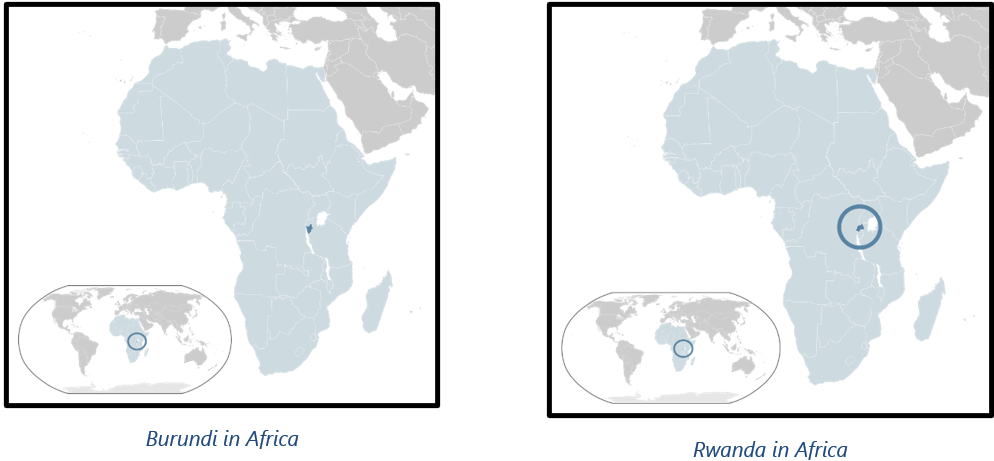
Burundi: The “Forgotten” Massacres
While Rwanda often captures the headlines, Burundi’s history is a mirror image of the same horror.
- The 1972 Uprising: A Hutu rising against the Tutsi elite led to a savage crackdown where over 100,000 Hutus were systematically killed. This was a “precursor” to the larger genocides.
- The Cycle of Reprisals: In 1993, Burundi held its first democratic election. A Hutu president was elected, only to be murdered by Tutsi soldiers months later. This triggered a chaos that left 50,000 dead and the economy in ruins.
- The Peace Process: It took the mediation of African giants like Julius Nyerere and Nelson Mandela to bring a power-sharing agreement in 2001 (The Arusha Accords).
- A Glimmer of Hope: President Pierre Nkurunziza (2005) managed to reach a ceasefire with the last rebels. He focused on “grassroots” leadership—meeting villagers and providing free primary education—showing that even in the most broken societies, a “born-again” approach to peace is possible.
Rwanda: 100 Days of Darkness (1994)
In 1994, Rwanda experienced a level of slaughter that the modern world had promised would “never again” happen.
A. The Spark
The presidents of both Rwanda and Burundi (both Hutu) were killed when their plane was shot down over Kigali in April 1994. Extremist Hutu militias (the Interahamwe) used this as a signal to launch a pre-planned “Final Solution.”
B. The Genocide
In just 100 days, roughly 800,000 people (mostly Tutsis and moderate Hutus) were murdered.
- The Method: This was a “low-tech” but highly efficient genocide. Neighbors killed neighbors with machetes. Churches, once places of sanctuary, became slaughterhouses where even clergy were complicit.
- The World’s Silence: This is the most damning part. The UN withdrew most of its troops. The USA (scarred by a failure in Somalia) refused to intervene. France and Belgium had intelligence but turned a blind eye. The global community watched the blood run in the streets of Kigali on television and did nothing.
The Kagame Era: Discipline and Development
The genocide ended when the Rwandese Patriotic Front (FPR), led by Paul Kagame, marched into Kigali and drove the Hutu extremist government out.
- Reconciliation vs. Justice: How do you move on when 100,000 people are in jail for murder? Kagame introduced a policy of forgiveness for those who confessed, attempting to heal the nation through “Truth and Reconciliation.”
- The “Singapore of Africa”: Under Kagame’s presidency (2000–present), Rwanda has seen an economic miracle:
- Per capita income doubled.
- Primary education enrollment jumped from 20% to nearly 50%.
- Corruption was crushed, and tourism (safari parks) flourished.
- The “Authoritarian” Price: However, as a student of history, you must see the “other side.” Kagame’s peace is kept with an iron fist. Opposition leaders have been silenced, and journalists killed. The 95% election victories suggest that while there is “calm,” there is very little “representative democracy.”
Critical Analysis: The Historiography of Hate
When we analyze the region, we must ask: Who is responsible?
- The “Internalist” View: Some argue the conflict is an ancient tribal hatred that was inevitable.
- The “Externalist” View (Linda Melvern): This perspective correctly highlights that the genocide was planned, funded, and ignored by international actors. It was a modern political crime, not an ancient tribal one.
- The Institutional Lesson: Rwanda and Burundi show that “Winner-Takes-All” politics is a death sentence in ethnically divided states. Only through “Power-Sharing” and “Consociational Democracy” can these nations survive.
Conclusion:
The tragedy of Rwanda and Burundi serves as a grim reminder that when the international community ignores “small” states because their “interests are not threatened,” they become complicit in the greatest of human failures. Rwanda’s recovery today is a testament to African resilience, but the scars under the surface remain deep.
Having seen the struggles of Ghana, Nigeria, Tanzania, the Congo, Angola, and now Rwanda—do you think the “European Model” of a Nation-State was fundamentally incompatible with African social realities?
One Comment