
UPSC CURRENT AFFAIRS — 12 OCTOBER 2026
Judges at Arm’s Length: Why the ONOE Panel’s Supreme Court Meeting Was Called Off
(POLITY AND GOVERNANCE) (TH) A proposed interaction between the Joint Parliamentary Committee (JPC) examining the ‘One Nation, One Election’ (ONOE) Bills and sitting judges of the Supreme Court has been dropped. Opposition members objected that judges who may later hear challenges to the law should not be consulted on it — a classic separation of powers question.
What exactly happened
- The plan: The JPC, chaired by BJP MP P.P. Chaudhary, was to discuss the Bills with the Chief Justice of India and other judges in early October 2026.
- The objection: Opposition MPs called it unprecedented, since the same Bench could later test the validity of these very amendments through judicial review.
- The outcome: The Supreme Court conveyed that no such meeting would take place, and the JPC dropped the visit.
The Bills under examination
The Constitution (129th Amendment) Bill, 2024 and the Union Territories Laws (Amendment) Bill, 2024 were introduced in the Lok Sabha in December 2024 and referred to a JPC. They follow the report of the High-Level Committee chaired by former President Ram Nath Kovind (constituted September 2023; report March 2024).
| Provision | What it does |
| New Article 82A | Empowers simultaneous elections to the Lok Sabha and all State Legislative Assemblies |
| Amendment to Articles 83 & 172 | A House elected after premature dissolution serves only the unexpired part of the original five-year term |
| Election deferment | ECI may recommend that a particular Assembly poll be deferred; its term still ends with the Lok Sabha’s |
| Amendment to Article 327 | Adds ‘conduct of simultaneous elections’ to Parliament’s law-making powers on elections |
| Local bodies | Panchayats and Municipalities are kept outside the present Bills |
India held simultaneous elections from 1951–52 to 1967, after which premature dissolutions broke the cycle. Supporters cite lower costs and fewer disruptions from the Model Code of Conduct; critics raise federalism and accountability concerns.
Separation of powers: the Indian version
The idea traces to Montesquieu’s The Spirit of the Laws (1748): power divided among the Legislature, Executive and Judiciary prevents tyranny. India does not follow ‘watertight compartments’ like the US, but a functional separation backed by checks and balances.
| Constitutional anchor | Significance |
| Article 50 | DPSP directing separation of the judiciary from the executive in public services |
| Articles 121 & 211 | Bar Parliament and State Legislatures from discussing the conduct of judges in the discharge of duties |
| Articles 122 & 212 | Courts cannot question the validity of legislative proceedings on grounds of irregular procedure |
| Article 143 | President may seek the Supreme Court’s advisory opinion on questions of law or fact |
| Basic structure | Recognised as a basic feature in Kesavananda Bharati (1973) and reiterated in Indira Nehru Gandhi v. Raj Narain (1975) |
Parliament makes law ➜ Executive implements ➜ Judiciary reviews validity ➜ Prior consultation = risk of pre-judgment
Why consulting sitting judges is problematic
- Pre-judgment: Judges who shape a Bill may later have to rule on it — a conflict of interest that offends the principle that no one should be a judge in their own cause.
- Public trust: Closed-door meetings with a political committee can create a perception of alignment, eroding confidence in judicial neutrality.
- A formal route exists: Article 143 lets the President seek the Court’s opinion on record, rather than through informal briefings.
Way forward
- Use independent expertise: Parliamentary committees can consult former judges, the Attorney General (Article 76), the Law Commission and scholars.
- Codify protocols: The Rules of Procedure can spell out that committees will not seek inputs from sitting judges on pending legislation.
- Respect institutional distance: The episode itself sets a useful precedent of self-restraint on both sides.
📖 Read More: Basic Structure of the Constitution • Judicial Review • Parliamentary Committees • Electoral Reforms
One to Three, and Back Again: How the Election Commission Became a Multi-Member Body
(POLITY AND GOVERNANCE) (IE) Protests in Delhi demanding the removal of Chief Election Commissioner Gyanesh Kumar continued for a second day on 11 October 2026, with police detaining thousands. The episode has revived interest in how the Election Commission of India (ECI) is structured and protected.
Constitutional basis
The ECI is a permanent constitutional body set up on 25 January 1950. Under Article 324, it holds the superintendence, direction and control of elections to Parliament, State Legislatures and the offices of President and Vice-President. Article 324 does not fix the number of members — the President decides it from time to time.
Evolution at a glance
| Phase | What happened |
| 1950–1989 | Single-member body headed by the CEC |
| October 1989 | Two Election Commissioners — S.S. Dhanoa and V.S. Seigell — appointed before the 9th Lok Sabha polls amid differences with CEC R.V.S. Peri Sastri |
| 1990 | V.P. Singh government rescinded the notification; the Supreme Court dismissed Dhanoa’s challenge (S.S. Dhanoa v. Union of India), but observed that a multi-member body needs rules of business |
| 1991 | CEC and ECs (Conditions of Service) Act, 1991: CEC given Supreme Court judge status; ECs given High Court judge status |
| October 1993 | P.V. Narasimha Rao government appointed M.S. Gill and G.V.G. Krishnamurthy; an Ordinance renamed the law the Election Commission (Conditions of Service of Election Commissioners and Transaction of Business) Act, 1991 |
| July 1995 | T.N. Seshan v. Union of India: five-judge Bench upheld the multi-member structure and the equality of all three members |
| 2023 | Anoop Baranwal v. Union of India (March 2023) and the new CEC and Other ECs Act, 2023, which created a selection committee and replaced the 1991 Act |
Single member (1950) ➜ Three members (1989) ➜ Back to one (1990) ➜ Three members (1993) ➜ Upheld (1995)
Decision-making and safeguards
- Rules of business: Sections 9, 10 and 11 (added in 1993) required unanimity where possible and a majority view in case of disagreement.
- Tenure: Six years or up to age 65, whichever is earlier; salary and perks on par with Supreme Court judges.
- Removal: Under Article 324(5), the CEC can be removed only like a Supreme Court judge; other ECs only on the CEC’s recommendation.
- Budget: The Commission’s Secretariat has an independent budget, finalised directly with the Union Finance Ministry.
- Appointment (2023 Act): A selection committee of the Prime Minister, the Leader of Opposition (or leader of the largest Opposition party) in the Lok Sabha and a Union Cabinet Minister nominated by the PM recommends names.
Beyond conducting polls
The ECI has advisory jurisdiction on the disqualification of sitting MPs (Article 103) and MLAs (Article 192). Cases of persons found guilty of corrupt electoral practices are also referred to it for an opinion on whether, and for how long, they should be disqualified.
📖 Read More: Election Commission of India • Electoral Reforms • Types of Bodies in Indian Polity • Elections
Security Without Sacrificing Liberty: The Case for Reforming UAPA
(INTERNAL SECURITY) (TH) The second death anniversary of Delhi University professor G.N. Saibaba (12 October) has renewed calls to reform the Unlawful Activities (Prevention) Act, 1967 (UAPA). Arrested in 2014 and convicted in 2017, he was acquitted by the Bombay High Court in 2024 after a decade in prison and died soon after release.
What the UAPA is
The UAPA is India’s principal anti-terror and anti-secession law. As a special statute, it departs from ordinary criminal procedure — longer police custody, tougher bail and wide executive powers to ban organisations and designate individuals as terrorists. It sits within India’s broader framework for countering terrorism.
How the law evolved
16th Amendment (1963) ➜ UAPA enacted (1967) ➜ TADA lapses (1995) & POTA repealed (2004) ➜ 2004 amendment adds terror provisions ➜ 2008, 2012, 2019 amendments
The 16th Constitutional Amendment (1963), based on the National Integration Council’s advice, allowed reasonable restrictions on freedoms under Article 19(1)(a), (b) and (c) in the interest of sovereignty and integrity. After TADA and POTA ended amid misuse concerns, the UAPA became the main counter-terror statute.
Key provisions
| Provision | What it does |
| Section 2(o) | Defines ‘unlawful activity’, including acts questioning India’s territorial integrity |
| Sections 15–23 | Define and punish terrorist acts and related offences |
| Section 25 | Seizure of property representing proceeds of terrorism, with approval of the DG, National Investigation Agency in NIA cases |
| Section 35 (2019) | Centre can designate individuals, not just organisations, as terrorists |
| Section 43D(2) | Police custody up to 30 days; chargesheet deadline extendable from 90 to 180 days |
| Section 43D(5) | Bail barred if the court finds reasonable grounds that the accusation is prima facie true |
The core concerns
- Process as punishment: In the Bhima Koregaon case (2018), 16 activists and scholars were jailed; eight years on, charges are yet to be framed. Father Stan Swamy died in custody.
- Low convictions: Government data shared in Parliament put the UAPA conviction rate at only around 2% for cases registered between 2016 and 2020.
- Vague definitions: ‘Membership’ of an unlawful organisation is not defined, and terror clauses are broad enough to cover speech or possession of literature.
- Judge-centric bail: Some Benches closely scrutinise chargesheets; others defer to the police version, making outcomes unpredictable.
How the Supreme Court has read the law
| Case | Holding |
| NIA v. Zahoor Ahmad Shah Watali (2019) | At the bail stage, courts must broadly accept the prosecution’s material as it stands and not weigh admissibility in detail |
| Union of India v. K.A. Najeeb (2021) | Section 43D(5) does not oust constitutional courts’ power to grant bail when prolonged custody violates the right to a speedy trial under Article 21 |
| Arup Bhuyan v. State of Assam (2023) | On review, overruled the 2011 view that only ‘active membership’ is punishable; mere membership of a banned outfit can attract liability |
Balancing the two sides
- Security gains: The law has helped the NIA attach terror-linked property, disrupt terror financing networks and ban outfits such as the Popular Front of India.
- Liberty costs: Long pre-trial detention under a stringent bail regime clashes with the maxim that bail is the rule and jail the exception.
Way forward
- Precise definitions: Require an overt act or direct incitement to violence for ‘membership’ and ‘terrorist act’.
- Time-bound trials: Provide default bail if charges are not framed or trial does not begin within a statutory period.
- Meaningful scrutiny at bail: Allow courts to test the quality of evidence, in line with Najeeb.
- Accountability: Create a compensation mechanism for those wrongfully incarcerated and later acquitted.
📖 Read More: Countering Terrorism in India • Legal Architecture of Internal Security • National Investigation Agency (NIA) • Right to Freedom
From Entitlement to Mission: What the Shift from MGNREGA to VB-G RAM G Means
(SOCIAL JUSTICE) (TP) Rural employment data show 20.21 crore person-days generated in July–August 2026 under the new Viksit Bharat–Guarantee for Rozgar and Ajeevika Mission (Gramin) (VB-G RAM G), against 29.77 crore under MGNREGA a year earlier — a fall of 9.56 crore (about 28.5%). The decline has reopened debate on how the rural job guarantee was redesigned.
From MGNREGA to VB-G RAM G
The MGNREGA, 2005 gave every rural household a legal right to at least 100 days of unskilled wage work a year, giving shape to Article 41 of the Directive Principles. The VB-G RAM G Act, 2025 received Presidential assent in December 2025 and replaces it.
| Feature | MGNREGA, 2005 | VB-G RAM G Act, 2025 |
| Days guaranteed | 100 days per household | Not less than 125 days per household |
| Funding | Centre bore 100% of unskilled wages | 60:40 Centre–State; 90:10 for North-Eastern and Himalayan States; 100% for UTs without legislature |
| Seasonal pause | None | States may notify a pause of up to 60 days in peak sowing and harvesting |
| Allocation | Demand-driven | State-wise normative allocation on objective parameters |
| Monitoring | Muster rolls and social audits | Biometric authentication, geo-tagging, real-time dashboards and Gram Sabha social audits |
Arguments for the redesign
- Farm labour: The seasonal pause responds to complaints that public works during peak seasons raised wage bills and caused labour shortages.
- Leakages: Geo-tagging, digital muster rolls and Direct Benefit Transfer aim to curb ghost beneficiaries.
- Durable assets: Emphasis on water management, connectivity and climate-resilient infrastructure over short-lived earthworks.
- Shared ownership: A State share is expected to encourage more careful planning and oversight.
Concerns on the ground
- Weaker safety net: A fixed pause removes the fallback for landless workers whose crops fail during that window.
- Digital exclusion: Poor connectivity and biometric or face-scan failures can turn genuine workers away.
- Fiscal stress: Poorer States may struggle to find their 40% share on time, delaying work and wages — a strain on fiscal federalism.
- Rights to rationing: Tying work to normative allocations risks shifting a demand-based right towards a supply-driven scheme.
- Uneven impact: Rajasthan, Bihar and Odisha reported the sharpest falls in workdays during the transition.
Why it matters
- Rural demand: Wage transfers sustain consumption of food staples and FMCG; lower person-days reduce rural liquidity.
- Wage floor: Assured public work strengthens the bargaining power of landless labourers.
- Women: Women account for over half of person-days, so cuts hit their financial autonomy and female labour force participation.
- SCs and STs: Groups with the least land depend most on manual wage work.
Way forward
- Local calendars: Let Gram Sabhas and Panchayats set pause periods to suit local cropping and rainfall.
- Fail-safe attendance: Back digital systems with offline records; no worker should lose earned wages to an algorithmic rejection, and social audits must stay central.
- Rethink funding: Consider full Central funding of unskilled wages, with cost-sharing for materials.
- Climate convergence: Direct work to water conservation, micro-irrigation and afforestation.
📖 Read More: MGNREGA • Schemes under Ministry of Rural Development • Unemployment • Poverty and Hunger
Rights on Paper, Rights in Practice: National Conclave on Tribal Legal Safeguards
(SOCIAL JUSTICE) (PIB) The Ministry of Tribal Affairs held a two-day National Conclave on ‘Constitutional Rights and Legal Provisions for Tribal Communities’ on 6–7 October 2026 at the SCOPE Complex, New Delhi, to identify hurdles that Scheduled Tribes face in accessing their rights.
About the conclave
- Participants: More than 75 delegates from about 30 States and UTs — senior officers of tribal welfare and revenue departments, along with experts.
- Leadership: Inaugurated by Union Minister of Tribal Affairs Jual Oram; Minister of State Durgadas Uikey joined virtually.
- Themes: Digitisation of records, simpler documentation, online tracking, grievance redressal and stronger inter-State verification, with safeguards against fraudulent claims.
- Aim: Field-level feedback and best practices to frame practical guidelines for simple, transparent and time-bound services.
Constitutional safeguards for STs
| Provision | Safeguard |
| Articles 15(4) & 16(4) | Special provisions and reservation in education and public employment |
| Article 19(5) | Restrictions on free movement and residence allowed to protect ST interests |
| Article 46 | State to promote educational and economic interests of STs and protect them from exploitation |
| Article 244 & Fifth Schedule | Scheduled Areas, Tribal Advisory Councils and Governor’s special powers |
| Article 338A | National Commission for Scheduled Tribes, created by the 89th Amendment (2003) |
| Article 342 | President specifies STs for each State/UT; Parliament can modify the list by law |
Key laws
- PESA Act, 1996: Extends Panchayati Raj to Scheduled Areas and gives Gram Sabhas a central role over resources.
- Forest Rights Act, 2006: Recognises individual and community forest rights to correct historical injustice.
- SC/ST (Prevention of Atrocities) Act, 1989: Protects STs against atrocities, discrimination and exploitation.
Constitutional guarantee ➜ Law & rules ➜ Certificates & records ➜ Field delivery ➜ Real access to rights
Why such dialogue matters
Most tribal grievances arise not from the absence of law but from weak delivery — delays in caste certificates, missing land records and poor awareness. Exchanges between States help replicate what works and close gaps in the last mile of tribal development.
📖 Read More: Scheduled and Tribal Areas • PESA Act, 1996 • Schemes under the Ministry of Tribal Affairs • SCs, STs and OBCs
A Year of Lifting Laggard Districts: PM Dhan-Dhaanya Krishi Yojana Turns One
(ECONOMICS) (PIB) The Prime Minister Dhan-Dhaanya Krishi Yojana (PMDDKY) completed its first year on 11 October 2026. The average composite score of its 100 districts rose from 18.85 in April 2026 to 46.89 in August 2026.
About the scheme
Approved by the Union Cabinet on 16 July 2025 and launched on 11 October 2025, PMDDKY is a six-year mission starting 2025-26. Modelled on the Aspirational Districts Programme, it targets 100 Aspirational Agricultural Districts, with at least one in every State and UT.
- Selection criteria: Low productivity, low cropping intensity and low agricultural credit disbursement.
- Convergence: 36 Central schemes across 11 Ministries/Departments, plus State schemes and private partnerships.
- District Action Plans: Built on baseline surveys, with outcome targets folded into State annual plans.
- Monitoring: 121 indicators (74 output, 47 outcome); monthly district rankings on the PM-DDKY dashboard hosted by NITI Aayog.
- CSR window: The Department of Public Enterprises has included adoption of these districts in CPSE CSR activity for 2026-27 and 2027-28.
Three-tier governance
National Executive Committee (Union Agriculture Minister) ➜ State Samiti (Chief Secretary) ➜ District Samiti (Collector/DM) ➜ District Action Plan
First-year scorecard (April → August 2026)
| Objective | Average score |
| Agricultural productivity | 1.50 → 8.08 |
| Crop diversification & sustainable practices | 4.08 → 10.18 |
| Post-harvest storage capacity | 2.14 → 5.19 |
| Irrigation infrastructure | 1.38 → 4.91 |
| Short- and long-term credit access | 2.40 → 6.53 |
| Governance & service delivery | 7.41 → 12.05 |
| Overall composite | 18.85 → 46.89 |
FPOs as engines of change
- Gadchiroli (Maharashtra): An FPO of 800 members runs a 3 tonnes/hour rice-processing unit and a 900 MT warehouse; turnover ₹1.24 crore in 2025-26.
- Tumakuru (Karnataka): A 750-member FPO supplies ball copra to a French multinational; turnover ₹1.60 crore in 2025-26.
- Jaisalmer (Rajasthan): 1,236 members grow cumin with integrated pest management on 2,000 acres and run solar sprinklers on 500 acres.
- FPO Sangam (December 2025): Over 72 FPOs from 15 States shared practices in natural farming, micro-irrigation and market access.
Significance and challenges
- Targeted approach: Moves from uniform State schemes to district-specific, agro-climatic planning for agricultural productivity.
- Income and resilience: Diversification, water efficiency and value addition can raise farm incomes and climate resilience.
- Challenges: Convergence across 11 Ministries needs strong coordination, and low baseline scores show how far districts still have to go.
📖 Read More: Aspirational Districts Programme • Government Policies in Agriculture Sector • Agriculture and Allied Sectors • Agricultural Productivity
When Mountains Let Go: Nepal’s Gorkha Flash Flood and Lessons for the Indian Himalaya
(GEOGRAPHY) (IE) Early on 11 October 2026, a surge of water, mud, boulders and debris swept through settlements along the Budhi Gandaki river in Nepal’s Gorkha district, damaging homes and infrastructure. Officials suspect a landslide that blocked the Chumke Khola stream above Siuribas, or a temporary blockage near Chekampar, gave way.
What is a flash flood?
A flash flood is a sudden, rapid rise in water with a very high peak, usually within about six hours of the trigger. In mountains it is often caused by a cloudburst, a landslide-dam breach or a glacial lake outburst flood (GLOF).
Why the Himalaya is so prone
- Young, fragile mountains: Fractured rock, steep slopes and high seismicity make slopes prone to landslides.
- Retreating glaciers: As glaciers shrink, lakes form behind moraines — loose heaps of sand, gravel and boulders, not solid rock.
- Thawing ice: Warming weakens the ice that binds rock and debris together, making slopes collapse more easily.
- Loose sediment: A surge picks up gravel and boulders and turns into a dense slurry that can crush bridges and houses.
- Settlements in harm’s way: Roads, hydropower and buildings on narrow riverbeds sit directly in the path of debris flows.
Warming & glacier retreat ➜ Moraine lake / landslide dam ➜ Breach or overtopping ➜ Sediment-laden surge ➜ Downstream damage
India’s recent warnings
| Event | Trigger | Key lesson |
| Kedarnath, Uttarakhand (June 2013) | Extreme rainfall and snowmelt; Chorabari lake overflowed | Pilgrim settlements in valley floors need hazard zoning |
| Leh, Ladakh (August 2010) | Cloudburst | Even cold deserts face sudden floods |
| Chamoli, Uttarakhand (February 2021) | Rock-and-ice collapse in the Rishiganga valley | Hydropower projects need risk-based siting |
| South Lhonak, Sikkim (October 2023) | GLOF down the Teesta basin | The Chungthang dam of Teesta-III was breached — lakes need monitoring |
Wider implications
- Strategic infrastructure: Roads, tunnels and dams in border valleys are repeatedly damaged.
- Downstream siltation: Sediment from Nepal’s rivers raises riverbeds in the Kosi and Gandak plains of north Bihar.
- Transboundary risk: Surges originating in Nepal or Tibet can reach India with little warning, making India–Nepal data-sharing vital.
What needs to be done
- Map and monitor: Identify hazardous lakes and unstable slopes, using satellites and radar that work in all weather — as envisaged in the NDMA guidelines on GLOFs.
- Ground sensors: Satellites alone cannot catch a fast-rising lake; water-level gauges and automated weather stations can give downstream villages hours of warning.
- Lower lake levels: Controlled siphoning, pumping or outlet channels can reduce the risk of a breach.
- Floodplain zoning: Keep permanent buildings off active riverbeds and floodways.
- Prepared communities: Train local volunteers, such as Aapda Mitras, in evacuation and first response — a core part of disaster management.
📖 Read More: Floods: A Natural Hazard • Cloudburst: A Natural Hazard • Landslides: A Natural Hazard • Major Glaciers of Himalayas • NDMA
Missiles over the Desert Kingdom: Saudi Arabia in the Map
(GEOGRAPHY) (HT) Yemen’s Iran-backed Houthi movement struck King Khalid International Airport, Riyadh, on 10 October 2026 — its third attack on the airport in under a week. At least a dozen people were killed and over 300 injured, and the Houthis warned travellers to avoid Saudi airspace.
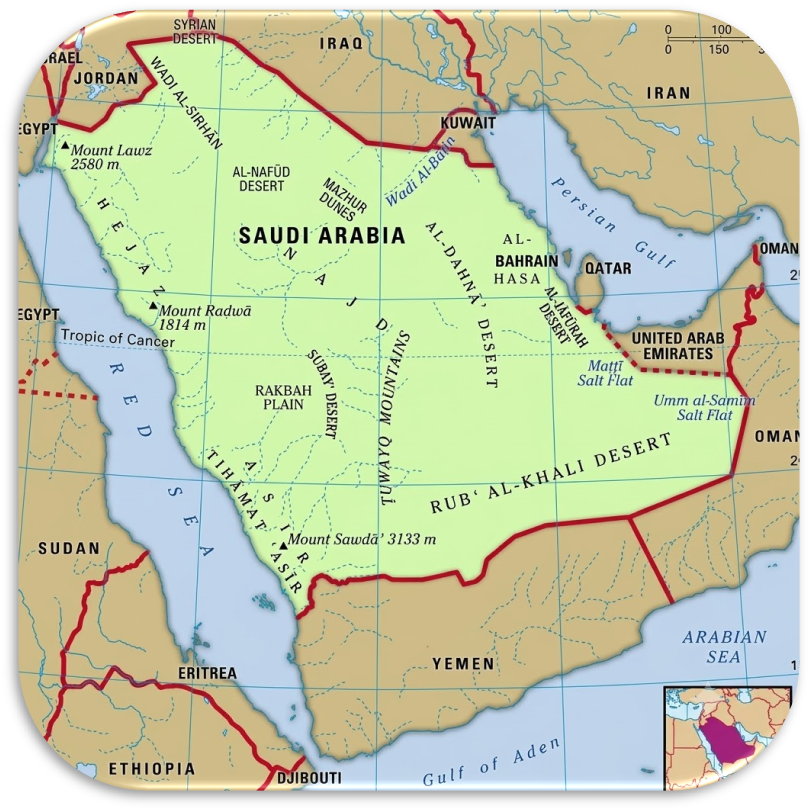
Behind the escalation
- Revived war: The 2022 truce in Yemen has collapsed; the Houthis seized much of the south-western coast, including the port of Mokha, before a Saudi-led counter-offensive began.
- Airports as targets: An 8 October strike killed three people; Dammam’s airport has also been targeted.
- Strained defences: Despite THAAD and Patriot systems, interceptor stocks are a concern after months of regional war.
- Allies: Riyadh invoked a mutual-defence pact with Pakistan and Turkey; Pakistan has deployed troops, though not for Yemen.
Know the country
| Feature | Details |
| Location | Occupies about four-fifths of the Arabian Peninsula, West Asia |
| Capital | Riyadh |
| Land neighbours | Jordan, Iraq, Kuwait, Qatar, UAE, Oman and Yemen; linked to Bahrain by the King Fahd Causeway |
| Water bodies | Persian Gulf to the east; Red Sea and Gulf of Aqaba to the west |
| Deserts | Rub’ al Khali (Empty Quarter) — the world’s largest continuous sand desert — linked to the An-Nafud by the Ad-Dahna belt |
| Relief | Hejaz and Asir (Sarawat) mountains along the Red Sea; Najd plateau and Tuwaiq escarpment in the interior |
| Water | No permanent rivers; depends on wadis, aquifers and desalination |
| Resources | Among the world’s largest proven oil reserves, mainly in the Eastern Province; leading OPEC member |
| Religion | Home to Mecca and Medina, Islam’s two holiest cities, in the Hejaz |
Houthi missile strikes ➜ Airport & airspace closures ➜ Oil-supply & shipping risks ➜ Higher prices & insurance ➜ Pressure on Gulf economies
Why it matters for India
- Energy security: Saudi Arabia is a key crude supplier; disruption raises India’s import bill — a core concern of oil and energy diplomacy.
- Diaspora: Millions of Indians live and work in the Kingdom, and flight disruptions affect them directly — see the Indian diaspora.
- Strategic ties: The crisis tests the India–Saudi Arabia partnership and India’s wider West Asia policy.
📖 Read More: India and Saudi Arabia Relations • India and West Asia Policy • Deserts of Asia • World Distribution of Petroleum
Old Friends at Sea: INS Sahyadri Sails for INDRA-2026 at Vladivostok
(INTERNATIONAL RELATIONS) (NOA) Indian Naval Ship Sahyadri has arrived at Vladivostok, Russia, for the bilateral maritime exercise INDRA-2026 with the Russian Federation Navy, scheduled for 13–18 October 2026.
About the exercise
- Partners: Indian Navy and Russian Federation Navy.
- History: The INDRA naval series began in 2003.
- Format: A harbour phase at Vladivostok (planning, cross-deck visits, professional exchanges) followed by a sea phase in the adjoining Sea of Japan.
- Drills: Surface firings, air-defence drills, tactical communication and seamanship evolutions to improve interoperability.
- Ship: INS Sahyadri is an indigenously built Shivalik-class stealth frigate.
Strategic significance
- MAHASAGAR: The Ministry of Defence links the deployment to India’s MAHASAGAR vision of security and growth across regions.
- Pacific presence: Operating in the Sea of Japan extends India’s naval reach into the north-western Pacific.
- Partnership: It builds on the ‘Special and Privileged Strategic Partnership’ and the momentum of the 23rd India–Russia Annual Summit (December 2025).
Harbour phase (Vladivostok) ➜ Sea phase (Sea of Japan) ➜ Interoperability ➜ Stronger strategic partnership
📖 Read More: India – Russia Relations • Maritime Foreign Policy Strategy • Coastal and Maritime Security
Counting the Tallest Flier: India’s First Synchronised Sarus Crane Census
(ENVIRONMENT) (DTE) The Bombay Natural History Society (BNHS) has announced a synchronised, nationwide All-India Sarus Crane Survey to set a population baseline, map strongholds and priority landscapes, and guide wetland and farmland policy for India’s tallest flying bird.
About the survey
- Method: Simultaneous counts at Sarus habitats across States, with volunteers reporting sightings by email.
- Partners invited: State Forest Departments, research bodies, farmers, colleges and citizen scientists; the Union Environment Ministry has been called upon to support it.
- Why now: Older estimates (8,000–10,000 birds in India) cannot be compared with recent State counts — Uttar Pradesh alone reported nearly 20,000 in 2024.
Know the species
| Feature | Details |
| Scientific name | Antigone antigone |
| Distinction | World’s tallest flying bird (up to about 1.5 m); India’s only resident breeding crane |
| Looks | Grey plumage with a bare red head and upper neck |
| Habitat | Marshes, jheels, flooded paddy fields and canals in human-dominated farmland |
| Behaviour | Lifelong pairs; dancing courtship displays; breeds in the monsoon and is non-migratory |
| Range today | Mainly Uttar Pradesh, Gujarat, Rajasthan, Madhya Pradesh and Haryana; isolated birds in Maharashtra |
| Status | IUCN: Vulnerable; CITES Appendix II; Schedule I of the Wild Life (Protection) Act, 1972 |
| Symbol | State bird of Uttar Pradesh |
Threats
- Habitat loss: Drainage and degradation of wetlands and changes in cropping.
- Power lines: Collisions and electrocution with overhead lines.
- Chemicals: Pesticide and agrochemical poisoning.
- Disturbance: Egg and chick collection, poaching, and predation by free-ranging dogs.
The State of India’s Birds report places the Sarus among species in long-term decline. Because it thrives in farm wetlands, it is a good indicator of healthy agro-ecosystems — and farmers who guard nests show how agriculture and conservation can coexist.
📖 Read More: Species of Conservation Concern: Birds • Wetland Ecosystem • Ramsar Sites in India • Wild Life (Protection) Act, 1972
Hot Water, Wrong Sex: How Warming Turns Frog Sex Reversal into an Extinction Risk
(ENVIRONMENT) (TH) A study of wild agile frogs (Rana dalmatina) in Hungary, published in Science Advances in September 2026, finds that heat-induced sex reversal lowers breeding success and could push small populations towards extinction as the climate warms.
What is sex reversal?
Sex reversal occurs when an animal develops the reproductive organs and traits of the sex opposite to its chromosomes. Sex is normally set genetically — XX/XY in mammals and many frogs, ZZ/ZW in birds and some reptiles — but in cold-blooded animals, high temperatures during early development can override those signals.
Genetic sex (XX or XY) ➜ Heat during larval stage ➜ Hormonal signals disrupted ➜ Opposite phenotypic sex
| Group | Examples |
| Amphibians | Agile frog, wood frog, common frog |
| Reptiles | Central bearded dragon and other agamid lizards |
| Fish | Clownfish, wrasses and groupers (natural sex change) |
Key findings of the study
- Hidden females: About 20% of adult males were genetically female (XX).
- Poor breeders: These sex-reversed males sired only about 4% of egg clutches — roughly a fifth of what their numbers suggest.
- Inherited sensitivity: Under heat, 61% of offspring of sex-reversed fathers reversed sex, against 17% for normal fathers.
- Disease link: Heat-exposed froglets of sex-reversed fathers carried higher ranavirus loads.
- Grim projection: In simulations, heat-driven sex reversal alone wiped out populations within about 60–70 years; adding disease brought extinction forward by nearly a decade.
Why it matters
- Skewed sex ratios: Fewer true females means fewer eggs and fewer mates.
- Genetic erosion: Smaller breeding pools raise inbreeding and reduce adaptability.
- Compounding stress: Heat and disease together accelerate decline, adding to the impact of global warming on amphibians, already among the most threatened vertebrates.
📖 Read More: Introduction to Climate Change • Impact of Global Warming • Reproduction
A Global Stamp for a Made-in-India Shield: CERVAVAC Wins WHO Prequalification
(SCIENCE AND TECHNOLOGY) (TP) The World Health Organization has granted prequalification to CERVAVAC, India’s first indigenous quadrivalent human papillomavirus (HPV) vaccine, made by the Serum Institute of India (SII), Pune. Prequalification makes it eligible for procurement by UN agencies.
About the vaccine
- Type: Gender-neutral quadrivalent vaccine against HPV types 6, 11, 16 and 18.
- Co-developers: Department of Biotechnology, BIRAC, WHO’s International Agency for Research on Cancer and the Gates Foundation.
- Ages: Licensed for girls and boys aged 9–26 years.
- Technology: A recombinant vaccine produced in the yeast Hansenula polymorpha; given intramuscularly as a 0.5 ml dose.
- Journey: After approval by the Drugs Controller General of India, its scientific completion was announced on 1 September 2022.
| Age group | Schedule (as per manufacturer) |
| 9–14 years | Two doses, six months apart |
| 15–26 years | Three doses: second after two months, third after six months; all within a year |
Know the virus
HPV is a common sexually transmitted virus. High-risk types 16 and 18 cause most cervical cancers and some vulvar, vaginal and anal cancers; low-risk types 6 and 11 cause most genital warts. Almost all cervical cancers are caused by persistent HPV infection, and the disease is largely preventable through vaccination and screening.
HPV vaccination by 15 ➜ Screening by 35 & 45 ➜ Treatment of disease ➜ Cervical cancer elimination
Why prequalification matters
- Global supply: UN agencies and Gavi can buy an affordable Indian vaccine for low- and middle-income countries.
- WHO targets: Supports the 90-70-90 targets for 2030 — 90% of girls vaccinated by 15, 70% of women screened, and 90% of those with disease treated.
- Self-reliance: Cuts import dependence and costs for India’s own immunisation drive under the National Health Mission.
- Vaccine diplomacy: Reinforces India’s role as a trusted supplier of quality-assured vaccines, a strength of biotechnology in healthcare.
📖 Read More: Biotechnology in Healthcare • Major Human Diseases • Health and Nutrition
A First on the Green: Putul Sonowal Wins India’s Debut Medal at World Bowls Champion of Champions
(SOCIETY) (TB) Assam’s Putul Sonowal won bronze in men’s singles at the 2026 World Bowls Champion of Champions at Club Barham, New South Wales, Australia — India’s first-ever medal at the event.
The event and the result
- The tournament: An annual contest for the national singles champions of World Bowls member nations.
- Group stage: Sonowal topped his group with six wins out of seven.
- Knockouts: He beat Singapore’s Harriman Yuen in the quarter-final, then lost the semi-final to Scotland’s Ian McLean, ranked third in the world.
- Women’s singles: India’s Bangita Hazarika won four of seven group games but did not advance.
Know the sport
Lawn bowls is a precision sport in which players roll biased balls, called ‘bowls’, towards a small target ball, the ‘jack’. India’s women’s fours won a historic gold at the 2022 Commonwealth Games, sparking new interest.
Why it matters
- Beyond mainstream sports: Success in lesser-known disciplines widens India’s sporting base and attracts investment.
- North-East talent: Highlights the growing contribution of athletes from Assam and the North-East.
- Policy lens: Underlines the role of grassroots support and athlete welfare in the governance of sports.
📖 Read More: Governance of Sports in India • Schemes under Ministry of Youth Affairs and Sports