
UPSC CURRENT AFFAIRS — 3 NOVEMBER 2026
1. Why a Strong El Niño Doesn't Always Mean Drought
(GEOGRAPHY) (TH) A strong El Niño is building in the Pacific, with sea-surface temperatures near 2°C above normal, and the 2026 southwest monsoon ended about 13% short (87.4% of the Long Period Average). Yet the record shows that even a severe El Niño does not automatically bring drought to India.
The Normal Pacific Set-up
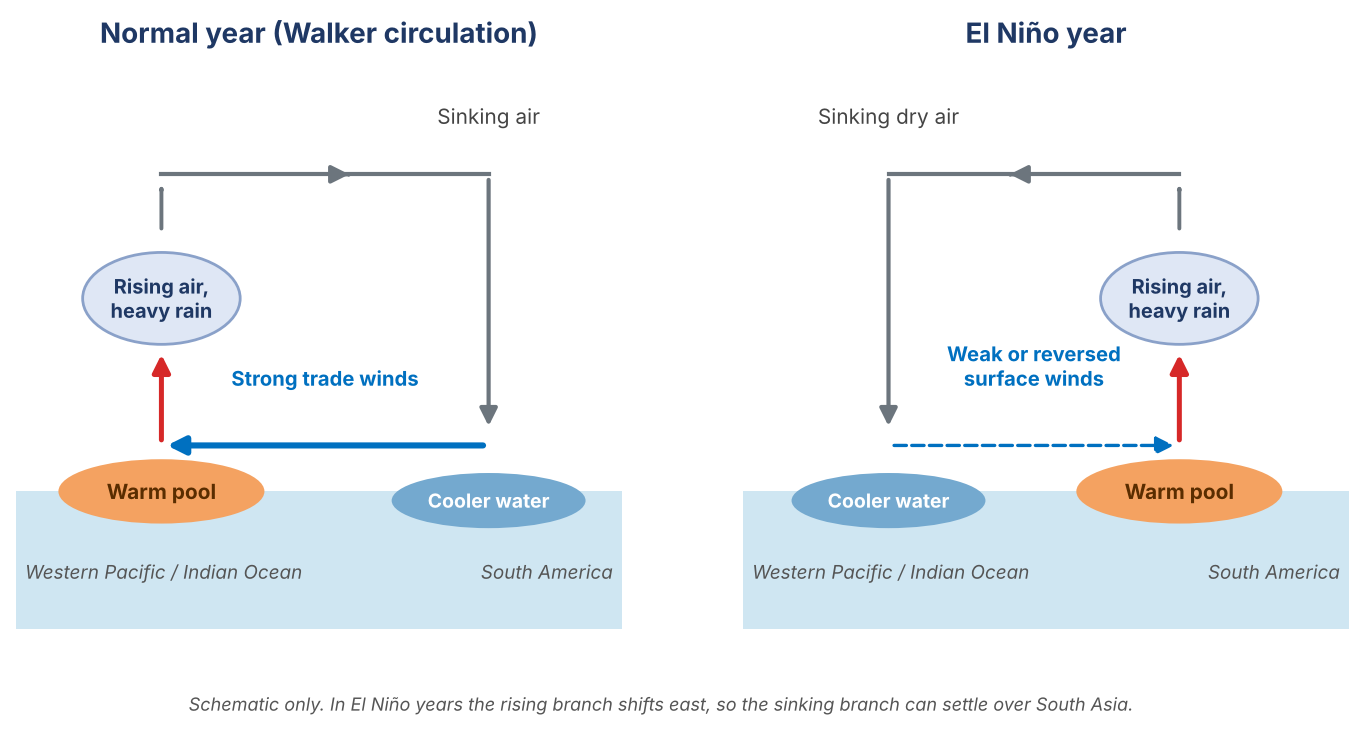
Under normal conditions, trade winds blow east to west across the equatorial Pacific and pile warm water near Indonesia. Warm water there drives deep convection and rain, while cold, nutrient-rich water wells up off South America. This loop is the Walker circulation.
How El Niño Suppresses the Monsoon
Every 2 to 7 years the trade winds weaken or reverse, and the warm pool slides east. Rising air moves with it, so compensating descending air settles over other parts of the tropics, including the Indian subcontinent.
Trade winds weaken ➜ Warm pool shifts east ➜ Rising air moves away from Indonesia ➜
Descending dry air over India ➜ Cloud formation suppressed ➜ Monsoon weakens
Why the Link Is Not Automatic
Since 1950, five of seven moderate or strong El Niño years reportedly brought deficient monsoons. But 1997, a very strong El Niño year (+1.64°C), still delivered normal rain, unlike 2015 and 2026. Four other forces can offset the Pacific signal.
| Factor | How it changes the outcome | Illustration |
|---|---|---|
| Indian Ocean Dipole (IOD) | A sea-surface temperature see-saw between the western and eastern Indian Ocean. A positive IOD warms the west, adds moisture to the Arabian Sea flow and cushions El Niño | A strong positive IOD neutralised the 1997 El Niño; in 2015 the dipole failed to develop |
| Location of the warm pool | Warming in the far eastern Pacific pushes the dry sinking air away from India; warming in the central Pacific (El Niño Modoki) parks it over India | 1997 was eastern-Pacific dominated, so India escaped |
| Madden–Julian Oscillation (MJO) | A 30 to 60 day pulse of clouds and rain that circles the tropics and shapes breaks and revivals within the monsoon | August 2023 was India's driest August in 122 years, then rains revived in September |
| Mid-latitude and Arabian Sea systems | High-pressure ridges over the Iranian plateau or lows over the Arabian Sea can pull moisture inland and override Pacific drying | Cited for 1983 and 1997 |
Why It Matters
- About half of India's net sown area (roughly 51%) is rain-fed, so a weak monsoon quickly hits livelihoods and food security.
- Kharif losses: dry spells during the vegetative phase cut acreage and yields of paddy, pulses and oilseeds.
- Water stress: poor recharge drains reservoirs and aquifers, hurting rabi irrigation and urban supply.
- Inflation: weaker farm output lifts food prices and can prompt export curbs on rice, wheat or sugar.
- Forecasting limits: the non-linear mix of ENSO, IOD and short waves strains seasonal models.
Way Ahead
- Give the Indian Ocean Dipole and intraseasonal waves more weight in the IMD's coupled forecast models, alongside Niño indices.
- Promote short-duration, drought-hardy crops such as millets and pulses in rain-fed zones.
- Expand farm ponds, micro-irrigation and community recharge to drought-proof watersheds.
- Speed up PM Fasal Bima Yojana payouts using satellite and drone-based yield assessment.
El Niño is a major risk factor, not a guarantee of drought. Local ocean–atmosphere interactions can soften or sharpen its impact, so resilient water systems and better multi-ocean models matter more than any single index.
📖 Read More: Walker Circulation and ENSO • Influencing Factors of Indian Monsoon • Mechanism of Indian Monsoon • PMFBY
2. Cryosphere 2026: The Price of Overshooting 1.5°C
(ENVIRONMENT) (DTE) Ahead of COP31 in Antalya (9–20 November 2026), the International Cryosphere Climate Initiative and UNEP released State of the Cryosphere 2026: The Cost of Overshoot. It warns that even a temporary breach of the 1.5°C limit risks irreversible ice-sheet loss and a surge of carbon from thawing permafrost.
What Is the Cryosphere?
The cryosphere is every place on Earth where water is frozen: ice sheets in Greenland and Antarctica, mountain glaciers, seasonal snow, sea ice, lake and river ice, and permafrost. Its bright surface reflects sunlight, and it stores huge volumes of fresh water and carbon, so it acts as a planetary thermostat.
Key Findings of the Report
| Theme | What the report reports |
|---|---|
| Polar and Himalayan warming | The Arctic is warming about four times faster than the global average; the Hindu Kush Himalaya warms 1.8–2.2°C for every 1.5°C of global rise |
| Permafrost carbon | About 14 million sq km of permafrost holds roughly 1,700 billion tonnes of carbon; rapid thaw could release emissions comparable to current annual US output for 100–200 years |
| Ice sheets | Greenland and Antarctica are losing ice about six times faster than in the 1990s |
| Sea level | At 2.8–3.2°C of warming, sea level could rise by up to 5 cm a year by 2150, beyond what coastal wetlands can adapt to |
| Mountain glaciers | A 3°C world could remove most mid-latitude glaciers below 6,000 m and about two-thirds of Hindu Kush Himalayan ice |
| Ocean circulation | Long ice-free Arctic summers and a possible AMOC disruption could alter Atlantic currents and European climate |
| India's GLOF toll | Between 1835 and 2025, India reportedly recorded 6,119 deaths in 62 glacial lake outburst floods |
Why the Ice Is Retreating
Greenhouse gases rise ➜ Surface melt increases ➜ Darker land and water exposed ➜
More sunlight absorbed ➜ Warming accelerates
- Overshoot: the Greenland ice sheet's tipping point is projected near 1.5°C, so crossing it even briefly is risky.
- Warm ocean water under floating ice shelves weakens them from below, as seen at West Antarctic grounding lines.
- Rain-on-snow events and boreal wildfires strip insulating soil and speed deep permafrost thaw.
Why It Matters for India
- Himalayan glaciers feed the Indus, Ganga and Brahmaputra; retreat disturbs dry-season flows and downstream farming.
- Growing glacial lakes behind weak moraines raise the risk of outburst floods that destroy dams, roads and settlements.
- Thawing permafrost turns the Arctic from a carbon sink into a source, locking in global warming for centuries.
Recommendations
- Cap any 1.5°C overshoot near 1.7°C and for no more than about two decades, with global net-zero by 2050.
- Pair emission cuts with large-scale carbon dioxide removal to bring concentrations toward 350–380 ppm.
- Install water-level sensors, lake-siphoning systems and satellite InSAR monitoring at high-risk Himalayan lakes.
- Scale up loss-and-damage and adaptation finance for mountain communities and Arctic peoples.
Holding warming as close to 1.5°C as possible is the only dependable way to avoid cascading tipping points. For India, glacier-hazard monitoring and adaptation finance are now urgent, not optional.
📖 Read More: Impact of Global Warming • Major Glaciers of Himalayas • Floods: A Natural Hazard • IPCC Special Reports • COP30 (Belem, Brazil 2025)
3. Ladakh's Saffron Trial Flowers in Just 30 Days
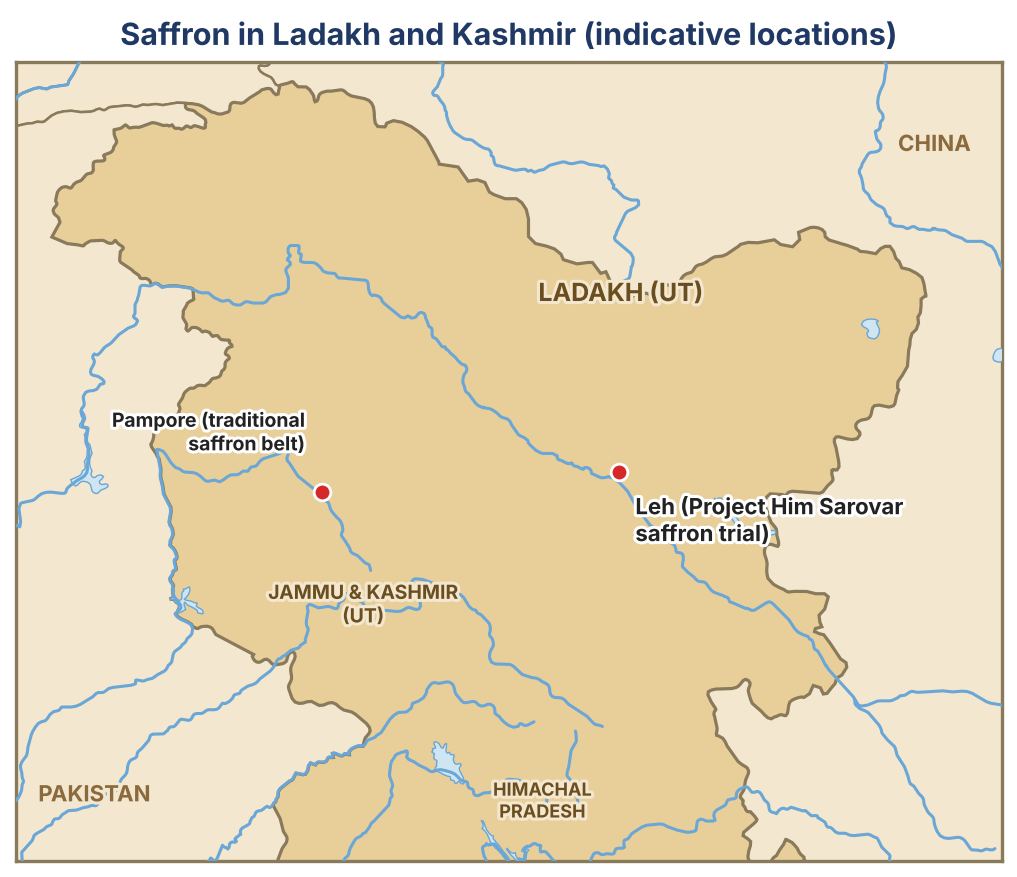
(GEOGRAPHY) (NIE) (LADAKH ADMIN) A pilot saffron plot on barren land revived under Project Him Sarovar in Ladakh produced its first flowers in 30 days, about half the usual two-month cycle. The trial hints that the cold-arid trans-Himalaya could become a new frontier for the world's costliest spice.
About Saffron
| Feature | Details |
|---|---|
| Species | Crocus sativus, a perennial autumn-flowering geophyte of the iris family; the spice is the dried crimson stigma |
| Climate and soil | Cool, dry high-altitude zones at roughly 1,500–2,800 m; well-drained, loose, neutral-to-slightly-alkaline loam with low water retention |
| Propagation | Sterile triploid, so it cannot set viable seed; grown from underground corms planted in late summer |
| Flowering window | Only 2–3 weeks in late October to mid-November; flowers are hand-picked early in the morning |
| Labour intensity | Roughly 1.5–1.75 lakh flowers are needed for 1 kg of dried spice |
| Key compounds | Crocin (colour), picrocrocin (taste) and safranal (aroma) |
Why It Matters
- High returns for small and marginal farmers can turn cold, arid land into productive cropland.
- Extending saffron beyond Kashmir to Ladakh, Himachal Pradesh and Sikkim diversifies production and reduces dependence on one belt.
- The crop is drought-hardy and tolerates snow and sub-zero dormancy, which suits dry plateau microclimates.
- Kashmir saffron already carries a Geographical Indication (GI) tag, granted in 2020; a GI for new regions would need separate registration.
A single pilot proves little. Multi-season trials on yield, stigma quality and water use will decide whether Ladakh can scale up beyond a promising first bloom.
📖 Read More: Agroclimatic Zones • Specialized Horticulture • Intellectual Property Rights
4. Shey-Phoksundo: Nepal's Trans-Himalayan Giant
(GEOGRAPHY) (TP) Six Indian tourists stranded by heavy snowfall at the Numla and Wagla passes, near Phoksundo Lake, were rescued by a private helicopter after two days without contact. The incident spotlights Shey-Phoksundo National Park, the largest national park in Nepal.
Quick Facts
| Parameter | Details |
|---|---|
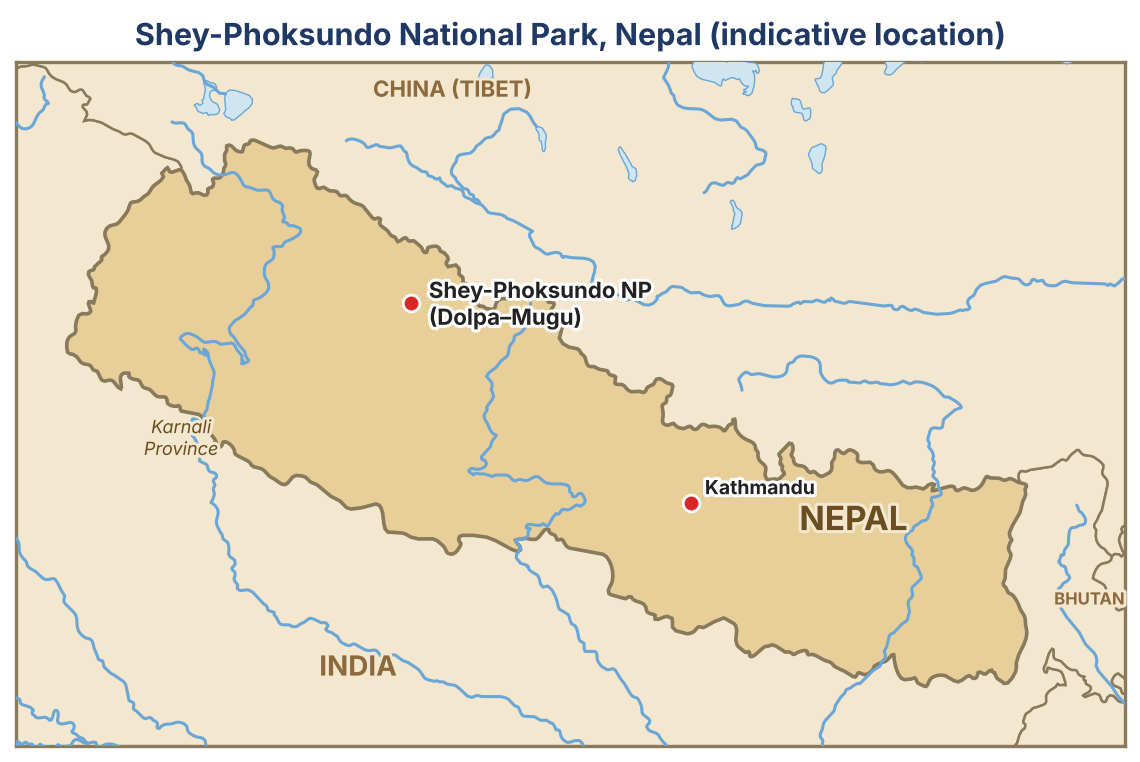
| Location | Dolpa and Mugu districts, Karnali Province, north-western Nepal; headquarters at Palam, Dolpa |
| Area and status | 3,555 sq km; established 1984; a 216 sq km buffer zone was declared in 2006 |
| Altitude | About 2,130 m near Ankhe to 6,883 m at Kanjiroba Himal |
| Phoksundo Lake | Oligotrophic lake at about 3,612 m with turquoise water; a Ramsar site since September 2007 |
| Rivers | Langu, Suligad and Jugdual systems; a waterfall of about 167 m |
| Wildlife | Snow leopard, with prey such as blue sheep, Himalayan musk deer and argali |
| Vegetation | Arid shrubs, juniper and Tibetan-plateau flora in the rain shadow; birch and silver fir in moister southern valleys |
| Culture | Shey Gompa, Ringmo village and the pre-Buddhist Bon-po tradition |
Why It Matters
- It is Nepal's only protected area within the trans-Himalayan ecological zone, making it a key corridor for snow leopards and high-altitude biodiversity.
- It protects agro-pastoral livelihoods, ancient monasteries and pilgrimage routes while supporting sustainable tourism.
- Early-winter snow at high passes shows why trekking in the Himalaya needs weather alerts, permits and rescue capacity.
📖 Read More: India and Nepal • Ramsar Sites in India • National Parks in India
5. Domicile Quotas in Private Jobs: A Constitutional Test
(POLITY AND GOVERNANCE) (TH) The debate over job quotas for locals in private firms has returned. In October 2026 Karnataka moved to revisit the Karnataka State Employment of Local Candidates in the Industries, Factories and Other Establishments Bill, 2024, which had been shelved after industry backlash.
What the Constitution Says
| Provision | Relevance to domicile quotas |
|---|---|
| Article 14 | A geography-based classification struggles to pass the test of "intelligible differentia" and "reasonable classification" |
| Article 15(1) | Bars discrimination on grounds only of religion, race, caste, sex or place of birth |
| Article 16(2) and 16(3) | 16(2) bars discrimination based on residence in public employment; 16(3) lets only Parliament, not States, prescribe residence for specific posts |
| Article 19(1)(d) and (e) | Freedom to move, reside and settle anywhere in India |
| Article 19(1)(g) | Right to practise any profession or carry on any trade; hiring quotas restrict an employer's choice |
| Article 371D | Special local-cadre safeguards for Andhra Pradesh and Telangana, an exception needing a Presidential order |
Courts on Domicile
- In Dr. Pradeep Jain v. Union of India (1984), the Supreme Court stressed that India recognises a single domicile.
- The Punjab and Haryana High Court struck down Haryana's 75% private-sector local-hiring law (for jobs paying up to ₹30,000 a month) in November 2023, warning of "artificial walls" between States.
State passes local-hiring law ➜ Challenged under Articles 14, 16 and 19 ➜ Court tests reasonableness ➜ Law struck down or stayed
Arguments For and Against
| In favour | Against |
|---|---|
| Industries often occupy land acquired from local farmers, creating a duty to offer jobs | Undermines national integration and the spirit of Ek Bharat Shreshtha Bharat |
| Migrants may accept sub-minimum wages, pushing local youth out of work | Retaliatory quotas could fragment the national labour market |
| Agrarian distress and jobless growth create heavy political pressure on States | Raises compliance burden and brings back an "inspector raj" in hiring |
| Eases strain on housing and transport in mega-cities | Skill mismatches can drive capital to States with flexible rules |
| Local-language skills help in service sectors | States lack competence to regulate private hiring by domicile; the effect is indirect circumvention of Article 16 |
Way Forward
- Offer performance-linked incentives to firms that voluntarily hire and train local workers, instead of rigid quotas.
- Scale up vocational training through skilling schemes such as PMKVY 4.0 and the World Bank-assisted STRIVE.
- Spread jobs through One District One Product and Tier-2/3 industrial corridors.
- Back local entrepreneurship via MUDRA and PM Vishwakarma.
- Use the Inter-State Council under Article 263, as the Punchhi Commission (2010) urged, to settle cross-State friction.
Regional job anxiety is real, but rigid private-sector quotas invite constitutional challenge and capital flight. Skills, decentralised industry and cooperative federalism are the durable answers.
📖 Read More: Right to Equality • Regionalism in Indian Society • Inter-State Relations • MUDRA Yojana
6. VB-G RAM G Sets a 15-Day Grievance Deadline
(POLITY AND GOVERNANCE) (ET) The Ministry of Rural Development notified the Grievance Redressal Rules, 2026 under the Viksit Bharat – Guarantee for Rozgar and Ajeevika Mission (Gramin), or VB-G RAM G, which replaced MGNREGA. Every scheme-related complaint must now be resolved within 15 days.
How the Process Works
Complaint filed ➜ Digitised within one working day ➜ Inquiry in 7 working days ➜
Resolved in 15 days ➜ Auto-escalation and appeal
Key Features
| Feature | Provision |
|---|---|
| Time limits | Resolution within 15 days; inquiry by the Grievance Redressal Officer (Gram Panchayat, Block or District) within 7 working days |
| Scope | Work allocation, wage payment, asset quality and muster-roll issues |
| Channels | In person, Speed Post with proof of delivery, helplines or the central grievance portal |
| Non-rejection | Complaints cannot be refused on grounds of format, language or technical defects |
| Digitisation | Same-day or next-working-day entry on the central digital platform with an acknowledgement and tracking number |
| Escalation | Cases pending beyond 15 days go automatically to the next higher authority; appeal lies under the parent Act |
| Dropped clauses | As reported, draft provisions on automatic FIRs for misappropriation and on action-taken reports to Gram and District Panchayats were removed |
Why It Matters
- Time-bound redress protects the wage and employment rights of rural households.
- Digital tracking raises transparency and local accountability.
- Critics may question the removal of the FIR and local-body reporting clauses, which weakens deterrence and social audit links.
📖 Read More: MGNREGA • Sevottam Model
7. PM-KISAN's 24th Instalment Reaches 9.34 Crore Farmers
(ECONOMICS) (PIB) The Government released the 24th instalment of PM-KISAN from Banaskantha, Gujarat, on 30 October 2026. About ₹18,680 crore reached over 9.34 crore farmers through Direct Benefit Transfer.
Scheme at a Glance
| Feature | Details |
|---|---|
| Launch and type | 24 February 2019; Central Sector Scheme, fully funded by the Centre; operational from 1 December 2018 |
| Nodal ministry | Ministry of Agriculture and Farmers Welfare |
| Benefit | ₹6,000 a year in three equal instalments of ₹2,000, sent by DBT to Aadhaar-seeded accounts |
| Beneficiary | Landholding farmer family (husband, wife and minor children), subject to exclusions |
| Continuation | As reported, approved for 2026–27 to 2030–31 with an outlay of ₹3.15 lakh crore |
| Who is excluded | Institutional landholders, higher constitutional office-holders, serving or retired government employees (except Group D/MTS), income-tax payers, pensioners drawing ₹10,000 or more a month, and practising professionals |
| Grievances | PM-KISAN portal and CPGRAMS; national-level review chaired by the Cabinet Secretary |
Digital Backbone
- Portal and app (2020): self-registration, e-KYC and instalment tracking.
- Face authentication (2023): e-KYC without OTP or fingerprint.
- Kisan-eMitra (September 2023): an AI chatbot with 24×7 voice and text help in 11 languages, built with EkStep Foundation and Digital India BHASHINI.
- Aadhaar, PFMS and banking links help weed out duplicate and ineligible records.
Challenges
- Land-record seeding and e-KYC gaps still delay some payments.
- Tenant and landless farmers sit outside a land-based design.
- Recovering money from ineligible beneficiaries remains slow: as reported, ₹416.75 crore had been recovered by December 2025.
📖 Read More: PM-KISAN Scheme
8. First International Maize Conference Targets 75 Million Tonnes
(ECONOMICS) (DD NEWS) The 1st International Maize Conference (IMC 2026) opened in Hyderabad under the theme "Maize Revolution for Food, Feed, Fodder, Fuel and Sustainability in the Changing World" (M4FS). It gathered scientists, policymakers and agribusiness to chart a roadmap for maize.
Key Outcomes
| Outcome | What was agreed or urged |
|---|---|
| 4F to 5F | Food, Feed, Fodder and Fuel widened to include Farmers, stressing profit, lower input costs and livelihoods |
| Production goal | Raise output to 75 million tonnes by 2036 through better hybrids and crop management |
| Crop zoning | Grow maize in Kharif, Rabi and Spring seasons without displacing pulses and oilseeds |
| Seed and research | Strengthen the AICRP on Maize, expand public hybrid seed supply and ensure aflatoxin-free grain |
| Ethanol link | Support the 20% ethanol blending target through bio-refineries |
Maize and India
- India ranks 4th globally by area under maize, behind the United States, China and Brazil, per the conference material.
- Karnataka, Madhya Pradesh and Maharashtra are among the top producing States, followed by Bihar, Rajasthan, Uttar Pradesh and Telangana.
- Maize feeds poultry, starch and ethanol industries, which explains the 4F-to-5F shift.
📖 Read More: Maize • Biotechnology in Agriculture
9. Supreme Court Declines Disclosure Order on AIFs, FPIs
(ECONOMICS) (TH) The Supreme Court refused to direct SEBI to mandate full public disclosure of the ultimate beneficial owners behind Alternative Investment Funds (AIFs) and Foreign Portfolio Investors (FPIs). The Court cited the absence of a supporting legislative framework.
The Dispute
- The petition argued that AIFs and FPIs, unlike mutual funds under the SEBI Mutual Fund Regulations, 1996, work through opaque structures that risk market manipulation, money laundering and tax evasion.
- It cited AIF assets of about ₹13 lakh crore (2024) and FPI assets under custody above ₹74 lakh crore (2025), as stated in the petition.
- The Solicitor General replied that disclosures already go to the regulator and cited the January 2024 Vishal Tiwari v. Union of India (Adani–Hindenburg) ruling on the limited judicial review of SEBI's expert domain.
- The Court indicated that systemic transparency questions are better settled by Parliament, in line with separation of powers.
AIF versus FPI
| Feature | Alternative Investment Fund | Foreign Portfolio Investment |
|---|---|---|
| What it is | Privately pooled vehicle investing in private equity, venture capital, start-ups, real estate, infrastructure and private credit | Passive foreign investment in stocks and bonds, without control of the company |
| Regulator and rules | SEBI (Alternative Investment Funds) Regulations, 2012 | SEBI FPI rules and the FEMA (Non-debt Instruments) Rules, 2019 |
| Investors | HNIs, family offices and institutions with high risk appetite | Foreign institutions and individuals |
| Key threshold | Minimum ₹1 crore (₹25 lakh for directors and specified employees of the AIF or manager) | An FPI with its group must hold below 10% of a company's paid-up equity; beyond that it must divest or reclassify as FDI |
| Structure | Trust, company, LLP or body corporate | Registered foreign entities |
AIF Categories
| Category | Examples |
|---|---|
| Category I | Venture capital, angel, SME and infrastructure funds |
| Category II | Private equity, debt and real-estate funds |
| Category III | Hedge funds and funds using complex trading strategies |
An FPI differs from FDI by lacking control, and FIIs are only an institutional subset of FPIs. The ruling leaves beneficial-ownership transparency to SEBI's rules and to Parliament.
📖 Read More: Investment Funds in India • Foreign Portfolio Investment • SEBI
10. India Rejects TB Alliance's BPaL Patent Claim
(SOCIAL JUSTICE) (IE) The Indian Patent Office rejected a patent application by the US-based Global Alliance for TB Drug Development (TB Alliance) for the BPaL regimen, a combination used against drug-resistant tuberculosis. The ruling clears the way for cheaper generic versions.
The Regimen
| Regimen | Composition | Note |
|---|---|---|
| BPaL | Bedaquiline + Pretomanid + Linezolid | Six-month, all-oral treatment recommended by the WHO for drug-resistant TB |
| BPaLM | BPaL + Moxifloxacin | About 89% treatment success, against roughly 52–75% for older, longer regimens that need injections |
Why the Patent Failed
TB Alliance applies ➜ Civil society files pre-grant opposition (Section 25(1)) ➜ Controller finds no novelty or inventive step ➜
Application rejected ➜ Generic makers need CDSCO approval
- Opponents argued that clinical trials from 2015 had already disclosed the medicines in combination.
- Section 3(d) blocks patents on new forms of known substances without enhanced efficacy, a safeguard against evergreening.
- Section 3(e) excludes a mere admixture of known substances; Section 3(i) excludes methods of treating humans.
Public-Health Stakes
- India accounts for nearly a quarter of global TB cases; the source reports an incidence of 187 per lakh in 2024.
- India missed its 2025 elimination target under the NTEP, though incidence fell by about 21% between 2015 and 2024, as reported.
- Generic competition lowers prices and lets the NTEP stretch its budget further.
- Cheaper treatment supports the Right to Health under Article 21, echoing the State's duty to protect life in Parmanand Katara v. Union of India (1989).
- Rejection does not itself authorise sales: generics still need CDSCO marketing approval and must meet national treatment guidelines.
📖 Read More: Important Diseases Explained • Intellectual Property Rights • Health and Nutrition
11. Navy's Project 18A Destroyers Get an Initial Nod
(INTERNAL SECURITY) (CNBC) The Defence Acquisition Council, chaired by the Defence Minister, gave in-principle approval to the Navy's Project 18A Next-Generation Destroyer programme, estimated at about ₹80,000 crore. The ships would eventually succeed the Visakhapatnam-class (Project 15B).
What Is Planned
| Feature | Reported detail |
|---|---|
| Designer | Navy's in-house Warship Design Bureau |
| Size and design | Stealth guided-missile destroyers of about 10,000–13,000 tonnes with integrated electric propulsion; the Visakhapatnam class is smaller |
| Indigenous content | Targeted at about 75% across hull, electronics and weapons |
| Weapons | Up to 144 Vertical Launch System cells for BrahMos, long-range land-attack missiles and air-defence interceptors |
| Sensors | Indigenous AESA radars and an integrated combat management system |
| Anti-submarine | Advanced sonar, SMART missiles and Varunastra torpedoes |
Acceptance of Necessity by DAC ➜ Request for Proposals to shipyards ➜ Evaluation and contract ➜
Construction ➜ Commissioning
Significance
- Builds blue-water strength to match expanding Chinese naval deployments and submarine activity in the Indian Ocean Region.
- Replaces ageing destroyers with indigenous platforms, supporting Aatmanirbhar Bharat in defence.
- In-principle approval is only the first step; contracts, designs and delivery lie years ahead. Specifications above are as reported and may change.
📖 Read More: Coastal and Maritime Security
12. Air Force Schools Train Teachers as Cyber Guardians
(INTERNAL SECURITY) (AIR) The Indian Air Force has rolled out the ScrollControl Child Digital Safety Programme across Air Force Schools. 261 teachers from 42 schools have been certified as Cyber Crime Intervention Officers.
What the Programme Covers
| Area | Focus |
|---|---|
| Teacher certification | Trained staff identify and respond to student-related cyber threats |
| Online exploitation | Prevention of online grooming, cyber exploitation and AI misuse |
| Gaming and fraud | Awareness of gaming vulnerabilities and online financial fraud |
| School framework | Cyber awareness built into school routines through trained educators |
Why It Matters
- Builds children's resilience against cybercrime and AI-linked threats.
- Creates school-level cyber-safety personnel for early detection and response.
- Links digital literacy with responsible online behaviour, a theme also relevant to ethics.
Legal and Reporting Backstop
- The POCSO Act, 2012 covers online sexual offences against children.
- Cyber crimes can be reported on the National Cyber Crime Reporting Portal or helpline 1930.
📖 Read More: India's Cyber Security Challenges • Understanding Cyber Security and Cyber Threats
13. MINURSO's Mandate Lapses After Council Vetoes
(INTERNATIONAL RELATIONS) (UN) The mandate of the UN Mission for the Referendum in Western Sahara (MINURSO) expired on 31 October 2026 after reciprocal vetoes by Russia and the United States blocked rival draft resolutions in the Security Council, as reported.
Background
| Year | Development |
|---|---|
| 1975–76 | Spain withdraws; Morocco and Mauritania move in; the Polisario Front proclaims the Sahrawi republic (see Western Sahara conflict) |
| 1991 | Ceasefire between Morocco and the Polisario Front; MINURSO set up on 29 April 1991 under Resolution 690 |
| 2020 | After the Guerguerat crisis, the Polisario declares the ceasefire over; MINURSO continues monitoring |
| 31 Oct 2025 | Resolution 2797 extends the mandate to 31 October 2026 by 11–0–3 and calls Morocco's autonomy plan a basis for talks |
| 31 Oct 2026 | Mandate lapses after competing drafts are vetoed |
What MINURSO Does
- Observes the ceasefire from team sites on both sides of the Moroccan berm and investigates violations.
- Supports UN mine action and clearance of unexploded ordnance.
- Assists the UN Personal Envoy in talks involving Morocco, the Polisario, Algeria and Mauritania.
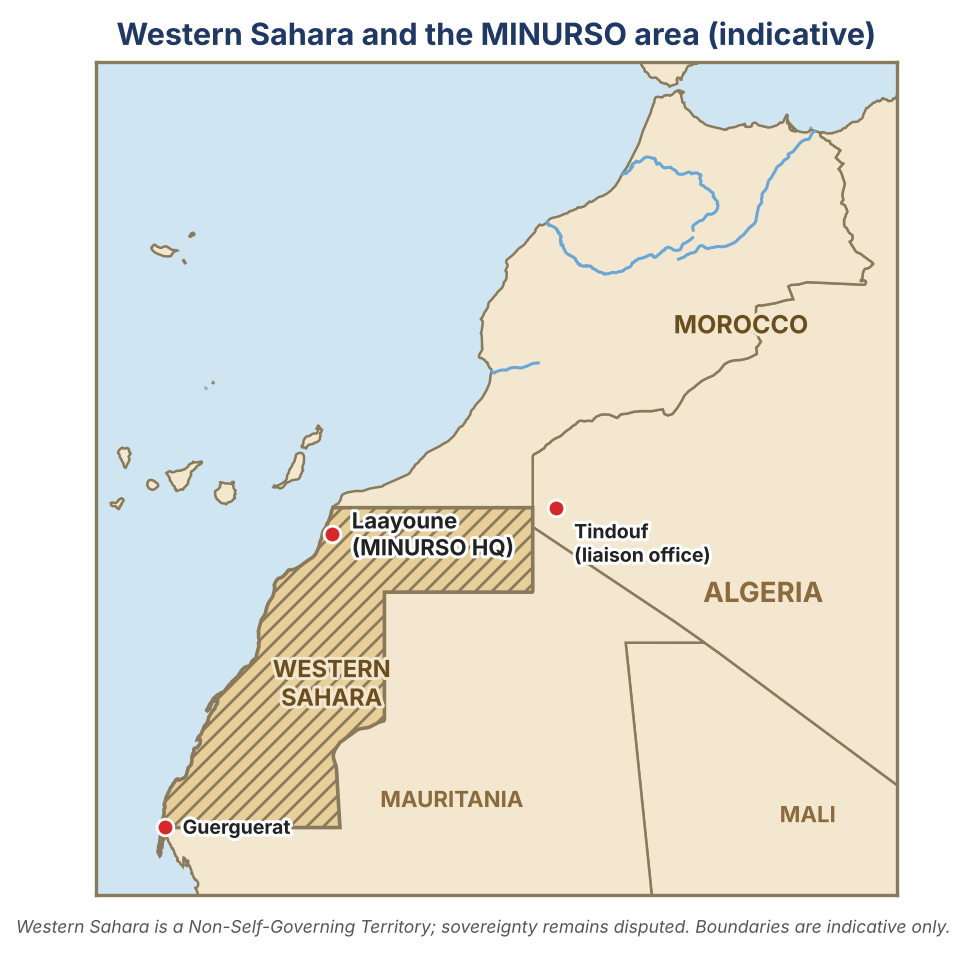
- Works from Laayoune and a Tindouf liaison office, coordinating with Algeria and agencies assisting Sahrawi refugees.
- Facilitates humanitarian contact and confidence-building between refugees and communities in the territory.
How Renewal Works
US as penholder drafts text ➜ Consultations with Group of Friends ➜ Secretary-General report ➜ Vote: 9 yes votes, no P5 veto
Renewal needs at least nine affirmative votes and no veto by the US, UK, France, Russia or China. A lapse leaves ceasefire monitoring without a UN presence and shows how veto politics can paralyse peacekeeping.
📖 Read More: The United Nations as a Peacekeeping Organization • India's Relations with West and North Africa • Major Deserts of Africa
14. Bhutan's Project 108: Stupas for Gelephu
(INTERNATIONAL RELATIONS) (TH) (PIB) On Lhabab Duchen (1 November 2026), Bhutan consecrated 108 stupas at Gelephu Mindfulness City (GMC) and dedicated Stupa No. 76 to Prime Minister Narendra Modi, recognising his support for the project and for India–Bhutan ties.
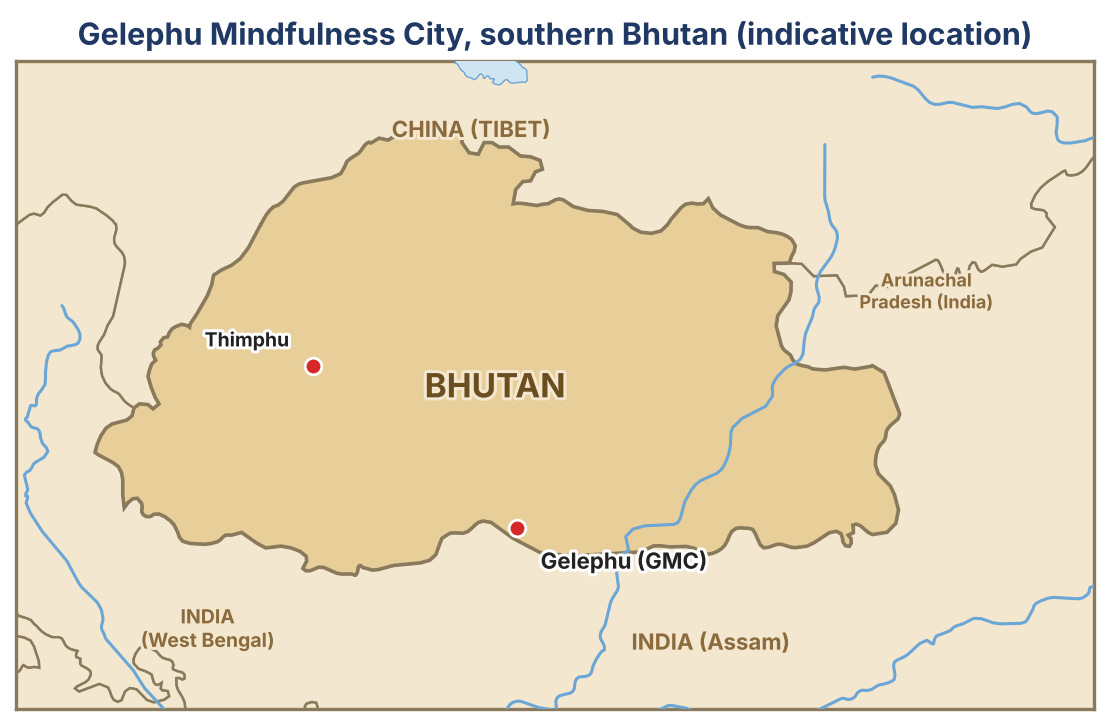
Project 108 at a Glance
| Feature | Details |
|---|---|
| Idea | Royal initiative of King Jigme Khesar Namgyel Wangchuck to raise 108 Jangchub Chortens (Stupas of Enlightenment) in a single day |
| Scale | About 40,000 volunteers, monks and artisans reportedly built them within nine hours |
| Layout | Spaced 108 m apart along about 11.7 km of the Mau Chhu river, near Bhutan's border with Assam |
| Construction | 15-metre stupas combining traditional proportions with prefabricated steel and modular methods |
| Consecration | Rituals led by the Je Khenpo; each stupa holds Zung (scriptures, mantras, relics and prayers) |
| Aim | Position Gelephu as a Vajrayana Buddhist centre that blends tradition with sustainable development |
Stupa No. 76 is described as a symbol of India–Bhutan friendship, acknowledging India's financial, infrastructure and connectivity support for GMC. Reports link the number to the Prime Minister's age.
India–Bhutan Link
- India approved two cross-border rail links in September 2025: Kokrajhar–Gelephu (69 km) and Banarhat–Samtse (20 km), at ₹4,033 crore, Bhutan's first rail connections.
- GMC is being developed as a special administrative region near the Assam border, so it matters for Northeast connectivity and trade.
- Cultural diplomacy like Project 108 adds a people-to-people layer to a partnership long anchored in hydropower and security.
📖 Read More: India and Bhutan
15. Manisha Bhanwala Wins India's First Women's Wrestling World Gold
(SOCIETY) (DD) Manisha Bhanwala became the first Indian woman to win gold at the Senior World Wrestling Championships, beating Abigail Elizabeth Nette (USA) 8–6 in the 59 kg final at Astana, Kazakhstan. She is India's second senior world champion after Sushil Kumar (66 kg, 2010).
India's Medals at Astana
| Wrestler | Weight | Medal |
|---|---|---|
| Manisha Bhanwala | 59 kg (non-Olympic) | Gold |
| Neelam Sirohi | 50 kg | Silver |
| Kajal Dhochak | 76 kg | Silver |
| Tanu Sharma | 72 kg | Bronze |
- Four medals make this India's best-ever women's showing at the Championships.
- Earlier, Anshu Malik had reached a final (silver, 57 kg, 2021); Vinesh Phogat and Antim Panghal had won bronze medals.
- The Championships are organised by United World Wrestling, the sport's international federation.
The win highlights women's growing role in Indian sport and ties into debates on athlete welfare and sports governance.
📖 Read More: Governance of Sports in India