
UPSC CURRENT AFFAIRS — 20 NOVEMBER 2026
1. Gram Sabha Consent Is Mandatory: Supreme Court
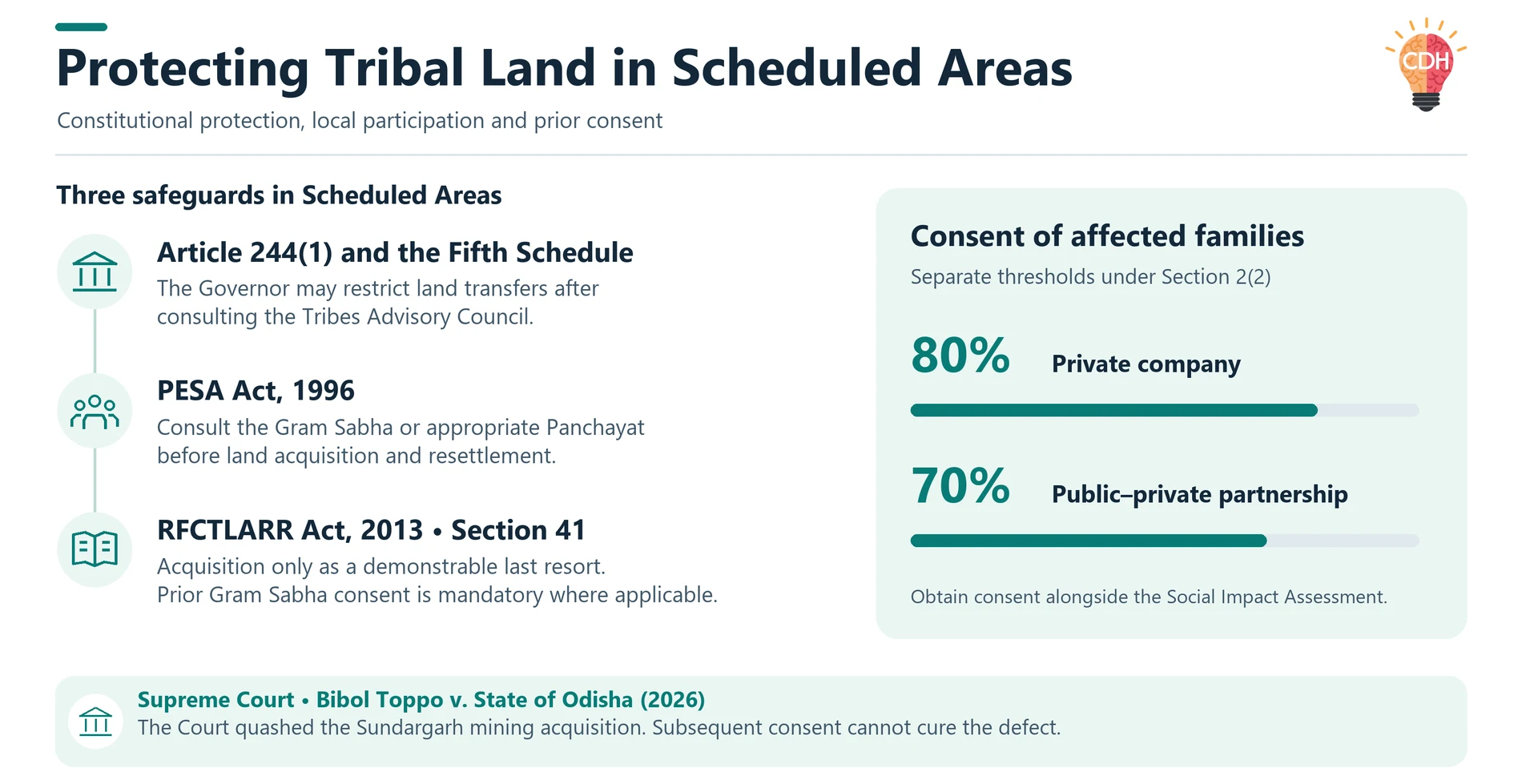
(POLITY AND GOVERNANCE) (IE) In Bibol Toppo v. State of Odisha (2026), the Supreme Court quashed Odisha’s acquisition of 273 hectares in Sundargarh, a Fifth Schedule district, for mining by a private cement company. It held that prior Gram Sabha consent is mandatory, not merely directory.
What the Court Held
- Mandatory consent: under Section 41(3) of the Right to Fair Compensation and Transparency in Land Acquisition, Rehabilitation and Resettlement (RFCTLARR) Act, 2013, prior consent of the Gram Sabha is required for every acquisition in Scheduled Areas.
- Private projects: acquisition for a private company also needs prior consent of at least 80% of affected families (70% for PPP projects), obtained along with the Social Impact Assessment.
- No later cure: consent cannot be obtained after the fact; the Court rejected the High Court’s view of consent as a ‘continuing process’.
- Compensation is not acquisition: paying compensation under the MMDR Act, 1957 cannot replace acquiring the land under the 2013 Act.
- Bench: Justices Dipankar Datta and Satish Chandra Sharma; the 2024 Orissa High Court ruling was set aside.
The Protective Framework
| Safeguard | What it provides |
|---|---|
| Article 244(1) and Fifth Schedule | Special administration of Scheduled Areas; Governor can restrict land transfers (Para 5(2)) after consulting the Tribes Advisory Council |
| PESA Act, 1996 | Gram Sabha to be consulted before land acquisition and resettlement in Scheduled Areas |
| RFCTLARR Act, 2013 (Sec 41) | Acquisition in Scheduled Areas only as a demonstrable last resort, with Gram Sabha consent |
| Forest Rights Act, 2006 | Recognises community rights over customary forests |
Landmark Precedents
- Samatha v. State of Andhra Pradesh (1997): mining leases of Scheduled Area land to non-tribals held void; even the State counts as a ‘person’ for transfer restrictions.
- Orissa Mining Corporation v. MoEF (2013): Gram Sabhas allowed to decide the impact of Niyamgiri bauxite mining on their rights; all 12 rejected it.
📖 Read More: Scheduled and Tribal Areas • PESA Act, 1996 • Land Reforms
2. Civic vs Ethnic: The Nationalism Debate
Two Ideas of the Nation
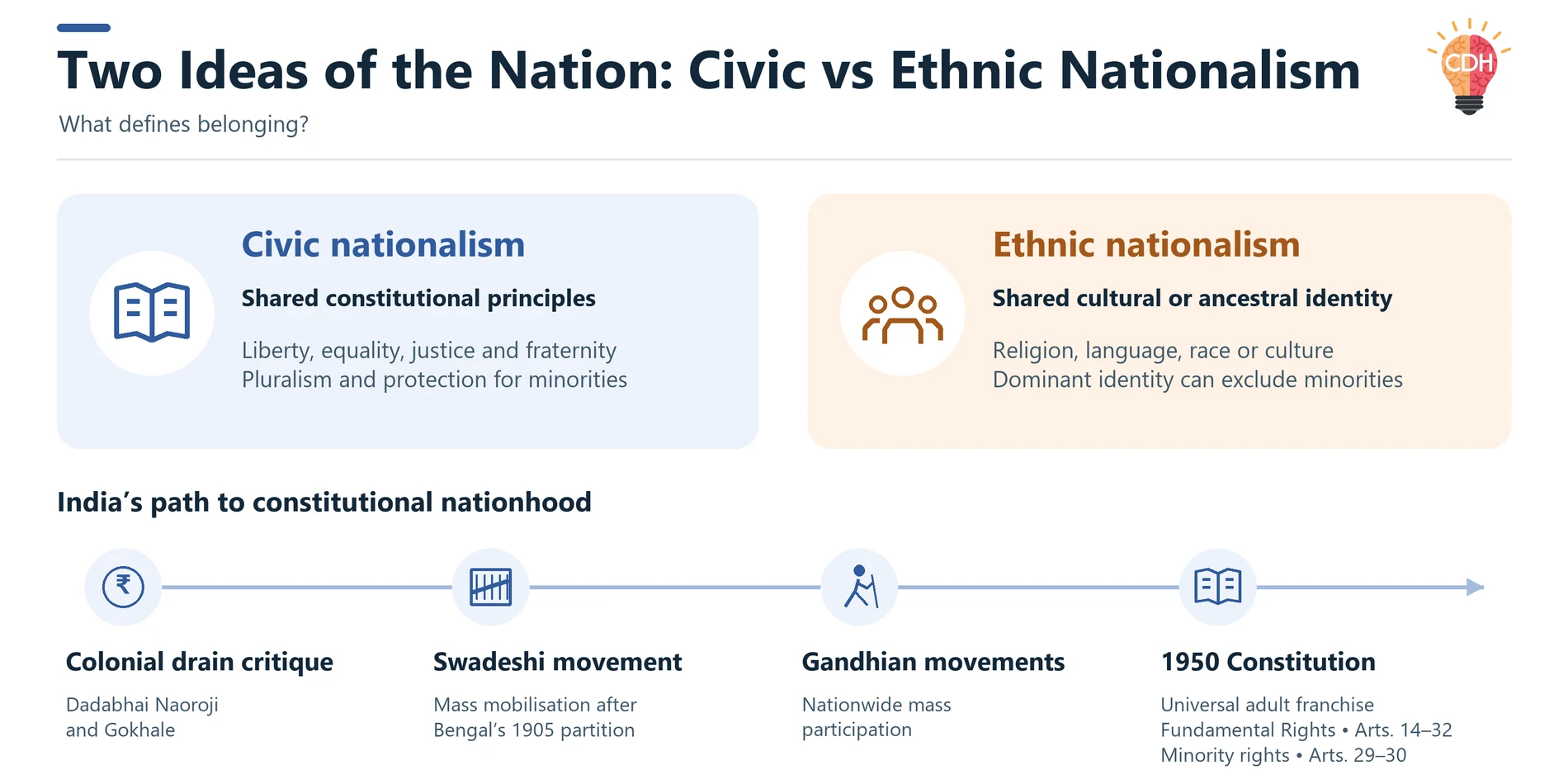
| Basis | Civic nationalism | Ethnic nationalism |
|---|---|---|
| Belonging | Shared commitment to liberty, equality, justice, fraternity and the Constitution | Shared religion, language, race or culture |
| Diversity | Inclusive; protects minorities and marginalised groups | Privileges one dominant identity |
| Risk | Can seem abstract and weakly emotive | Can exclude minorities and equate dissent with disloyalty |
Political scientist Benedict Anderson called the nation an ‘imagined community’: members never meet most compatriots, yet share a sense of belonging.
How Indian Nationalism Evolved
Economic critique (Naoroji, Gokhale) ➜ Swadeshi mass mobilisation (1905) ➜ Gandhian mass movements ➜ Constitution (1950): civic citizenship
- Early phase: Moderate nationalists exposed colonial economic drain, uniting Indians across religion and caste.
- Swadeshi phase: the Partition of Bengal (1905) took nationalism to the masses.
- Tagore’s caution: he warned that narrow patriotism could not be humanity’s final refuge.
- Constitution: universal adult franchise, Fundamental Rights (Articles 14–32) and minority protections (Articles 29–30) anchored nationhood in citizenship, not identity.
The Contemporary Debate
Critics see growing majoritarian pressure, vigilantism and intolerance of dissent. Others argue that assertive cultural pride and large national projects reflect confidence, not exclusion. For UPSC, the balanced view is that unity has been strongest when India accommodates diversity: linguistic states (1956), the Fifth and Sixth Schedules and Article 371 show inclusion strengthening integration (see secularism and regionalism).
📖 Read More: Nationalism • Salient Features of Indian Society and Diversity in India
3. PM SVANidhi Samman Awards for Street Vendor Support
(SOCIAL JUSTICE) (PIB) The Ministry of Housing and Urban Affairs is conferring the PM SVANidhi Samman Awards 2026 on 20 November 2026 in New Delhi: 52 awards and 5 special recognitions for States/UTs, urban local bodies, lenders and partners that strengthened street vendors’ livelihoods.
PM SVANidhi at a Glance
| Feature | Details |
|---|---|
| Launch | 1 June 2020, as a Central Sector Scheme after the COVID-19 lockdown |
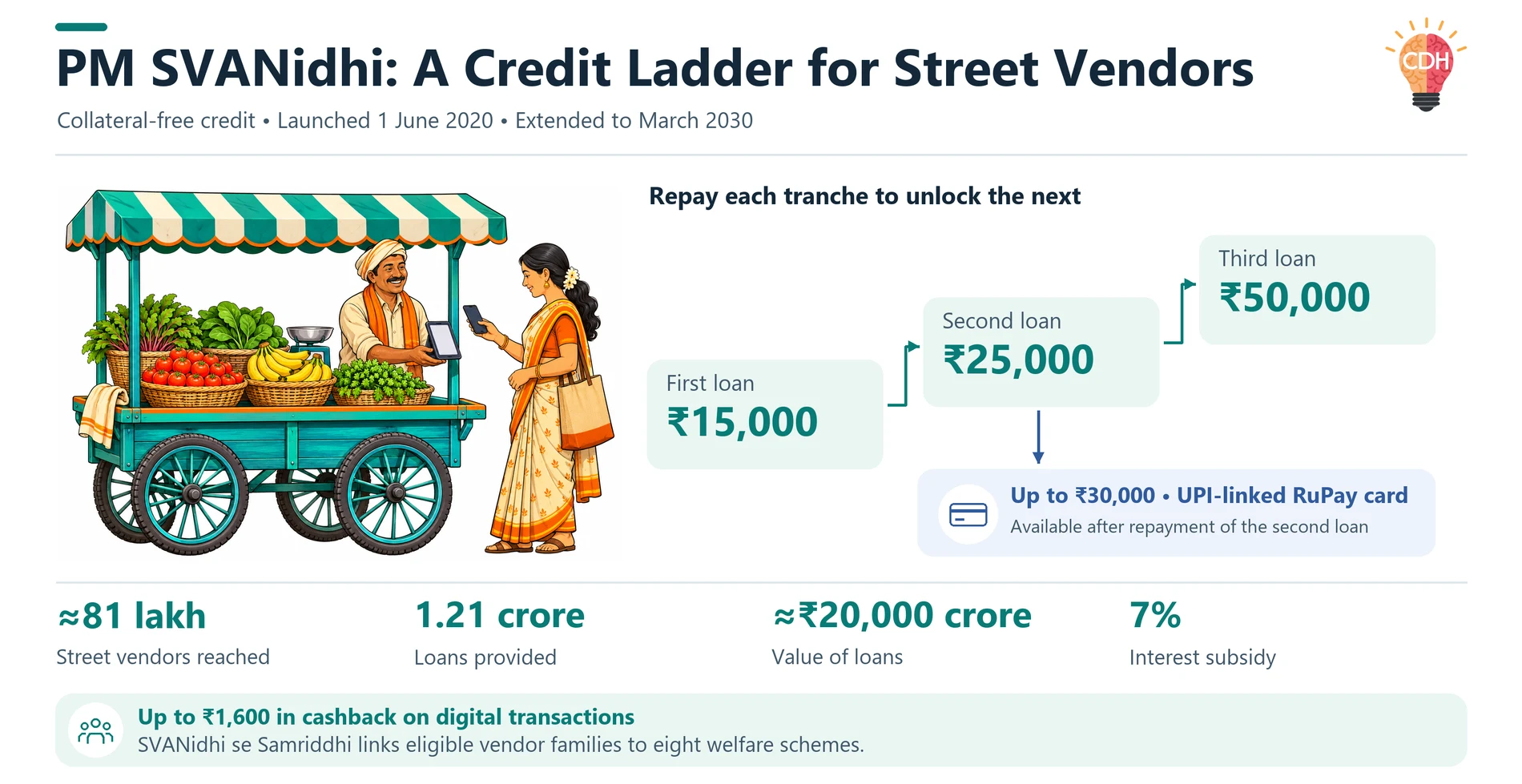
| Reach | About 81 lakh vendors, 1.21 crore loans worth about ₹20,000 crore |
| Tenure | Restructured in August 2025; lending extended to 31 March 2030 (outlay ₹7,332 crore) |
| Loans | ₹15,000, then ₹25,000, then ₹50,000 in three collateral-free tranches, with a 7% interest subsidy |
| Credit card | UPI-linked RuPay credit card up to ₹30,000 after repaying the second loan |
| Digital push | Cashback up to ₹1,600 on digital retail and wholesale transactions |
| Coverage | Extended beyond statutory towns to census towns and peri-urban areas |
Beyond Credit
- SVANidhi se Samriddhi: profiling of over 52 lakh vendor families, leading to 1.62 crore sanctions under eight welfare schemes.
- Ecosystem: 50 Street Food Hubs, food-safety and hygiene training.
- Inclusion: builds credit histories and digital footprints for informal workers (see urban challenges).
📖 Read More: PM Street Vendor’s Atma Nirbhar Nidhi (PM SVANidhi)
4. Jan Aushadhi: Cheaper Medicines, Limited Reach
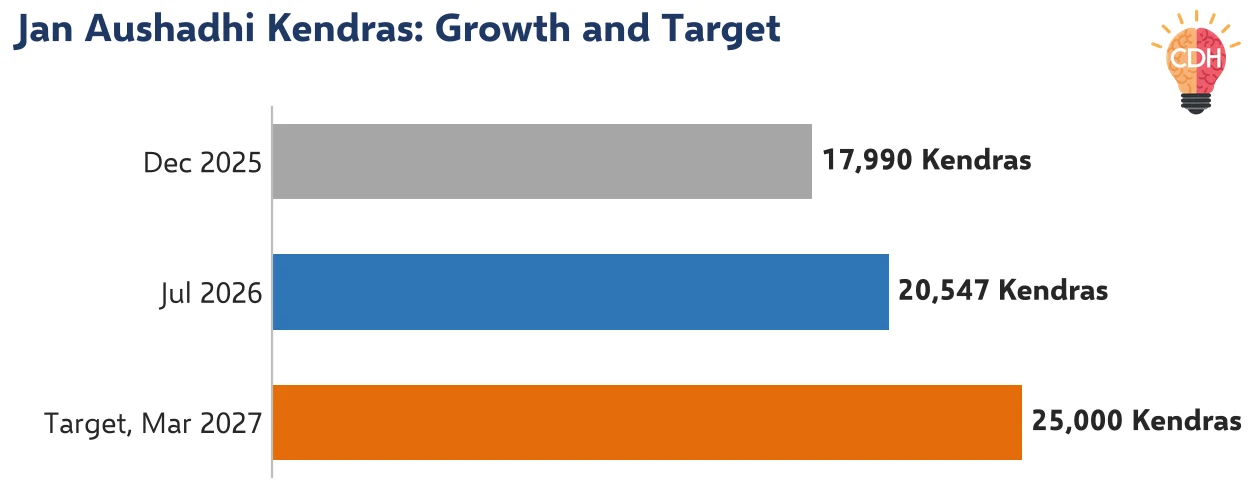
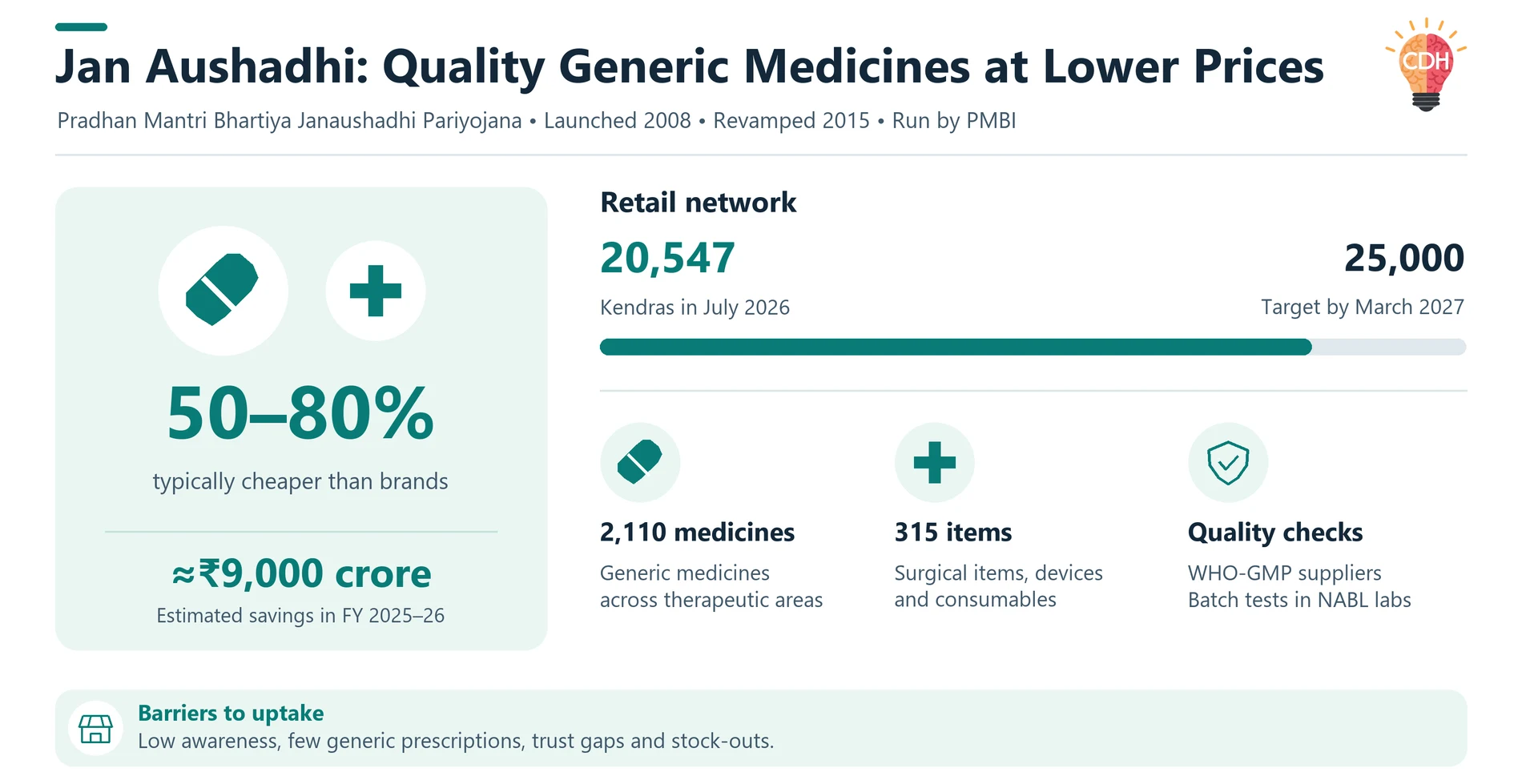
(SOCIAL JUSTICE) (TH) The Pradhan Mantri Bhartiya Janaushadhi Pariyojana (PMBJP) now runs 20,547 Kendras (July 2026), but that is only about 1.7% of India’s roughly 12 lakh chemist outlets, prompting calls to widen its reach.
Key Facts
- History: launched as the Jan Aushadhi Scheme in 2008, revamped in 2015; run by the Pharmaceuticals and Medical Devices Bureau of India (PMBI) under the Department of Pharmaceuticals.
- Basket: 2,110 medicines and 315 surgical items, typically 50–80% cheaper than branded equivalents.
- Savings: sales of ₹2,252 crore at MRP in 2025-26; estimated citizen savings of about ₹9,000 crore that year and ₹45,000 crore over 12 years.
- Target: 25,000 Kendras by March 2027.
Why Uptake Is Low
- Low awareness and Kendras often located away from busy markets.
- Prescriptions: doctors rarely write generic names; a generic-prescription directive was put on hold.
- Trust: lingering doubts about generic quality, despite WHO-GMP sourcing and batch testing in NABL labs.
- Stock-outs of prescribed medicines discourage repeat visits.
Medicines are the largest component of out-of-pocket health spending. Wider generic use, alongside Ayushman Bharat PM-JAY, is key to Universal Health Coverage.
📖 Read More: Pradhan Mantri Bharatiya Jan Aushadhi Pariyojana (PMBJP) • Drugs and Pharmaceuticals Industry
5. Critical Minerals: From Mining to Material Security
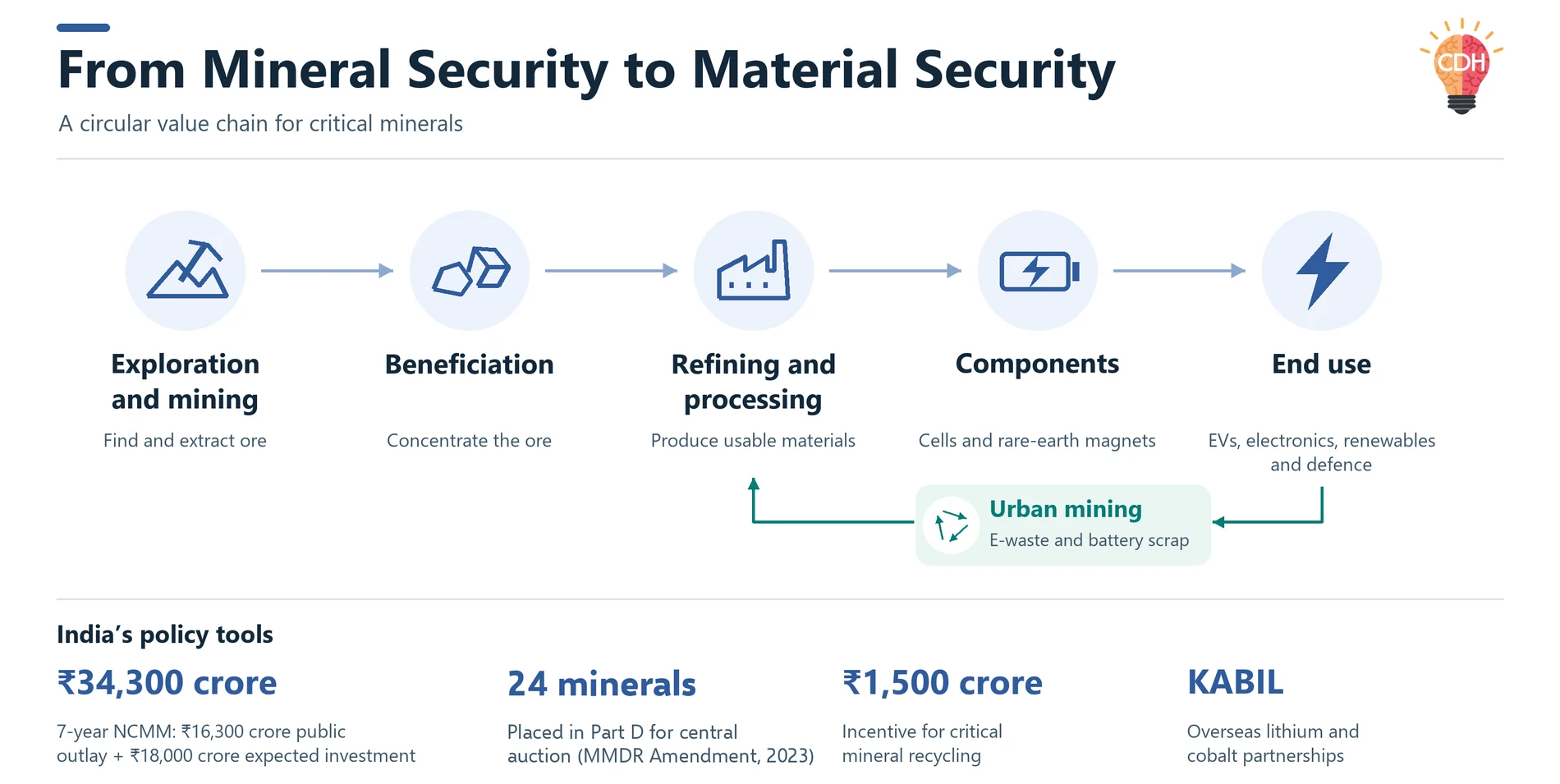
(ECONOMICS) (TH) Experts argue India’s critical minerals policy must move from mineral security (auctioning blocks) to material security: turning ore and scrap into refined, factory-ready inputs through domestic processing, refining and recycling.
The Policy Push So Far
| Measure | Key feature |
|---|---|
| National Critical Mineral Mission (2025) | ₹34,300 crore over seven years (FY25–FY31) for exploration, mining, processing and recycling |
| MMDR Amendment, 2023 | 24 critical and strategic minerals in Part D; Centre auctions their blocks |
| Recycling Incentive Scheme | ₹1,500 crore for recovering minerals from e-waste and battery scrap |
| KABIL | Acquires overseas lithium and cobalt assets, e.g. in Argentina |
| Partnerships | Minerals Security Partnership, Quad critical minerals work |
The Value Chain India Must Build
Exploration & mining ➜ Beneficiation ➜ Refining & processing ➜ Components (cells, magnets) ➜ Recycling (urban mining)
Why Mining Alone Is Not Enough
- Processing gap: China’s leverage comes from controlling global refining, not just mines.
- Import dependence: near-total reliance on imports for lithium, cobalt and nickel.
- Long gestation: clearances, land and infrastructure delay new mines by years.
- Informal recycling: e-waste and battery scrap lack traceable collection and quality standards.
Way Forward
- Measure tonnes, not blocks: track refined and recycled material actually delivered to Indian factories.
- Co-locate processing parks with mining clusters and the new rare earth corridors (see rare earths).
- Flexible stockpiles of processed materials, not raw ore.
- Fair benefit-sharing via District Mineral Foundations.
📖 Read More: Critical Minerals in the Indian Context • Critical Minerals: Usage & Availability in India
6. Export Promotion Mission Rules Eased for MSMEs
About the Export Promotion Mission
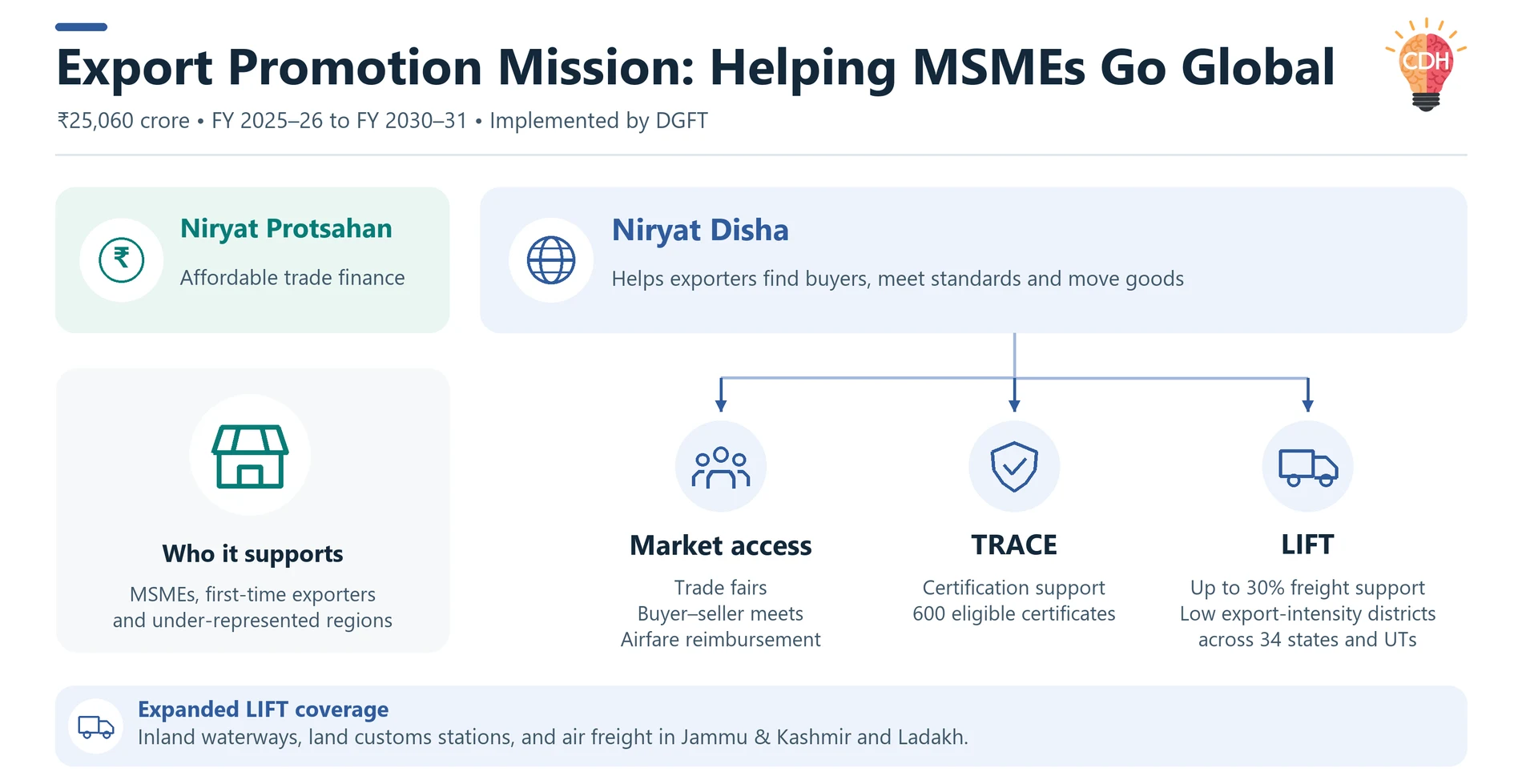
- Approval: Union Cabinet, 12 November 2025; outlay ₹25,060 crore for 2025-26 to 2030-31.
- Implementation: DGFT, through a dedicated digital platform.
- Two sub-schemes: Niryat Protsahan (affordable trade finance) and Niryat Disha (non-financial support: branding, compliance, logistics).
- Focus: MSMEs, first-time exporters and low export-intensity districts; it absorbs the Interest Equalisation Scheme and Market Access Initiative.
What Has Been Relaxed
| Intervention | Key changes |
|---|---|
| Market Access Support | Airfare support for exporters with turnover up to ₹50 crore; EPC membership needed for 3 months instead of 6 |
| TRACE (standards and certification) | Certificates eligible for reimbursement raised from 462 to 600 |
| LIFT (freight support) | Up to 30% of freight for MSMEs in low export-intensity districts; coverage widened from 13 to 34 States/UTs; Land Customs Stations, ICPs and waterways added; distance threshold cut to 100 km; air freight from J&K and Ladakh eligible; all goods except a negative list |
The changes complement the Foreign Trade Policy 2023 and aim to pull landlocked and remote districts into export value chains (see MSME schemes).
📖 Read More: Foreign Trade Policy 2023 • India’s International Trade: A Dynamic Landscape
7. Surveillance Pricing: When Data Sets Your Price
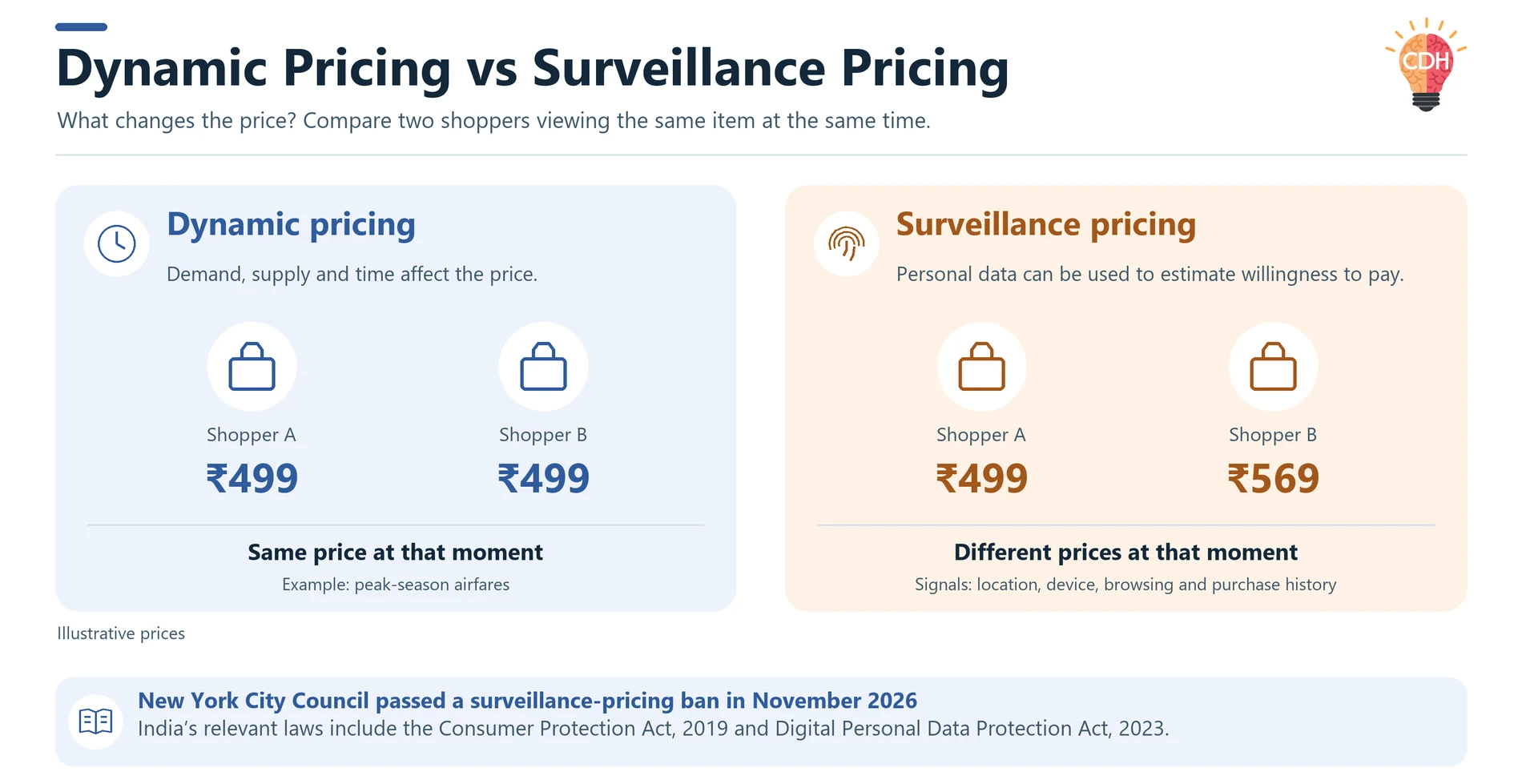
| Basis | Dynamic pricing | Surveillance pricing |
|---|---|---|
| Driver | Market conditions: demand, supply, time | Individual’s personal data: location, history, device, behaviour |
| Example | Higher airfares in peak season | Two users see different prices for the same item at the same moment |
| Concern | Generally transparent | Hidden, discriminatory, hard to compare prices |
- New York law: fines up to USD 1,000 per violation; genuine, uniformly offered discounts remain allowed.
- India: no specific ban. Practices can be examined under the Consumer Protection Act, 2019 (unfair trade practices, dark patterns) and the Digital Personal Data Protection Act, 2023 (consent and purpose limits).
- Precedent: in January 2025, the CCPA sought explanations from ride-hailing apps over alleged different fares on Android and iPhone devices.
The debate links consumer protection, data privacy and competition in digital markets.
📖 Read More: Consumer Protection • Data Localisation and Privacy Issues
8. India–Japan 2+2 Deepens Defence Ties
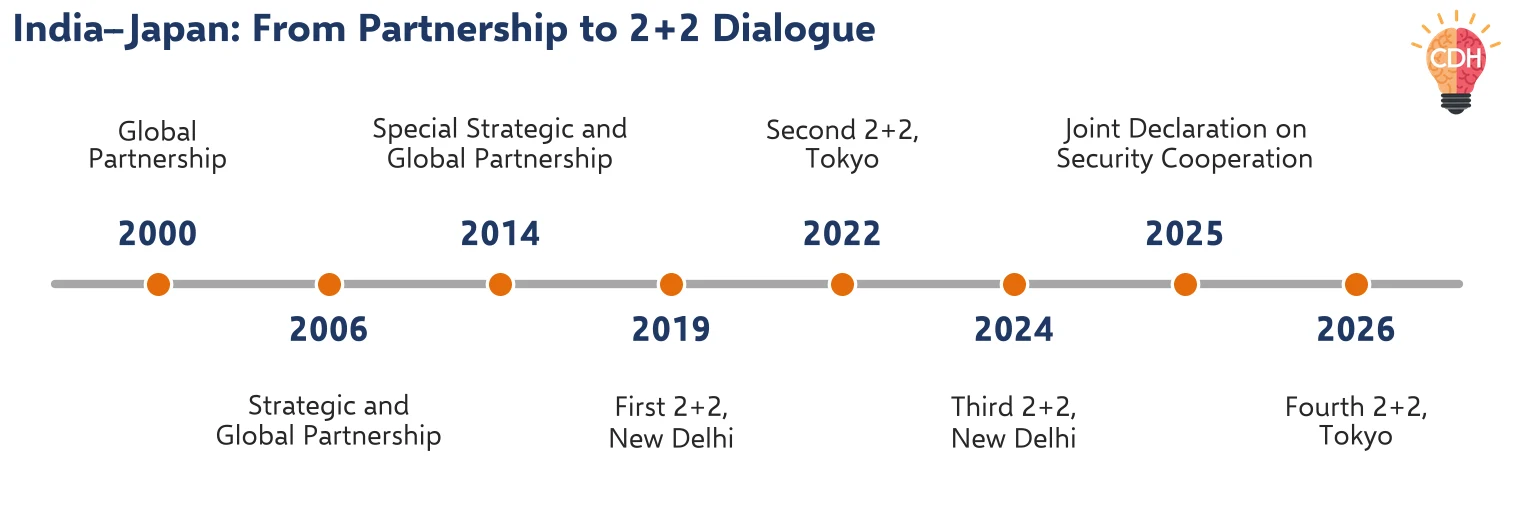
(INTERNATIONAL RELATIONS) (PIB) The fourth India–Japan 2+2 Foreign and Defence Ministerial Meeting was held in Tokyo on 19 November 2026. It built on the Joint Declaration on Security Cooperation (August 2025), ahead of 75 years of diplomatic ties in 2027.
Key Outcomes
- Air exercise first: Japan Air Self-Defense Force fighters visited India for the first time, for Veer Guardian 26.
- Live-fire training: a Letter of Intent lets Japan’s forces conduct their first live-fire training (including surface-to-ship missiles) at Indian ranges.
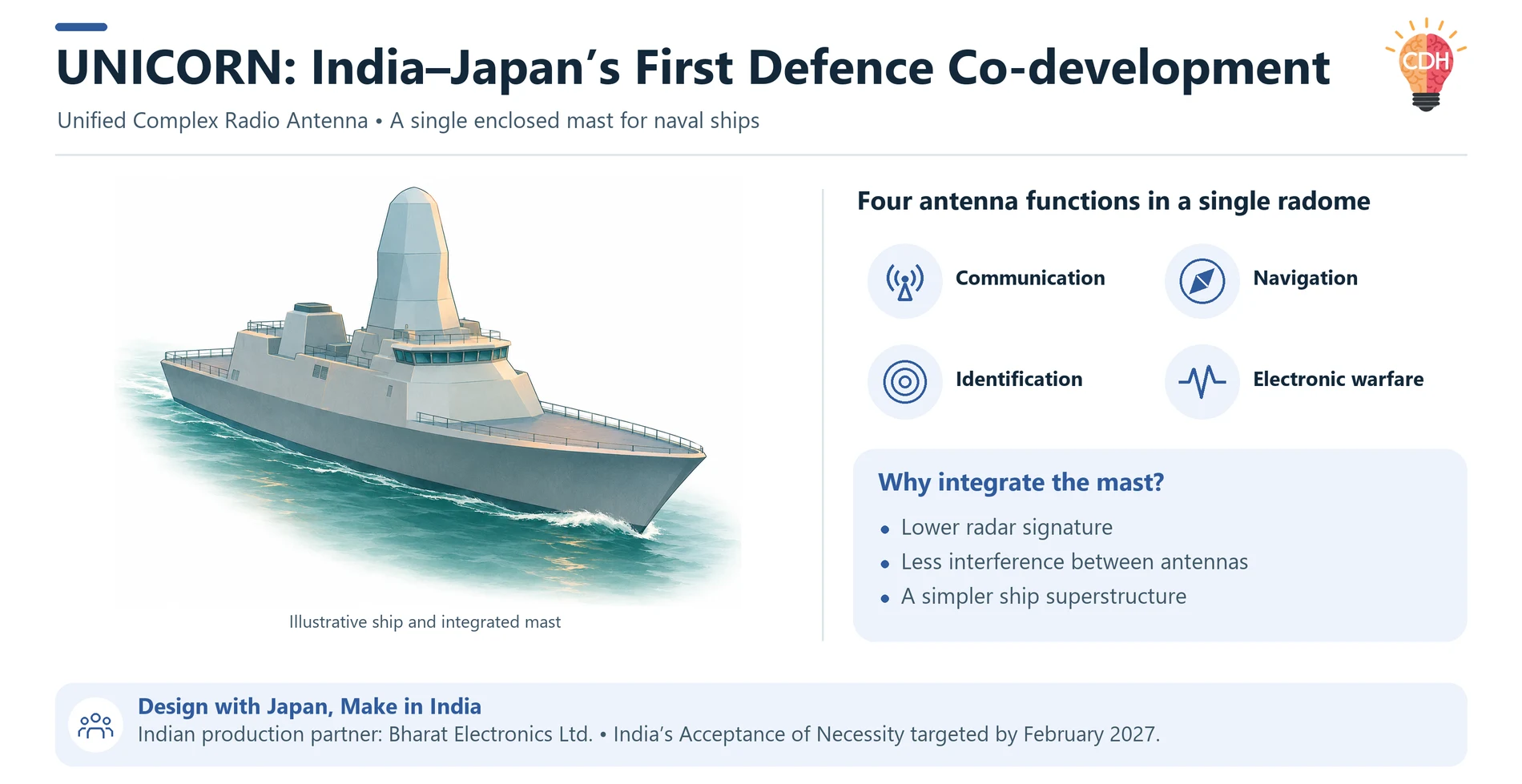
- UNICORN: both sides seek early arrangements and India’s Acceptance of Necessity by February 2027.
- Maritime: implement the Memorandum on Maritime Security Cooperation: domain awareness, search and rescue, HADR, mine countermeasures.
- Industry: co-production under ‘Design with Japan, Make in India’.
- New domains: undersea cables, AI-enabled cybersecurity, space situational awareness.
UNICORN (Unified Complex Radio Antenna) is a stealthy integrated mast that combines communication, navigation and electronic-warfare antennas. It is the first India–Japan defence co-development project, with BEL as India’s partner.
The dialogue aligns India’s IPOI and MAHASAGAR with Japan’s Free and Open Indo-Pacific, and complements Quad cooperation (see India–Japan relations).
📖 Read More: India – Japan Relations • Make in India Initiative
9. APEC Shenzhen Summit and a Rare Three-Way Meeting
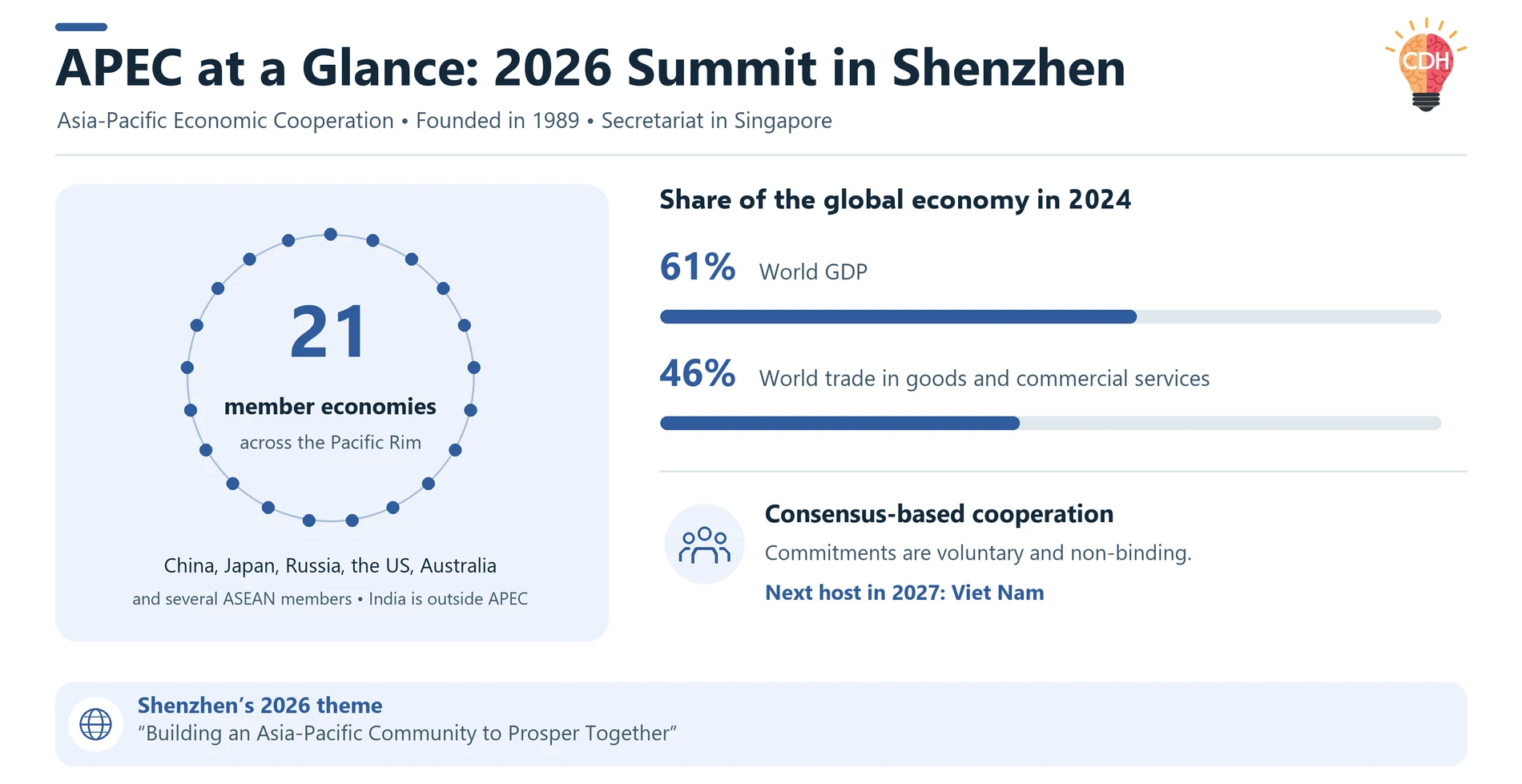
(INTERNATIONAL RELATIONS) (AP) China hosted the 33rd APEC Economic Leaders’ Meeting in Shenzhen (18–19 November 2026) under the theme ‘Building an Asia-Pacific Community to Prosper Together’. On the sidelines, the US, Chinese and Russian Presidents held their first-ever trilateral meeting.
| Feature | Details |
|---|---|
| Founded | 1989; Secretariat in Singapore |
| Members | 21 economies, including China, Hong Kong, Chinese Taipei, Russia, the US and Japan |
| Method | Consensus; voluntary, non-binding commitments |
| Weight | About 60% of world GDP and nearly half of world trade |
| India | Not a member; it has long sought entry |
- China’s pitch: Xi called for open trade, lower tariffs and an ‘Asia-Pacific community’.
- Russia: Putin criticised Western sanctions in his first in-person APEC appearance since 2017.
- Next host: Vietnam in 2027.
For India, APEC membership would deepen links with Pacific supply chains; the summit also shows the region’s shifting great-power balance (see India–China relations and ASEAN).
📖 Read More: Types of Trade Agreement • ASEAN
10. Harimau Shakti 2026: India–Malaysia Army Drill
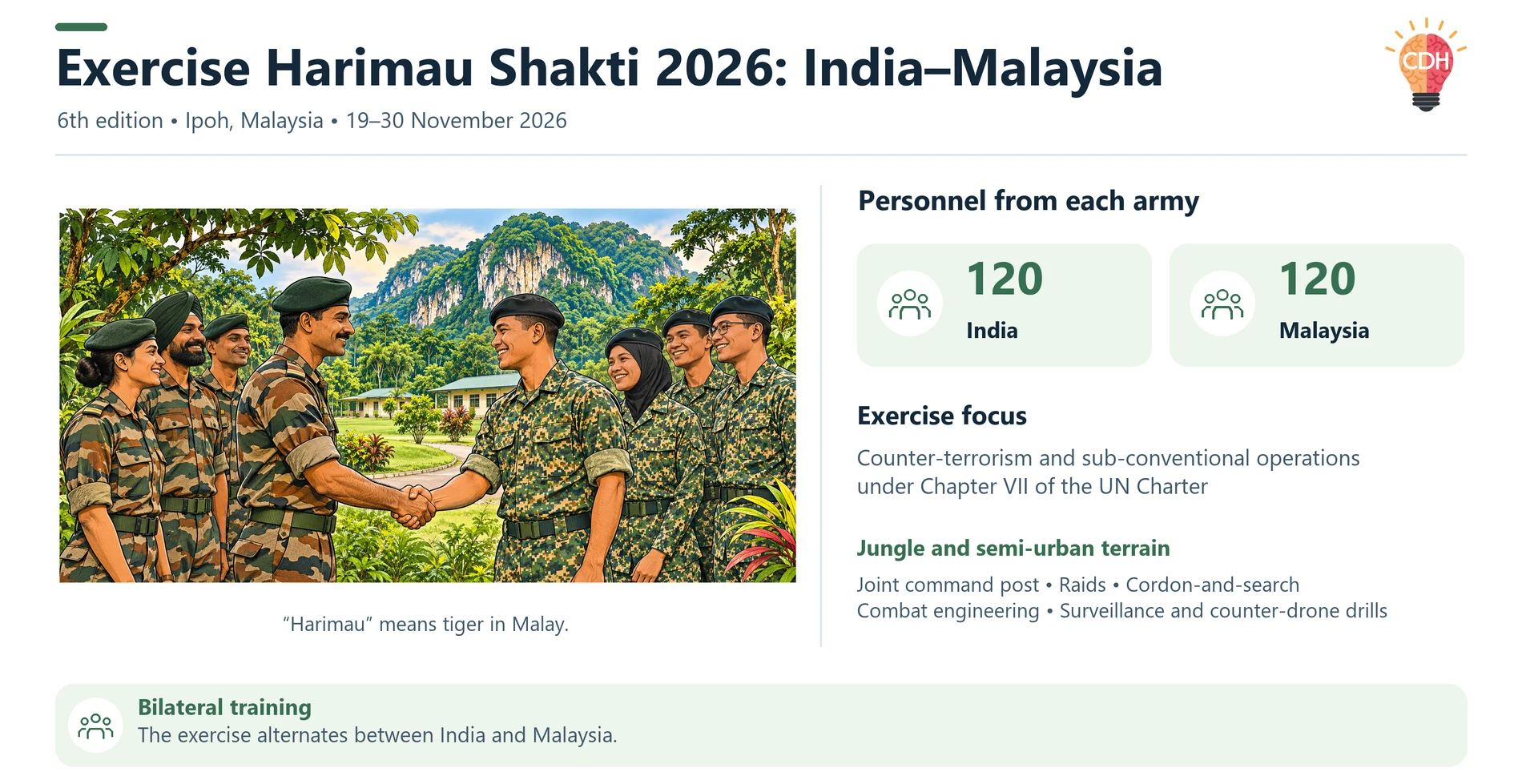
(INTERNAL SECURITY) (PIB) The 6th edition of the India–Malaysia joint military exercise HARIMAU SHAKTI began at Ipoh, Malaysia, and runs 19–30 November 2026, with 120 personnel from each side.
- Aim: rehearse sub-conventional operations under Chapter VII of the UN mandate, with a focus on counter-terrorism.
- Terrain: jungle and semi-urban settings.
- Drills: a joint command post, raids, cordon-and-search, combat engineering, and use of drones and counter-drone systems.
- Format: held alternately in India and Malaysia; ‘Harimau’ means tiger in Malay.
The exercise strengthens India–Malaysia defence ties under the Act East Policy.
📖 Read More: India – Malaysia Relations
11. Hydrogel Beads Feed Crops on Demand
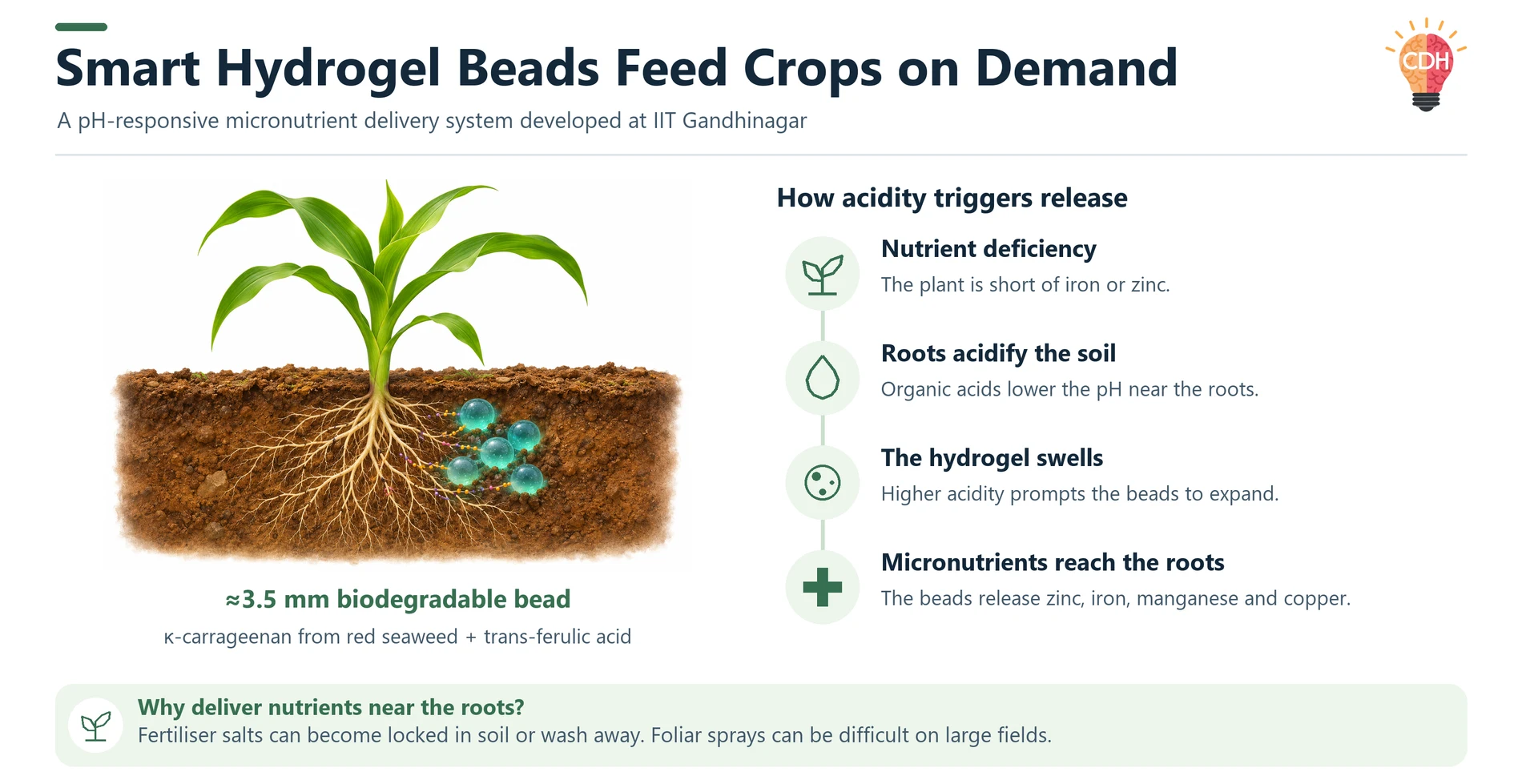
(SCIENCE AND TECHNOLOGY) (IE) Researchers at IIT Gandhinagar have made seaweed-based hydrogel microbeads that release micronutrients near plant roots only when the soil turns acidic. The idea is borrowed from controlled-release drug delivery used in cancer treatment.
Plant lacks iron/zinc ➜ Roots release acids; soil pH falls ➜ Beads swell ➜ Micronutrients released at roots
- Material: κ-carrageenan from red seaweed (such as Kappaphycus) with trans-ferulic acid, a natural antioxidant from cereals; beads about 3.5 mm across and biodegradable.
- Nutrients: zinc, iron, manganese and copper.
- Advantage: soil-applied salts get fixed or leached; foliar sprays are impractical at scale; chelated forms are costly and persistent.
- Recognition: published in ACS Omega; won a top prize at the SOMS 2026 summit.
Hidden hunger in soils lowers crop nutrition. Precision delivery like this complements biotechnology in agriculture and balanced fertiliser use.
📖 Read More: Biotechnology in Agriculture • Fertilisers
12. Giant Elephant Fossil Found on the Narmada
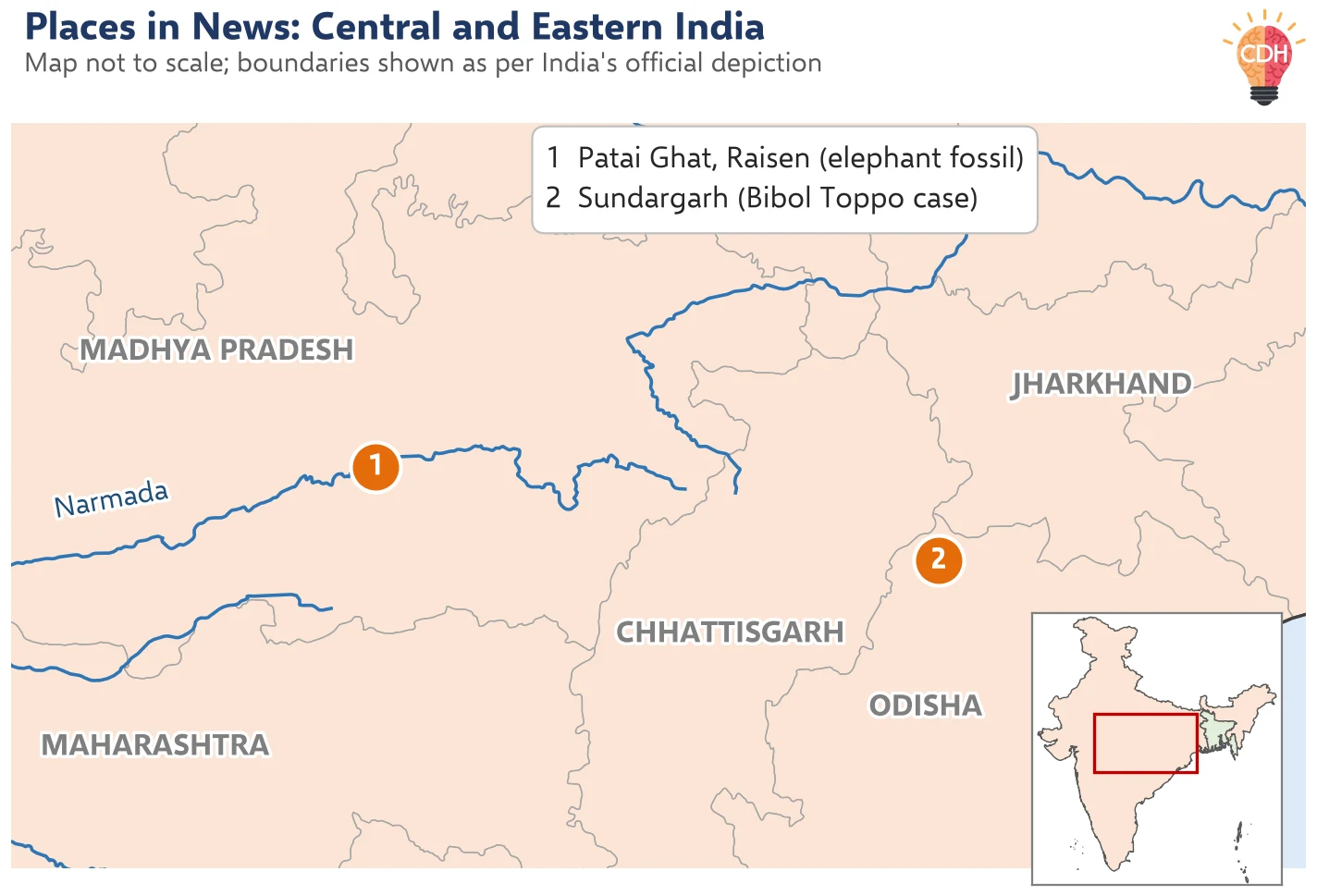
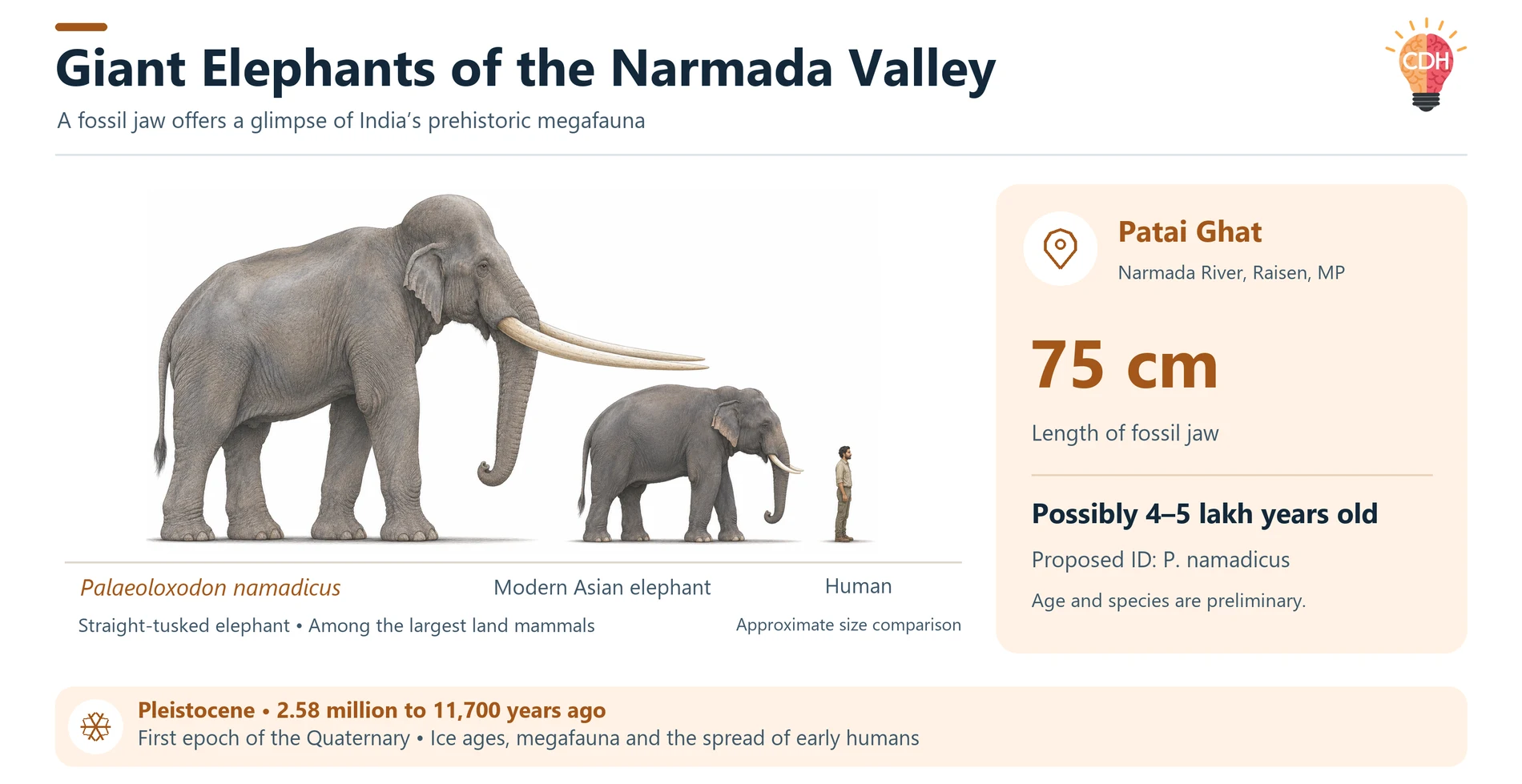
- Species: an extinct straight-tusked elephant of the Indian subcontinent; ‘namadicus’ refers to the Narmada.
- Age: possibly 4–5 lakh years old, from yellow Pleistocene sediments; the molars suggest a young animal.
- Next step: the Geological Survey of India has inspected the site; more bones may lie nearby.
- Narmada valley: a key prehistoric site, also known for the Hathnora hominin fossil.
The Pleistocene Epoch
The Pleistocene ran from about 2.58 million to 11,700 years ago. It is the first epoch of the Quaternary Period (see geological time scale). It saw repeated ice ages, giant mammals (megafauna) and the spread of early humans.
📖 Read More: Geological Time Scale • Scientific Methods to Date the Prehistoric Past
13. Saraiki: Language of the Middle Indus
(ART AND CULTURE) (IE) A Saraiki folk song, ‘Chhalrey Chhalrey Waal’, has gone viral across the border, drawing attention to the Saraiki language.
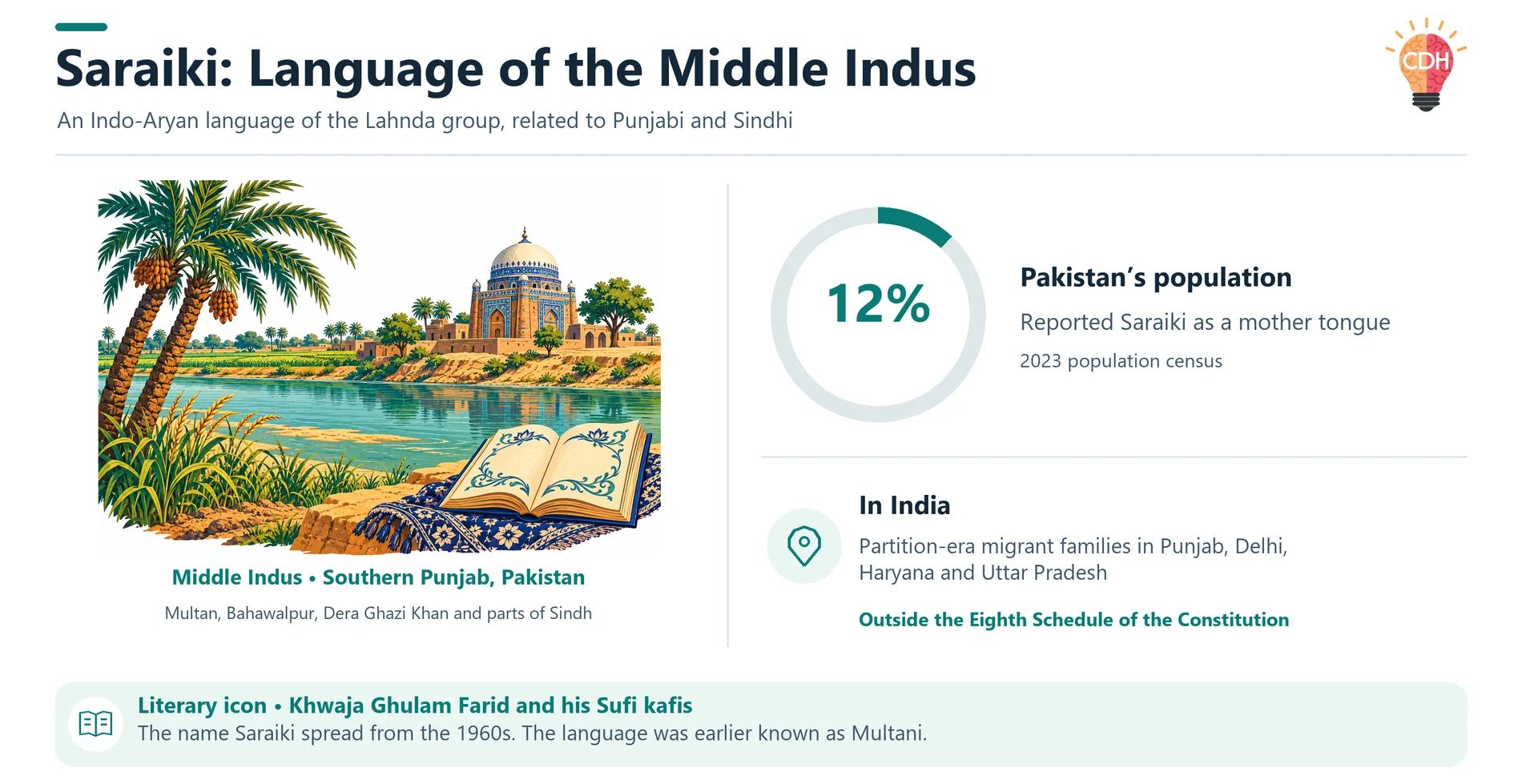
- Family: an Indo-Aryan language of the Lahnda (western Punjabi) group, close to Punjabi and Sindhi.
- Where spoken: southern Punjab in Pakistan (Multan, Bahawalpur, Dera Ghazi Khan), plus parts of Sindh; about 12% of Pakistan’s population.
- In India: spoken by families who migrated during Partition, in Punjab, Delhi, Haryana and Uttar Pradesh; not in the Eighth Schedule.
- Literature: the 19th-century Sufi poet Khwaja Ghulam Farid wrote kafis still sung today (see Sufism).
Saraiki was once called Multani; the name Saraiki gained ground in the 1960s. See language families of India.
📖 Read More: Major Language Families of India • Spatial Distribution of Languages and Linguistic Diversity