
UPSC CURRENT AFFAIRS — 19 NOVEMBER 2026
1. Police Reform Moves From Policy to Station
(POLITY AND GOVERNANCE) (TH) The Indian Police Foundation (IPF) has finalised a ‘change manual’ under its Internal Police Reforms project, supported by the Azim Premji Foundation. Based on field surveys in Punjab, Telangana and Tamil Nadu, it targets the daily citizen–police interface at the police station.
What the Surveys Found
- Citizens: fear of harassment, repeated visits before a complaint is registered, and no updates on inquiries.
- Police personnel: excessive workloads and too few weekly rest days.
Four Pillars of the Change Manual
| Pillar | Key measures |
|---|---|
| Complaint registration | Digital visitor management, help desks, QR codes; e-complaints converted into FIRs |
| Crime prevention | Night escorts for working women, panic buttons in taxis, body-worn cameras, citizen outreach |
| Misconduct prevention | DySP-level arrest review, phone call and legal-aid information for the accused, videographed searches, remote lock-up monitoring |
| Working conditions | Weekly offs, rest rooms, vehicles and e-Sakshya tablets for investigating officers |
Structural vs Station-Level Reform
| Aspect | Structural reform | Station-level reform |
|---|---|---|
| Basis | Prakash Singh v. Union of India (2006) directives; Model Police Act, 2006 | IPF change manual |
| Focus | Autonomy and accountability: State Security Commission, fixed tenures, Police Establishment Board, Police Complaints Authority | Daily functioning of the police station |
| Friction | High; police is a State List subject and States resist ceding control | Low; internal SOPs within existing law |
| Limitation | Compliance still partial after 20 years | No statutory force; depends on police leadership |
Bottlenecks
- e-FIR rule: under Section 173(1) of the BNSS, 2023, an e-FIR must be signed by the informant within three days, slowing conversion of e-complaints.
- Vacancies: chronic staff shortages make weekly offs hard to grant.
- Transfers: frequent transfers of SHOs and district chiefs undermine the two-year tenure rule.
- CCTV gaps: non-functional cameras breach Paramvir Singh Saini v. Baljit Singh (2020) and defeat remote lock-up monitoring.
📖 Read More: State Police and Police Reforms • Prakash Singh Case (2006)
2. Women Legislators Meet at First CWP India Conference
(POLITY AND GOVERNANCE) (DD) The Lok Sabha Speaker inaugurated the First Commonwealth Women Parliamentarians (CWP) India Region Conference in Bengaluru (17–18 November 2026). It brought together 135 women legislators from Parliament and State Legislatures.
- Theme: ‘Strong Foundations, Stronger Voices: Inclusive Cyberspace and Mentorship Pathways for New Women Legislators’.
- Digital push: using AI, digital platforms and e-governance for transparency and citizen engagement.
- Mentorship: senior women legislators to mentor newcomers, including Panchayat Sarpanches and Municipal Chairpersons.
- Representation: the Speaker noted that many States already give 50% reservation to women in Panchayats and Municipalities.
Nari Shakti Vandan Adhiniyam, 2023
The 106th Constitutional Amendment reserves one-third of seats for women in the Lok Sabha, State Legislative Assemblies and the Delhi Assembly. It takes effect only after the first census and delimitation following its commencement, and lasts 15 years, extendable by Parliament.
The CWP is a network within the Commonwealth Parliamentary Association that works to increase women’s representation in legislatures across Commonwealth countries.
📖 Read More: Equality, Empowerment and Women-led Development
3. Uttarakhand’s Baini-Bhuli Scheme for SHG Women
(SOCIAL JUSTICE) (Outlook) Uttarakhand announced financial support for more than five lakh women under the Baini-Bhuli scheme. The incentive will be paid by direct benefit transfer in two instalments, the first in December 2026.
- Who benefits: women linked to self-help groups and the State Rural Livelihood Mission.
- Name: ‘Baini’ and ‘Bhuli’ mean sister in the Garhwali and Kumaoni dialects.
- Related scheme: the State’s Nanda Gaura Yojana gives ₹11,000 at the birth of a girl and ₹51,000 after she passes Class 12.
Such cash support builds on SHG-led livelihood drives like Lakhpati Didi, helping women convert savings and credit into stable enterprise income.
📖 Read More: Self-Help Groups (SHGs)
4. RBI Holds the Line on Microfinance Lending
The 2022 Framework
| Feature | Rule |
|---|---|
| Definition | Collateral-free loan to a household with annual income up to ₹3 lakh, rural or urban |
| Repayment cap | Total loan repayments capped at 50% of monthly household income |
| Approach | Activity-based: applies equally to banks, SFBs, co-operative banks and NBFC-MFIs (earlier, mainly NBFC-MFIs under the Malegam Committee norms) |
State of the Sector
- Portfolio: ₹2.69 lakh crore across 7.15 crore loans in June 2026, down 12% year-on-year, even as disbursements rose.
- Lenders: NBFC-MFIs hold about 47% of the portfolio, the largest share (see NBFCs).
- Stress: early delinquency fell to 1.9%, but loans overdue beyond 180 days stood at 17.4%, showing legacy stress.
Industry Demands vs RBI Stand
| Demand | RBI’s position |
|---|---|
| Raise the ₹3 lakh income ceiling | Only after better income assessment and credit reporting |
| Review the uniform 50% cap | Retained; it is an upper limit, not a target |
| Count only interest, not principal, in obligations | Rejected; it would understate real indebtedness |
| Uniform credit-bureau classification | Agreed in spirit; wants accurate, frequent reporting |
Key Concerns
- Pseudo-consent: borrowers sign without understanding rates, fees or terms.
- Multiple lending: weak bureau data hides total household debt.
- Shocks: inflation and extreme weather turn credit into debt traps.
- Self-regulation conflict: the two RBI-recognised SROs, MFIN and Sa-Dhan, are industry bodies.
Microfinance remains vital for financial inclusion and women’s enterprise, but only with responsible lending.
📖 Read More: Financial Inclusion in India • Non-Banking Financial Company
5. India Pushes Resilient Infrastructure at COP31
(INTERNATIONAL RELATIONS) (CDRI) At the Coalition for Disaster Resilient Infrastructure (CDRI) Ministerial Dialogue at COP31 in Antalya, Türkiye, India called for affordable finance, proven technology and capacity building to help developing countries build infrastructure that withstands climate and disaster shocks.
About CDRI
| Feature | Details |
|---|---|
| Launch | By India at the UN Climate Action Summit, New York (23 September 2019), with support from UNDRR |
| Members | More than 60 countries and organisations, including the EU, World Bank and ADB |
| Secretariat | New Delhi |
| Global goals | Sendai Framework Target (d) on infrastructure damage; Paris Agreement; SDGs 9, 11, 13 |
Flagship Initiatives
- IRIS (Infrastructure for Resilient Island States): launched at COP26 (2021) for Small Island Developing States.
- IRAF (Infrastructure Resilience Accelerator Fund): a UNDP- and UNDRR-supported fund for developing countries and SIDS.
- Global Infrastructure Resilience Report 2025: resilient infrastructure could halve disaster-related GDP losses by 2050.
CDRI anchors India’s international disaster cooperation and complements the International Solar Alliance as a climate-diplomacy platform.
📖 Read More: The Evolution of Global Frameworks on Disaster Risk Reduction • International Cooperation on Disaster Management
6. India Re-elected to ITU Council for 2027–30
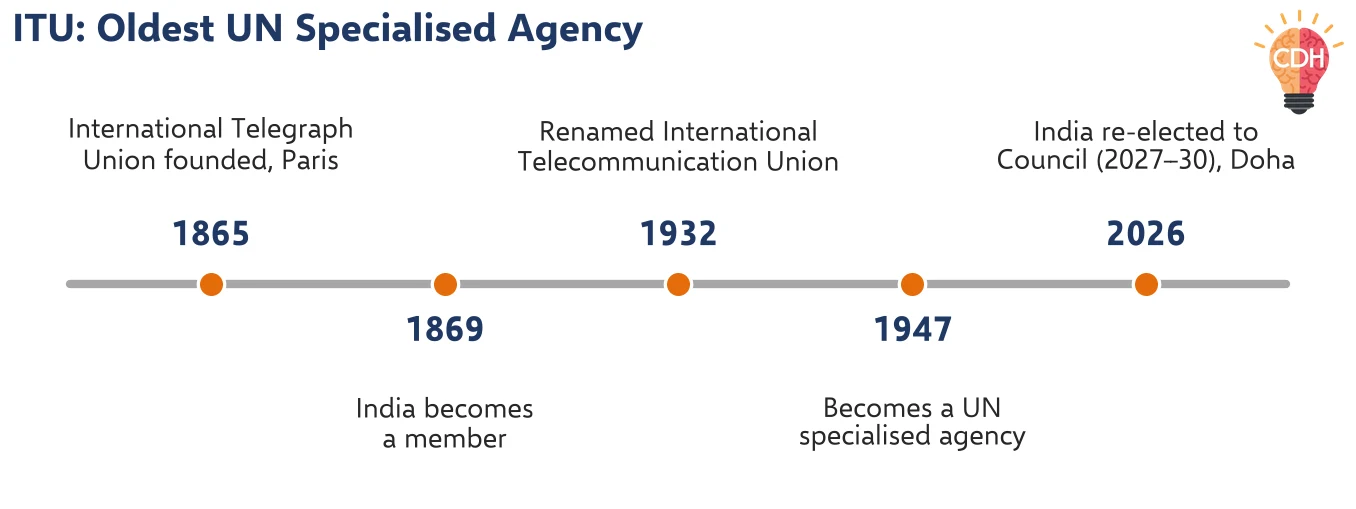
(INTERNATIONAL RELATIONS) (AIR) India has been re-elected to the International Telecommunication Union (ITU) Council for 2027–2030 at the ITU Plenipotentiary Conference in Doha, Qatar.
| Feature | Details |
|---|---|
| Status | Oldest specialised agency of the United Nations; HQ Geneva |
| Members | 194 Member States plus industry, academic and sector members |
| Plenipotentiary Conference | Supreme policy body; meets every four years |
| Council | 48 members; governs between conferences, oversees policy, strategic and financial plans |
| Mandate | Allocates radio spectrum and satellite orbits, sets ICT standards, bridges the digital divide |
Re-election strengthens India’s voice on spectrum, 5G and beyond, and standards that shape its digital public infrastructure.
📖 Read More: The United Nations
7. Navy’s Barak Missile Shield Gets an Upgrade
(INTERNAL SECURITY) (TH) The Ministry of Defence signed a ₹1,976.40-crore contract with Israel Aerospace Industries (IAI) on 18 November 2026 to upgrade the Barak Point Defence Missile System on Indian Navy warships.
- System: Barak-1, an Israeli ship-borne surface-to-air missile for short-range defence against aircraft and anti-ship missiles; the warship’s last missile-based layer of air defence.
- Scope: hardware and software upgrade with improved engagement range, plus obsolescence management (replacing ageing parts to extend service life).
- Route: signed under the Other Capital Procurement Procedure.
The deal reflects deep India–Israel defence ties; the two countries also co-developed the longer-range Barak-8 / MRSAM family.
📖 Read More: Missile Technology • Naval Defence
8. JAIMEX 2026: India–Japan Naval Drill
(INTERNAL SECURITY) (PIB) INS Sahyadri took part in JAIMEX 2026 with Japan’s JS Ise of the Japan Maritime Self-Defense Force on 13–14 November 2026.
- Drills: tactical manoeuvres, communication drills and cross-deck landings to improve interoperability.
- Exercise: bilateral India–Japan maritime exercise, first held off Japan in 2012 (earlier called JIMEX).
- INS Sahyadri: indigenous Shivalik-class (Project 17) guided-missile stealth frigate built by Mazagon Dock Shipbuilders.
- Significance: supports the India–Japan Special Strategic and Global Partnership and a free, open Indo-Pacific.
📖 Read More: India – Japan Relations • Naval Defence
9. AI Data Centres Face a Sustainability Test
(SCIENCE AND TECHNOLOGY) (IE) Opposition to fast-growing AI data centres is rising worldwide. In the 2026 US midterms, 46 of 47 local ballot measures on data centres rejected expansion or sought more scrutiny. In India, legal challenges target the USD 15 billion Adani–Google AI campus at Visakhapatnam.
What Makes AI Data Centres Different
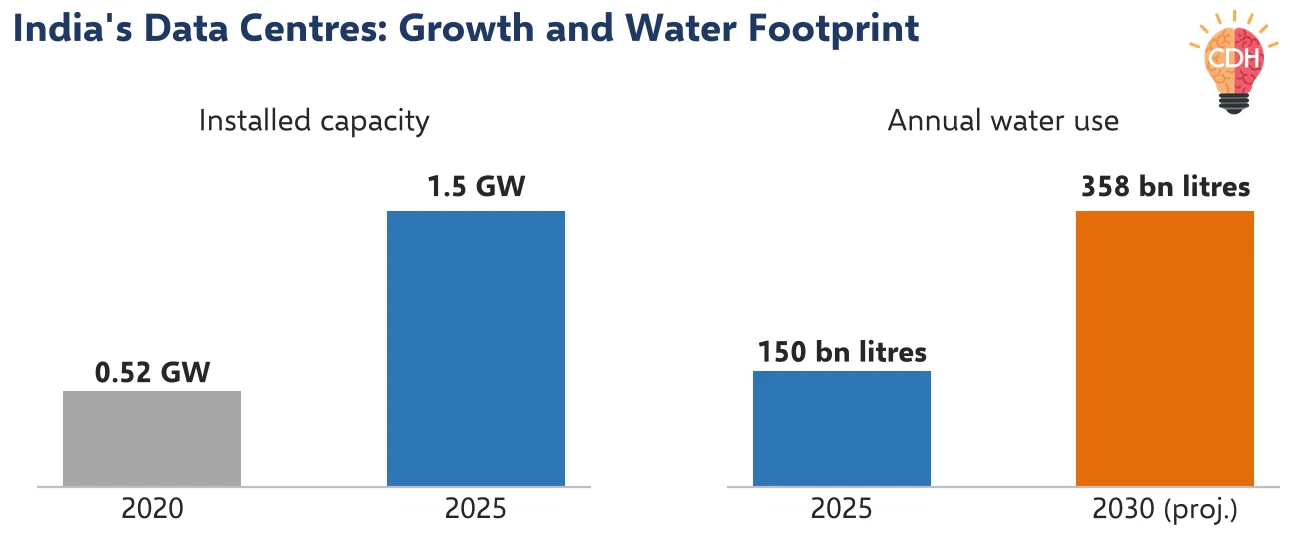
A data centre houses servers, storage, networks and cooling. AI centres pack dense GPU clusters to train AI models and serve real-time inference, so they need far more power and cooling. The IEA notes a typical AI data centre uses as much electricity as 100,000 households.
Why India Wants Them
- Hosting gap: India generates about a fifth of the world’s data but hosts only a small share of global data-centre capacity.
- Data sovereignty: domestic hosting aids security and compliance with the Digital Personal Data Protection Act, 2023.
- Digital economy: powers UPI, e-governance, cloud (MeghRaj) and the IndiaAI Mission.
- Policy support: infrastructure status since Budget 2022-23.
Concerns
- Power: round-the-clock loads strain grids and risk coal lock-in against the Net Zero 2070 goal.
- Heat and water: nearly all power becomes heat; evaporative cooling drains freshwater in stressed cities (see water conservation).
- Local burden: noise, urban heat and land use fall on host communities, with few permanent jobs.
- Clearance gap: no separate category under the EIA Notification, 2006 (see EIA).
Way Forward
- National policy linking approvals to grid, water and site suitability.
- Disclosure of Power Usage Effectiveness (PUE) and Water Usage Effectiveness (WUE).
- Closed-loop liquid cooling, additional renewables and benefit-sharing with host communities.
📖 Read More: Artificial Intelligence (AI) • Environmental Impact Assessment
10. IndiaAI Releases EKA-1 and Dhīr Models
(SCIENCE AND TECHNOLOGY) (IE) The IndiaAI Mission (MeitY) released three indigenous foundation models on 3 November 2026: EKA-1 by Soket Labs, and Dhīr 2B and Dhīr 5B by Bengaluru’s ZenteiQ AiTech Innovations. They were built with subsidised access to national AI compute.
| Feature | EKA-1 | Dhīr 2B / Dhīr 5B |
|---|---|---|
| Size | 26.3 billion parameters; ~7.5 trillion training tokens; sparse hybrid design | 2 and 5 billion parameters: small language models |
| Languages | All 22 scheduled languages + English | English + 10 Indian languages |
| Strength | Maths, coding, reasoning, agentic tasks; banking and cybersecurity | Run offline, on-premise or on-device; data stays local |
| Use cases | Enterprise and sector-specific AI | Government, defence, education in low-connectivity areas |
Why Indigenous Models Matter
- Strategic autonomy: less dependence on foreign AI for critical sectors (see AI governance).
- Language access: India has over 19,500 languages and dialects; many, like Bhojpuri or Dogri, are ‘low-resource’ with little digitised data.
- Token tax: English-centric tokenisers split Indic scripts into many pieces, making Indian-language AI slower and costlier.
- Data ecosystem: models are available via AIKosh, alongside BHASHINI for translation.
📖 Read More: Artificial Intelligence (AI) • Spatial Distribution of Languages and Linguistic Diversity
11. Why India Needs a Space Security Doctrine
(SCIENCE AND TECHNOLOGY) (TH) Experts argue India needs a comprehensive national space security doctrine, as threats shift from destroying satellites to disrupting the services they provide.
From Destruction to Disruption
| Threat | Effect |
|---|---|
| Jamming | Blocks satellite communication and navigation signals |
| Spoofing | Feeds false position or timing data to receivers |
| Cyber attacks | Target satellites, ground stations and networks (see cyber threats) |
| Electronic warfare | Degrades signals and reliability without physical damage |
Why a Doctrine Is Needed
- Dependence: defence, banking, logistics, weather and disaster management all rely on satellites.
- Attribution: disruptions are hard to trace, so clear thresholds are needed to tell attacks from accidents.
- Dual use: satellites serve civil and military users, complicating response.
- Escalation risk: misreading a glitch as an attack could trigger conflict.
- Coordination: defence agencies, ISRO and private operators need shared standards.
Existing Building Blocks
- Indian Space Policy, 2023: opens the sector to private players.
- Defence Space Agency (2019) and the Mission Shakti anti-satellite test (2019).
- Indian Space Situational Awareness Report: tracks debris and collision risks.
📖 Read More: Space Security and Strategic Competition • Space Governance and Traffic Management
12. China’s LineShine Tops Supercomputer Rankings Again
(SCIENCE AND TECHNOLOGY) (TH) China’s LineShine kept the top spot on the 68th TOP500 list, released at SC26 in Chicago on 16 November 2026. It is the first Chinese leader since Sunway TaihuLight in 2017.
- Speed: about 2.198 exaflops on the High Performance Linpack test, the first TOP500 system to cross 2 exaflops, drawing ~42 MW.
- Indigenous stack: China-made processors and the Kylin operating system, despite US chip curbs.
- Built for: atmospheric and ocean research, by the Shenzhen Cloud Computing Centre.
- India: highest-ranked system is Yotta’s Shakti Cloud at No. 35.
| Rank | System | Country |
|---|---|---|
| 1 | LineShine | China |
| 2 | El Capitan | US |
| 3–4 | Frontier, Aurora | US |
| 5 | JUPITER Booster | Germany |
TOP500 is published twice a year since 1993 and ranks systems by Rmax (measured Linpack speed), not Rpeak (theoretical peak). India’s own push is the National Supercomputing Mission.
📖 Read More: National Supercomputing Mission (NSM)
13. India–ICTP Fund to Boost Researcher Mobility
(SCIENCE AND TECHNOLOGY) (DD) India’s Department of Science and Technology (DST) and the International Centre for Theoretical Physics (ICTP), Trieste, signed a Letter of Intent to set up the India–ICTP Co-operation Fund, during the Science Minister’s visit to Italy (11–15 November 2026).
- Aim: give formal structure to existing ties and widen fellowships, diploma courses and postdoctoral openings for Indian researchers.
- Areas: high-energy physics, astrophysics, climate modelling, computational science and mathematics.
- Partners: DST, CSIR, IITs and universities already work with ICTP.
- About ICTP: founded in 1964 by Nobel laureate Abdus Salam; run with UNESCO and the IAEA.
The fund adds to India’s science and technology diplomacy and global research networks.
📖 Read More: Science & Technology Diplomacy
14. Wind Energy: India’s 59 GW and the Road to 156
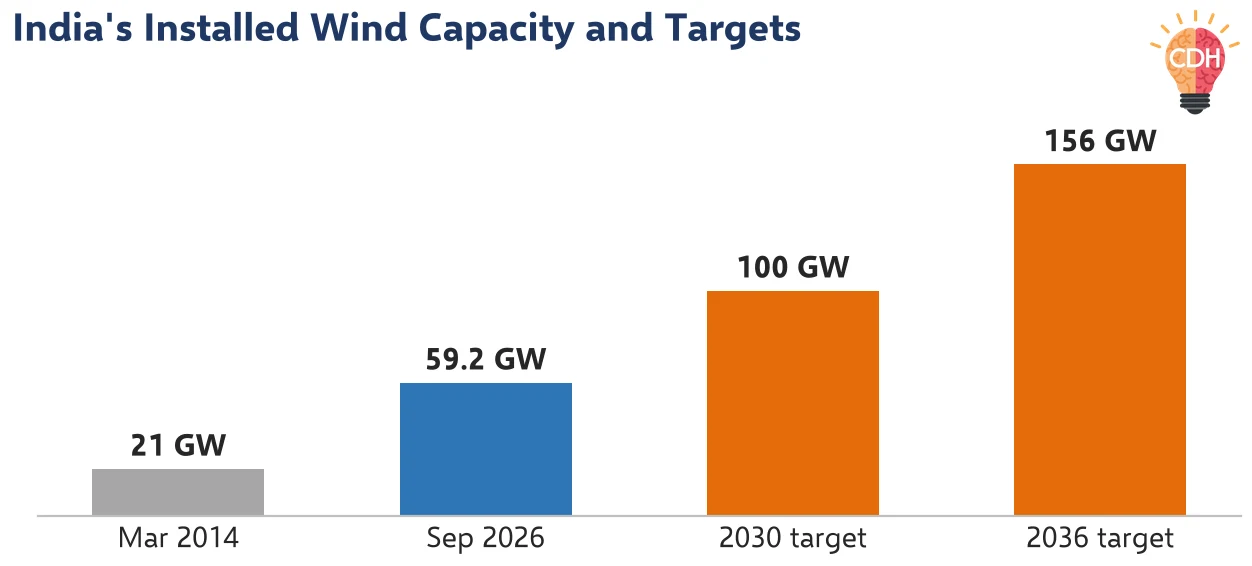
(ENVIRONMENT) (PIB) India’s installed wind capacity reached 59.20 GW on 30 September 2026, about 19.8% of total renewable capacity of 299.25 GW. India ranks 4th in the world in installed wind power.
Key Facts
- Potential: 695.5 GW at 120 m and 1,163.9 GW at 150 m hub height; Rajasthan leads, followed by Gujarat, Maharashtra and Karnataka.
- Record year: 6.05 GW added in 2025-26, beating 5.4 GW in 2016-17.
- Generation: 106.7 billion units in FY 2025-26; about 45% comes in peak-demand hours, complementing solar.
- Manufacturing: turbine capacity rose from 10 GW (2014) to about 24 GW; 70–80% indigenisation.
Policy Support
- Offshore VGF: ₹6,853 crore for 1,000 MW off Gujarat and Tamil Nadu (500 MW each).
- Contracts for Difference: 500 MW pilot for revenue certainty.
- Wind RPO, Green Energy Open Access Rules, ISTS charge waiver, and National Wind-Solar Hybrid Policy (2018).
- Task Force (January 2026) on land, transmission and regulatory hurdles.
Challenges
- Intermittency and grid balancing; need for storage-linked round-the-clock supply.
- Transmission gaps in high-potential regions; land acquisition delays.
- Offshore costs: foundations, vessels, ports and subsea cables (see challenges of renewables).
📖 Read More: Wind Energy • Measures to Boost Renewable Energy
15. Climate Risk Index 2027: India Among Hardest Hit
(ENVIRONMENT) (DTE) The Climate Risk Index (CRI) 2027, released by Germanwatch at COP31, ranks India 10th most affected by extreme weather over 1996–2025 and 12th for 2025 alone.
| Measure | India (1996–2025) | World (1996–2025) |
|---|---|---|
| Extreme events | 436 | ~10,000 |
| Deaths | > 78,000 | > 9 lakh (heatwaves > 3.64 lakh) |
| People affected | > 120 crore (cumulative) | ~550 crore (cumulative) |
| Economic losses | > USD 170 billion | > USD 4.7 trillion |
- Most affected, 1996–2025: Dominica, Myanmar, Honduras.
- Most affected, 2025: Jamaica (Hurricane Melissa, Category 5), Sri Lanka (Cyclone Ditwah), Spain.
- India’s major events: Odisha super cyclone (1999), Uttarakhand floods (2013), Hudhud (2014), Amphan (2020), and repeated heatwaves.
The CRI measures fatalities, people affected and economic losses. It is distinct from Germanwatch’s Climate Change Performance Index, which rates mitigation effort. The results strengthen the case for adaptation finance under the UNFCCC.
📖 Read More: Introduction to Climate Change • Heat Waves: A Natural Hazard
16. Global Fund for Coral Reefs Adds $30 Million
(ENVIRONMENT) (DTE) At COP31, the Global Fund for Coral Reefs (GFCR) announced more than USD 30 million in new investments and donor contributions for reefs in 22 developing countries.
- What it is: a blended-finance fund, launched in 2020, mixing grants, concessional loans and private capital.
- UN partners: includes UNEP among supporting agencies (see UNEP).
- Projects: Mesoamerican Reef (Mexico, Belize, Guatemala, Honduras), Indonesia’s Biru Fund, marine protected areas in the Philippines, and Zanzibar.
- Model: backs reef-positive businesses such as sustainable fisheries, seaweed farming and waste management.
Coral Reefs in Brief
Reefs are built by tiny coral polyps that secrete calcium carbonate and live in symbiosis with algae called zooxanthellae. Covering a tiny part of the seafloor, they host about a quarter of marine species. Warming seas cause coral bleaching when corals expel these algae.
📖 Read More: Introduction to Coral Reefs • Coral Bleaching
17. Andaman Cobra: India’s Island Cobra at Risk
(ENVIRONMENT) (TH) Experts have flagged growing conservation challenges for the Andaman cobra (Naja sagittifera), India’s only island-dwelling cobra, and how little is known about it a century after its discovery.
| Feature | Details |
|---|---|
| Range | Endemic to the Andaman Islands, including Little Andaman |
| Described | 1913 by herpetologist Frank Wall |
| Status | IUCN: Endangered; CITES Appendix II |
| Looks | Arrow-like or crossband markings; smaller hood than the mainland spectacled cobra |
| Spitting | Not a true spitting cobra; spits rarely and with poor aim, as a defence |
- Antivenom gap: India’s polyvalent antivenom targets the mainland ‘Big Four’ snakes and works poorly against this species.
- Vulnerability: small, enclosed island range means no outside population can support recovery (see species of conservation concern).
📖 Read More: Development of Andaman and Nicobar Islands • India’s Wildlife Laws, Policies and Institutions
18. Cyclone Akvan Heads for Andhra–Odisha Coast
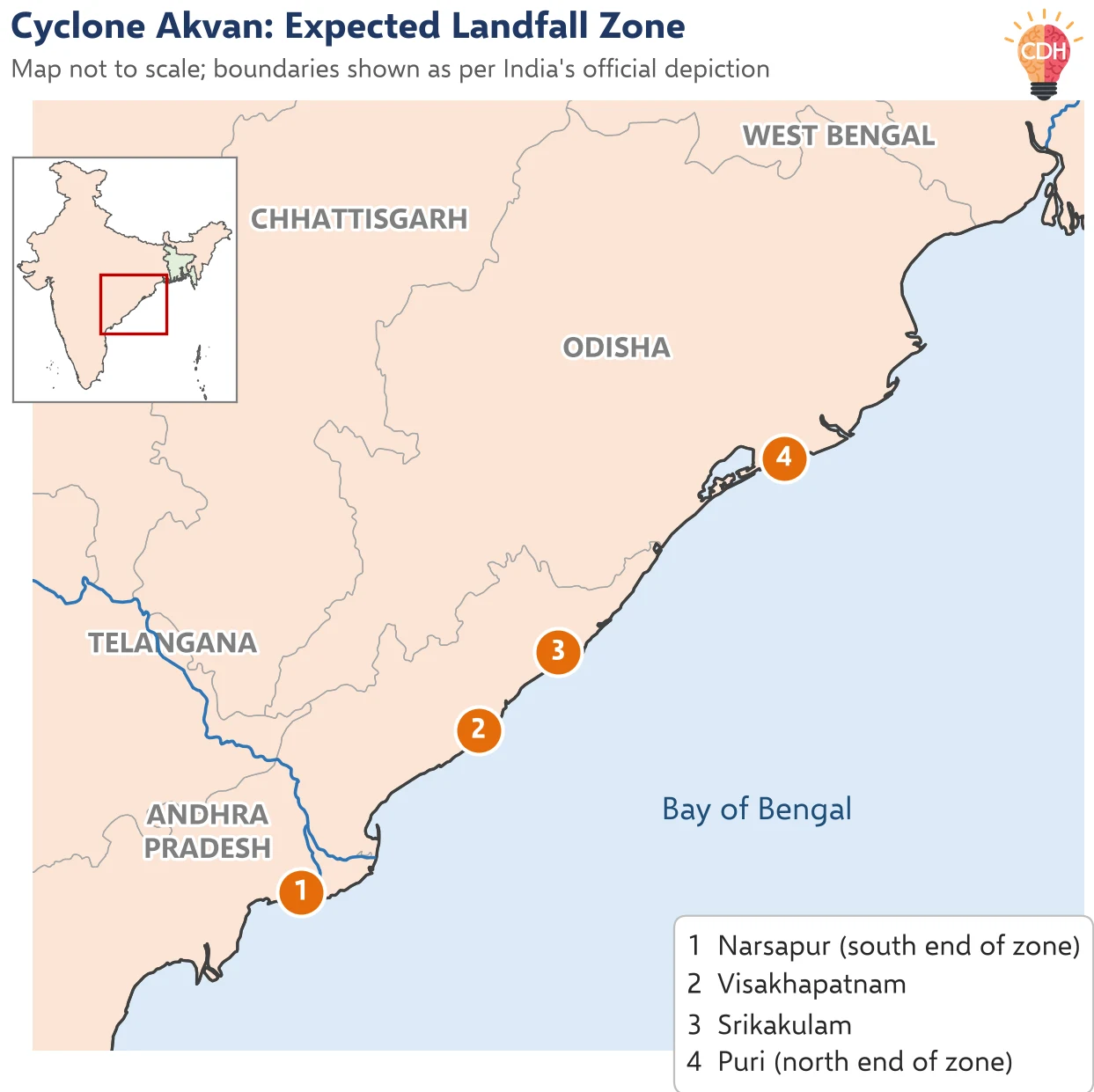
(GEOGRAPHY) (AIR) Cyclone Akvan has intensified into a Severe Cyclonic Storm over the west-central Bay of Bengal. It is expected to cross the north Andhra Pradesh–south Odisha coast between Narsapur and Puri on 20 November 2026. It is the third cyclone in the basin in about a month, after Arnab and Murasu.
- Preparedness: NDRF, SDRF and fire teams on standby; Srikakulam farmers told to protect harvested paddy.
- Name: proposed by Iran; Akvan is a demon-giant (Akvan Div) in Ferdowsi’s epic Shahnameh.
- Season: October–December, the north-east monsoon, is the main Bay of Bengal cyclone season (see tropical cyclones).
IMD Cyclone Categories
| Category | Wind speed (km/h) |
|---|---|
| Depression / Deep Depression | 31–49 / 50–61 |
| Cyclonic Storm | 62–88 |
| Severe Cyclonic Storm | 89–117 |
| Very Severe Cyclonic Storm | 118–165 |
| Extremely Severe Cyclonic Storm | 166–220 |
| Super Cyclonic Storm | 222 and above |
📖 Read More: Cyclones: A Natural Hazard • Types of Tropical Cyclones
19. Pushkar Fair Opens in Rajasthan
(ART AND CULTURE) (AIR) The Pushkar Fair in Rajasthan’s Ajmer district began on 17 November 2026 with a traditional flag-hoisting ceremony and runs till 24 November.
- Three facets: a religious, cultural and livestock fair; one of India’s largest trading fairs for camels, horses and cattle.
- Pilgrimage: devotees bathe in the sacred Pushkar Lake; the fair peaks on Kartik Purnima.
- Heritage: Pushkar has the rare Brahma Temple; folk music, dance and contests showcase Rajasthan’s rural culture.
- Tourism: a major draw for domestic and foreign visitors (see tourism).
📖 Read More: Fairs in India • Festivals in India