
UPSC CURRENT AFFAIRS — 6 OCTOBER 2026
Shield or Sword? Supreme Court Leaves the Privileges–Free Speech Question Open
(POLITY AND GOVERNANCE) (IE) A seven-judge Constitution Bench of the Supreme Court has closed the long-pending reference in N. Ravi v. Speaker, Legislative Assembly, Chennai as infructuous. The Court consciously kept the core question open — whether legislative privileges can override a citizen’s right to free speech — for decision in a future, suitable case.
The case began in November 2003, when the Tamil Nadu Assembly treated an editorial in The Hindu as a breach of privilege and ordered the arrest of its journalists. The matter was referred to a five-judge Bench in 2003 and to seven judges in 2004, and stayed pending for over two decades.
What are legislative privileges?
They are special rights and immunities enjoyed by the Houses of Parliament and State Legislatures, their committees and members, so that lawmakers can function independently and without fear. Read the full concept in Parliamentary Privileges.
| Type | What it covers |
| Collective privileges | Regulating internal proceedings, publishing debates, excluding strangers, and punishing members or outsiders for breach of privilege or contempt. |
| Individual privileges | Freedom of speech within the House and freedom from arrest in civil cases during sessions (and 40 days before and after). |
Constitutional anchors
- Article 105: Powers, privileges and immunities of Parliament, its members and committees.
- Article 194: The corresponding provision for State Legislatures.
- Articles 105(3) and 194(3): Allow the legislature to define privileges by law; until then, they remain those that existed before the 44th Amendment Act, 1978 came into force.
- Articles 122 and 212: Courts cannot question proceedings on the ground of mere procedural irregularity; judicial review for illegality or unconstitutionality survives.
- Articles 118 and 121: Speech in the House is subject to the rules of procedure, and the conduct of Supreme Court/High Court judges cannot be discussed except on a removal motion.
How a privilege complaint travels
Privilege notice by a member ➜ Consent of Speaker/Chairman ➜ Committee of Privileges examines ➜ Report to the House ➜ House decides penalty
The Committee of Privileges has 15 members in the Lok Sabha (nominated by the Speaker) and 10 in the Rajya Sabha (nominated by the Chairman). It acts in a quasi-judicial manner and may recommend reprimand, apology, suspension or expulsion.
How the Supreme Court has balanced the two
| Case | Principle |
| Pandit M.S.M. Sharma v. Sri Krishna Sinha (1959) | Privileges under Article 194(3) prevailed over the reporter’s right under Article 19(1)(a). |
| Special Reference No. 1 of 1964 (Keshav Singh) | Privileges do not automatically override Fundamental Rights; courts can review a legislature’s penal action. |
| Raja Ram Pal v. Speaker, Lok Sabha (2007) | Expulsion and other privilege powers are subject to judicial review. |
| Amarinder Singh v. Special Committee, Punjab Vidhan Sabha (2010) | Privilege cannot be used to punish acts unconnected with the functioning of the House. |
| Sita Soren v. Union of India (2024) | A seven-judge Bench overruled P.V. Narasimha Rao (1998): bribery is not protected by Articles 105(2)/194(2). |
Why the conflict matters
- Article 194(3) vs Article 19(1)(a): Uncodified privilege can collide with the right to freedom of speech, which includes freedom of the press.
- Personal liberty: Arrests ordered for breach of privilege engage Article 21 and the need for fair procedure.
- Sword, not shield: Critics argue privileges meant to protect debate are being used to silence critics and the press.
- Constitutional supremacy: Unlike the UK’s parliamentary sovereignty, India’s Constitution is supreme, so Part III cannot be lightly displaced.
The way forward
- Codify privileges under Articles 105(3) and 194(3) to give clear, predictable limits.
- Harmonious construction so that the dignity of the House and press freedom coexist.
- Judicial review of penal action that touches liberty, while respecting the House’s internal autonomy.
📖 Read More: Parliamentary Privileges • Privileges of the State Legislature • Right to Freedom • Judicial Review
Beyond Banks and Watches: India and Switzerland Widen Their Partnership
(INTERNATIONAL RELATIONS) (HT) (PIB) Swiss President Guy Parmelin held talks with Prime Minister Narendra Modi in New Delhi during a State Visit that coincided with the first anniversary of the India–EFTA Trade and Economic Partnership Agreement (TEPA). Five agreements were signed and the two sides agreed to explore cooperation in defence production, military exchanges and nuclear energy.
Outcomes of the visit
| Agreement | What it does |
| Migration and Mobility Partnership (MMP) | Multiple-entry visas valid up to five years, renewable one-year student permits, and verification timelines of 30–90 days, while curbing irregular migration. |
| Exchange of Young Professionals Agreement | Up to 300 young professionals a year from each side, scalable to 500, for work experience and skill building. |
| MoU on transport, mobility and infrastructure | Cooperation between MoRTH and Switzerland’s economic affairs department on e-mobility, ropeways and tunnelling. |
| Letter of Intent: DST–SNSF | Long-term joint research between the Department of Science and Technology and the Swiss National Science Foundation. |
| DST–Zurich University of Applied Sciences arrangement | Indo-Swiss Academia–Industry Training (AIT India) for early-stage deep-tech start-ups. |
The leaders also noted infrastructure collaboration such as the Varanasi ropeway, Jewar Airport and mountain tunnelling. Switzerland will host the Geneva AI Summit in 2027, building on India’s AI Summit in February 2026 — a shared push for responsible and human-centric AI governance.
The relationship at a glance
- Diplomatic foundation: A Treaty of Friendship was signed on 14 August 1948, among independent India’s earliest.
- Trade pattern: India’s imports are dominated by gold bullion, machinery and pharmaceuticals; exports include organic chemicals, jewellery, textiles and machinery. The balance is heavily in Switzerland’s favour.
- Tax transparency: Banking secrecy gave way to the Automatic Exchange of Information, under which India received its first set of Swiss account data in September 2019.
- Science: India is an Associate Member State of CERN in Geneva, and the Indo-Swiss Joint Research Programme supports collaborative research.
TEPA and EFTA in brief
TEPA was signed on 10 March 2024 and entered into force on 1 October 2025. It is India’s first FTA with a European economic bloc. EFTA states aim to mobilise USD 100 billion of investment in India and support one million direct jobs over 15 years. See types of trade agreements.
| Feature | EFTA |
| Origin | Stockholm Convention, 1960 |
| Members | Iceland, Liechtenstein, Norway, Switzerland |
| Nature | Free trade area, not a customs union; each member sets its own external tariffs |
| Link with EU | Iceland, Liechtenstein and Norway are in the EU single market via the European Economic Area; Switzerland relies on bilateral agreements with the EU |
Friction points
- No investment treaty: India terminated its older Bilateral Investment Treaties in 2017; Swiss investors want treaty protection and international arbitration, while India’s Model BIT prefers exhausting local remedies first.
- Pharma patents: Swiss firms seek data exclusivity and patent-term extensions, which clash with Section 3(d) of the Patents Act, 1970 — upheld in Novartis v. Union of India (2013). See Intellectual Property Rights.
- Investment pledge: The USD 100 billion target depends on private EFTA companies, not government guarantees; India must keep its business climate competitive.
- Neutrality limits: Swiss war-material laws restrict defence exports and re-exports, shaping how far defence-industrial ties can go.
Way forward
- Channel TEPA investment through the India–EFTA Desk into PLI sectors such as precision engineering, medical devices and renewables.
- Move the IPR debate from litigation to co-development, with Swiss R&D and API manufacturing in India.
- Use Swiss expertise in tunnelling, ropeways and avalanche protection for Himalayan connectivity.
📖 Read More: India and Switzerland • India and Europe • Foreign Direct Investment (FDI) • Intellectual Property Rights
How India Moves: Key Findings of the First National Household Travel Survey
(ECONOMICS) (PIB) The National Statistics Office (NSO) under the Ministry of Statistics and Programme Implementation has released findings of India’s first-ever National Household Travel Survey (NHTS), conducted from July 2025 to June 2026. It maps how, why and by what mode Indians travel for study, work and overnight trips.
About the survey
- Coverage: 14,274 villages and 10,377 urban blocks; 4,92,023 households and 20,34,371 persons across all States and UTs.
- Definition of travel: Only trips of 1 km or more count; shorter trips are not recorded.
- Primary mode: The mode used for the longest distance in a trip.
- Purpose: Evidence for transport planning, infrastructure investment and accessibility, including the data needs of the Ministry of Railways.
Headline findings
| Indicator | Finding |
| Students travelling ≥1 km | 66.4% of students aged 6+ (65.6% rural; 68.1% urban) |
| Top student modes | Walking 37.0%, buses 29.5%, bicycles 15.8% |
| Workers travelling ≥1 km | 57.6% of workers aged 15+ (54.5% rural; 64.1% urban) |
| Gender gap | 61.9% of male workers vs 41.9% of female workers make daily work trips |
| Main worker mode | Two-wheelers 42.6% (37.1% rural; 52.3% urban) |
| Average travel time | 23 minutes for students; 25 minutes to a fixed workplace |
| Within 30 minutes | 87.6% of students; 83.4% of workers |
| Monthly commute cost (workers) | ₹785 on average — ₹1,044 urban vs ₹612 rural; ₹835 for men vs ₹533 for women |
| Overnight trips | Buses 55.8% and railways 17.7%; 70.2% are for social and religious purposes |
What the numbers tell us
- Last-mile matters: Walking and buses dominate student travel, so safe footpaths and reliable road transport directly shape school access.
- Two-wheeler economy: Heavy reliance on two-wheelers signals weak public transport in many towns; mass transit (metro, suburban rail, monorail, trams) carries only 5.0% of urban workers nationally.
- Women’s mobility: Fewer women travel for work and they spend less — a pointer to both lower participation and constrained choices. See women and development.
- Rail for long journeys: Railways carry about 22.7% of urban but 14.0% of rural households’ overnight trips — useful for rail transport planning.
Household travel data ➜ Gaps in routes and frequency ➜ Targeted transport investment ➜ Better access to jobs and schools
📖 Read More: Introduction to Transport and Communication • Road Transport in India • Schemes under MoSPI
Down the Brahmaputra to Dhaka: Upper Assam’s First International Cargo since Independence
(ECONOMICS) (NDTV) Union Minister Sarbananda Sonowal flagged off a barge carrying 540 metric tonnes of methanol from the Bogibeel inland water terminal near Dibrugarh to Bangladesh. It is the first international cargo from Upper Assam since Independence, reviving a river trade route that had fallen silent for decades.
The shipment
| Aspect | Details |
| Cargo | 540 MT methanol produced by Assam Petro-Chemicals Ltd (APCL), Namrup |
| Vessel | Dumb barge DLB Patkai, pushed by the tug Kushal Konwar |
| Route | 768 km down the Brahmaputra (National Waterway-2) to the border, then the Indo-Bangladesh Protocol route |
| Destination | Pangaon port near Dhaka (Narayanganj); total journey about 1,300 km |
Rise, fall and revival of a river route
| Period | Milestone |
| 1856 | Regular steamer links connect Calcutta and Dibrugarh |
| 1882 | Dibru–Sadiya Railway turns Dibrugarh into a rail–river hub for tea, oil, coal and timber |
| 1947 | Partition places East Pakistan across the route |
| 1950 | The Assam–Tibet earthquake (15 August 1950, about Mw 8.6–8.7) alters the Brahmaputra’s bed at Dibrugarh |
| 1956 | Dibrugarh river ghat closed on 15 October |
| 1965 | India–Pakistan war suspends cross-border river transit |
| 1972 | Protocol on Inland Water Transit and Trade (PIWTT) with Bangladesh |
| 1988 | 891-km Sadiya–Dhubri stretch declared National Waterway-2 |
Why it matters
- Cheaper bulk logistics: Water transport is the lowest-cost, lowest-emission mode for heavy and hazardous cargo like methanol.
- Act East and BBIN connectivity: It deepens economic links with Bangladesh and gives the landlocked North-East a riverine outlet.
- Industrial boost: A new market for the petrochemical industry of Upper Assam.
- Challenges: Shifting channels, siltation and seasonal depth on the braided Brahmaputra demand constant dredging and navigation aids.
APCL, Namrup ➜ Bogibeel terminal ➜ NW-2 to Dhubri ➜ Indo-Bangladesh Protocol route ➜ Pangaon, Dhaka
📖 Read More: Water Transport in India • Brahmaputra River System • India and Bangladesh • Schemes under Ministry of Ports, Shipping and Waterways
Financing Taps and Toilets: India’s First WASH-Focused Social Bond
(ECONOMICS) (PIB) NABKISAN Finance Limited, a subsidiary of NABARD, has listed India’s first Social Bond dedicated exclusively to Water, Sanitation and Hygiene (WASH) on the National Stock Exchange. The issue was oversubscribed 1.8 times and raised ₹180 crore for safe water and sanitation in rural and underserved areas.
Bond at a glance
| Feature | Details |
| Issuer | NABKISAN Finance Ltd (subsidiary of NABARD) |
| Amount | ₹180 crore; oversubscribed 1.8 times |
| Tenure and coupon | 5 years; 8.10% coupon; matures September 2031 |
| Rating | CRISIL AAA (Stable) and CARE AAA (Stable) |
| Listing | National Stock Exchange (NSE), listed on 1 October 2026 |
| Partner | Water.org as Technical Advisor and Knowledge Partner |
What is a social bond?
A social bond is a use-of-proceeds debt instrument: money raised can be spent only on projects with clear social outcomes such as housing, health, education or, here, WASH. Global good practice is set by the ICMA Social Bond Principles, which stress transparency and impact reporting.
| Label | Proceeds used for |
| Green bond | Environmental projects — renewables, clean transport, pollution control |
| Social bond | Social outcomes — water, sanitation, health, affordable housing |
| Sustainability bond | A mix of green and social projects |
Significance
- Crowding in private capital: Shows how the capital market can fund development priorities alongside budget schemes like the Jal Jeevan Mission and Swachh Bharat Mission (Grameen).
- Credibility: Top ratings from credit rating agencies lower borrowing costs and attract institutional investors.
- Last-mile WASH: Proceeds are ring-fenced for safe water, sanitation and hygiene solutions in rural and underserved communities.
Investors buy WASH bond ➜ NABKISAN raises ₹180 crore ➜ Lending for water and sanitation ➜ Health and livelihood gains
📖 Read More: Bonds • Capital Market • All India Financial Institutions (AIFIs)
Drones over Grain Routes: The Geography of the Black Sea
(GEOGRAPHY) (IT) The Turkish-owned cargo ship MV Royad Mammadov, carrying corn from the Ukrainian port of Izmail to Italy, caught fire and sank in the Black Sea within Romania’s exclusive economic zone after a reported Russian drone strike. Two crew members were killed; Indian nationals were among the crew.
Ukraine attributed the strike to Russian drones, while Romanian authorities did not confirm the cause of the fire. The incident again highlights the risk to merchant shipping in a sea that carries much of the world’s grain trade.
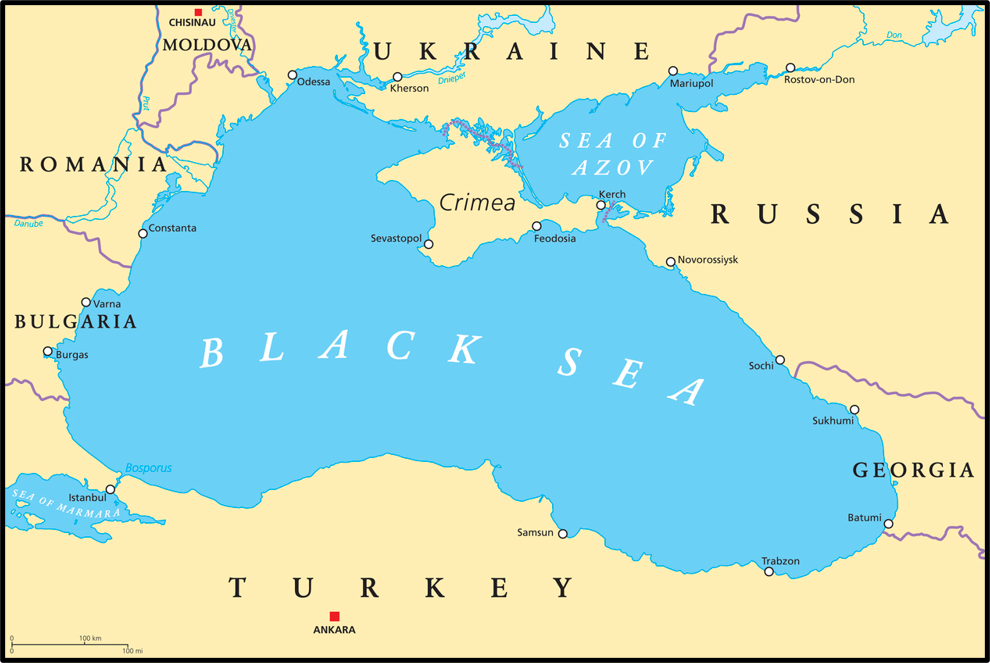
Location and connections
The Black Sea is an inland marginal sea between south-eastern Europe and western Asia. It links to the Sea of Azov through the Kerch Strait, and to the Mediterranean through the Bosporus, the Sea of Marmara and the Dardanelles. Locate it on the political map of Europe.
Black Sea ➜ Bosporus ➜ Sea of Marmara ➜ Dardanelles ➜ Aegean Sea ➜ Mediterranean Sea
| Feature | Details |
| Bordering countries | Bulgaria, Ukraine, Russia, Georgia, Romania, Türkiye (mnemonic: BURGER-T) |
| Area | About 436,400 sq km (excluding the Sea of Azov) |
| Maximum depth | About 2,212 m, south of Yalta (Crimea) |
| Major rivers | Danube, Dnieper, Dniester; the Don enters via the Sea of Azov |
| Strait regime | Montreux Convention (1936) — Türkiye regulates passage through the Turkish Straits |
Unique physical features
- Largest anoxic basin: Over 90% of its deep water volume is anoxic and rich in hydrogen sulphide, because a sharp density layer stops surface and deep waters from mixing.
- Low surface salinity: Large river inflows keep surface salinity at about 17 PSU — roughly half that of the open ocean. See ocean salinity.
- Relief: A broad, shallow continental shelf in the north-west gives way to steep slopes and a deep central basin.
Strategic significance
- Food security: A key export route for wheat, maize, barley and sunflower oil from Ukraine and Russia to Asia, Africa and West Asia.
- Geopolitics: Russia’s warm-water access to the Mediterranean, alongside NATO members Türkiye, Romania and Bulgaria. See India–Russia relations and India–Türkiye relations.
- Seafarer safety: Indian crews serve widely on merchant ships here, making maritime security a consular concern for India.
📖 Read More: Waters of Europe • Important Facts about Europe • Laws of the Sea
Carbon Credits with Japan: India–Japan JCM Moves to Implementation
(ENVIRONMENT) (PIB) India and Japan have jointly launched the Operational Manual for the India–Japan Joint Crediting Mechanism (JCM) in New Delhi. It sets out step-by-step procedures for projects under Article 6.2 of the Paris Agreement, marking the shift from institutional design to actual implementation.
What is the JCM?
The JCM is a bilateral, project-based mechanism started by Japan with partner countries. Japanese and host-country participants deploy advanced low-carbon technologies; the verified emission reductions become credits shared between the two governments and counted towards their climate targets.
Building blocks of the India–Japan JCM
| Milestone | Date |
| Memorandum of Cooperation signed | 7 August 2025 |
| Rules of Implementation adopted | 8 June 2026 |
| Operational Manual launched | 30 September 2026, New Delhi |
Project cycle
Project Idea Note ➜ Project Design Document ➜ Third-party validation ➜ Monitoring and verification ➜ Joint Committee approval ➜ Credit issuance and authorisation
Article 6 of the Paris Agreement in brief
| Provision | What it allows |
| Article 6.2 | Voluntary bilateral cooperation with transfer of Internationally Transferred Mitigation Outcomes (ITMOs) |
| Article 6.4 | A UN-supervised crediting mechanism (Paris Agreement Crediting Mechanism) |
| Article 6.8 | Non-market approaches such as capacity building and technology transfer |
Corresponding adjustments are the safeguard: when a credit is transferred abroad, the host country adds it back to its own emissions account, so the same reduction is not counted twice. The Paris Agreement entered into force on 4 November 2016.
Significance for India
- Finance and technology: Brings Japanese capital and low-carbon technology into Indian industry, supporting climate mitigation.
- Market confidence: Clear procedures build trust in international carbon markets and complement India’s domestic Carbon Credit Trading Scheme.
- Strategic ties: Adds a green pillar to the India–Japan partnership.
- Caution: India must authorise transfers selectively so that cheap reductions needed for its own NDC are not exported.
📖 Read More: UNFCCC Summits Post-Kyoto • Paris Climate Change Conference 2015 (COP 21) • India–Japan Relations
From PARAM 8000 to PARAM Rudra: India’s Supercomputing Leap
(SCIENCE AND TECHNOLOGY) (PIB) India has deployed 40 supercomputers with a combined capacity of 68 petaflops (PF) under the National Supercomputing Mission (NSM), as of September 2026. The Mission is also building indigenous servers, system software, interconnects and cooling — a push towards compute self-reliance ahead of ESTIC-2026 (27–29 October, Bharat Mandapam).
Supercomputing basics
- Parallel processing: Thousands of processors or nodes work together on one problem, linked by high-speed interconnects.
- Measured in FLOPS: 1 teraFLOPS = 10¹² operations per second; 1 petaFLOPS = 10¹⁵; 1 exaFLOPS = 10¹⁸.
National Supercomputing Mission
| Aspect | Details |
| Launch and outlay | April 2015; about ₹4,500 crore |
| Steered by | Department of Science and Technology (DST) and MeitY |
| Implemented by | C-DAC, Pune and IISc, Bengaluru |
| Approach | ‘Build approach’ with three concurrent phases — assembly, manufacturing, and design and manufacturing support |
| Target | 50 supercomputers with more than 123 PF |
| Status (Sept 2026) | 40 systems, 68 PF: 13 above 1 PF, 12 between 500 TF and 1 PF, 15 below 500 TF |
Evolution of Indian supercomputers
PARAM 8000 (1991, 1 GF) ➜ PARAM Yuva (54 TF) ➜ NSM launched (2015) ➜ PARAM Shivay and Pravega ➜ PARAM Rudra (indigenous servers)
Indigenous building blocks
- Rudra servers: Designed by C-DAC and manufactured by Indian EMS partners; 6,000 deployed and 1,500 more under manufacture.
- Interconnect: Indigenous high-speed network tested at 100 Gbps and 200 Gbps.
- Cooling and software: Indigenous cooling technology (now in deployment) and a complete HPC system software stack.
- PARAM Shavak: A ‘supercomputing-in-a-box’ for colleges and universities.
Applications
| Area | Example |
| Floods | Early warning up to two days ahead for the Mahanadi basin |
| Forest fires | Fire-spread model tested in the Sikkim Himalayas |
| Health | Genomics and drug-discovery platform used to screen drugs during COVID-19 |
| Energy | Seismic imaging suite for oil and gas exploration |
| Cities | Urban weather and air-pollution decision support |
Users and output: over 16,000 researchers (2,900+ PhD scholars) from 400+ institutions, more than 1.5 crore compute jobs and over 1,990 publications. The systems are linked through the National Knowledge Network, and NSM work supports 11 SDGs.
Challenges
- Chip dependence: CPUs and GPUs remain imported — see the semiconductor industry and AI chips.
- Scale gap: The top system on the June 2026 TOP500 list, China’s LineShine, delivers about 2,198 PF on its own — over 30 times India’s combined NSM capacity.
- Low industry use: Most workloads come from public research bodies; private firms often rent foreign cloud compute.
- Energy and cooling costs in tropical conditions, and software lock-in to proprietary GPU ecosystems.
Way ahead
- Integrate indigenous processors under the India Semiconductor Mission and RISC-V programmes.
- Align NSM with the IndiaAI Mission’s GPU compute for training Indian foundation models.
- Pair future exascale systems with renewable power and subsidised access for start-ups.
📖 Read More: National Supercomputing Mission (NSM) • Semiconductor Industry • Artificial Intelligence (AI)
Switching Neurons On with Light: Nobel Medicine 2026 Honours Optogenetics
(SCIENCE AND TECHNOLOGY) (TH) (FP) The 2026 Nobel Prize in Physiology or Medicine has been awarded jointly to Karl Deisseroth, Peter Hegemann and Georg Nagel “for their discoveries concerning light-gated ion channels and optogenetics” — a technique that lets scientists switch specific brain cells on or off with flashes of light.
The laureates
| Laureate | Affiliation | Contribution |
| Peter Hegemann | Humboldt University of Berlin, Germany | Co-discovered channelrhodopsins, light-sensitive ion channels in green algae |
| Georg Nagel | University of Würzburg, Germany | Showed that channelrhodopsins are light-gated channels that work in other cells |
| Karl Deisseroth | Stanford University and HHMI, USA | Introduced channelrhodopsin-2 into neurons (2005) and built optogenetics into a precise tool |
Key concepts
- Ion channel: A protein pore in the cell membrane that lets charged particles pass, changing the cell’s electrical state — the basis of nerve signalling. See neural control and coordination.
- Light-gated channel: Channelrhodopsin-2, found in the alga Chlamydomonas reinhardtii, opens when hit by blue light (peak around 480 nm), letting positive ions in.
- Optogenetics: Genetic engineering makes chosen neurons carry these channels; light then activates or silences them with millisecond precision.
Algal channelrhodopsin gene ➜ Inserted into target neurons ➜ Blue light through optic fibre ➜ Channel opens, ions flow ➜ Neuron fires on command
Why it matters
- Cause and effect in the brain: Unlike drugs or electrodes that act broadly, light targets defined circuits — mapping pain, hunger, reward, sleep and memory.
- Disease research: Insights into Parkinson’s disease, epilepsy, depression and schizophrenia.
- Vision: In 2021, an optogenetic therapy partially restored vision in a patient with retinitis pigmentosa.
- Beyond the brain: Studies of how the nervous system talks to the heart and gut; possible improved cochlear implants.
Limits to human use
- Requires gene delivery into human cells, with safety and ethical concerns — see biotechnology in healthcare.
- Visible light does not penetrate the skull; deep targets need implanted optical fibres.
📖 Read More: Neural Control and Coordination in Humans • Biotechnology in Healthcare • Important Global Scientists and Engineers
An Old Killer Resurfaces: Pneumonic Plague Scare in Siberia
(SCIENCE AND TECHNOLOGY) (IE) Nearly 200 contacts were hospitalised or placed under observation in Russia’s Irkutsk region after a young laboratory worker linked to an anti-plague institute died of severe pneumonia suspected to be pneumonic plague. Regional authorities referred only to a suspected “particularly dangerous infection”.
Official confirmation of plague was not formally announced; reports relied largely on regional statements and media accounts. The episode is a reminder of laboratory biosafety and the zoonotic reservoirs that persist in Central Asia and Siberia.
The pathogen
- Cause: Yersinia pestis, a Gram-negative, rod-shaped (coccobacillus), facultatively anaerobic bacterium, discovered by Alexandre Yersin in 1894.
- Reservoir and vector: Wild rodents and their fleas, chiefly the oriental rat flea Xenopsylla cheopis.
- Incubation: Usually one to seven days; as short as 24 hours for pneumonic plague.
Three clinical forms
| Form | How it arises | Key features |
| Bubonic | Bite of an infected flea | Painful swollen lymph nodes (buboes); most common form; person-to-person spread rare |
| Septicaemic | Bacteria multiply in the bloodstream | Bleeding, tissue death (gangrene), organ damage |
| Pneumonic | Inhaling infected droplets, or spread from untreated bubonic/septicaemic plague | Most virulent; severe pneumonia with bloody sputum; spreads person to person |
Untreated, bubonic plague kills 30–60% of patients, and pneumonic and septicaemic plague are always fatal. Early antibiotics such as gentamicin, doxycycline or ciprofloxacin are effective.
Containment
Suspected case ➜ Isolation and PPE ➜ Contact tracing ➜ Preventive antibiotics for contacts ➜ Rodent and flea control
India’s own experience: the 1994 Surat outbreak (bubonic and pneumonic) caused 56 deaths from 693 suspected cases and triggered mass panic and migration — a lesson in risk communication. Learn more on major human diseases and biological disasters.
📖 Read More: Major Human Diseases • Important Diseases Explained • Biological Disasters
Mountain Guardian 2026: India and UAE Train for High-Altitude Warfare
(INTERNAL SECURITY) (NOA) The inaugural edition of the India–UAE joint military exercise Mountain Guardian 2026 has begun at the Foreign Training Node, Chaubatia in Uttarakhand. The 14-day exercise (5–18 October) involves 92 personnel, drawn equally from both armies, with a focus on mountain warfare.
Key features
| Component | Activities |
| Mountain craft | Rock climbing, cliff assault, rappelling, obstacle crossing, endurance training |
| Surveillance | Drone operations and a surveillance grid with day/night sensors |
| Weapon training | Combat and sniper firing, counter-terrorism drills |
| Culmination | Integrated field training exercise under joint command |
Significance
- Terrain diversity: Complements Desert Cyclone, the two armies’ desert-terrain exercise, giving UAE troops exposure to the Indian Army’s Himalayan experience.
- Interoperability: Joint planning and drills build trust and shared procedures for counter-terrorism operations in difficult terrain.
- Strategic partnership: Deepens the defence pillar of the India–UAE relationship, alongside trade, energy and investment ties.
Joint planning ➜ Skill drills ➜ Surveillance and firing ➜ Integrated field exercise ➜ Interoperability
📖 Read More: India and United Arab Emirates • Armed Forces and Internal Security • India and West Asia Policy
Surya Takes to the Water: Navy’s First Indigenous Fleet Support Ship
(INTERNAL SECURITY) (PIB) Raksha Mantri Rajnath Singh launched Surya (FSS-1), the first of five Fleet Support Ships for the Indian Navy, at Hindustan Shipyard Limited (HSL), Visakhapatnam. He also laid the keel of FSS-5 and inaugurated the upgraded Slipway-4 and a 300-tonne Goliath crane.
What are Fleet Support Ships?
They are large auxiliary vessels that replenish warships and submarines at sea with fuel, water, ammunition, food and stores. This lets a naval task force stay deployed far from home without returning to port — the backbone of blue-water operations.
| Aspect | Details |
| Programme | Five ships built by HSL; contract worth about ₹19,000 crore signed in August 2023 |
| Size | About 43,500 tonnes displacement |
| Build pace | FSS-1 launched 18 months after steel cutting |
| Capabilities | Underway replenishment, onboard maintenance workshops, helicopter deck, self-defence systems; secondary roles in HADR and evacuation |
| Shipyard upgrade | Slipway-4 and Goliath crane allow vessels up to 45,000 DWT |
Why it matters
- Reach and endurance: Sustains carrier battle groups and task forces across the Indian Ocean Region — see naval defence and maritime strategy.
- Aatmanirbhar shipbuilding: The first fleet support ships of this size designed and built in India by an Indian shipyard, boosting a defence PSU and its supply chain.
- Humanitarian role: Large logistics capacity supports HADR missions in the neighbourhood.
FSS at sea ➜ Fuel, ammunition and stores transferred ➜ Warships stay on station ➜ Longer reach across the IOR
📖 Read More: Naval Defence • Coastal and Maritime Security • Maritime Foreign Policy Strategy